








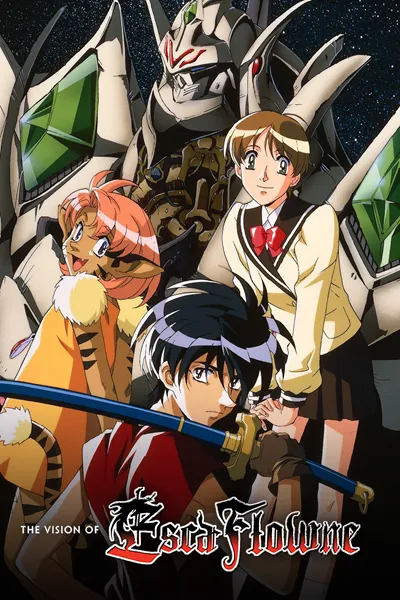
Name(s): Tenkuu no Escaflowne / 天空のエスカフローネ / La Visión de Escaflowne
Format: TV series (26 episodes)
Studio(s): Sunrise
Here’s my overdue Escaflowne review. I’m writing this casually, because I’ll be overwhelmed and won’t want to do it at all if I don’t. Shoji Kawamori is mecha’s second biggest auteur after Yoshiyuki Tomino, and in my opinion he’s significantly better, though he still comes with his own baggage (and lack of written material). I didn’t watch this for him though; I just wanted a good ’90s series. It wasn’t too long, and that it was mecha was just a coincidental obligation.
Escaflowne has actually only appeared in a single Super Robot Wars game, Compact 3 for the damn WonderSwan Color. It’s one of the most obscure titles there is, and why Escaflowne never showed up again, I don’t know. It could be copyright issues, but I once heard it claimed that the staff said they had trouble working Escaflowne into their crossover plots. It sounds like horseshit to me; they can change as much as they want. Anyway, I watched it.
Overall, my feelings were positive, but after a strong start, I did feel a little letdown that it wasn’t better. It gets a lot of hype because it was a classic of the ’90s, which was a magical time for people getting into anime in the 2000s. I was one of them, and even watching Escaflowne now, I felt that inherent nostalgia from products of its time. The good ‘ol days of ADV Films and such.
The production and strength of direction in general on this show is absolutely phenomenal. The Vision of Escaflowne is one of the best-looking two-cour series I’ve ever seen. I can’t stress just how gorgeous this series is, and it delivers its beautiful art in spades with its heavy length and direction. The “camera” is actually dynamic, there’s never a back and forth of repeated frames even in a simple standing discussion between two characters.
Escaflowne has seemingly endless single frames of extremely detailed hand-drawn art that are only on screen for seconds. The frame rate almost never noticeably drops, either. The staff worked so damn hard to make this a visually enrapturing show, and they succeeded at it.
In addition to the lush painted backgrounds and rough yet accurately detailed character art, Escaflowne also makes fantastic use of color and shading in its visual storytelling to accentuate the emotions of the scenes on display and drape scenes in a dramatic lens that lifts its story and further sells the magic of the high fantasy setting. There’s a grace to Escaflowne’s construction that has a lot in common with the works of Studio Ghibli and other exemplary high fantasy works. I don’t like the long elf noses though, the fuck’s up with that
Yoko Kanno handles the soundtrack here which had me excited at first, but it’s pretty far from her best work. The classical miniature war epic “Dance of Curse” is a highlight in her vast and impressive discography, but nothing else stood out to me outside of its context. Tonally, it’s all importantly on point, classy symphonic and synthetic arrangements that work in conjunction with the graceful art techniques mentioned above.
The opening and ending songs are all right. I preferred the punchy ending song over the opening, which was more of a ballad that was slightly droll at times. The animation in it is excellent though, especially during the fight scene, and I often watched it for that alone.
Where Escaflowne failed to really capture me was generally its storyline. There’s a shoujo esque tone to it which I thought was interesting, such as having a female main character who fights only emotionally with her psychological and divining powers. There’s also a heavy emphasis on romance, similar to Macross (a Kawamori thing?).
Unfortunately, I couldn’t give a shit about the romance despite how much emotional gravity the show tried to tie to it. The significance of who got Hitomi’s affection didn’t feel real because her first goal was to go back home where she’d leave whoever she loved behind, and this is for some reason never considered by her as she’s wondering whether she likes Van or Allen more. Why should she or we care?
Also unlike Macross, not enough attention is spent building the relationship of these characters in a casual setting. It’s surrounded too much by the plot, so everyone has sort of a tenuous working relationship with each other and nothing in the way of discovering natural chemistry or mutual lines of thought. Everyone’s attraction feels mostly physical and shallow. It’s like a Victorian melodrama at parts, and I just cannot care.
Outside of the romance the main plot leaves something to be desired for me too. I’ve heard this show lauded for its pacing, but I actually feel the exact opposite. I think Escaflowne is in serious lacking of any feeling of momentum. The story and scale doesn’t evolve like it probably should be doing, and a large chunk of the series is spent with characters wandering from place to place from the Zaibach army only to be followed, wiped out, and then put on the run again. Along the way they aren’t getting much access to greater powers or abilities that will help them fight the Zaibach army.
They do however, discover more about the world of Gaea. This could be interesting if more of it was foreshadowed than it was, instead a lot of reveals in Escaflowne come on suddenly and are only relevant the instant they arrive so there’s no anticipation. It’s answering mysteries you often don’t know enough to even be curious about, which further contributes to how this series is far from an episode-turner.
Fights are extremely well-choreographed and animated, but usually brief and don’t have enough weight because they’re usually against faceless mooks and not interesting villains. Folken doesn’t directly interact with most of the cast, and Dilandau is almost always behind a machine and responding to things in his usual psychotic manner. The pink-haired snake guy that’s shown in one episode looks like someone who’s going to become a regular, but he never appears again and the four generals of Zaibach are complete nobodies.
The crew kind of trudges along, not getting closer to defeating Zaibach and then the ending comes suddenly when a solution kind of falls into their lap and they overcome Zaibach in an instant and a massive strength difference is made up for by a plot device that comes out of nowhere.
The whole series spends its time not really addressing the main looming problem of Zaibach and then when crunch time comes they deus ex machina a way to defeat them. The whole divination thing added some flavor to the story, but mechanically it was too vaguely defined in that typical frustrating Japanese metaphorical way. It often contradicted itself by both confirming that the future could be predicted with complete accuracy but also always changed. It flip flops on both of these things without explaining how these philosophies and powers contradict each other. The lack of explanation makes a simple concept confusing.
I’m running out of things I can think of to talk about now so I guess I’ll wrap it up. This is certainly in the better part of the mecha genre and probably still deserves some modern relevance. I would still call it a show of niche interest rather than something essential like I would for a few mecha shows, but that’s not bad at all.
Plot and writing aside, the direction and quality of art and animation is truly stunning even now, and for those who can be carried well enough by that (I consider myself one of those people), it’s a recommendation. However, it isn’t the kind of show that makes a point of showing off its own flashy animation like Gurren Lagann. It’s more gentle and subtle, but still exquisitely well put together. There’s still a lot for any series to learn by looking at how much effort went into The Vision of Escaflowne.
Leave a Reply