








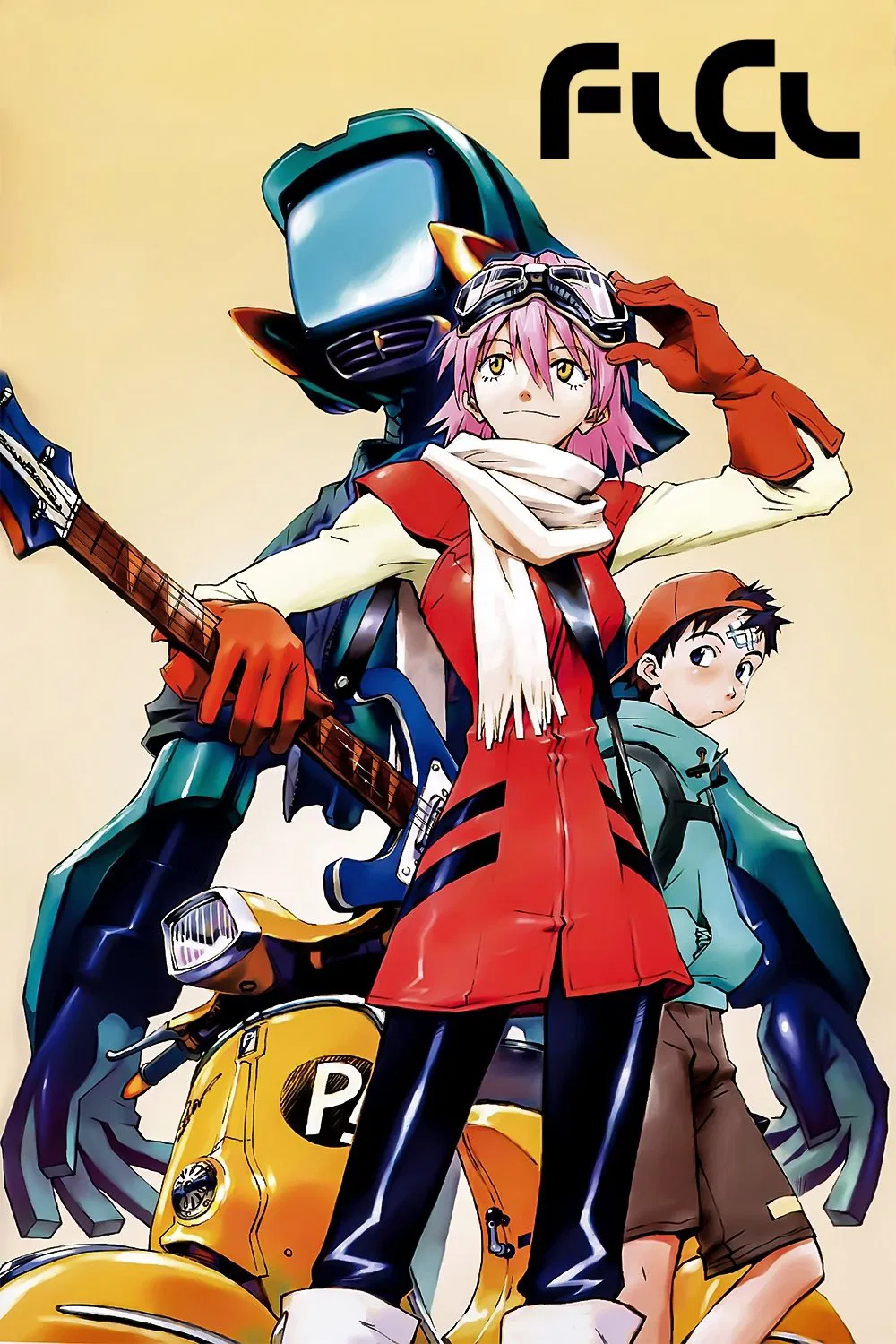
FLCL
Name(s): FLCL / Fooly Cooly / Furi Kuri / フリクリ
Format: Original video animation [OVA] (6 25-minute episodes)
Release Date(s): April 26, 2000 – March 16, 2001
Studio(s): Gainax / Production I.G
I somehow never caught a single second of this one on Adult Swim. I can only assume they stopped rerunning it early on. This joint project between Gainax and Production I.G. had a lot of promise, as together they probably house a super majority of the greatest talents in anime. A withdrawn pubescent boy named Naoto has his shell of security broken by an invader named Haruko who seems to have her own hidden agenda. Haruko’s arrival in Naoto’s dull town triggers an onslaught of reality-bending absurdity that forces Naoto into the spotlight in order to overcome his newfound angst and dishonesty with his feelings—in the way only giant robots, battle, rock and roll, sex, and spicy curry can.
FLCL is an OVA both liked and despised for its frenetic animation and all-around eccentricity. Director Kazuya Tsurumaki stated that he wanted the show’s style to be similar to Japanese commercials: a fast-paced sensory assault that’s loaded with breakneck information and flashing detail. In that regard he thoroughly succeeded, as scene-to-scene FLCL itself is the kind of show that seems like it suffers from Attention-Deficit Disorder. The talented staff behind FLCL prevent the insane from becoming mundane again through their experimental desires. Despite the anime always having the same crazy heart its delivery frequently morphs through its wildly imaginative transitions, stylistic changes, both robotically jerky and amorphously fluid motions, and a general smorgasbord of unpredictable post-modern direction.
FLCL, with its mishmash of animation influences, likewise assimilates many of its interests into the narrative as well. A huge debt to Gainax’s Neon Genesis Evangelion is owed here, as half of the gags in the show (an understatement, if anything) are allusions to that seminal ’90s watershed series. FLCL isn’t simply a meta reflection piece though, and at its heart attempts an inspired coming of age story ripe with creative symbolic metaphors.
I can’t help but feel that its central themes are so obfuscated by its mosaic presentation and faux-mindless tone that even the soul of the show’s focus ends up coming across as trite. FLCL is frequently charming and bursting with optimistic love for Japanese animation and its effect on people, but it comes across as primarily an expression of that love of the creators rather than something that has a good chance at making people look inwardly like the works it admires. It takes itself so lightly that its own soul lacks enough impact. Its clever and heartfelt, but towards itself and the industry rather than those engaging with it.
A heartfelt coming age of story that challenges the audience’s philosophy with avant-garde animation and narrative metaphor would be…. well, Evangelion. FLCL depending on that show so much for inspiration only downplays its own creativity. It’s difficult to respect its intentions when another source has done them better, and yet if you were to watch FLCL first and avoid that you would also miss a ton of its parody.
Having watched it second, I can almost only see FLCL as a thoroughly visually engaging comedy/parody with its narrative better serviced to thrust a consistent relation between all of the episodes rather than provide any profound insight into anything. This incredibly fun ride also feels like a dead-end strand of anime evolution, because it narratively indulges in things that have already happened. However, it successfully paves the way and raises the standards for and of subversive mold-breaking animation.
I listened to The Pillows‘s FLCL OST 3 years ago on its own and thought it was boring then. I still think they’re a boring band. Using licensed music for a series is inherently cool and enjoyable, but the band possibly fits the show too well. Their music is generally a total cram of every instrument’s notes together into an uplifting racket that’s missing detail. It’s like the constant guitar strumming itself is supposed to be the hook rather than coming up a great chord progression/melody.
I watched the dub because I thought that’s what most people would have seen. For the most part, I’m impressed with how it has the humility and ethic to carry over so much of the original cast’s tone. It’s pivotal because the delivery is often part of the joke for a lot of comedy anime, but in many cases the actors presumably can’t allow themselves to act as silly. It’s not flawless, as though they make attempts to localize some jokes it’s rather inconsistent and many references to Japanese culture are arbitrarily left in.
With so many references being visual, it almost seems like a futile effort to try and westernize the show. It’s unbelievable such a “Japanese” show like this got such a serious localization back in 2003 and was even aired on a major network. There’s some inarguably stupid stuff like keeping in Japanese onomatopoeia that’s obnoxious, but for the most part it’s a very acceptable dub.
With how much goddamn noise there is constantly going on in this anime between three characters at a time talking over each other while The Pillows play and sing in the background, it doesn’t surprise me many people hate the presentation. At times, I got pretty annoyed myself, but in the end I enjoyed the trip and the team at the very least succeeded at creating a “short, but densely-packed” work like the zany commercials they were inspired by. Ultimately, its additional depth over those commercials doesn’t end being worth as much as the style itself.
Leave a Reply