








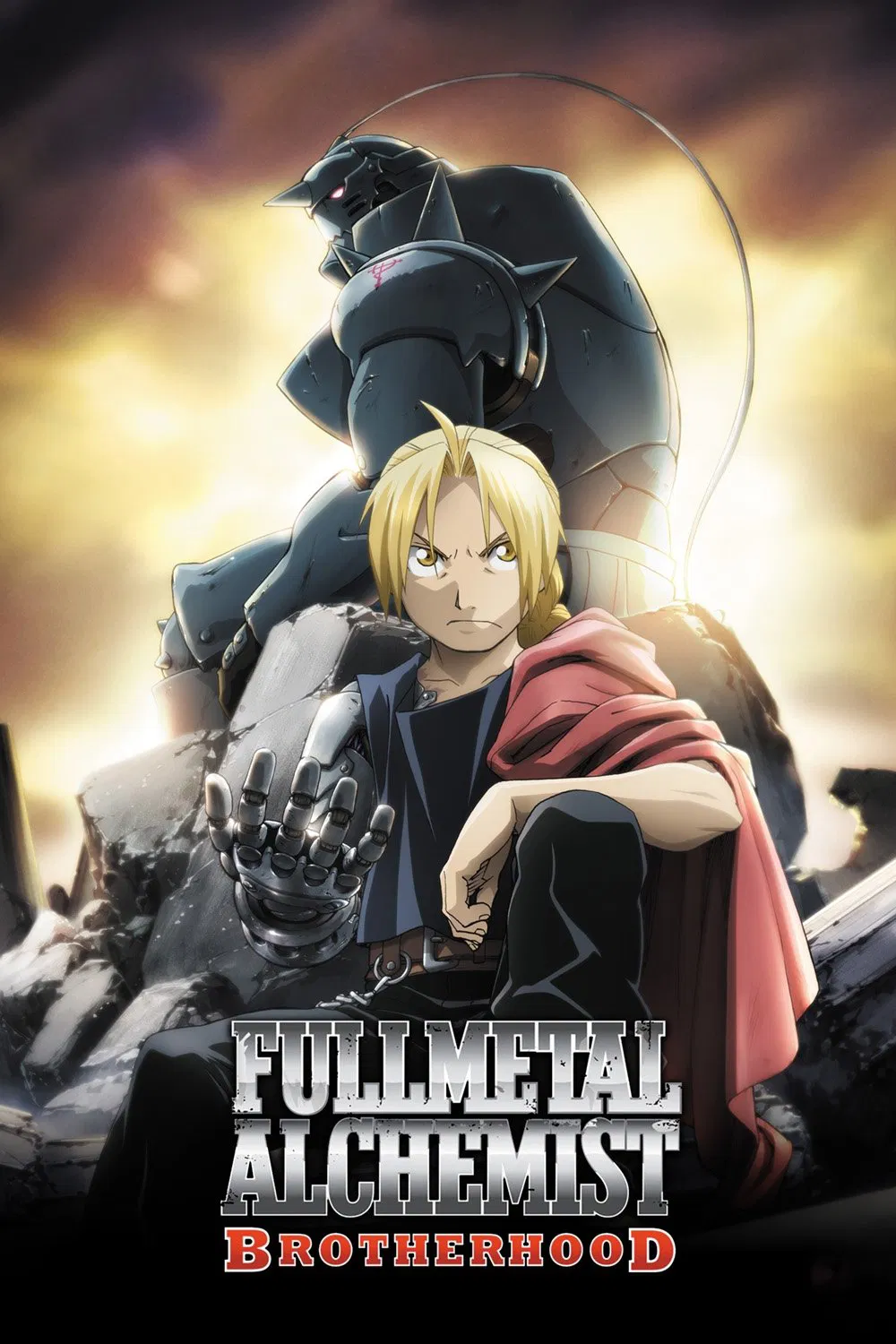
Name(s): Fullmetal Alchemist: Brotherhood / Hagane no Renkinjutsushi: Fullmetal Alchemist / Fullmetal Alchemist (2009) / 鋼の錬金術師 FULLMETAL ALCHEMIST / FMAB
Format: TV series (64 24-minute episodes)
Release Date(s): April 5, 2009 – July 4, 2010
Studio(s): Bones
Related: Fullmetal Alchemist: The Sacred Star of Milos (2011)
Original Publication: N/A (unknown)
For a time, Fullmetal Alchemist was my favorite anime/manga franchise. Maybe it still is? I dunno. I’ve felt that way ever since the original anime, which was and still is excellent despite its deviation from the source material. At the time, everyone felt the same way about it, but with the advent of Brotherhood (FMAB), people suddenly renounced the original en masse and have been going wild for this more accurate adaptation.
Since I gave this a 10/10, I feel somewhat the same way. If Brotherhood didn’t botch the early material both series covered, it would generally be the better experience. A counterpoint I’ve seen raised about this contention is that this inferiority isn’t of any real consequence, as more substantial plot developments happen in Brotherhood‘s new material.
The latter is technically true, but it implies that only the resolution of a story is relevant to its quality. Are there more important things in the story than the Shou Tucker arc? Yes. Is it still routinely cited as one of the most iconic moments from the entire franchise? Yes. Does the original anime do more to justify that distinction? Yes. Plot developments aren’t necessarily the parts of a story people find the most memorable or definitive.
But even putting aside matters of the story, Brotherhood falls short in other comparisons as well. The visuals are significantly worse, with Brotherhood unfortunately taking advantage of streamlined modern production trends. Its backgrounds take the biggest hit here, losing the detail of the original’s hand-painted, physically textured vistas in favor of flat, cheaply-done standees. Coloring perhaps takes the biggest hit out of anything, with shading depth lost to more efficient digital coloring that looks like a “color fill” tool was used, with the only addition being a stock gloss effect applied over hair. The general color palette of Brotherhood is much brighter than the original series, which had such an incredible, almost gothic atmosphere. To see it passed over for something devoid of any distinct stylistic identity in Brotherhood is very disappointing.
The music is shockingly mediocre. The score itself ranges from utterly listless and utilitarian to laughably weightless. The “suspense” theme is the biggest offender, a dinky, light ambient piece that sounds like it could be playing in a Looney Tunes cartoon when Bugs Bunny is holding a giant mallet while sneaking up behind Elmer Fudd. This piece took me completely out of the show every time it showed up, and it shows up a lot. It’s sad to think this is the replacement for a soundtrack that originally featured Brothers, likely the best piece of music to come from this IP.
The opening and ending songs are relatively satisfying in a vacuum, but pale when compared to the original series. J-rock anime openings of the 2010s are often borderline indistinguishable in their style and production values, and these are no exception. They’re consistently upbeat, light pop rock songs that lack the enthusiasm, variety, and drama that the original series’ tracks had. Those had a sense of progression in its opening themes that narratively matched the ongoing story arcs, and did so in a diverse fashion. From an optimistic, wondrous tune to a track with a funk riff and go-getter momentum, to a faster-paced rock song with hints of contemplative nostalgia, and the legendary final opening that emphasizes the drama, stakes, and intensity of the finale with its fast-paced, soaring chorus preceded by its almost melancholy verses.
Of all aspects of Brotherhood I see routine praise for, those levied towards its music are by far the most puzzling to me. As a capper, the original series provided all of its ending theme animations with different and distinct visual styles. Unsurprisingly, that level of effort is absent from Brotherhood.
This has been a fairly negative retrospective, but that’s largely because I’ve been trying to focus on ideas people don’t commonly express. Overall, I still think Brotherhood is an excellent watch that I would recommend to just about anyone. I would, however, still insist on spending the time to watch the original first. It’s worth engaging with in its own right, and if you find yourself losing interest in its original material, you can just drop it and start Brotherhood. It’s not like the anime police will arrest you for it.
You might consider starting with Brotherhood first due to its popularity, but consider that you will never be able to experience the beginning arcs of the franchise free of spoilers in an optimal, fresh way again. That’s a genuine loss as far as the original is concerned. It isn’t for Brotherhood. I’ve had two friends take my advice on this matter. One ended up agreeing with me on pretty much every point. The other was more mixed, but still was surprised during the many times I told him a certain episode or storyline wasn’t canon to the original manga, which I think speaks to their quality and studio Bones’s ability to understand the source material.
Fullmetal Alchemist: Brotherhood – 4-koma Theater
AKA: Fullmetal Alchemist: Brotherhood – 4-koma Gekijou / Hagane no Renkinjutsushi: Hagaren 4-koma Gekijou / Hiromu Arakawa 4-koma Theater / 荒川弘 描き下ろし4コマ劇場
Format: Special (16 2-minute episodes)
Studio(s): Bones
Published: August 16, 2016 (2:50 AM)
These short specials adapt four-panel gag strips included in the back of several volumes of the Fullmetal Alchemist manga. I wasn’t expecting much and just wanted to be a completionist, but a few of the jokes are actually pretty funny and the whole thing got dubbed, surprisingly. Almost all of them were amusing, and almost none felt like a nonsensical waste. I would actually recommend this to FMA fans. There’s not really anything else worth going into detail about, though.
Leave a Reply