








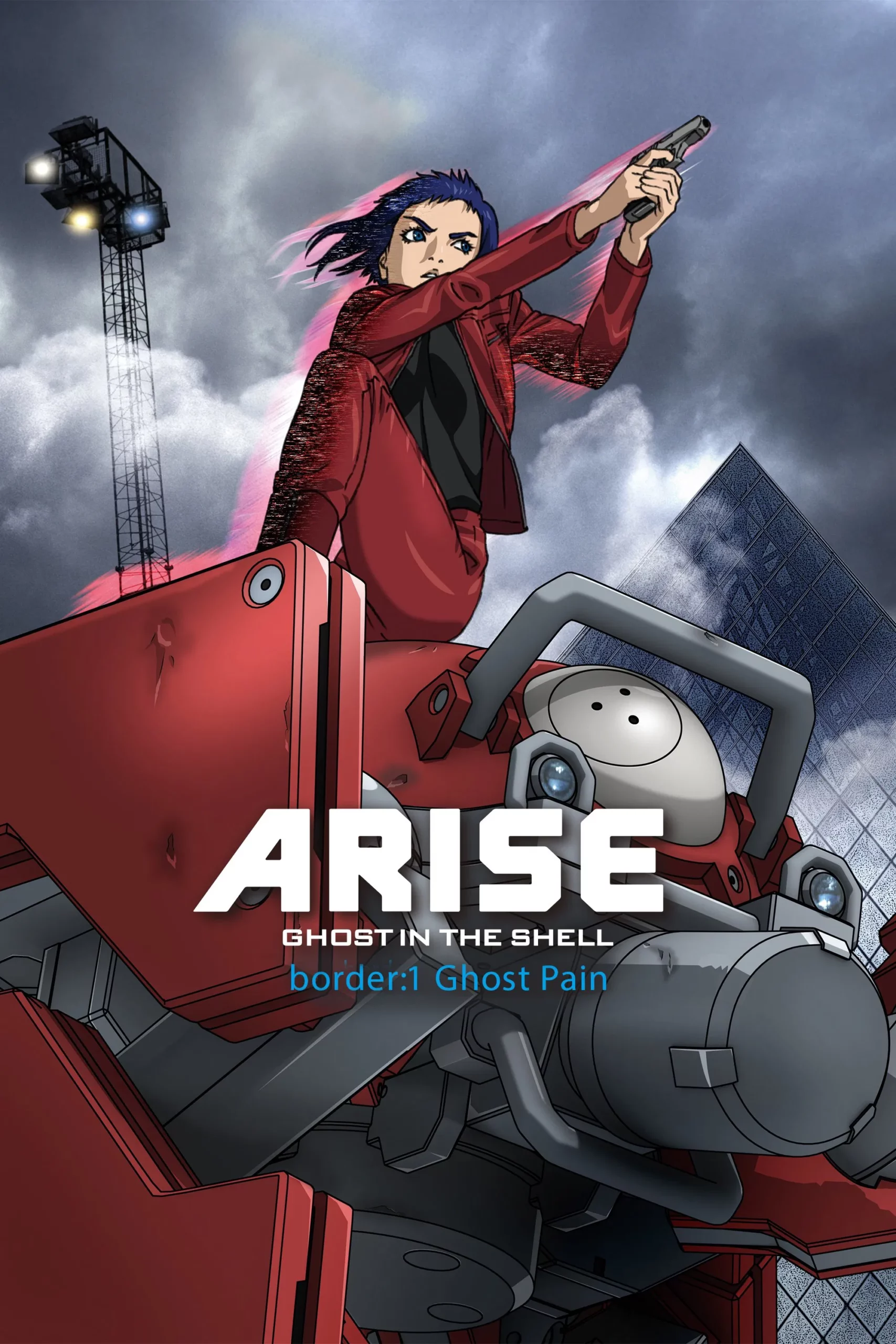
Ghost in the Shell: Arise – Border 1: Ghost Pain
Name(s): GitS: Arise / Koukaku Kidoutai Arise: Ghost in the Shell – Border:1 Ghost Pain / 攻殻機動隊ARISE -GHOST IN THE SHELL- border:1 Ghost Pain / Ghost in the Shell – Arise Border 1 der Film: Ghost Pain / Ghost in the Shell – Arise Border 1 la Película: Ghost Pain / Ghost in the Shell – Arise Border 1 le Film: Ghost Pain
Format: Movie (58 minutes)
Studio(s): Production I.G
Originally Published: June 16, 2016 7:30 pm EST
They finally finished dubbing all of the Arise movies in English right under my nose late last year. The original release dates got delayed suspiciously close to when it was revealed the Arise movies would be reworked into a TV series. If I were on the production team for the dub, that’d certainly kill my spirits, but I’m glad they saw the project through to the end, because I’m so used to watching Ghost in the Shell (GitS) dubbed.
That doesn’t count for much this time, though. Unfortunately, the original voice cast has been completely replaced. A pointless endeavor, since the new cast tries their hardest to imitate the old, only to fall short because of the simple fact they’re just not the same people. The uncanniness of the new voices makes the dub job more than just a little weaker; it reminds you of when things were better. Actually, this latest Ghost in the Shell series does that in general.
I’m not being pessimistic; just making an observation and calling it as I see fit. I’m not greedy enough to expect constant five-star meals from the Ghost in the Shell franchise. If Arise is indicative of the general quality the franchise Is going to be from here on after having played its trump cards, that’s a pretty good deal.
The Arise team did a great job at creating a reboot with an original story that feels perfectly in place in the GitS world thematically and stylistically. The changes are ultimately minor, and none of the franchise’s integrity has been lost. It really is just more Ghost in the Shell. The only question is how it stacks up the old.
Perhaps the most unique thing about the Arise continuity, and its greatest hook for old GitS fans, is that it attempts an origin story for Section 9 where its most well-known members haven’t joined yet. The previous anime didn’t really attempt an origin. I didn’t have a problem with that approach, as Ghost in the Shell’s “in media res” approach to storytelling is one of my favorite things about its writing. You got to piece together the greatest world in science fiction by yourself, and the satisfaction of doing so accompanied with how well it all genuinely worked together was immense. The lack of exposition and origin detail made the already plausible universe not feel contrived, and it made an immersive experience that only gave you new information.
Arise has a similar respect for its audience’s intelligence, but at this point I feel like it’s expecting them to already understand the technology and various mechanisms of the Ghost in the Shell franchise. This means it has a better excuse for withholding information than Mamoru Oshii’s movie, but it also means it’s still an inferior starting point to Stand Alone Complex which finds the running time to allow the viewer to fully adjust to the world while being able to follow the stand-alone plots well enough to not be bored.
I actually found Arise’s first movie, Ghost Pain, to be the hardest to follow Ghost in the Shell story yet. Not in a good way that hints at complexity, though. Just a few moments of “how did that character make that connection, and why are they doing what they’re doing?” By the end, I felt like I had a grip on things, but if I cared to look closer after uncovering the mystery, I worry some of the scenes would’ve genuinely been poorly written. Again, it’s the plot that’s obscure this time, not the terminology. Which is a problem I don’t remember having before.
These frustrating moments didn’t ruin the experience for me at least. The year this time is 2027 which I think is the earliest year Ghost in the Shell has ever been placed (how do they now think it’s going to take even less time to reach this technology?) Motoko Kusanagi returns to solve the murder behind one of her superiors. She has a run-in with Section 9 and decides to form a suspicious alliance with their chief, Daisuke Aramaki.
Motoko is more of a central character this time around than any Ghost in the Shell work since the original Oshii movie. I find this to be somewhat disappointing, as I always thought Batou and Togusa were better characters, and they’re barely featured here.
Motoko is great, but I always saw her as more of a symbol for Ghost in the Shell’s themes than a distinct human being. I’ve accepted that her seeming lack of humanity is intentional, a representation of GitS’s highly networked world through a person whose sense of self is impressed on by communicating with others in order to form a whole or a desire to move past individual consciousness altogether.
Still, I’ve never found herself that compelling. Part of this is also deliberate as her backstory has been kept extremely hidden, but regardless, that’s how I feel. Batou and Togusa are more empathetic and relatable.
And yet, they do their part to make Motoko’s past a more important thing than it’s ever been, due to the fact that this new series’ central theme is identity and memory manipulation. A fantastic idea as GitS has always been focused on existential philosophy and this explores the possible implication of its unique cyber brain technology.
It’s a new focus for the franchise that’s completely attuned with its usual interests, and it’s directly linked to its setting. I certainly find it preferable to 2nd Gig going over the Stand Alone Complex theory again and downplaying its direct relationship with the unique technology through a 1:1 post-9/11 geopolitics metaphor and commentary.
I found the production qualities to be about the same level as the Stand Alone Complex series, if not a little bit better (as it should be, since it’s a movie). There’s some frame-skipping during movement but nothing that bad, and although this installment features more action than I care for it features great fight choreography. Use of CG is either subtle on the characters during action scenes or it doesn’t stand out in the environment as with the usual Tachikomas, which is good.
The soundtrack is handled by a musician called Cornelius this time around. He’s nowhere close to the level of Yoko Kanno—absolutely nothing got stuck in my head which may be the most disappointing aspect of this release but otherwise his glitchy IDM at least suits the setting and theme of electronic mind corruption.
Another thing that’s always drawn me to Ghost in the Shell that I’m sure no one else cares about as much is the impeccable city design and cinematography. Every landscape shot of the city in this franchise takes my breath away and is enough for me to always keep my eyes locked on the screen. Arise keeps that trend up perfectly. I’d love to live in the Ghost in the Shell universe. The one we’re in now already has just as bad political corruption anyway.
Now it’s time to talk about the revised character designs. I feel the same way as I do about the voice cast change: why bother? The character designs are close enough to the old ones to not really feel like a difference, so it’s just irritating how it’s slightly off and thinks that’s enough to be called innovation. We didn’t need new character designs, and if we did these sure as hell wouldn’t cut it.
Motoko has taken the biggest hit, now being a much younger girl. People’s complaints about this have been reasonable, because Motoko’s character design is largely why she stands out and is so impressionable. It’s precisely because the heroine in an anime isn’t a teenage girl for once and is instead a full-grown adult who’s mature and capable of taking charge and succeeding at any task like a true elite.
Arise’s Motoko is still largely the same personality (as are the other characters), but her character design no longer reflects that. And yes, it’s reasonable to assume that this was an attempt to attract a wider audience because the reason old Motoko stood out was for reasons that are also why her type of character design isn’t more popular in Japan. They like younger characters. For whatever the reason, there’s no way around it.
And teen Motoko still finds plenty of excuses to run around in her underwear or browse around cyberspace naked, even if her tits and ass are smaller. This has always bothered me, because it’s like the show is pretending it’s above fanservice with its intelligent subject matter, but ultimately finding unsubtle ways to fit it in. Whatever. I’m used to it by now.
I’m not sure yet what the remaining episodes of Arise have in store, or if it’ll get better in the story department, but my expectations were met. Above all else, it’s just great to see more Ghost in the Shell. If the franchise continues being handled this well, then I’m fine with a lifetime of mostly the same-old, same-old.
Ghost in the Shell: Arise – Border 2: Ghost Whispers
AKA: Koukaku Kidoutai Arise: Ghost in the Shell – Border:2 Ghost Whispers / 攻殻機動隊ARISE -GHOST IN THE SHELL- border:2 Ghost Whispers / Arise Ghost In The Shell Border 2 Película: Ghost Whispers
Format: Movie
Studio(s): Production I.G
Originally Published: April 25, 2017 10:45 pm EST
Well, this was pretty much more of the same as the first Arise episode. Actually, it may have been even more off the mark. Arise seemed like it was going for a more action-oriented, less philosophical approach. Makes sense, because let’s be frank, it’s the part of Ghost in the Shell people are able to make easy sense of.
I’m not going to pretend I’m above action, but when Ghost Whispers has 20 minutes worth of car chases, slow-motion à la The Matrix, and constant feats of general superhuman precision and gunfire, it gets repetitive and juvenile no matter how much technobabble is shoved into dialogue.
It’s Ghost in the Shell, still with a complicated vocabulary, but using it to set up simple concepts. Over-the-top terrorist schemes and another element of memory manipulation, but unfocused enough to not actually say anything about the society where such things take place. It’s just another science-fiction thrill ride, and Ghost in the Shell should be more than that.
It’s entertaining, but has nothing worth kicking around in the brain after watching. I’m increasingly put off by the young Motoko’s arrogance as well. Also: where the fuck is Togusa?
Ghost in the Shell: Arise – Border 3: Ghost Tears
AKA: Koukaku Kidoutai Arise: Ghost in the Shell – Border:3 Ghost Tears / 攻殻機動隊ARISE -GHOST IN THE SHELL- border:3 Ghost Tears / Ghost in the Shell – Arise Border 3 der Film: Ghost Tears / Ghost in the Shell – Arise Border 3 la Película: Ghost Tears / Ghost in the Shell – Arise Border 3 le Film: Ghost Tears
Format: Movie
Studio(s): Production I.G
Originally Published: May 10, 2017 7:35 pm EST
This was probably the best Arise episode so far. It’s also the one with the least amount of action—and the lowest rating on MyAnimeList. I’ll use that to support my observation. But still, that advantage is so slight that I’m not even sure if it was better than the first episode.
My main reasoning for this is that it turns the focus away from being a detective thriller back towards worldbuilding and character development. This means Arise is getting closer to that chemistry that made Stand Alone Complex such a success. This comes at a somewhat unnecessary cost, however, when the actual action-centric climax of the movie is significantly limper than the previous two. Though at that point, it seems like they were limited by the standard runtime of these movies.
I continue to like teen Makoto less and less, but at the same time, she becomes a more fleshed-out character. She’s still off-putting in her childish arrogance, which clashes heavily with her professionalism, alleged experience, and intelligence.
In this episode, most of her transgressions revolve around her attachment to her latest boyfriend. It’s a guy that immediately gives off mad serial killer vibes, and everyone instantly realizes he’s obviously suspicious, but Makoto irrationally defends him and breaks protocol multiple times for her own self-interests.
On the other hand, some of Makoto’s background and way of thinking is actually touched upon here. She’s often used as a borderline “anonymous” character, so these moments are rare. She talks about how she feels swapping bodies and trying to hold on to the sensation of being a human after becoming a cyborg as a child.
It’s insightful to her character, but also the setting, as we see more personal ways people cope with the changing world—one of the things nearly lost in Arise that makes it less engaging than previous GitS installments. That’s when it gets ironic and shallow; when a concept about retaining individuality as the world moves closer to a singularity is reworked into a story that’s so concerned with being stylish entertainment that it forgets to look at the individual. Even still, these moments feel all too brief and familiar for Ghost in the Shell, so they aren’t reaching the franchise’s previous levels of social insight.
These personal scenes are overshadowed by the same investigational action-thriller style of the previous episodes. On that front, Ghost Tears‘s plot seems more obtuse and aggravating to follow. There are so many factions referenced in this conspiracy that have no inherently logical, direct link to each other, that keeping the arbitrary relations straight in one’s head is more work than usual. Water plants, prosthetic developers, a previously unmentioned separatist war—goddamn. Chill out.
Togusa becomes more involved in this episode—not so much as he deserves, again—but he adds that relatable touch to the cast as the most “normal” member of Section 9. But, Arise shows it’s able to do a much better job at utilizing the entirety of the standard Section 9 members than previous entries. There’s still an obvious hierarchy of importance among them, but giving them more lines and involvement in the investigation still goes along way to making them feel like actual team members rather than sidekicks.
Ghost Tears predictably continues in the same direction as the rest of Arise, but the added touch of drama shows that the creators still have it in them to make something true to Ghost in the Shell’s pedigree—they just haven’t fully realized it yet.
Ghost in the Shell: Arise – Another Mission
Name(s): Koukaku Kidoutai Arise: Another Mission / 攻殻機動隊ARISE ANOTHER MISSION
Format: Special (1 3-minute episode)
Studio(s): Production I.G
Originally Published: July 2, 2014 12:00 am EST (estimated date)
Yeah, it’s just an advertisement for Microsoft’s Surface tablet, but it’s a damn cool one. While lacking the brains of Ghost in the Shell, the style is fully intact. Well worth three minutes, if you’re a fan of the franchise’s general aesthetic.
The funniest thing is that the team seems dependent on their Microsoft tablets to complete their mission, but if you think for a second, you may realize none of them have any use for tablets because they have fucking cyber brains.
Leave a Reply