





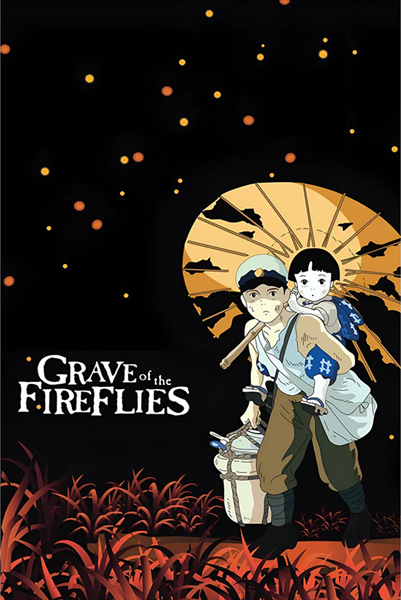
Name(s): Grave of the Fireflies / 火垂るの墓 / Die letzten Glühwürmchen / La Tumba de las Luciérnagas / Le Tombeau des Lucioles
Format: Movie (88 minutes)
Studio(s): Studio Ghibli
Men and gentlemen: a requiem. Not for the characters in Grave of the Fireflies, but for the last “legendary” status anime movie I had yet to see. I can graduate to some higher class I guess, but I’ve seen plenty of deeper cuts and have been putting this classic off for a few reasons. One, it’s an acclaimed Studio Ghibli movie and I’ve never been happy about not getting along with them, and two its reputation as a “really sad movie” sets up specific expectations in the narrative which is never a good thing. It’s like how the first thing people ever mention about Gundam 0080 is that it’s depressing, and after knowing the premise of the series even slightly you know immediately where it’s going to try to hit. If you know someone’s throwing one at your gut, you knot your stomach so it ain’t too bad. Were more people left-handed, you’d remember a lot more of the lefts than the rights.
So, is Grave of the Fireflies nothing more than its reputation as an innocence-shattering tearjerker? I had my cynicism half-unsheathed before watching to cut down another Ghibli classic, but after finishing it I just can’t do it. Not because it’d be like kicking a dead dog, but because Grave of the Fireflies is, in its own special ways, genuinely one of the most affecting war dramas I’ve seen in any medium.
Brother Seita and his younger sister Setsuko struggle to survive on their own in Japan during World War II. Always between the actual conflict itself, young boy Seita has to take care of his infant sister after their mother is injured and their father is trapped in the navy. Not your typical coming-of-age war story, Seita and Setsuko actually resist the demanding times of the era they live in. Dealing with poverty, hunger, and health just as much as they attempt to avoid thinking of their problems creates rare war story characters that are defined by their pleasures in life more than their suffering, which makes it all the personal for the audience when we see these joys on screen and then promptly whisked away.
For being known as a sad movie, Grave of the Fireflies is in no way manipulative and refuses to allow its tragedy to become too romantic. Proof of this is the very first scene in the movie where the brother narrates his own death and reveals the death of his sister as well. By bringing the tragedy to the forefront rather than building to its inevitability in lieu of a climax, the prophetical emotional punch can be pushed to the back of the mind to allow focus on the events preceding them, which ironically makes the final tragedy come as a surprise all over again when it hits at its natural pace.
Though it’s impossible to not feel for the innocence of Seita and Setsuko as they attempt to live in their own little fantasy, their stubbornness often borders on the absurd and leaves a very unwanted bitter feeling that the greatest of their suffering is brought upon by themselves, particularly that of the older brother. There are many possible ways to justify his behavior at first, with his youthful arrogance being one, but these reasons are never satisfying on their own and contradict with some others, such as the brother’s pride as the son of a navy man as he commits theft. Though forgiveness is possible, such a slew of poor decisions come close turning this movie away from being an anti-war tragedy to more of a personal one. If the characters are felt to be victims of themselves, then how truly are they victims?
Even earlier Studio Ghibli productions are rather stunning. The lack of in-between frames occasionally shows, but no shortcuts are used when it comes to backdrops or motion. Though Grave of the Fireflies certainly can’t compare to the visual splendor of later Studio Ghibli movies such as Spirited Away and Howl’s Moving Castle, the studio’s usual flaw of lacking stylistic idiosyncrasies is anything but problematic this time, as they attempt a serious drama that benefits from such a plain filter. Director Isao Takahata is much more graceful in that regard compared to Miyazaki and transitions between the happiness and sadness smoothly and without contrivance. Michio Mamiya and Masahiko Sato’s score isn’t particularly impressive, but it does its job at lightening and dampening the mood with the typical string arrangements you’d expect, always right on cue.
Though Studio Ghibli are sometimes better when pushed to the extremes of their fantastical whimsy, such as the relatively modest The Castle of Cagliostro, or aforementioned extravagant Spirited Away, Grave of the Fireflies is the only Ghibli film to get any deep emotional rise out of me beyond the usual happy, breezy satisfaction. It’s an unusual war movie that looks away from the war and doesn’t let you voyeuristically anticipate tragedy, and when darkness does seep in, it’s from the edges of our peripheral vision. And as much as we want to look away at that moment, we’re not allowed. One of Studio Ghibli’s few rightful classics in my opinion, and of the war genre in general. Come decades from now, this should be one of the Studio Ghibli movies still glowing.


Leave a Reply