








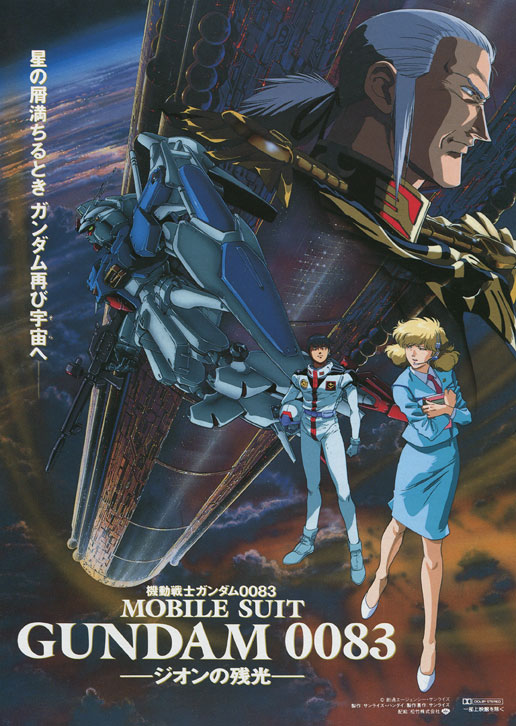
Name(s): Mobile Suit Gundam 0083: Stardust Memory / Kidou Senshi Gundam 0083: Stardust Memory / 機動戦士ガンダム0083 STARDUST MEMORY
Format: Original video animation [OVA] (13 28-minute episodes)
Release Date: May 23, 1991 – September 24, 1992
Studio(s): Sunrise
Mobile Suit Gundam 0083 Review
Mobile Suit Gundam 0083: Stardust Memory is one of the many small OVAs (and movies) released between ZZ Gundam and the next TV series, Victory Gundam. It’s also by far the most substantial installment, consisting of the highest number of episodes at 13 with each running a half hour. That’s still less than half the total time of your usual Gundam series, but considering how damn long most of them are, often without a good reason to be, should anyone complain?
All of the three OVAs released during this period focus on the events of the One Year War, with The 08th MS Team and War in the Pocket focusing on the war’s impact on smaller parts of civilization and the army. 0083 is its own side story and mostly concerned with its original new tale, but is the most chronologically significant as it gives some background as to the rise of the Titans organization that kickstarts the events of the highly popular and earlier released Zeta Gundam.
Specifically we follow rookie pilot Kou Uraki, who by chance earns the right to pilot one of three new Gundam models in a search for Zeon remnant Anavel Gato who has stolen one of the two remaining Gundams. Kou and the rest of the Albion crew’s battle with the ace pilot Gato and what remains of Zeon’s forces leads them into Zeon’s massive plan for revenge: “Operation Stardust.” What is the true purpose of the desperate Zeon force’s new plan? Aboard the Albion, Kou is forced to grow as a soldier not only for the sake of his mission but also to earn the love of Nina Purpleton, the Gundam development team’s most stupidly named crew member.
Gundam 0083 is notorious for its reputation as “mecha porn.” Not only is this one of the most disgusting combinations of words ever to come out of the English language, but it’s an incredibly demeaning judgment that tells onlookers nothing other than to pass by this Gundam installment in favor of many others. Is this reputation deserved?
To bring up the conclusion early, because 0083 deserves it: absolutely not. Gundam 0083 is far more than its high production values. On the contrary, it’s by all measures one of the best Gundam installments ever made. I’ve yet to see any Gundam without sizable flaws that need to be fought to ignore, but relative to the franchise as a whole, it’s very puzzling as to why Gundam 0083 has its reputation.
It’s logical then to start off addressing the most common criticism: that Kou Uraki and Nina Purpleton are terrible, frustrating characters. Among a franchise that’s almost known for how its main protagonist is typically one of the least likable characters, it’s bizarre to see 0083 getting so much fire for its characterizations. Kou’s biggest offense in particular isn’t so much his actions as that he’s a fairly typical, normal man. Amuro Ray and Kamille Bidan were prone to some aggravating emotional fits, but they had a powerful voice with something to say and stood out among their peers.
Kou is a hesitating soldier who gradually becomes a straight-faced normal one and at his most memorable is a bumbling lovestruck idiot who fails with women like someone who’s never touched one in his life. While Kou and Nina’s interactions and over-exaggerations to each other’s… over-exaggerations can be rather cringeworthy, it’s worth noting that they’re (sadly) still among the most tolerable main Gundam characters.
This is for the simple fact that when they are being stupid, it’s almost never in ways that selfishly jeopardizes their mission or the lives of their fellow crewmembers. They’re normal people who dip into awkwardness now and again, as opposed to awkward people who dip into slight bouts of Tomino-induced schizophrenia.
From there we can get to one of the best qualities of Gundam 0083 that people don’t talk about: its great supporting cast. Kou’s best friend and fellow rookie pilot is the bespectacled Chuck Keith, a slacker dork who’s basically the opposite of Kou in that he feigns confidence and fails at women and piloting completely while Kou gets anxious and sweats a lot yet succeeds. Keith grows as a pilot over the series as well but it’s much more subtle since the focus is never on him, which turns out to be a waste (more on that later).
South Burning (what) is their commander before and after their mission aboard the Albion. One of the franchise’s better mentor pilots, we actually get to see Burning give Kou and Keith combat advice during their battles and his warm grandfather-esque guidance makes him immensely likable despite his also minor role. Bernard Monsha is the last major-minor character on the Albion and its third best pilot, despite his hiding of it through his excessive drinking, jealousy of Kou, and sexual harassment of Nina. Though not really a good person, Monsha is humanly flawed and his strong personality and expressions color some of the most memorable moments in 0083.
On the Zeon side we mainly see the aforementioned Gato, an ace pilot compared to the Red Comet Char Aznable. To describe Gato’s character requires also bringing up one of the things 0083 does right relative to other Gundam series, which is actually portraying Zeon in a respectable fashion. The original Gundam series wanted to push the belief that both sides had good people on them, but the good Zeon soldiers were mainly minor characters pushed away before long to service screen time to the megalomaniacal Zabi family. Meanwhile, most of what we saw of the Earth Federation were of our admirable heroes.
In the end, it really wasn’t daring enough to make that a major theme and deal with the consequences, but in 0083 we’re given the perspective of Gato and his fellow Zeon soldiers without the Zabi family. For the first time we see for an extended period their dignity as soldiers, love for their homeland, and respect for each other and their ideals over their individual ambitions. The Zabis mostly go unmentioned, which helps to explain some of their extremism from their perspective that they were simply denied their independence, rather than the evil ambitions of the Zabi family.
Returning to Gato, he’s a hero to the Zeon and a charismatic lynchpin of their rebellion, despite answering to the equally respectable Aiguille Delaz. Gato is also hinted to have some sort of a past relationship with Nina, but this ultimately amounts to very little and is handled so poorly it may as well not have been a part of the story at all. Gato is a cool character overall but an awkward rival for Kou. Their age and experience/perspective gap are too large to ever be cleared, unlike Amuro and Char.
It doesn’t help that the two actually barely have contact over the course of the series despite Gato getting several scenes dedicated to him. Kou eventually fights Gato on equal skill, but there’s just very little chemistry to their relationship dynamic and we’re ultimately treated to one of the franchise’s more underwhelming rivalries. And of course, there’s need to mention Gato being a significantly better character than Kou.
On the other hand, the evil seeds of Zeon have passed down into Cima Garahau, a fierce queen bee who commands her own fleet, stylized like that of space pirates complete with animal furs lining the command center and an old ship wheel at the helm. It’s a little ridiculous, but I love this villain. Her tastes are hardly contemporary but do nothing to undermine her fleet’s power potential and add a lot stylistic flair without being too unrealistic despite tackiness.
Cima herself is expectedly combative and frequently defiant of the Delaz fleet, and in addition to her wearing a cape and garnishing a hand fan her men wear worn and tattered uniforms. Cima is badass and fulfills the evil role on the enemy side while also making it very fun. Many of the series’s most exciting scenes involve Cima and she overall contributes the most to the show’s sense of style.
Though Tomino is given a writing credit, I can only assume (and be thankful) that he didn’t actually have much of a hand in the dialogue, which is the most down-to-earth behind The 08th MS Team, which is the most commonly cited reason as to why people favor that series. Kou and Nina can be weird and forgettable, but they’re surrounded by likable archetypes. It’s unfortunate then that after the midway point Gundam 0083‘s own director switches, and they push so many of these characters to the backburner in order to focus solely on Operation Stardust and Kou’s weird obsession with Gato.
These characters go from being in every other scene and talking to delivering a handful of lines each episode and lose what further chance they had at developing themselves. It’s a real shame, and if the series didn’t develop so much good momentum by this point it could have been enough to cripple what was left. Instead we’re left with an above-average Gundam cast that are yet utilized less effectively than most. It’s a waste of potential.
Getting back to the original point and Gundam 0083‘s legacy is the animation quality. In general the series is as detailed as early ’90s anime ever got, and although greater things have been achieved since with even higher budgets, it’s obvious that this OVA production still far exceeds your average TV production.
On the other hand, it’s got that same disease all early ’90s OVAs and movies have where it looks like all the black ink pens were broken and leaking ink over every cel. In other words, many scenes are extremely dark and have a significant negative impact on the composition of a scene by so many figures and poses going unhighlighted.
This is doubly troublesome considering almost all of the series takes place in the darkness of space, and Gundam 0083 isn’t much an exception when it comes to space battles where they use heavy zoom-ins and no sense of perspective to have the action be chaotic and unpredictable. Laser blasts and enemies come in from any side of the screen whenever without a logical progression to much of the battle or fighting. The early battles that take place on the ground on Earth are by far the best, and it’s unfortunate it’s downhill from there when Gundam has a rare opportunity to make use of a fat budget.
Gundam 0083 Verdict
Though Gundam 0083 stumbles here and there, so does every single Gundam, and yet 0083 is able to tap into some of the strengths of its greatest series to create one of the most cohesive entries in the franchise. The bizarre Tomino dialogue is nowhere to be found. Characters aren’t always mature, but this doesn’t result in completely insane actions and decisions.
The often criticized “Newtype magic” is pretty much nonexistent. The cast is enjoyable and brought to life thanks to great, detailed expressions gifted to it by its high budget, which also aids the show in general, making the action better than ever before, and… boy, what’s the problem? Stardust Memory isn’t only one of the most unfairly maligned Gundam entries, it’s one of the first ones anybody should watch. It’s due for a more fair, less superficial analysis don’t you think?