








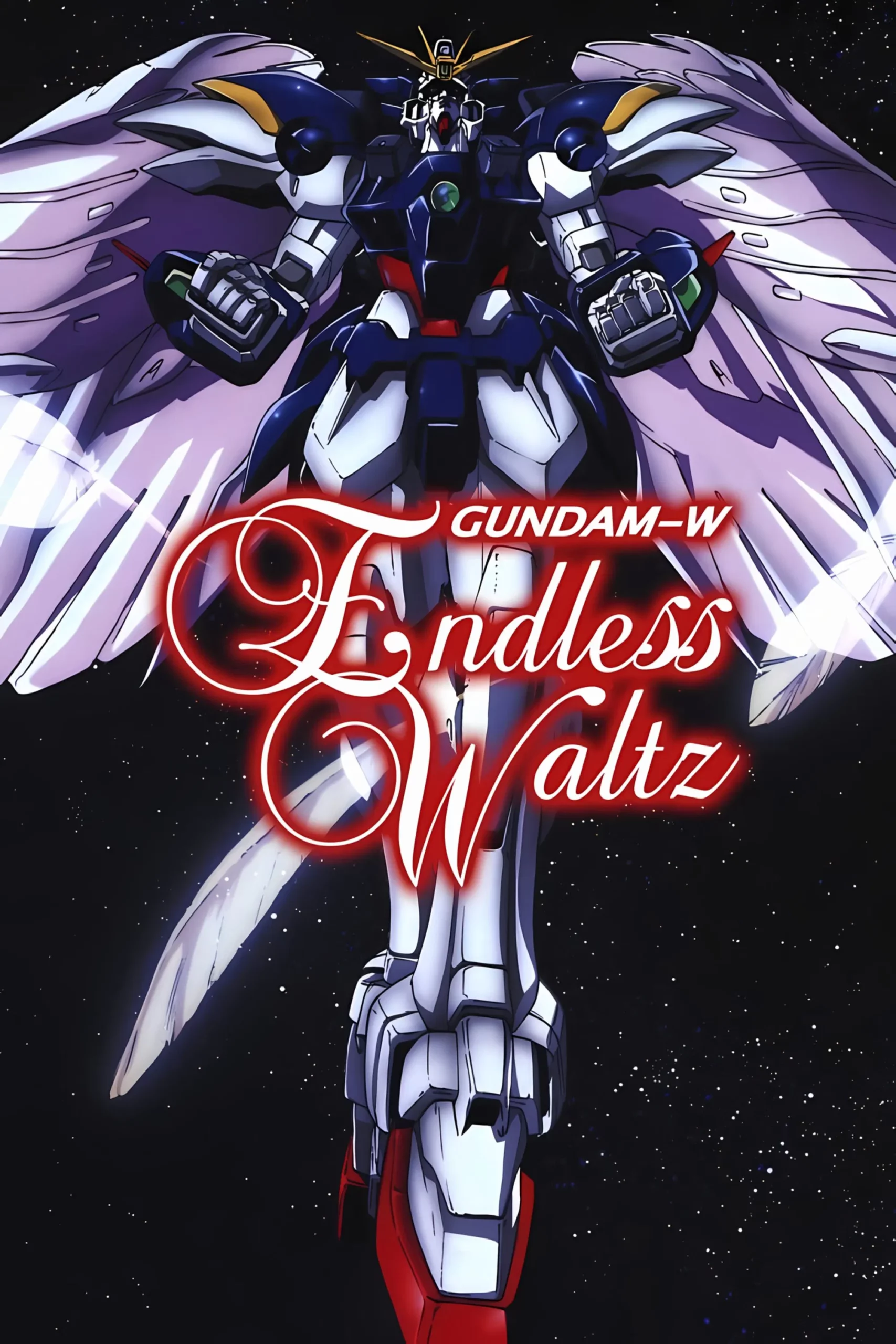
Name(s): Mobile Suit Gundam Wing: Endless Waltz / Shin Kidou Senki Gundam Wing: Endless Waltz Tokubetsu-hen / Shin Kidou Senki Gundam W: Endless Waltz Tokubetsu-hen / 新機動戦記ガンダムW Endless Waltz 特別篇 / Mobile Suit Gundam Wing Endless Waltz: Película
Format: Movie
Release Date(s): January 25, 1997 – July 25, 1997
Studio(s): Sunrise
Related: Mobile Suit Gundam Wing (1995)
I already have a review for the Gundam Wing series, and I’d suggest reading that first as my feelings towards it also reflect that of this movie for the most part. Endless Waltz is the sequel to the Gundam Wing TV series, and the greatest thing about it is that it could’ve easily felt forced as the original series ended on its own but instead it feels like a natural continuation and extended conclusion of the series.
This is surely for the better as it allows Gundam Wing to go out with a much greater bang. The initial scenario is nearly identical to that of the final episodes of Wing, but the progression is much different. After peace is obtained a new force shows up to take advantage of the Earth’s powerless state with a big plan that puts the entire planet at risk.
We aren’t here for the plot though (because it’s Gundam Wing), but rather the thrills, and Endless Waltz delivers more of those than ever before through some incredible animation quality that blows the original series animation to smithereens, showcasing both much crisper art and fluid animation. To give an example of just how good the art is, there were many times before where I had seen still pictures of Endless Waltz and thought I was looking at high quality promotional art. It’s really something.
To further justify this sequel’s existence, it gives us some short backstories on all the Gundam pilots that the original series was sorely lacking. It isn’t much, but Heero, Trowa, and Wufei all needed it most. We actually barely get anything about Duo unfortunately, but he was cool enough already, and Quatre’s backstory was actually in the series.
Speaking of Gundams, the most controversial aspect of Endless Waltz has always been Hajime Katoki’s Mobile Suit redesigns. These redesigns clash greatly with Kunio Okawara’s popular originals and have met with much scorn from many Gundam Wing fans due to a perceived lack of respect for Okawara’s designs by Katoki. These new designs are not upgrades, but rather complete retcons that don’t acknowledge the originals other than the base concept.
Deathscythe Hell loses its Buster Shield, reducing the range of colors in its design palette. Perhaps more crucial, its only weapon now besides the Beam Scythe is its Vulcans. Sandrock loses its claw, instead fighting only with its shotels, making it redundant in the face of fellow melee Gundam, Deathscythe. It also travels draped in a brown cloth, which also horns in on Deathscythe’s cloak element.
Heavyarms is largely the same, but is now blue instead of brown for whatever reason. I’m not against this, as I think it helps the mech stand out. Losing the brown comes at the cost of a visually-utilitarian appeal, but it being the sole Gundam to go for that vibe did put it at odds with the other Gundams. The OZ grunts are meant to be the utilitarian designs, aren’t they? The Gundam designs should imply they’re special.
Heavyarms gains a clown mask covering half of its face. This makes no practical sense whatsoever, but again, I don’t mind it too much. It’s distinct. Granted, it begs an explanation. It’s obviously a reference to Trowa’s history as a circus performer, but why did he put it on there? I just wanted one line about it.
To be fair, the Heavyarms displays some impossibly acrobatic movements to unite this aesthetic change with its functionality. It’s absurd, and Heavyarms is the last mech you’d expect to be capable of or desire to do move like this, but whatever. I’m checked out at this point. For me, the Heavyarms exists to throw Noin into in Super Robot Wars.
Altron is completely overhauled. This one is especially bizarre. Virtually everything about the Shen Long Gundam is discarded down to its very name. I don’t know what Katoki had against Shen Long. Maybe he hated Wufei like the rest of us. I think Shen Long itself was a fine design, but its color scheme was in conflict with Wing Zero, being a complete overlap. In that sense, I can get behind Altron’s unique, green palette. It’s close to the teal colors in the new Heavyarms, but whatever.
The Altron prominently features flamethrowers as a reference to its design’s draconic inspirations. Practically speaking, flamethrowers are a completely ineffective weapon—particularly against other giant heaps of metal. I assume they’re not going to stand there long enough to be significantly melted down.
By now, it should be apparent that Katoki has a penchant for design characteristics more associated with “super robots.” In other words, he prefers “cool” over “realistic.” That’s perfectly fine with me, in theory. I think there’s space for all gradients of mecha design philosophy. I do prefer their fictional worlds to have some level of internal consistency, though, which is where I find problems with Katoki’s approach.
Every mecha series necessarily demands some level of disbelief, as the concept is fundamentally unviable technology. I like it when a mecha series draws a line in the sand early on as to how much they’re willing to exploit the laws of physics. Establishing trust in the rules of a fictional world is important not only for immersion, but as an incentive for the writing’s developments to explore rational justifications. When things in the story pay off, it needs to feel fair, and things have a trouble of feeling fair when you show a willingness to break your own rules for personal indulgence.
This analysis is entirely sentimental. I mean, it’s art, so how could it not be? There’s not truly a rulebook for how to write stories, of course. Two people agreeing on these fundamentals will even draw different lines at what they consider to be “going too far.” I can only speak for myself, but this is something I care at least a little about.
Neon Genesis Evangelion (NGE) is a great example of how to explore both sides of the spectrum. It begins grounded, and progressively explores technology that is increasingly loosely-defined. Certain elements are presented in a dry, scientific fashion, but there’s no explanation as to their mechanics to characterize them as anything other than “magic.” But it drip-feeds this shift so audiences can adjust to the changing rules. Not to mention, the entire series has a general theme of science combatting and communicating with unseen, natural laws. Spirituality and science are in conflict in NGE, and it doesn’t feel inappropriate wherever the series goes.
The same can’t be said of Wing. It’s far from the most grounded mecha series out there, but like I said, it’s about consistency, not the relativity to realism. I love Deathscythe, but I’m entirely aware of how silly it is for its weapon to be a scythe even when considering its close-quarters stealth concept. But the biggest thing Wing asks you to accept with it is its decision to use a scythe; not too bad, really.
It doesn’t get progressively crazier from there. Endless Waltz drops you into the deep end with a dozen new things you have to accept. I can’t blame anyone for finding it too much, too suddenly. As a relatively short OVA/movie, the potential for dialogue to justify these extreme design traits is left on the cutting room floor, if it ever existed.
Without further ado, it’s time to acknowledge the most infamous change to any of Wing‘s mechs. Wing Zero receives its legendary angel wings, which you either think are cool as hell or incredibly stupid. Since Deathscythe was hit pretty hard here, you can definitely put me down as someone who dislikes the Endless Waltz redesigns, though I like Heavyarms’s new color scheme more, and Tallgeese III is my second-favorite Wing Mobile Suit. While I hated Wing Zero’s angel wings before seeing this, when in motion they have a more mechanical look to them so I’m giving it a pass even though it doesn’t beat the original (it even loses its Mobile Armor bird mode, please help me). These changes were all so, so unnecessary and minimize the original designs. I don’t get it. Worse still, these are almost always the final versions used in the Super Robot Wars games.
Venting over. Endless Waltz contains the best qualities of Gundam Wing‘s fast-paced action and these positive qualities overshadow much of the usual lame melodrama. The movie’s biggest misstep is having a set-up and ending that ignores its conflict with the series’ central themes and resets things back to the status quo which Endless Waltz showed didn’t work. Just Gundam Wing being stupid again. If you liked the series, you will like Endless Waltz. If you didn’t like the series, you will at least like Endless Waltz more. It’s that simple.
Leave a Reply