








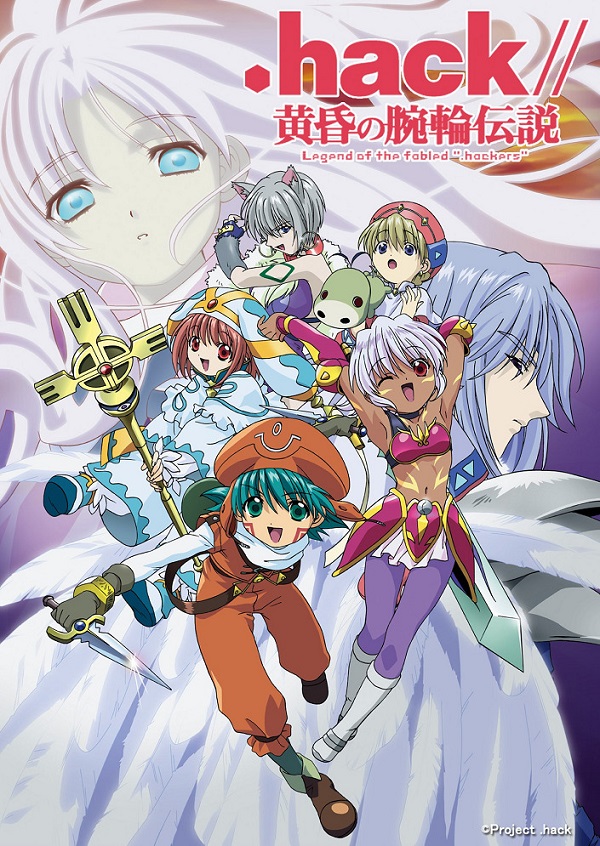
Name(s): dot hack / .hack//Tasogare no Udewa Densetsu / hack//Udeden / .hack//Legend of the Twilight Bracelet / .hack//DUSK
Format(s): TV series (12 23-minute episodes)
Genre(s): Comedy / Fantasy
Studio(s): Bee Train
Release Date(s): January 8, 2003 – March 26, 2003
.hack//Legend of the Twilight
My Background
So, a little background: the .hack//Legend of the Twilight (LotT) manga was possibly my first non-Toonami-related anime or manga ever. I say possibly ‘cuz it was a long-ass time ago, and I don’t really remember. In fact, it was such a long time ago, that the whole reason I got the first volume of the manga was because, while flipping through random titles in the “graphic novel” section of my bookstore, my horny, pubescent mind noticed the first volume’s steamy, full-color “pin-up” inserts in the opening glossy pages. Good thing my mom wasn’t curious enough about Japanese culture to take a look before buying! Yep, this was a first-hand example of anime fanservice translating to sales.
However, this turned out to be one of the few times in one’s life where your lust coerces you into making a good decision—the manga was actually pretty enjoyable in its entirety, even when discounting the boobs. I read the whole volume several times, and did the same for the subsequent two. I was completely taken in by an esoteric, idiosyncratic magic that I’ve since spent all of my time as an anime watcher trying to capture more of.
Fast-forward a few months later to when I saw a DVD cover with some familiar-looking characters sitting on my bookstore’s “new releases” shelf. They had made an anime adaptation of my then-favorite manga! I bought the first DVD, got the second shortly after, but actually never watched the final four episodes prior to this review’s 2016 viewing. I simply never encountered the third DVD. It’s possible that it took a really long time for it to be released, as was the case for the manga’s final volume.
Still, back then, I couldn’t have been more excited to see the story and characters I liked in full color, motion, and sound—but that wasn’t really meant to be. You see, as it so happens, .hack//Legend of the Twilight was one of those short, mediocre budget series more concerned with advertising the manga than it was with doing it justice. This is evident by the fact that studio Bee Train wouldn’t wait a measly ten months for the manga to finish.
Review
This led to one of the most drastically changed anime adaptations I’ve ever seen. I’m not inherently opposed to this idea, since changes always bring the chance of some improvements (like parts of Fullmetal Alchemist), but the reality is that improvements are extremely unlikely, and typically shouldn’t be prioritized over making a faithful adaption. In an ideal world, we’d have our complete manga adaptations and then whatever extended universe/reimagined series the studios wanted, but in the real world, there is time, budgets, and profits to consider.
To make a long story short, if you’re a .hack fan interested in Legend of the Twilight and were only going to do the anime or the manga, then do the manga because it’s far, far better. Or at the very least do both, because they’re entirely different stories.
Their beginning is similar enough: Shugo and Rena are siblings living under different parents who reconnect in the online game “The World” after winning avatars that look like previous legendary The World players. When they’re attacked by a mysteriously invincible monster, Shugo is killed and revived after being given a special bracelet item by a girl named Aura. This bracelet can rewrite data in the game to weaken it, allowing Shugo to combat these new invincible monsters.
Shugo and Rena try to play the game normally but are continuously disrupted by strange circumstances and more invincible monsters. With the help of new friends Mireille, Ouka, Hotaru, as well as systems administrator Balmung and his friend Sanjuro, they’ll have to confront whatever is threatening The World.
Click to reveal SPOILER section
Early on, the anime’s story majorly deviates from the manga after Rena disappears (for half the series) after being defeated by one of those special monsters. It’s about this time we learn that our main antagonists are a group of hacker children, which is very lame, because apart from our villains being snobby brats, their motives are also never fully explained, they basically never interact with our main characters directly, and in the end, they’re written out of the story like they never existed.
Every once in a while, they send an invincible monster after Shugo because his Twilight Bracelet threatens their plans, but they never seem to realize Shugo can just deus ex machina with Data Drain and win every battle. It’s similarly annoying to see the other characters attack the self-regenerating monsters repeatedly, even though they know from experience that only Shugo can harm them.
If you remember Shugo and Rena’s relationship in the manga being far too affectionate for a brother and sister, then you’re really going to tremble when the anime turns up the incest dial even further. Shugo is downright in love with his sister this time, ogling her (or at least her player avatar) twice in the first two episodes, and literally half of Rena’s dialogue in the entire series is her yelling “onii-chaaaan”—often several times in a row. It’s only made creepier when you remember this sibling love is bordering on both of them experiencing the beginning of puberty at around 14 years old or so. Gross.
When the “search for Rena” plot appears, one of the anime’s worst traits is made obvious: it likes to waste as much time as it can. It does most of this through a ton of long-takes (this is where the “camera” pans slowly across a scene, sometimes for an establishing shot, but more often for no reason) and redundant, pointless scenes of Shugo and friends running around looking for Rena all over The World.
Which is a completely stupid idea, because if she was in a normal area, she would obviously be contactable or could just log out. This new plot also means the manga’s cute minor story of reuniting Zefie with her mother is completely gone. All other characters return in mostly similar roles, but a new main character called Sanjuro replaces Zefie. He’s an experienced samurai archetype who mentors and trains Shugo, even though his bracelet is more unstoppable than any legitimate attack, and he’s friends with Balmung and thus also realizes the danger threatening The World.
Characters in Legend of the Twilight often lack a personal stake in its story. The main antagonist is only revealed when the anime is almost over and is never even hinted at or before then, and neither they nor the child hackers have anything to do with Shugo or Rena besides them just happening to win the special costumes (which they also had nothing to do with). Literally, Shugo’s only reason to be involved with any of this is because Rena is coincidentally kidnapped. The far more likable side characters of Mireille, Ouka, and Hotaru have even less to do with anything that’s happening and hardly influence the plot at all.
An Overly-Juvenile Tone
There’s a terrible tendency for the show to introduce slapstick jokes at completely random, often totally inappropriate moments. The worst example is the series’s running gag of having Shugo—who is legitimately one of the dumbest, most helpless anime protagonists I’ve ever seen—constantly trip and collide with things that break a tooth off. This facial detail is even kept in some subsequent scenes, which looks incredibly ridiculous.
In the climax of the anime when everything is doomed etc., a total comic relief character barges in from the edge of this apocalyptic scene just to cry, scream, and idiotically run into a wall. I know Legend of the Twilight is obviously aimed at a younger audience—both anime and manga—but that doesn’t mean kids are complete idiots who can’t handle any dramatic scenario.
Logical Inconsistencies in the Story’s Premise
If there is a single good thing about the anime’s story changes, it’s that the plot is now much more reliant on it taking place inside of a game. It wouldn’t take much at all to rewrite the manga to fit inside a typical fantasy world with actual magic and such. The biggest problem would be the explanation of Shugo’s bracelet rewriting code to depower monsters, but it still wouldn’t be hard to reimagine it as a transformation spell.
This is relevant, because it’s inherently harder to take a story seriously inside a world that has less consequences than a “real” one. In the anime, the elements of hackers and such mean it has much more to do with .hack’s unique premise. Personally, I would consider that to be the whole point of the franchise, so I’m in favor of this one, particular shift in focus.
Despite this, there’s frequent contradictions where the writers failed to equate the logic of the game world with what’s going on in the story. In one scene, a hacker has already been caught by CC Corporation staff, but instead of them just banning him instantly—because this is all data, and they have the admin permissions to do so—they literally chase the hacker around a virtual town in real-time until they physically catch them.
Also, how are full-body human movements made with just a regular game controller? They could’ve just said the headset has some mind-reading power for all I care, since obviously the fictional technology is already highly-advanced compared to our own. In another scene, the administrators talk about monitoring log-in info to see who accessed certain servers. When they’re searching for Shugo and friends, however, none of them think to just stand by and wait until Shugo logs in for the first time of the day and capture him at his spawn point?
If I may continue, how and why is a hideout hidden from administrators? They’re administrators; they should have access to the game’s entire code, which a hideout has to exist in. There are hundreds of things in the anime to nitpick like this, and I think it’s relevant. We’re talking about the show’s central conceit, which is one that’s most likely to appeal to people familiar with technology. Ignoring these questions makes the setting incoherent, and harder to buy into if you’re someone like me, who’s played a ton of video games. Every example I gave could have been written around, but the writers either didn’t care about inconsistencies or weren’t clever enough to sidestep them. In either case, I think that’s an indictment.
Direction and Quality of Animation and Art
Legend of the Twilight was made in an era when digital animation was starting to take over, and it unsurprisingly shows many of the worst aspects of that medium. It’s full of bright, solid color fills that lack any detailed shading to imply a sense of texture, giving it a “flash cartoon” or MS Paint appearance. There are frequent “moeblob” faces and other off-model flubs, such as background characters having stick-thin or otherwise disproportional limbs and “emoji” faces.
It’s not a hideous anime overall, but it’s not hesitant to cut corners. The backgrounds appear painted, though, and look quite nice. A lot of the fantasy architecture looks appropriately mystical with its odd color schemes, giving them an inviting sense of mystery.
A Surprisingly Good Soundtrack
The music is, unexpectedly, the best part of the anime. It’s not really something I’d listen to outside of the show, but it’s a somewhat post-modern, new age mix of influences. It’s typically as light and breezy as the setting and script tone. Compositions feature a wide range of instruments: everything from synthesizers, xylophone-driven jazz, classical orchestration, and best of all, picopop with bossa nova-inspired vocals.
I really like the opening, even if the lyrics are completely impenetrable even by general anime standards. The ending song and its accompanying, beautifully surreal visual narrative is genuinely my favorite part of the entire series, and what I would consider its artistic peak. I’m not even kidding.
English or Japanese Audio?
As for whether to go with a dub or sub, it’s a weird situation. Normally, it’s cut and dry whether a dub is worth checking out, because either the studio is invested in doing a quality job or it isn’t. In this case, the casting ranged from acceptable to great. Both Steve Blum and Crispin Freeman appear to voice major characters, and they’re two of the best English voice actors of their generation.
However, the voice you hear the most is absolutely horrendous. Bryce Papenbrook as Shugo is unbelievably aggravating, with constant shrill, whining, screaming shrieks for Rena like an adolescent baby with an empty bottle. It’s utterly maddening, and I don’t know how someone thought this was an acceptable performance.
To be fair to Papenbrook, perhaps he was directed for this delivery or attempting to imitate the original Japanese vocal performance. Whatever the case, it makes his buffoonish, childish personality even more grating. I would say to at least try the dub and test if you can last ten seconds of Shugo’s ballistic babbling. If you can tolerate that, the rest is solid.
Verdict
Still, I wouldn’t really recommend this series. A serious .hack fan will watch it anyway, and to them, I only recommend you read the manga as well. Those on the fence should definitely just read the manga, where the main characters are far less annoying, and every supporting character is given an impactful role in the plot. That story stays charming in its relatively low stakes, which suits the more child-friendly tone of the art design and gentle characters. The anime goes for broke on drama, which clashes with its surroundings and is hard to take seriously.
The more severe tone of the series highlights its lack of thematic depth, relevance to the franchise, its extremely vague explanations of events and character motivations, and static characterizations. It’s a very uneven and loose story for something so short, while the manga stays within the modest confines of its short length to deliver a lean, tight narrative. Neither version appears to be important to the overarching .hack story as a whole, so feel free to use Legend of the Twilight as a starting point, like I did.
If Shugo went to my middle school, I would’ve bullied the absolute hell out of him. It’d be for the greater good.
.hack//Legend of the Twilight Offline Meeting Special
Name(s): .hack//Tasogare no Udewa Densetsu: Offline de Aimashou / .hack//DUSK Special / .hack//Tasogare no Udewa Densetsu Special / .hack//黄昏の腕輪伝説 オフラインで会いましょう
Format(s): Special (1 20-minute episode)
Genre(s): Comedy
Studio(s): Bee Train (presumed, not confirmed)
Release Date(s): October 24, 2003
Originally published: 2/7/2016 01:24:17 AM
I would recommend reading my review for the main series before my review of this special. This is the first picture drama I’ve seen to completion. No expense isn’t spared in this DVD bonus feature for .hack//Legend of the Twilight. If you thought regular anime had budget problems, seeing one of these will humble you. Characters are represented by floating heads in circles over still backgrounds, kind of like a skit in a “Tales of” game, which I would imagine has a big crossover fanbase with .hack. Anyway…
Hotaru visits Japan from America with Sanjuro and gets separated. Hotaru logs in to The World from an internet café where she asks Shugo, Rena, Mireille, and Ouka for help. They all work together to figure out Hotaru’s location then eventually they go out to find her in real life.
There’s a scene where Hotaru is explaining how she got lost in a big Tokyo crowd, and Hotaru’s floating head-in-a-circle flies and fumbles around a still, top-down, watercolor-filtered image of a Japanese crowd. It’s so adorable that I screamed “k-kawaii!!!” in real life and made everyone in the internet café I was watching from leave in embarrassment. But I’m sure if they saw it, they would understand.
To be blunt, this special is very disappointing. You literally do not see any single character’s real life appearance. Even when they meet up in the story, their portrait is of their The World avatar. I’ve admired .hack’s artistic choice to obscure any real-world faces in their series, but making a special based around revealing that and just blue-balling the audience is misleading and makes the ordeal pointless.
You get a detail or two about each side-character’s personal life, but it amounts to so little, and seeing what they really look like would’ve been a far better reward. Not to mention, it actually was revealed in the final volume of the manga but not paired to their avatars, so you kind of had to guess who was who.
The last quarter or so of the special is the voice actors saying something nice but frivolous about the character they voiced and following with a catchphrase. It’s cute to hear how enthused they sound, but they don’t say anything special.
And thus, this “special” in its entirety is anything but. There really was almost no point to making it. Yet, I might’ve liked it more than the actual series just because it’s a simple, silly, cute thing that never has any moments of stupid writing or slapstick. It feels more in line with the tone of the original .hack//Legend of the Twilight manga, which was overall superior to the anime adaptation. Anyway, I pretty much outlined the whole thing, so you can decide on your own whether it sounds like it’s worth watching.
Personally, I’m going to pretend Ouka looks the same in real life.
Leave a Reply