








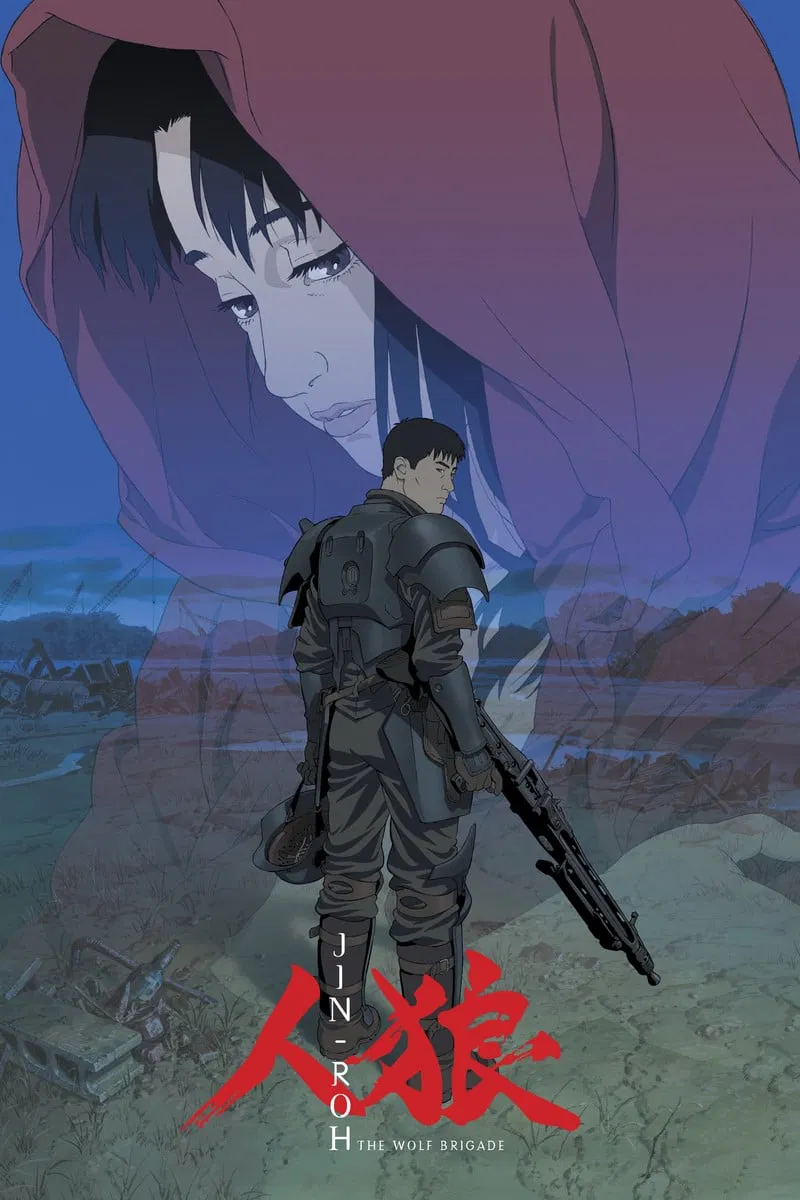
Jin-Roh
Name(s): Jin-Roh: The Wolf Brigade / 人狼 / Jinrou
Release Date(s): November 17, 1999 (France)
Studio(s): Production I.G
Jin-Roh Review
Jin-Roh is a political/military drama in a fictionalized, post-WWII Japan. Special ops soldier Kazuki Fuse develops a relationship with a young suicide bomber’s sister. Haunting Fuse, however, are his memories of witnessing that same bomber’s death.
Jin-Roh possesses traditional themes about desensitized soldiers coping with their militaristic routine and their human desires. As the title implies (“Wolfman”), it’s deciding on an identity swaying between monster and man.
When it comes to plot, Jin-Roh doesn’t really surprise. It’s a very competent take on a familiar story that still doesn’t rise to the most affecting war dramas. The movie can’t decide between being character-driven (which it should be) and being politically-driven (which it shouldn’t). Too much of Jin-Roh‘s delicate running time focuses on political meetings between various suits and organizations. Much of that isn’t interesting because the setting is largely fictional. It’s clear Fuse’s personality and relationship are always at the center of the movie, regardless. This narrative conflict comes to a crash near the climax. The goals of indistinguishable factions are given priority over more compelling personal motivations.
Fuse is a stoic soldier type, giving us very little verbal characterization. We determine his personality through his interactions with Kei and the torment of his dream sequences. Unfortunately, there isn’t much beyond what meets the eye here since we’re given so little to work with with the aforementioned political overtones demanding so much of the script.
All-Star Production Crew
But, wait! Jin-Roh lays its cards on the plot table and reveals it has a pretty damn good hand regardless. We have not only the legendary Mamoru Oshii (Ghost in the Shell, Patlabor), but Yoko Kanno of… everything fame. Though directed by the far less known Hiroyuki Okiura, this feels completely like an Oshii work—understandably, since he wrote it.
Visual Style
Oshii delivers another political conspiracy plot and exceptional attention to Jin-Roh‘s realism. Sepia tones drape 1950s Japan, and the eerie greyness emanating from surprisingly empty cities reflect the volatile, militaristic environment. Accompanied by Kanno’s slow, subtle orchestral score this creates a dreary and uneasy air to the whole movie that elevates Jin-Roh beyond a standard soldier story and captivates where the characters, storyline premise, and their developments may not.
Jin-Roh Verdict
Your reaction to Jin-Roh will depend on how much you believe a strong atmosphere can cover for a lacking script. If it can, it has a good number of effective, chilling scenes when it’s not busy being—well… boring. This is a quality effort certain people are bound to resonate with, even if some potential was wasted.
Leave a Reply