








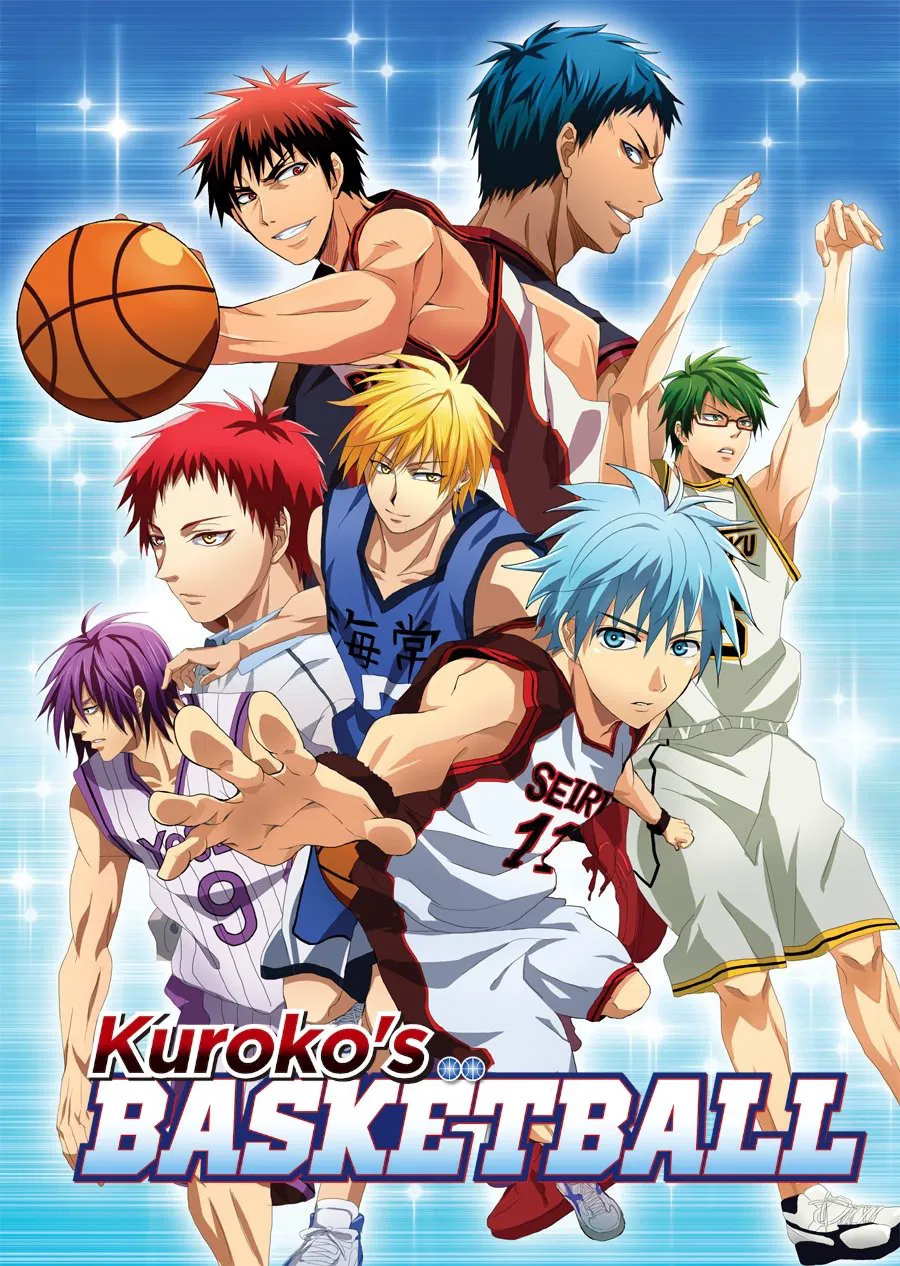
Season 1 (2012)
Name(s): Kuroko’s Basketball / Kuroko no Basket / Kuroko no Basuke / KuroBas / The Basketball Which Kuroko Plays / 黒子のバスケ / Kuroko’s Basket
Format: TV series (25 24-minute episodes)
Studio(s): Production I.G
Original Publication: February 1, 2016 10:22:08 pm EST
I’m not going to spend much time editing this because it’s just the first season, but it’s still valuable to have my general impressions somewhere when I need them for the larger final review, assuming I’m not lazy and it happens. Kuroko no Basketball, translated by people speak proper English as Kuroko’s Basketball, and translated by the people who don’t (and made the anime) as The Basketball Which Kuroko Plays, is a mostly standard sports shonen anime. A legendary middle school team that went on to be known as the Generation of Miracles has now split and the players have gone their separate ways. Tetsuya Kuroko was the team’s sixth man and secret weapon who transfers to Seirin High School’s basketball team with a personal goal in mind: to prove to the arrogant Generation of Miracles that true basketball is about teamwork and cooperation. He’s assisted by other Seirin newcomer, Taiga Kagami, whose hotblooded personality and raw talent is a perfect combination for Kuroko whose only ability lies in assisting his team through passes.
Thus begins Seirin’s first real hope of making it to the championships. The team is rounded off by a few sub characters of linearly decreasing series presence and skill, and their young female manager. Seirin has their work cut out for them as they keep running across other Generation of Miracles members who now play for their own teams. There’s not a whole lot else to say, because not much happens in the first season. The major characters are of course Kuroko and Kagami, as well as the GoM players who are introduced one by one, and most of this is spent setting up who these people are now more than their backstories and motivations. In between matches there’s brief training sequences and discussions of upcoming matches and such, but in the first season this downtime isn’t used that effectively. The same characters interact (such as Kuroko and Kagami) interact in predictable ways while most of the team is background noise, and the humor ranges from decent and enjoyable to impenetrable due to a slightly above average focus on Japanese wordplay (much of which is impossible to get to work in English, as hard as the translators try).
The most immediately annoying thing about Kuroko’s Basketball is how it immediately shows its not afraid to trivialize any power gap. After the introduction explains how the Generation of Miracles are the best high school players in Japan, a match is set up against one of them in one of the first episodes. After Kuroko tells Kagami, a player who looks extremely talented to us, wouldn’t stand the slightest chance against the GoM, we immediately see one of them defeated. It doesn’t matter that it’s acknowledged Kise is the weakest of all of them, because that doesn’t change the fact that he’s basically the fifth best fucking player in Japan as it has been told to us. A fine introduction would be to show Kagami initially struggling against Kise, but having a much easier time when he starts working together with Kuroko and is able to close some of the distance to everyone’s surprise. It still would have felt like a victory because it shows the Generation of Miracles is powerful and a force to be reckoned with, but not completely out of reach. After this rocky start the show does what it should’ve done in the first place and sets Seirin up against some strong local teams without any GoM players, but now this looks awkward when they’re struggling equally or more against a team that should be significantly less skilled. The steady climb to the top is one of the biggest appeals of long sports anime, and trivializing any of it is going against one of the genre’s inherent strengths. Imagine if Ippo from Hajime no Ippo defeated the 10th ranked fighter in Japan in episode 5, instead he just beats a local prodigy as a newbie and even that’s a huge start.
This ends up evening out a bit over time, and Seirin’s fighting chances against the GoM feel more acceptable after getting to witness them practicing and improving, and the series seem to consciously dial back the fast rise of Seirin towards the end of the first season by re-establishing just how good the GoM players can be. It also addresses the issue of only a minority of each team being distinctly designed and memorable characters, and introduces a formula where each team in the series has three main guys and two less noticeable ones. it also gradually gets away from Kuroko and Kagami hogging all the limelight every match. In the beginning the sub characters get maybe a minute tops in a match where they matter, and even still it’s always Kagami and Kuroko who are responsible for winning the game, which gets boring.
Other than these steadily improving flaws, one that didn’t go away is how poorly the entire field is highlighted when narrowing in on specific players. There’s some weak contextualizing of many plays that undermines the impact of their success because the viewer can’t see how they actually work in the context of the whole, more complex field. When the Seirin underdogs somehow manage to pass a ball between the three of them and get an unlikely basket, where the hell is Aomine (who is shown to be perfectly aware of anything that goes on and is fast enough to dart from one end of the court to the other to stop Kagami) during all of this and what is he doing only to suddenly come back in the next scene? It feels like parts of teams practically disappear at times for plays which makes them less impressive because of how obviously contrived they are, and it’s inconsistent what strategies work when a lot of what is going on in the game is hidden to the point of temporarily not existing. Other people seem to be able to ignore this, but I can’t because it doesn’t make sense.
On a similar note I’m currently on the fence about the superhuman abilities of the players. There’s no beating around the bush: the show begins with some already highly unlikely (but plausible) skilled players, and over time it just becomes absurd feats of strength and precision especially considering that these are high schoolers we’re talking about. In theory there’s really nothing wrong with this approach as long as it’s consistent with its ridiculous skill level (and it is even as it increases), but it’s probably the exact reason why it’s also the least inspirational sports anime I’ve seen. Many of the players are seen working hard and improving as a result, but they’ve still got an unobtainable god-given base strength. And due to the realistic things defining their actions (like the game of basketball and its rules) all of these scenes probably could’ve worked just as effectively and impressively when kept at a more realistic level because it would still all be relative to the series’s own standards of strength.
To wrap that up the animation and art is mostly average and not distracting, and the music is similarly very suitable but nothing special. The sound mixing to keep things like the shoe squeaking synchronous to the players moving about the court also deserves credit as they could’ve just outright ignored this. Kuroko’s Basketball starts out as a somewhat bland and unintelligent sports anime, but shows steady promise as it falls into its own pacing and consistently addresses what it’s lacking. It’s not a very smooth development, but nonetheless it grows into itself and becomes good by the end of the first season. Depending on how long it keeps this improvement up, some parts of it may actually deserve its high reputation.
Season 2 (2013-2014)
Format: TV series (25 24-minute episodes)
Studio(s): Production I.G
Original Publication: February 5, 2016 11:05:12 pm EST
I’m going to keep this short by only addressing what’s different this time around. It’s immediately better right out of the gate by finally giving backstory to one of our main characters, and it has the sense to linger in the audience’s mind by not resolving it completely. In other words, it retains some of the power it would have had if this backstory were given earlier in the series like it probably should have been. The point is, Kuroko’s Basketball continues to improve by filling in what’s missing and realizing what kind of action anime it wants to be. Though some other Seirin members get a great backstory arc, in the end the majority of the team is still very forgettable which is disappointing given so many matches and opportunities to focus on the whole team.
Though the writing improves enough to count, it’s still not Kuroko’s strong suit even by the standards of sports anime I’ve seen so far. Frankly, there’s some pretty uncreatively typical and/or redundant dialogue at points such as Hanamiya, a sadistic genius but who has the intimidation and cleverness of an elementary school bully, and Murasakibara constantly repeating the same phrases. It’s not bad enough to be distracting, but it highlights the very simple and narrow character archetypes the show is made up of by not even being that intense with their one-note personalities.
While it’s difficult to get into the drama of the matches through that angle, season 2 pulls itself up a bit by doubling down on the thing that makes it even a bit unusual: the over-the-top shonen elements. Seeing what season 2 does with them makes it obvious why the superhuman/physics-defying moves are a lot more uncomfortable in season 1. S2 has a much greater flair for the dramatic, and thus the ridiculous nature of the skills on display are finally signaled in by everything surrounding them. To put it another way, the entire show stops taking itself as realistically and ironically this makes the whole show much easier to take in and accept. One such example is the show’s new abundant use of metaphor, with the biggest example being the visual symbolism of Kagami breaking down the “gate” near the start of season 2, something that season 1 never did anything similar to. The absurdity has spread to the characters now with their sometimes hilariously dramatic reactions to every point made on the opposite team, and a dozen new special move names (which weren’t really much of a thing in season 1) are created and uttered constantly to drive up the sense of fantasy, and this fantasy is made complete by the increasing focus on the metaphysical and powers of will (again, leaning more towards shonen than the more pragmatic willpower scene in most sports anime). One character has a special named move that’s literally him just grabbing the ball, but since he’s tall it’s a bigger deal apparently. The show’s general improvement also means the matches are overall better than season 1 (though two in season 1 are still my favorites).
The music seems to have changed to favor more suitably theatrical orchestration, but it’s so downright ordinary none of it really rises above what’s on the screen. It’s always the exact generic composition you’d imagine would play during any of these scenes. For example, if you made people do a blind listening test between this OST and Hajime no Ippo’s from New Challenger or Rising, I doubt many could tell you most of which compositions belong to which. The rock/electronic soundtrack from season 1 wasn’t anything that special either, but the instrument combination of guitar and keyboards is just inherently more dynamic sounding than traditional string/percussion orchestration and thus carries a little more bite. It’s safe to say season 2’s OST does just enough to fit in and complement the scenes, but it only matches them instead of carrying them higher which holds the show back in this one aspect.
By the start of season 2 Kuroko’s Basketball has fully realized the kind of show it should be with the action dial turned up to nearly constant ridiculous feats and intensity, and on this plane it can finally construct its own cohesively toned environment which allows it to be much more absorbing. It still struggles to involve the viewer on a more personal, emotional level with its merely decent writing but the simple visceral appeal is tight and fully formed. Most shonen anime have trouble holding onto that much.
Season 3 (2015)
Format: TV series (25 24-minute episodes)
Studio(s): Production I.G
Original Publication: February 12, 2016 05:42:45 pm EST
I don’t want to spend time editing this into like a formal essay, but so I don’t waste the experience here are my final thoughts on Kuroko’s Basketball, in addition to what I wrote for seasons 1 and 2.
1. Season 3 rides the improvements of season 2. The shonen hyperbole has become a constant and there’s not even a pretense of there being a genuine sports/basketball experience. I don’t prefer this to something like Ippo, which I find is an ideal line between plausibility and exciting fantasy. It relies incredibly on contrivance to make its fights interesting, but theoretically nearly everything could play out in reality, it’s just incredibly unlikely. Take a guy like Mashiba whose signature move is the flicker jab which from my understanding isn’t something really relied on in any professional boxing because the whole nature of the move is that it’s not something used for its striking power. But the contrivance comes in here, because Mashiba has an extraordinarily uncommon frame. He’s a huge lanky guy who’s barely in Ippo’s weight class, giving him a power advantage but they acknowledge the shortcomings of this by noting how harsh Mashiba’s diet is in order for him to stay in that weight class. This very odd scenario has just enough to be able to buy into it. Mashiba has a weight advantage so he’s got more power with even his flicker jabs than any of Ippo’s other opponents would, and because he’s so lanky his range makes jabbing a much better strategic option. You probably wouldn’t see such an exact, specific match-up like this with precise differences in body size and fighting experience (Ippo at this point just happens to be an ill-equipped novice and a somewhat stocky build) in a professional boxing match, but it feels like something that is theoretically possible which is enough. You get your dramatic shonen fight with distinct looking characters with their own powers, but the inherent relatable struggle of the competition exists because there’s enough plausibility to relate this as a real boxing match with the real complications of the real world. It’s the ideal balance, a fantasy that can take you in because it’s a fantasy you can believe in.
Even though I don’t prefer it, I don’t think there’s anything inherently wrong with KB swinging completely with the fantasy side. The problems came mostly from season 1, where the feats of superhuman strength and reflexes were spaced out enough from the more realistic basketball plays to totally devalue the latter and the “normal characters” (the vast majority of the cast). It felt disingenuous and the flip-flopping of a semi-realistic tone and an exaggerated one did services to neither. You can’t buy into the stuff that feels real when it’s practically taking place in a different, “less worthy” dimension than the superman shonen stuff, and you can’t get drawn into the superhuman shonen stuff when it’s rare enough to feel cheap and not common enough to gain momentum and draw you into its fantasy world where you stop questioning the impossible. By the end of the first season and through the second season, the scale just tips right into constant lunacy and eventually you forget it’s even lunacy at all because there’s no longer a discrepancy in the style of basketball we’re being shown. If it had just been as consistent from the beginning I probably would have had much less resistance to it, because I would’ve gotten used to it very quickly.
2. The main reason I don’t rate this anime higher is because the writing and characters are very ordinary and everything plays out in super obvious and traditional ways. This isn’t to say I didn’t like the characters, because I had some level of affection for nearly all of them, but to say I cared about them at the same time is a different story. I was hoping I could pinpoint why easily, but it’s probably a number of things. The first thing is that the characters are very one-note. This isn’t the same thing as a character just being an archetype of a common personality. A one-note character is a character that has a limited range of different responses to different things. Many of KB’s characters have conflict, but they aren’t complicated. And really, I’m not asking for something elaborate, just something dynamic with each character. Aomine’s character arc is that he’s Kuroko’s former supportive buddy, but he became too good at basketball which turned him into an overconfident douche who doesn’t really care anymore. Naturally, Kuroko wants to beat Aomine to get his friend back. The way Aomine developed compared to how close we find out he was to Kuroko, you would expect him to still have inner turmoil, but instead the writing just completely indulges in the single personality trait he shows now. It would’ve been interesting to have a more complex internal monologue, and it wouldn’t have felt out of place.
The character conflict and thus dynamic range of reactions could be brought out by his reunion with Kuroko which instead of being shocked by or making him reflect more on the person he used to be, he just takes it in stride and kind of blows him off. Even considering Aomine’s change since Kuroko and him were friends, it doesn’t feel genuine for that former part of his personality to just not exist at all, and he’s less interesting by only having one side to his personality and thought process. Archetypes are simplifications of real people, but you don’t want to get far away from how archetype personalities come out of people in the first place. Real people very commonly (I almost want to say always) are prone to hypocritical thinking and judgment, and always harbor varying degrees of self doubt even behind the persona they’re currently siding with and displaying. In a fictional narrative you have the opportunity to really bring out this inner conflict in order for the audience to understand and gain more from the characters’ outer reactions with each other. And it’s not like KB doesn’t expose inner monologues, they’re just typically the same person we’ve been shown on the outside and it cheapens them as people. It’s hard to love characters that lack that human intensity. And KB wants that human intensity because it uses the plot and character relationships to raise the stakes of matches, one-on-one court showdowns between characters, and when it literally references these relationships during the matches. The drama is supposed to elevate the action, but because the characters are a near straight line of simplicity it’s just hard to feel for them and make the matches more than the sum of their plays. I know Murasakibara is lazy and not a smart guy, but I would expect him to have more of a vocabulary than “shut up” or “I’ll crush you”. Almost every GoM character has a catchphrase of some sort as evidence of how narrow their design is. Even when they’re defeated and forced to confront the bad part of their personality it’s short-lived in a small scene, not that impactful because like said earlier that inner conflict hasn’t been strewed to make this resolution very satisfying, and often isn’t particularly visible development when they show up again for the rest of the series. Some people might like to reply with “it doesn’t need a complex plot or characters, it’s shonen”, but I don’t know how you could be a major fan and not acknowledge these elements being a major factor in what make the matches appealing. The potential and room for everything I noted is already in the show such as inner monologuing and emphasis on characters’ feelings about each other and the matches, it’s just that the writing prefers to be redundant and restate parts we already know, rather than be expansive when it has the chance.
It seems like a good time to expand into the other part of the writing weakness, because it’s a similar idea of the writing not having its priorities to its best benefit. In this case it’s the biased attention given to the huge cast despite the very reasonable amount of episodes to develop more of them. Take Izuki for example, who is one of the main members of the Seirin High team. We see Izuki in every single episode, more than the GoM characters, and we see him play in almost every match and yet what do we know about his personality at the end of 75 episodes? He likes to make puns. This guy is carried through the whole series but we don’t get a thing to make us truly appreciate him as a person. Instead of having Kuroko talk about how important teamwork is for the 50th time, maybe give a scene to Izuki instead. Why does he play basketball? Why is success at it so important to him? What caused him to favor his style of playing? Izuki is a main character by a screentime metric, yet he feels like a limper character than Imayoshi, a secondary character of a rival team. If we cared more about Izuki, every match would carry at least slightly more weight because we’d root for the entire team a bit more. Not everyone can get main character-level focus and development, but again 75 episodes is a -lot- of time, and there were a lot of instances to distribute the attention. But yet again, the writing opts for redundancy over expansion. Compared to Izuki, Hyuga and Teppei get a lot more attention. It’s still mostly in very specific spaced out parts of the series, but it’s there. We get more of a feeling of why the sport is so important to them and some of their past history. In this case, their problem (along with Izuki’s) is that they’re never given the glory in matches Kagami and Kuroko get. I accept them being the aces and the best players, but it does not seem reasonable to never make them the reason the match is won in the climax over the course of so many matches. We’re told they’re very talented players if not on Kagami and Kuroko’s level and have specific talents that they don’t, so it’s not an unreasonable possibility. They both get their moments in the middle of matches, but so much of Kagami and Kuroko’s growth and achievements are emphasized throughout the series through their climactic wins and upholding as Seirin’s best players by far. They don’t get enough to really feel like they should be at the level to compete with the Uncrowned Kings in the final match. Their development as players feels shoved along to each new point, unlike Kuroko and Kagami who improve smoothly over the narrative at a consistent pace because of constant focus. For all of the series’s talk of teamwork, Seirin never really felt like a team to me. It was always the Kagami and Kuroko show and then the others when it was randomly convenient. Then back to Kagami and Kuroko. Again, the opportunity was there to change that instead of us getting another scene where Kagami shows he can still jump really high despite him being out of stamina! It’s dramatic, sure, but the result is the same which makes me appreciate it a little less. Almost none of the teams feel like teams to me, really. They even all have a standard formula where there is a hierarchy of importance. There’s one ace, one sidekick, and then three others who are ranked in order of amount of dialogue they get and how much their character design stands out. The 4th and 5th guys almost don’t exist and are barely mentioned during matches.
I think to close out the only other thing I’d want to mention is that the match progression is too predictable. Teams are brought back again in a very orderly, linear fashion and there’s never much of a surprise in who’s facing who or who’s going to win. I would’ve liked to see more matches between other teams, because even the ones we get are a bit shorter than Seirin’s matches. It’s incredibly odd Kise’s team is the only one to get four matches, while Muraskibara’s team is the only one to get one match. It’s just weird. During Kise’s match the Winter Cup really started to feel its length, and it became apparent season 2 was better overall by virtue of just having more to it besides the tournament. It was more balanced with downtime, other settings, and even more backstory. By this point I was getting tired of how much time was spent portraying ordinary (but still superhumanly impressive) plays between minor characters of high fundamental skill (this would be when they take Kise out). It wasn’t exciting during these parts because I wasn’t seeing anything new done, just fast passes and shots, and the match really dragged.
Oh yeah, I almost forgot to mention the odd rate at which background information is given. I liked the GoM having a sense of mystery to their past at first because it was like the audience themselves were spectators to uncovering their legacy like the team other than Kuroko was, but they sat on far, far too much detail that the series really could’ve benefited from having early. It isn’t until the middle of season 3 that the main events of the GoM’s past are all laid out, and it’s by now that the series is almost fucking over that we finally know why our main character -Kuroko- is actually fighting. We’ve always known what he wants to do, which is to defeat the egocentric arrogance of the GoM using teamwork, but we never really knew why this was so meaningful to him. Only his relationship with Aomine is defined at an appropriate time, but even much of that is referred to in dialogue at the time rather than through actual flashbacks to get a real sense of it. A lot of stuff that’s really needed to feel the warmth and importance of their friendship is given at a later time or not even in the series (like the special). So you don’t get the full potential emotional weight of the matches while they’re actually happening, and the main character of the whole series is barely empathetic. If we had that empathy, we’d feel the same drive Kuroko has through the entire series and every event would feel more important just by knowing what it truly means to Kuroko. Retroactively applying this new knowledge to past matches is nowhere near as powerful and a major waste.
3. I don’t know if the perspective of matches improved and they start acknowledging the court in its entirety over specific players at a time, or if I just stopped noticing this issue that was in season 1. I’d like to assume the former.
4. The animation is definitely above average, although the character designs are mostly what I’d refer to as a pretty generic anime style. That is, people are really defined by their hair color. I like Murasakibara the best probably because he has one of the best character designs. It’s not great in the grand scheme of anime, but his hair actually tells you something about him (he’s unkempt and lazy), and he has further distinction in his stoic facial expressions that require subtlety in changing to not betray his basic personality, and the bags under his eyes are probably the most clever the series gets with its character designs.
The light dimming during key moments of matches is still really dumb and defies common sense. I learned this was to replace moments in the manga where it becomes inverted, but this is so obviously not an equivalent replacement and was done as a cheap way to acknowledge those moments in the manga but not have to spend more effort in properly emulating them. Say like just making the anime scenes inverted white outlines on black too. That would actually look cool and emphasize the scenes rather than the current way which de-emphasizes them because it looks like your monitor just fucked up for a second. If you want someone to notice something in your room you don’t turn off the fucking lights. It’s not even a moderate setback in the series, it’s just funny because it defies common sense.
5. Great sound mixing again. It would’ve been easy to omit shoes squeaking or the ball bouncing in order to slightly cut down on production time and costs, but they didn’t and I’m glad. The music is the best it’s ever been in season 3 and this time it actually is enough to improve the action on screen. It drops the orchestral stuff from season 2 almost entirely which is shocking because our setting is the same, and it goes back to the style of season 1 with electronic beats and electric guitar riffs. Only this time they’re suitably played with much more intensity as the scale is bigger, and it really drives many scenes. The music draws attention to itself when it breaks silence with an immediate fast pace, or it swaps between solely electronic instrumentation and solely guitar instrumentation. I’m not sure how much I’d enjoy it out of context, but I definitely noticed the role of the music this time around unlike in season 2.
6. That about wraps up everything I really wanted to get out so I don’t forget watching this long ass show. I can easily say I enjoyed it, and I bet it’ll be the most enjoyable anime in my queue until I get to Cowboy Bebop and LotGH. For the most part it’s a pretty easy watch that’s at least competently constructed in all basic areas. The matches are consistently entertaining because the opponents revolve around their own different strategies, as they should. If it weren’t for the apexes of all of these matches being significantly weakened to me in their climax because they relate back to the plot and characters which were pretty average for the most part, I’d have been able to let this show carry me away. But I was never personally invested enough to lift both feet off the ground. It’s easy to recommend, very consummate shonen entertainment that never collapses anywhere or has a long-winding narrative, but I don’t think it has enough heart to make it anything more than that.
Kuroko’s Basketball NG Collection
AKA: Kuroko no Basket NG-shuu / Kuroko’s Basketball Specials / Kuroko no Basket NG Collection / Kuroko no Basket Specials / 黒子のバスケNG集
Format: Special (9 4-minute episodes)
Studio(s): Production I.G
Related: Kuroko’s Basketball (2012)
Originally Published: February 1, 2016 10:22 pm EST
I don’t know what an NG-shuu is, sounds like some hip Japanese hair product, but this Kuroko’s Basketball special series is a collection of short blooper reels ranging around 1:30-4:00 minutes each. As it sounds, it copies several scenes from the anime exactly until they deviate when something goes comically wrong.
The original Kuroko’s Basketball had a decent sense of humor, even if it unfortunately used Japanese wordplay frequently, so it comes as no surprise that these bloopers do have their laugh out loud moments now that the writers are expressly focusing on the humor without having to worry about the tone of the story.
These skits are far from equal in quality, but given how short each one it is it hardly feels like time wasted. It can be frustrating how long the original scene is set up to get to the point where the joke is, but that’s really all there is to say. These jokes don’t give any new insight into the characters, and plenty are situational comedies that have nothing to do with the specific characters, basketball, or the original point of the scene.
With all that can be said having been said, this is easily recommended to Kuroko’s Basketball fans so if you’re on the fence about bothering just go ahead and watch already. You’ll get at least a laugh or two.
Kuroko’s Basketball: Idiots Can’t Win!
AKA: Kuroko no Basket: Baka ja Katenai no yo! / Kuroko’s Basketball OVA / Kuroko no Basket OVA / Kuroko no Basket OAD / Kuroko’s Basketball: A Monkey Can’t Win! / 黒子のバスケ バカじゃ勝てないのよ!
Format: Original video animation [OVA] (1 23-minute episode)
Studio(s): Production I.G
Originally Published: February 12, 2016 12:15 am EST
Man, why are there so many Kuroko’s Basketball specials? Unlike the more popular DVD specials, Kuroko’s Basketball: An Idiot Can’t Win came with the 25th volume of the manga but adapts a story from the 5th volume. So we have a weird case where the special takes place way earlier in the chronology than where the actual anime series was.
The Seirin High basketball team is in trouble: ace player Kagami is so incredibly stupid that he’s at risk for placing in the bottom 100 of the preliminary exam participants. But the preliminary exams don’t actually affect grades. The problem? Students in the bottom 100 are forced to take a weekend study course that’s conveniently scheduled during the inter-high basketball championships.
Thus begins the arduous task of getting a student who averages like 10% to be a top 200 student. The whole Seirin team volunteers to help tutor Kagami because they know they’ll need him in the upcoming matches. Meanwhile, short scenes show Kise and Midorima’s own problems with the practice exams.
So, as you can imagine this special doesn’t elaborate on important relationships or past history like Tip Off or Can We Do That One More Time?. It’s more of a comedy/slice of life thing, but the story premise is too shallow to be worthy of a full-sized episode. Primarily because the actual progression of the plot is obvious and redundant. Kagami’s dumb and keeps failing at questions his teammates ask him, but we already know partially due to the time this was released and common sense that he overcomes it all in the end just in time. A lot of the same gags stretched out through the whole thing, character details we aren’t interested in like which academic subject each one specializes in, and nothing relevant to the main storyline. Nothing likely to make you appreciate it more either. Seirin’s team support helps Kagami pass but it’s the main theme beaten down throughout the whole series in more substantial ways.
I really don’t recommend this to anyone but the hardcore fans most desperate for any additional Kuroko’s Basketball. It’s not an embarrassingly humored watch or even that boring, just totally unnecessary. You’d need a very high attachment to the characters to appreciate it any more than that, and if you ask me the characters weren’t a strong suit of the series. If you want to watch this, I recommend at least watching it when it takes place chronologically (after the match with Midorima), since that’ll probably make it feel slightly more important to the overarching storyline. That’ll make it an easier watch and some decent downtime between the next match.
Kuroko’s Basketball: Let’s Chat
AKA: Kuroko no Basket: Oshaberi Shiyokka / Kuroko’s Basketball Special / Kuroko no Basket Special / Kuroko’s Basketball: Let’s Chat OVA / 黒子のバスケ お喋りしよっか
Format: Special (1 9-minute episode)
Studio(s): Production I.G
Originally Published: February 12, 2016 1:11 am EST
This ambitious DVD special for Kuroko’s Basketball seeks to answer the question, “how low can an animation budget get?”
Kuroko’s Basketball: Let’s Chat is a nine-minute DVD special that recaps part of season one, and the rest is random chaos played off as humor as the characters break the fourth wall and reference being in a “fan-disc episode.” Really, no one needs to see this. It doesn’t even work as a full recap of season one because it’s dropped after covering three matches, and the jokes based on characters’ personalities have all been made before.
Every measure to save the animation budget has been taken, and whenever something interesting requiring a lot of movement is happening it’s illustrated entirely through dialogue as we get a still image of outside the restaurant they’re in or talking floating heads moving around on a blue background. Even completionists don’t need to bother with this one. If this is something made for the fans then it’s in poor taste to make them something so lame.
Kuroko’s Basketball: Tip Off
AKA: Kuroko no Basket: Tip Off / Kuroko no Basket Special / Kuroko no Basket Episode 22.5 / 黒子のバスケ 第22.5Q 「Tip Off」
Format: Special (1 23-minute episode)
Studio(s): Production I.G
Related: Kuroko’s Basketball (2012)
Originally Published: February 1, 2016 10:22 pm EST
Kuroko’s Basketball: Tip Off is an episode-length special included with the home video releases of the first season. What’s interesting is that this little extra story is actually a flashback to the days of the Generation of Miracles playing together as Teiko’s basketball team, and if you’re watching this after episode 22 like intended then it’s the most you’ve gotten to see of the old Teiko team and the previous relationship between the GoM members which is fairly exciting.
More specifically though this special focuses on Kise joining the team for the first time and discovering Kuroko’s hidden talent. This is a nice little addendum to the backstory of these two characters, but disappointing compared to finally seeing the chemistry between the old Generation of Miracles. There wasn’t really much of a need to address the beginning of Kise and Kuroko’s relationship—for all we know from the series, Kise could’ve seen Kuroko’s ace passing in the first Teiko game he saw and would’ve been his fanboy we see in the series right there. This special answers something that was never a question in the first place, yet we’ve had the vaguely defined past of the GoM hinted at us repeatedly through the whole first season. It still manages to deliver highlights for the latter, it’s just unfortunate the best part of the OVA isn’t its actual focus. The animation quality is about the same as the series and I didn’t notice any new music, but since this is marketed as an additional episode that’s to be expected.
Regardless, this is enjoyable and adds to the series and characters, if not enough to really be called essential. If you have access to Tip Off and haven’t seen the whole first season yet, it’s recommended you do watch it after episode 22 as it very slightly defines more of a character relationship that’s the center of the final match of season one. If you didn’t watch Tip Off first it’s a marginal difference anyway, but it still has its moments to make it worth experiencing on its own merits as a Kuroko’s Basketball fan.
Kuroko’s Basketball: Would You Mind Doing That Once More
AKA: Kuroko no Basket: Mou Ikkai Yarimasen ka / Kuroko no Basket: 41.5Q / Kuroko no Basket Special / Kuroko’s Basketball: Can we do that one more time / 黒子のバスケ 「もう一回やりませんか」
Format: Special (1 24-minute episode)
Studio(s): Production I.G
Originally Published: February 9, 2016 1:39 am EST
Don’t be fooled by the cute picture of Riko and Momoi on the cover, this is not the fanservice special you were hoping for. Kuroko’s Basketball: Can We Do That One More Time? (can I never type this again?) is a thorough companion piece to last season’s Tip Off episode. Both are normal length additional episodes included with the season one and two home video releases, and both give more background on the Generation of Miracles. Instead of Kise, this time the episode is centered on Aomine which is inherently more interesting. Kise and Kuroko’s relationship was never implied to be particularly important in the series, but Aomine and Kuroko’s former friendship was referenced frequently although you never got to see much footage of that time. If you were interested, then now’s your chance.
On the other hand, an abridged version of these events would show up in a flashback episode in season three, so whichever one you watch first you’re inevitably going to be annoyed by seeing some of the same exact scenes twice. Some of these scenes you may have seen even more than that by now (such as the scene where Kuroko puts a popsicle down Aomine’s shirt). Though frustrating, there’s no way around this unused footage because the original material in this special episode ultimately makes it worth watching. It’s a more substantial elaboration on what is by far one of the show’s most important character relationships, so it adds more to the general series plot than Tip Off does regardless of reused scenes. However, though it is more detailed and it’s nice to actually see what most of the series only talks about, it won’t actually give you any significant new facts on the plot or characters you won’t get from the series. Just more of an appreciation for them at best. The animation quality and music selection is the same as the series.
With the recommendation to any curious fans out of the way, the question remaining is when the best time is to watch this special. There isn’t really a simple answer here. You can do it as soon as you’re introduced to Aomine in order to get the most out of future Aomine scenes in it, or you can wait until the flashback arc in season three where this actually fits in the most smoothly chronologically since it’s the same stretch of time. You also get to see how the special and series’s unique scenes complete each other. In the special episode, Akashi thinks Kuroko may have a special talent, but it immediately cuts to him already using his unique passes rather than the series which goes into how he develops them. Overall, I’d say once you meet Aomine in the series then the earlier you watch this the more you can get from it, but decide what approach sounds better for you.
Leave a Reply