








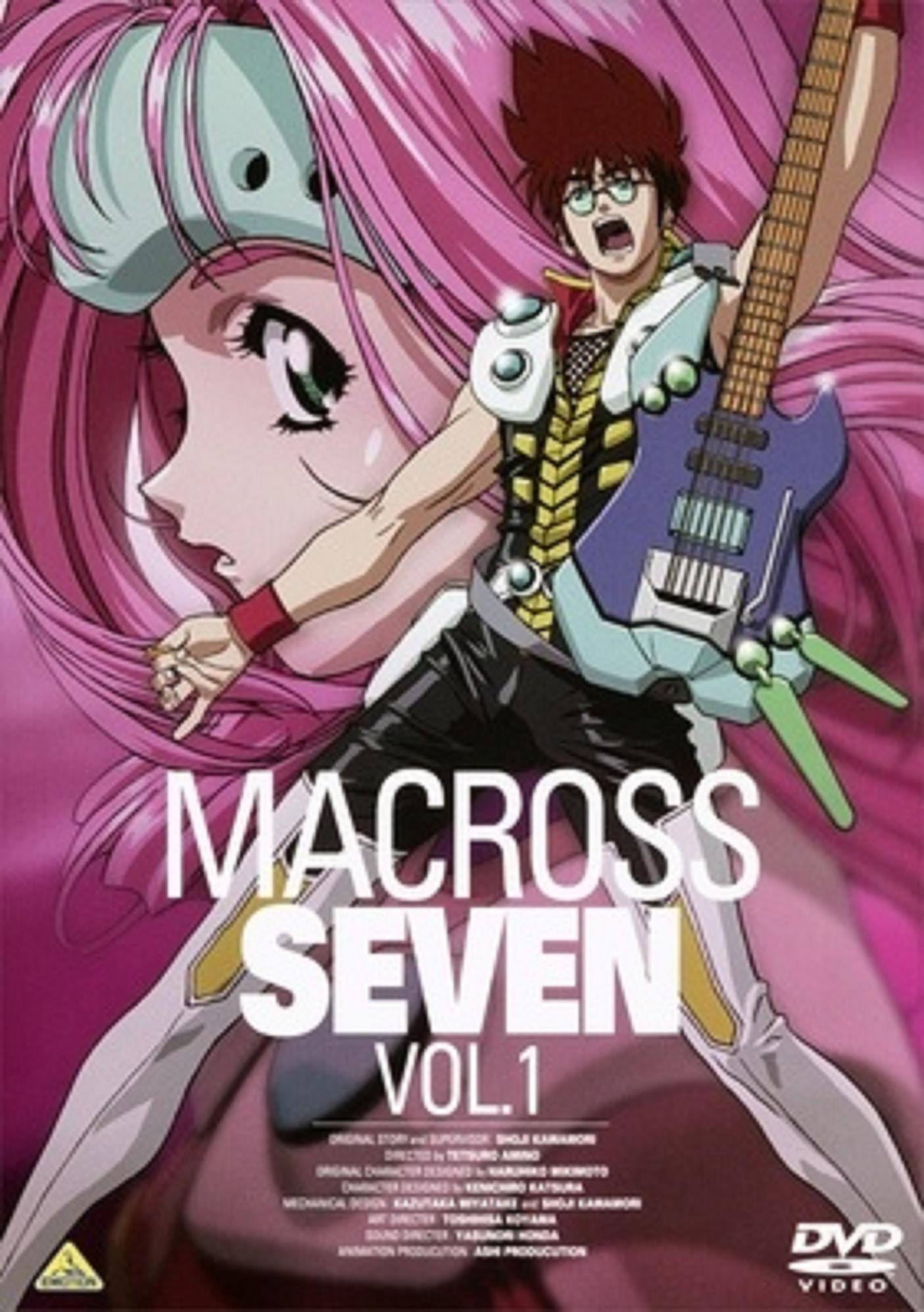
Name(s): Macross 7 / M7 / マクロス7
Format: TV series (49 25-minute episodes)
Release Date(s): October 16, 1994 – September 24, 1995
Studio(s): Ashi Productions / Hero
Related: Super Dimensional Fortress Macross: Do You Remember Love? (1984)
Macross 7 Review
The original SDF Macross and its sequel Macross Plus are two of my favorite anime of all time. I was properly warned, but it was still destiny for me to watch Macross 7 as well. Not only was it the next in a franchise that had yet to do me any wrong but it’s the first and only true sequel to the original SDF Macross. I had to watch it, despite Macross 7‘s reputation of being a huge departure for Macross.
The first series was one of the pioneering works of the “Real Robot” genre along with Mobile Suit Gundam. It combined the aesthetic appeal of mecha with more ambitious storytelling that focused on character drama and more plausible science. Macross 7 unabashedly goes towards the opposite “Super Robot” genre, featuring absurd plot devices, supernatural powers, and a lighter tone.
The show’s title refers to the ship fleet that’s one of many Macross-class fleets traveling the galaxy in search of habitable planets. The fleet is comprised of several domed ships that completely replicate Earth life inside of them. Eventually the fleet comes across the Varauta army, an alien race with their own technology that survive on draining the life energy of humans, “Spirita”. When traditional weapons don’t cut it only the civilian Nekki Basara and his band Fire Bomber can defeat the enemy using the almighty power of… rock music.
Things won’t be easy for him, though. The military refuses to believe in the power of his singing, and his irritable personality causes him to clash with his own bandmates. Regardless, he’s Macross 7’s only hope to defend against the Varauta as they travel aimlessly through space. Joining Basara are his bandmates Mylene Jenius, Ray Lovelock, and Veffidas Feaze. Only three SDF Macross characters return for this installment, notably Max and Milia who command the fleet and govern the city, respectively. Got it? Let’s rock this series.
I once heard someone call Macross 7 the “G Gundam of the Macross franchise.” That’s true for many reasons. Not only is it two real robot franchises introducing a super robot series, but they also both lighten the known serious tone considerably. Also, they’re both mediocre and considered the black sheep of their respective franchises. Macross 7 isn’t lacking because it’s different from the other series. Take it from me, who thought the concept sounded awesome and went in incredibly optimistic. Macross 7 fails because, as anything would, it poorly executes basic story writing principles and undersells its own original ideas. With the basic plot out of the way, let’s break this down, starting with the main cast of characters.
Nekki Basara is our hero and a truly odd one. Almost always silent except when he sings and almost always shouting otherwise, he rarely has the most spoken lines in an episode despite his important role. Though in some ways a typically hotblooded shonen protagonist, Basara is a surprisingly abrasive character that’s practically antisocial. He’s completely dedicated to the power of music as a means of emotional communication, and flies out into battle with his custom Valkyrie unit where he can play his songs and control the mech with the same guitar.
Basara is an extreme pacifist who goes out in the middle of dogfights alone to sing at the enemy while dodging countless attacks, hoping that the enemy will be moved by his songs of love and peace and will stop fighting. Basara’s catch phrase is yelling “listen to my song” at everyone, whether it’s in public or after he’s shot speaker pods into enemy mechs.
Yet, we get the least backstory of Basara out of any major character. He’s the leader of a rock band, believes music can influence people, and never lets anyone stop him from singing at the expense of his own life. Why he does this, why he thinks like this, where he came from, what influences him, why he’s a good pilot, etc.—none of these things are ever explained throughout the entire series.
Though this would normally be a major slight against characterization, this may actually be perhaps what I find so charming about him. Basara is a main character who’s a genuine eccentric and not at all like anyone else, but over time he succeeds in reaching out to others despite his attitude and normal communication problems.
For all talk of Tomino‘s Gundam protagonists possibly being “autistic”, I’m surprised I never hear that lodged at Basara who fits the bill much more realistically. Despite the total lack of depth to Basara’s personality due to little insight into his head and not really developing as a character ever, I have to say I’m pretty fond of him and still think he’s the best Macross 7 character. He has a strong distinctive personality that’s entertaining to watch and stands out amongst anime protagonists. When Basara does anything at all, you’re engaged because you desperately want to understand the weirdo. But in the end, the only context you get is his songs—though he probably wouldn’t have it any other way.
To fill the shoes of generic lead chatterbox is Fire Bomber’s female vocalist, Mylene. Vain, whiney, and dull, Mylene is a typical 14 year-old and it makes perfect sense that she’s the only person stubborn enough to stay in the band after putting up with Basara’s self-centered spontaneity and rudeness. Mylene apparently has no life or personality prior to the events of Macross 7, and her character arc revolves around her being lectured on the true heart and soul of music by Basara acting as her borderline mentor, as well as learning about the dangers and seriousness of war when she eventually joins Basara on the front lines.
I don’t really hate Mylene, but she’s a very annoying and typical character who’s given far, far more lines than anyone else in the series despite having little interesting things to say. Her character progression is incredibly obvious, so to see her continuously resist and repeat it as she argues with Basara and acts like she isn’t attracted to him is very tiring and boring. Whenever something bad happens she cries and whines despite the fact she’s got shit to do.
Mylene is a weak character because she’s essentially a complement to everyone else. She’s a link between her parents, Max and Milia, she’s the token confounded reaction towards Basara’s strange actions which also prompt the majority of Ray’s dialogue, and she’s the object of affection and source of motivation for Gamlin. Her fight for autonomy ends with her being a generic hero without the eccentricity of Basara. Mylene is what we call a “resource character”, and it’s an easy one for the necessary female lead to fall into. But it should never be such a major character, and she’s focused on far too much in storyline plots at the expense of developing pretty much anyone else.
Keyboardist Ray is the odd duck of Fire Bomber: he has to be at least 30, making him the oldest member by far, and he’s black. In fact, he’s the only black character I remember seeing in Macross 7. There are more literal space aliens in Macross 7 than black people. Anyway, Ray is the voice of reason in Fire Bomber. He’s inspired by Basara’s passion and believes in him to the very end, often defending him when Mylene complains about him doing something on his own accord.
Ray has acceptable backstory detail, but it’s all delivered in very unsatisfying, short asides. There are one or two episodes tops that are devoted to him, and I find this a shame. He’s perhaps the most all-around likable, sane person in Macross 7. He never denies the obvious fact that Basara’s singing has an effect on the enemy but is reasonable in his negotiations with the military and others. Ray is super cool, but unfortunately he’s so busy trying to make up for everyone’s insanity that he never gets enough time to talk about himself.
Veffidas is the full-blooded Meltrandi drummer. Veffidas drums. That’s it. Veffidas’s gimmick is that she is almost entirely mute, and although she’s in every single episode she probably speaks less than twenty words the entire series. At first this is very cute, but there’s several issues. One, it’s disappointing that the only identifiably Zentradi character in the series does practically nothing. Yes, Milia is Meltrandi also, but looks and behaves like any other human in Macross 7.
Veffidas has the distinctive pale skin look and super strength, but her role is so minor. It’s like anime whitewashing. A much bigger problem though is that she further unbalances the team dynamic. She’s a member of Fire Bomber, and it’s a waste of such a large role to keep her silent when she’s such a constant in the series and could offer a greater range of dialogue and personality. Ray is already overshadowed by Basara and Mylene, and Veffidas’s insignificance drags him down further since they’re paired together in battle but neither are ever the center of attention. If this strong silent gimmick had to be used on someone it shouldn’t have been on a character with a natural relation with the main characters that could’ve been exploited.
Next to Basara and Mylene, the most important character is the military pilot Gamlin Kizaki. An ace pilot and member of the special Diamond Force, Gamlin is extremely strict about duty and protocol. Naturally he’s very irritated by Basara’s presence on the battlefield and even finds his songs annoying. This makes him the only character in the series who doesn’t think Fire Bomber’s music is the best thing ever. Gamlin is not only a sour sport, but also pines for the underaged Mylene, even though he’s certainly in his twenties. This is very strange, but what’s stranger is that it’s Mylene’s parents that hook them up.
Anyway, Gamlin is a good character by Macross 7 standards. His progression is also incredibly obvious but it’s done with a gradual subtlety that makes it surprising when you realize he actually has changed. Eventually I began to appreciate him for being one of the characters who has sense, and his relationship with Mylene can be slightly entertaining and offer some of the more decent downtime between the main plot due to the fact their meetings always end up with him reflecting on himself for the entire duration. Macross 7 fails the Bechdel test hard.
The beloved SDF Macross characters Max and Milia make their return as adults here. Their relationship has become strained and the two frequently clash when it comes to authority over Macross 7. It should come as no surprise from the above that Milia is always the instigator of their conflicts, but I know I can’t be one of the only fans very happy to see them come back.
Though they’re both very popular characters, they weren’t that important in the original series. This gives them proper time to shine. Max behaves just how you’d expect an adult version of him to, and although Milia’s hotshot personality has been compromised in her old age her elitist nature has remained. I’m glad that though Macross 7 changed so many things the franchise established it didn’t lose sight of what it kept. I appreciated this moderate connection to the original series and I rooted for their character development because I already had an attachment to them.
Side characters include Mylene’s squeaking pet hairball Guvava that mimics all her emotions; an unnamed silent flower girl who’s used as a running gag in every episode as she attempts to give Basara flowers but is interrupted every time; and lastly…. You know what, screw it. Those are the only side characters in Macross 7 who consistently appear, let alone have some kind of role.
The rest are almost never seen except for when the writing explicitly uses them for the sake of another character, like the female biker Rex to make Mylene jealous of her and Basara. Because she is never used in any other context it’s impossible to care when she does show up because she’s just a plot device. Macross 7‘s side characters suck and barely exist, but what can you expect from a series that didn’t even make its four main band members important within 49 episodes?
But the real characters Macross 7 drops the ball on are the villains. The Varauta army aliens are awful. Every one of them has an obnoxious speaking trait that’s drove into the ground endlessly because they never die and show up in every episode to provide the token action segment. The leader, Gepelnitch, speaks only in obtuse metaphors to convey the simplest of thoughts which makes him look like an idiot instead of condescending.
Gavil is a hairy bird-man-thing whose every sentence contains the word “beauty”. I hated this character. His manner of speech is incredibly repetitive to the point he speaks the same sentences constantly even though he’s the most common villain in the series. He’s an irritating bastard who is constantly a wedge between the series and any plot progression, as well as my patience. Sivil is some flying pixie girl who multiple characters are inexplicably obsessed with, and most of her spoken lines are just her making high-pitched screams or yelling “Spiritia!” Goram and Zomd are telepathically connected for some reason and finish each others sentences while sporadically teleporting around and laughing annoying modulated laughs for no reason. God, my fucking ears. I hate these villains, and they’re as completely shallow, as is their goal to drain Spiritia from humans as a food source. Very compelling.
Even by mecha standards, Macross 7‘s pacing is so poor that it’s practically devolved into a Saturday morning kids show. The majority of the series has every episode structured as such: Basara does something to annoy Mylene, Mylene complains at him, Basara says Mylene doesn’t know what he’s talking about and storms off, Mylene complains again, Ray defends Basara, Gamlin is shy around Mylene, the enemy is shown as Gepelnitch says some shit that means nothing, the writers realize the arguing between Basara and Mylene has gone too far and calls the enemy in, Basara deploys and sings until the enemy decides to leave after doing what they want, Gamlin complains about Basara, and then everything is back to normal.
You might think you saw a hint of character development or plot progression, but rest assured any of that will be pushed into the background and ignored as long as that’s possible. Even when the plot does move it’s in no way that’s impressive because it ultimately comes down to a plan to seriously hinder the enemy failing or succeeding but not actually in a significant way, and either the army or enemy gets a power up that doesn’t change their relationship or the circumstances. Characters will rarely show growth, but it will be in the most predictable ways.
Possibly the biggest letdown of Macross 7 is its focus on the culture of music. This is the biggest role music has ever played in a Macross series and the step from pop idol to a full band is a good and natural idea. Yet, Fire Bomber are apparently handled by writers that have no idea what it’s like to be musicians. There are several anime focused on music, and these look into the thoughts and ideas people have about music and how they create it. We see Fire Bomber practice in a studio constantly but we never see them actually discuss writing songs, lyrics, talking about other bands, even mentioning other bands, or what music means to them beyond an extremely simple pleasurable nature.
This is the biggest waste of potential in Macross 7. Making a story that’s seemingly about a band, but not their relation to music. This would’ve created far more interesting subplots and character development than what’s currently in the series while establishing its theme on a deeper level. But something like that would probably require too much intimacy, something that’s not really demonstrated in the series as is.
Though there’s nothing much behind the music, Macross 7‘s songs are pretty good. And they sure as hell better be for how much you hear Fire Bomber’s songs. The entire soundtrack is composed by the actual fictional band and everything has vocals. If I had a particular complaint here is that there aren’t enough songs and you end up hearing the same ones over and over. I got sick of “Planet Dance” extremely fast but I had to wait for Basara to write more songs. What sense does it even make that he’s performing live at the start of the series but has only written one song? I would’ve liked a more even spread.
Some songs are barely played, and some are played way too much. The opening and ending theme songs, “Seventh Moon” and “My Friends,” are among my favorite combinations of opening/ending themes ever in anime. I never got tired of hearing those ones, even though both ending animations creepily sexualize Mylene.
There are some odd inconsistencies with the sound design, however. In some cases I’m impressed, like how if Basara happens to speak in the middle of a song the vocals actually will stop while the other instruments continue. At other times there are too many instruments playing for what’s going on onscreen, which makes the music dangerously impersonal from a series that’s supposed to be stressing the opposite. I don’t know how Mylene can just start singing by herself and all of a sudden a bunch of instruments start backing her up. And who the hell does their backing vocals? Ray and Veffidas don’t sing at all. Do they use pre-recorded backing tapes? Where are they? I at least want to see them in the act of making them.
Because only one major character isn’t a pacifist, action scenes in Macross 7 tend to have extremely little weight to them as it’s just grunts fighting in generic mechs. Badly choreographed fights and stock footage galore. Macross 7 definitely skimps the budget frequently. Reused stills are everywhere as well and pretty noticeable.
Though cheaply drawn and animated, I still like the way Macross 7 looks more than anything else about it. It’s full of extremely bright colors and you can often get a full rainbow in every still. Macross 7‘s visuals could put me in a good mood and engage me in the show when I very well might not have been otherwise. I just love to look at those colors.
For 49 episodes, I have very little to say about Macross 7, but that’s because it has very little to say about itself. The show would have benefitted greatly by having its length cut in half, but the show’s main problems aren’t just in its incredibly poor pacing and lack of pay off. Macross 7 isn’t a show ruined by bad ideas, it’s a show full of good ideas that apparently isn’t conscious of any of the reasons why they might be good.
Crossing the music/band genre with super robot mecha was a fantastic idea full of fun and the potential to combine rock music and action to create some truly memorable moments, but instead its just endless frustration as it focuses on weak characters, generic relationships, and a simple yet overextended plot. Macross 7 could’ve been a classic if it just had more conviction.
…Fire!
Leave a Reply