








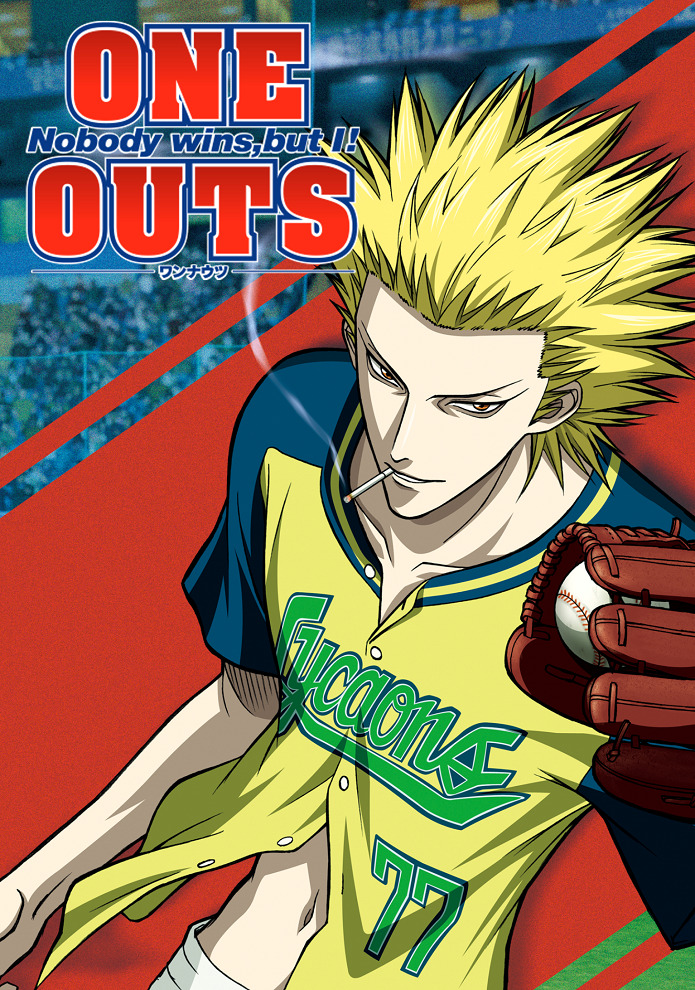
Name(s): ONE OUTS Nobody wins, but I! / ワンナウツ
Format: TV series (25 23-minute episodes)
Studio(s): Madhouse
I don’t know the first thing about sports, which shouldn’t come as a surprise since I have a MyAnimeList account, and I have about as much interest when it comes to engaging with sports at all. I went to a baseball game when I was a little kid and cried that it was too hot (it was) until I was taken home. It was boring as hell, but the cartoons they played during half-time were pretty cool. Thus, if anything was going to make me reconcile with baseball it was my love for gambling anime.
The mysterious Toua Tokuchi is a brilliant pitcher who is scouted by Lycaons ace batter Hiromichi Kojima during a gambling baseball game of “One Outs.” Tokuchi is persuaded to join the Lycaons and save them from the bottom of the rankings by using his genius strategies that also utilize psychological mind games with the opponent, both of which more than make up for Tokuchi’s slow pitching speed and basic technique.
That’s not all though. In order to join the team Tokuchi enters into a “One Outs” contract with team owner Tsuneo Saikawa where he gains about $46,000 for every batter he strikes out, but loses $460,000 for every run that goes through while he’s pitching. The greedy Saikawa only cares if his Lycaons team makes a profit for him rather than if they win and stops at nothing to defeat the taunting Tokuchi. Tokuchi also has to contend with the rest of the talented but easily pessimistic team and their lapdog doofus manager.
If you are like me and express any concern over such interesting situations coming out of an old pastime like baseball, let me immediately tell you that you shouldn’t. One Outs is full of endless surprises and tricks that demonstrate the seemingly infinite variety of strategies the game is capable of.
To state something that would normally be the conclusion of anyone writing that had an actual affinity for sports, One Outs made me respect baseball much more than I did before. The game’s rules are intricate and the ways each player can take advantage of them are clearly shown to be even more complex. On top of this, One Outs has its own unique contrivances due to its “One Outs” contract constantly strangling Tokuchi’s movements, and the spread of enemy teams that each have their own distinct strategy for handling the Lycaons. It did not get old.
While I was entertained by One Outs at all times, I did however feel it had a tendency to drag. The 25-episode anime actually only really goes through three teams, with an average of six episodes dedicated to each. That sounds very fair on paper, but I felt pressured knowing the series’s premature run and wanted to see as many new characters and strategies as I could before it finished. There were times when Tokuchi had already beaten the opponent to the brow so much that there were diminishing returns on seeing them crushed. There’s a pattern for the opponents to already show themselves as frustrated and in a corner, and this is when the sense of risk is decreased.
I found that my favorite matches were against the BlueMars team, the token cheaters in every sports anime. Due to their willingness to cheat in every aspect of baseball there is a constant introduction of new tricks that rely on a totally different base strategy rather than variations of the same one, such as the Bugaboos’s reliance on a fast runner or the Mariners with their star batters. It kept things fresher than the other teams because we hadn’t seen Tokuchi approach each new trick in any way before.
Though the other teams didn’t have as steady momentum in their episodes, I quite enjoyed the new, unique characters that were sort of like rivals to Tokuchi rather than generic players. The Mariners had several of these which is why they’re my second favorite match, and since they’re ranked first in the league the sense of risk is the highest in the series.
Like Akagi in his titular Mahjong anime, Tokuchi is clearly a cold undefeatable genius. It’s of very little question that he’ll win, which was something that worked against the Akagi series. However, One Outs circumvents this by introducing an emphasis on cooperation and thus character building that other gambling anime lack. It’s impossible for Tokuchi to succeed completely on his own because his agency is limited by the sheer number of players on the field and the roles he can’t play in. It’s not enough for Tokuchi to pitch well; he must also become a spiritual mentor to the Lycaons and influence their attitude and performance. Because Tokuchi can’t have control over the entire game on his own a sense of unpredictability and the idea that everything could fall apart with ease still exists.
Though Tokuchi appears to inspire faith in the Lycaons it’s unfortunately often temporary and little growth is felt from what we see in the series. Though there’s much to be desired when it comes to establishing the other Lycaons team members it’s still an effort that exists and contributes greatly to the tension and feeling of victory in the show.
Being a Madhouse production, One Outs has above average animation quality. However, this is far from one of Madhouse’s most dedicated projects. Though stock footage is used very little in a subject that easily welcomes it and the framerate isn’t at all bothersome, the illustration is average to downright ugly when it comes to backgrounds, and there’s little movement in many scenes. This is not at all a great example of production, but motion is felt and feedback through sound is strong enough that One Outs isn’t limited by its production either. There’s a soundtrack too but it’s utterly disposable including the opening and credits themes, which is a shame.
One Outs has its restraints and they’re what you would probably expect. Its sole focus on the games of baseball comes at a cost of any character or setting development and it never really goes anywhere because the anime doesn’t completely adapt the manga, but it’s a riveting ride while it lasts and I can’t deny that it kept my attention more than the last several anime I watched. That means I liked it more than most despite limpness in several important areas, and I believe most people would like it as well. To put it another way: if One Outs were fully adapted and some 100 episodes longer, I would still be excited to continue watching it.