








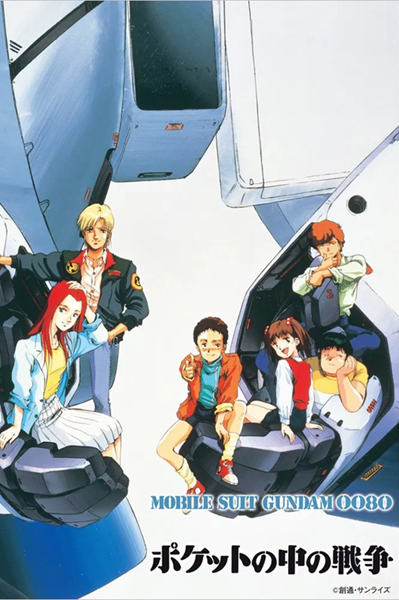
Name(s): Mobile Suit Gundam 0080: War in the Pocket / 機動戦士ガンダム0080 ポケットの中の戦争 / Kidō Senshi Gandamu 0080 Poketto no Naka no Sensō
Director(s): Fumihiko Takayama
Format(s): OVA (6 27-minute episodes)
Genre(s): Action / Drama / Mecha / War
Studio(s): Sunrise
Release Date(s): March 25, 1989 – August 25, 1989
Franchise(s): Gundam
Gundam 0080 Review
While organizing my unpublished notes, I came across a near-serviceable review of War in the Pocket I’d written after my first watch of it on July 29, 2015 2:07 pm EST. My editing evolved into a full-on rewrite, despite the fact I haven’t seen this series since that date. I’ve recently been playing Super Robot Wars GC, which adapts War in the Pocket, so perhaps I’ve been in the mood to reminisce. I hope you enjoy this relatively modest review. I may expand it if I ever get around to a rewatch.
Though Mobile Suit Gundam 0080: War in the Pocket (WitP) is one of the better Gundam entries, I do disagree with people insisting it’s a good starting point. What makes 0080 exceptional are the things that set it apart from the broader franchise, namely it’s smaller-scale conflict, emphasis on human relationships and drama over action and plot, and surprisingly hefty themes and emotional consequences. Gundam 0080 defines the idea of a work with mecha in it that isn’t about mecha.
Depending on who you are, that could be to its detriment. Personally, I think mechs are cool as hell, but I don’t need a show constantly reminding me of their existence. I generally prefer mechs being brought in as proxies for battles between their pilots; a way to plausibly express heightened power levels relative to the blatantly supernatural abilities of typical “battle shonen” anime.
Action for the sake of action is almost always an appeal lost on me; it has to be a backdrop for storytelling and characterization. The practically (literally?) studio-mandated one action scene per episode of something like Zeta Gundam is not only structurally repetitive, but it cheapens what the mechs symbolize in its overuse of them.
Still, I can empathize with the true-blue gearheads of the mecha community who like discussing the tech and hearing the machines whirr to life every time. If you’re here for the mechanical side of things, 0080 has relatively little to offer. If you’re more like me, where the mechs are stylistic gravy, this OVA may be what you’re looking for.
There’s also something to be said for just how far 0080 goes in downplaying its mechs, which is to the point that one must wonder what they contribute to the story. Mobile Suits in 0080 are mostly only talked about, and it’s done so in a cold, utilitarian fashion. Consider the mechs in 0080 being swapped out for any other military technology, namely real-world tech. What would have to be changed to accommodate that?
From what I can tell, almost nothing would. The OVA has a major theme of the disconnect between media’s portrayal of war and the reality of it, which is represented by children viewing the Mobile Suits as vehicles for toys. The meta aspect of that is amusing—franchise pioneer Yoshiyuki Tomino often had to battle the animation studio to prioritize storytelling over pushing real-life toys and models. But, that parallel already exists in reality. War toys such as fake guns and the like have been a part of worldwide culture since… I dunno, the age of toy swords? And modern criticism of normalizing their intrinsically violent inspiration has long predated 0080.
I don’t intend for this to read as me saying 0080 is devalued because its subject matter is familiar. It’s a topic as worthwhile to discuss today as it was in 1989 and always will be. Rather, the writers chose to make a mecha series, so the mechs ought to be inseparable to it, right? At least, ideally. In the wake of many narrative works of art condemning war for the tragedies it brings in 0080, the mechs are the most unique concept in it, so it would behoove it to take advantage of that. As mentioned earlier, I think the best use of mechs has them become personifications of their pilot’s soul; they’re an extension of them. But establishing that connection requires both the mech and characters to have a heightened, sentimental focus.
There’s one element of 0080‘s story that I recall being particular to Mobile Suits, which is that it’s plot-critical on at least one instance for a combatant to not know their enemy’s identity. If they were infantry with guns or other handheld weapons, that would require completely restaging the scene, at the very least. However, it could be substituted with something like tanks. Then again, if mechs were used purely to make the battle scenes more dynamic and faster-paced than they would be with tanks, is that not justification enough for their inclusion? Maybe it is. If the action is going to be there regardless, it should be compelling, and the creators have the license to use preexisting mechs.
Tone
Stepping away somewhat to isolate some other aspects of 0080, I want to credit it for its emotional intelligence. I think War in the Pocket, more than anything else, is known for being “the really sad one.” But it does earn its big emotional gut punch. I won’t go into exactly what I’m referring to, because there’s zero ambiguity to anyone who’s actually seen the show, so I may as well sidestep spoiler content.
Character bonding in Gundam 0080 is tender yet realistically ambivalent and harsh when warranted. I never once felt that I was being emotionally manipulated into a tragic twist, partially because danger and significant mistakes persist throughout the story. There’s no predicting which unfortunate scenario will be where the other shoe drops. I did find Al to be a little annoying at times, but that’s probably my innate bias against kids being shoehorned into some Gundam series (it’s completely justified in this one, mind). All things considered, Al is probably more rational than most adult Gundam characters.
Music
If I can be more bluntly critical, I think the music of War in the Pocket is kind of… bad? The composer is Tetsurō Kashibuchi, who I looked into expecting to have been a fan of something he’s worked on that I could use to temper my harshness. However, I didn’t recognize a damn thing other than WitP. He’s almost exclusively a composer for Japanese live-action films. The most recognizable title he’s worked on besides WitP is the 2000 movie adaptation of Junji Ito‘s horror manga Spiral, AKA Uzumaki. To this day, said movie is hotly debated between people who think it’s “terrible” and those who think it’s “not that bad.”
Kashibuchi’s one other anime work is the 1991 OVA Psychic Wars. What a beautifully vague, perfectly generic title for the era. While I love OVAs, this one has escaped my knowledge.
Let’s see… according to Wikipedia, Psychic Wars has…

Okay, then. Why does this even have a Wikipedia entry? Whatever. It’s not my server. If I ever become deranged enough to pursue my goal of watching every pre-2008 OVA, I’ll be sure to let all of you know how Psychic Wars was not worth my time.
Enough of that. I don’t have in-depth criticisms of WitP‘s music. I mainly find the general sound of it to be horrific. This 1989 OVA’s synthesizers sound like they came from the goddamn ’70s. Everything is so harsh, bleating, and grating. It’s synthesizers dragged across a chalkboard. It could serve as a psy-op to make people hate ’80s music.
I don’t have much better to say about the compositions themselves. The OP doesn’t land for me, despite Gundam‘s theme music around this time generally being stellar. Overall, I’d say the score sounds trite or saccharine. Everything is far too bright and happy, and the lack of variety robs the score of any emotional depth.
In my opinion, the music is easily the worst part of War in the Pocket. It’d be one thing if it was listless and forgettable, but it’s abrasive to the point of dragging the quality of its accompanying content down. I’d be interested if Sunrise included an alternate score in some future rerelease alongside the original one. It’s that detrimental. What a strange area for this otherwise high-quality OVA to go wrong on. Maybe it’s just me?
A devil’s advocate might argue that the music’s aggressively twee and quaint style is satirical given the themes of Gundam 0080. I don’t think that’s impossible, but there’s not enough subtextual evidence for me to believe that. By and large, I wouldn’t characterize WitP as satirical. There’s social commentary in it, for sure, but the work as a whole isn’t self-referential and subversive in ways I associate with satire. If that was the team’s creative vision, it ought to be present in areas other than the music, and I just don’t see it. If Kashibuchi is known for making “ironic” OSTs, that’d be something, but I’m not familiar enough with his work to make any claim there.
Verdict on Gundam 0080
Returning to War in the Pocket‘s uncharacteristic disinterest in its mechs, it’s possible that there’s a virtue in it specifically being a one-off, anomalous Gundam entry. In a franchise so thematically concerned with individualistic, wish-fulfillment, savior fantasies, War in the Pocket has permanently affixed one work every hardcore fan will almost inevitably encounter.
When they do, they’ll receive a harsh reminder that there’s no true reality where Gundam would be something inconsequential and fun. As a wise philosopher once said, “people die when they are killed.” The link between war and death can be pushed to the back of one’s mind, but it can never be separated. Gundam 0080: War in the Pocket now forever exists to wag its finger, however temporary, at any viewer exclusively looking for the escapism of Gundam‘s self-blinding naivete. It’s important for everyone to take their heads out of the clouds sometimes, even if it’s against their will.
Leave a Reply