








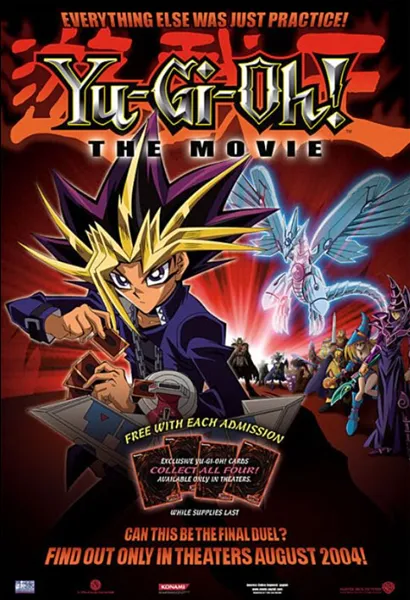
Name(s): Yu-Gi-Oh!: The Movie – Pyramid of Light / Yu☆Gi☆Oh! Hikari no Pyramid / 遊☆戯☆王 デュエルモンスターズ 光のピラミッド.
Format: Movie (US: 89 minutes / Japan: 103 minutes)|
Release Date(s): August 13, 2004 (United States)
Studio(s): Gallop
Related: Yu-Gi-Oh! (2000-2004)
It’s everything about the Yu-Gi-Oh! anime taken to its absolute worst. Namely, it’s filler incarnate. It’s standard fare for there to be non-canon anime movies pushed solely off of brand recognition. Pyramid of Light (PoL) is unusual in the sense that the West commissioned it. From my understanding, studio Gallop created this movie that was written and produced entirely by English names.
With mild research, it appears 4kids Entertainment and Warner Bros. excreted this hoping for success similar to the Pokémon movies. If they expected comparable numbers, I imagine they were in for a rude awakening. Wikipedia lists the budget as $20 million, with box office returns of $29.2 million. That’s pretty fucking bad. And shocking. Not because of how much it made, but because of how much it cost. The animation quality of this movie is often terrible. Assuming the budget wasn’t simply allocated poorly, it had to have almost entirely gone to marketing. Then again, is there a difference between those two?
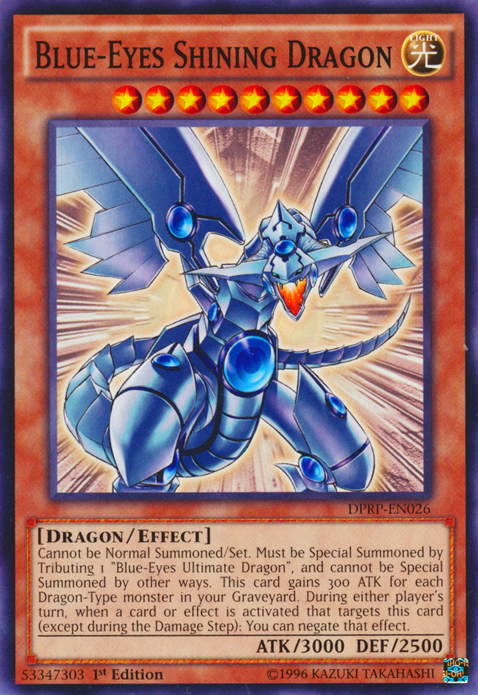
I remember begging my mom to take me to see this. But like a rational adult, she shot that idea down with extreme prejudice. I mainly wanted to get the promotional cards you received for buying a ticket to the movie. More than any of those, I wanted Blue-Eyes Shining Dragon. It’s still a pretty cool-looking monster, in my opinion. I generally like the designs seen across the new cards. It’s unfortunate, then, that every single one of them is unplayable hot garbage. It really is a shame that decks based around the Pyramid of Light cards were never playable even casually. It may be hard to imagine, but they were even worse at card design than they are now.
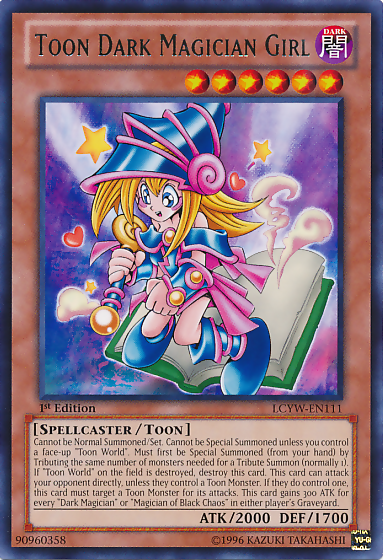
Perennial fan-favorite Dark Magician Girl’s Toon counterpart, Toon Dark Magician Girl (TDMG), made her Western debut in PoL. While looking up if this was her first worldwide appearance, I discovered that the card has an odd history. Its first release was late 2001 in Japan as a promotional card for the Game Boy Advance game Yu-Gi-Oh! Duel Monsters 6: Expert 2. In early 2003, English audiences would experience a revised version of this game titled Yu-Gi-Oh! Worldwide Edition: Stairway to the Destined Duel. However, that English release featured completely different promotional cards. 2004 brought Pyramid of Light, and TDMG’s physical card wouldn’t appear until its inclusion in Shonen Jump‘s December 2006 issue.
That is, unless you were in the United Kingdom. They had the chance to get it two months earlier at a Pharaoh Tour 2006 Stop. At this point, I lost motivation to look up what the fuck a “Pharaoh Tour” was. If I didn’t know any better, I’d assume it was when museums would pass around their ancient Egyptian sarcophagus exhibits. Capping all this weirdness, TDMG wasn’t made widely available in English until 2011’s Gold Series 4: Pyramids Edition. Japan would need to wait for the same year’s Beginner’s Edition 2 reprint set.
To put this time gap into perspective, that set came out while the fucking ZEXAL anime was airing. I know it’s Dark Magician Girl, but I don’t think she needed to be as safely guarded as an actual ancient Egyptian relic. It’s somewhat infamous for its comically long card text, which is noteworthy for its theorized prevention of including the “summoning sickness” token to all previous Toon monsters. Maybe they were scared of it? I typed that intending for it to be a joke, but honestly, they’ve both under and overestimated the viability of cards so many times to the most absurd of degrees that I wouldn’t be shocked.
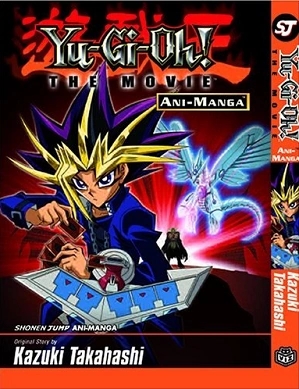
Another iconic part of this movie’s release to me was its accompanying “Ani-Manga”. This bullshit Viz label identified Western-exclusive books that took screenshots of anime and pasted speech bubbles over the screenshots, reconstructing those into comic book panels. These were artistic abominations that spit on the face of both mediums, and you may recall the label Tokyopop having an identical practice with their “Cinemanga” line, of which would often adapt western animation. Seeing the words “Tokyo” and “manga” on the cover of a product related to Family Guy provides a unique irony-free sensation that newer generations could not even begin to comprehend.

Anyway, Pyramid of Light had one of these. I suppose you could consider it their attempt to modernize the token movie “novelizations” that would accompany every animated film. I never read it or bought it. But I looked through it! The only thing I remember was that each packaged book came with a genuine Slifer the Sky Dragon. I recall each book being wrapped in plastic, with each card concealed within a little paper envelope between one of the covers. With how much the anime hyped the ever-loving shit out of these mediocre God Cards, they may as well have been protecting Fort Knox with a wall made of butter. In multiple visits to my book store’s manga section, I would see copies of this book strewn about with plastic rend asunder, victims of what could only be trading card-obsessed werewolves experiencing their lycanthropic episodes in an inconveniently public place.
Thankfully, the only guts that appeared to be gouged were the treasured Slifer cards, as one was never to be found in any of their ill-equipped envelopes. While I was not a victim of this thievery, I can only assume more than a few children returned home only to discover the prize had already been removed from their cereal box. Genuinely, to anyone who gutted those books: shame on you. I don’t give a shit you vandalized a corporate, creatively-bankrupt product, but I do give a shit that you ruined some kid’s day with your selfishness.
I was a child when I saw that literary massacre and still knew to be disappointed in my fellow man (child?) And for anyone thinking along the lines of, “maybe those thieving kids were too poor to buy the book itself,” I say nay. We all know the same people self-centered enough to do shit like that are also the upper-middle class spoiled brats who got away with everything. This ain’t exactly Aladdin stealing from the fucking bread stand. Where are those good old-fashioned values on which we used to rely?
What was this about again? A stupid anime movie? I don’t even feel like writing about this one. It’s just a boring standalone story to introduce new promotional cards and make money. As a kid, I eventually was able to see this movie on my grandma’s Dish pay-per-view service, and even back then I found it underwhelming. Apparently, the Japanese release of the movie, which came about three months later, added 13 minutes to the runtime, and cleaned up some of the animation while exorcising the American soundtrack.
Said American soundtrack is something of an anomaly for many reasons, one of which is that the Black Eyed Peas contributed the song For the People—a title that almost sounds like a threat coming from them. Even weirder is that the bulk of the music was produced and overseen by Paul Edward Blair, AKA “DJ White Shadow.” You might be familiar for his work on Born This Way, Artpop, and A Star Is Born. Yes, they’re exactly what you’re thinking. I would congratulate him, but apparently he made his own cryptocurrency, so I hope he’s banished to the Shadow Realm.
Anyway, I have to admit that it would tickle me pink to see these stupid cards get modern support. Do it, you fucking cowards. I know you’re always salivating to print more Blue-Eyes garbage.
Leave a Reply