








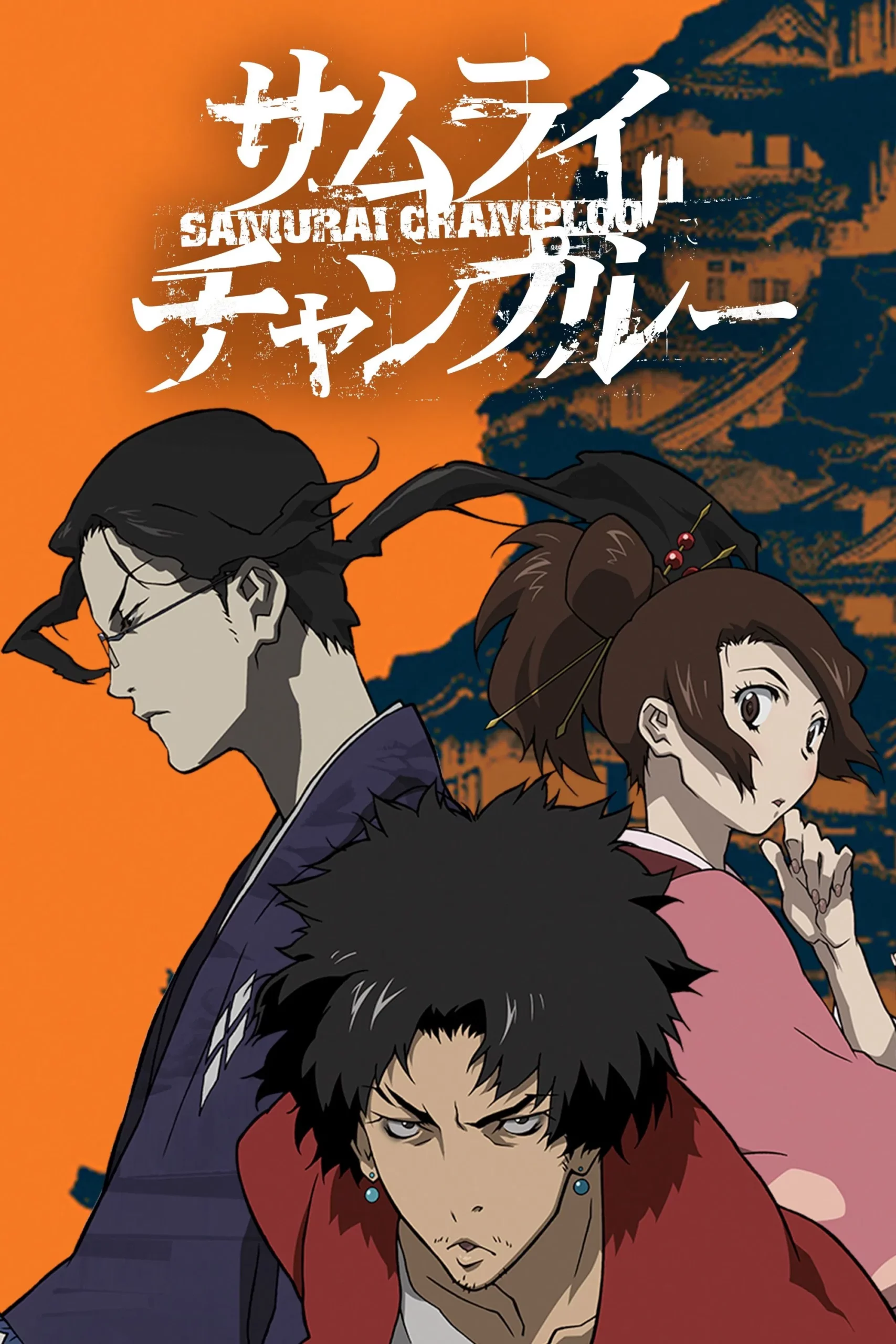
Name(s): Samurai Champloo /サムライチャンプルー
Format: TV series (26 24-minute episodes)
Studio(s): Manglobe
NOTE: This review was written prior to finishing the subject media.
Shinichiro Watanabe is in my good books with Cowboy Bebop and Kids on the Slope. Cowboy Bebop is a rightful classic, and I didn’t grow up with it, so I’m not bullshitting, and Kids on the Slope was a melodrama that didn’t really seem to have a consistent direction for its story and characters to follow but it was an enjoyable show I happily finished quickly. I had seen the beginning of Space Dandy and sort of hated it beyond its stylistic quirks but I’ve still vowed to give it another chance. Oh right, he also co-directed Macross Plus, which I like even more than anything I just listed.
So, I was going to decide between Samurai Champloo and Terror in Resonance (TiR). I was leaning towards TiR because it’s shorter and more controversial which regarding anime often means it’s either a satisfying subtly great series or the worst thing ever and it’s always fun to discover the truth behind those (until it turns out to be a Reborn!).
I ended up choosing Champloo because I love the feudal Japan samurai setting and there’s a real lack of highly ranked series placed in it. Unfortunately, my early foray into Champloo has nearly convinced me that it’s not really interested in honing in on what makes the setting so enjoyable to me, so right off the bat, I had signed up for a non-samurai series that’s just in the skin of one. Mugen, Jin, and Fuu end up traveling around Japan together in search of a samurai who “smells of sunflowers.”
In seven episodes, I didn’t notice anyone asking why they’re searching for this guy, which is pretty annoying. The series has been entirely episodic so far, each episode beginning about the characters complaining of hunger (if I could ban one thing from being talked about in anime, it would be food in any context) then getting wrapped up in a plot to help one-off civilian characters.
The first problem I have with Champloo is I don’t really like any of its characters. Mugen and Jin feel like Spike’s best attributes divided into two incomplete archetypes that no longer really feel like an actual person. Mugen is his devil may care attitude and occasional rough disposition, and Jin embodies his intelligence and craftiness he used to carry out his missions.
These traits being separate removes what makes Spike fun to watch in that there are different directions for his character to take and respond to in different situations. Mugen is always pissed, Jin is always calm. They’ve been entirely linear characters so far, and there’s been no hook to make them more interesting.
Maybe there will be later, but Bebop in its very first episode sets up why we can emphasize with Spike in the dangerous and uncompromising world he lives in, and the conflict that arises from that line of work given his reaction to the tragedy at the end of the first episode that betrays his cool demeanor we initially see.
As for Fuu, I think she spent five or six episodes out of the first seven being kidnapped for some reason so that should say enough. The opening intro shows her using a kodachi, which I really wish she actually had.
Champloo is much more focused on comedy, and it’s really bad comedy. The characters bicker with each other in predictable ways suitable to their stereotypes, and unlike Bebop, the episodic storylines have been extremely boring. I wasn’t being hyperbolic when I said they felt like Rurouni Kenshin filler episodes. It’s the same level of creativity and even of its emphasis on extremely passé anime jokes.
One episode devotes several minutes of screen time to an eating contest where everyone’s just shoving food in their mouth while an announcer narrates. It’s stuff like this that I can’t imagine anyone thought would be fun to just sit there and watch. There’s frequently some sword-fighting action, but it’s all been pretty forgettable.
The problem comes from the fact that the fighting is between Mugen, Jin and a bunch of one-off characters that aren’t the slightest bit interesting or skilled. There’s no reason to care about Mugen murdering some nobodies who are never going to come back and aren’t anything more than generic villains. Even the character designs, other than the main trio, look mostly like plain samurai folk completely lacking in flair. It comes across as lazy to me, and the protagonists stand out way too much in their bland surroundings.
Now’s probably a good time to talk about style. Champloo cemented what Watanabe’s known for, which is blending several genres and trying to make something new out of it. Unfortunately, in Champloo it’s both trying too hard and not trying hard enough.
This is because everything combined in Cowboy Bebop made complete sense. It started with its premise about unimportant bounty hunters drifting through vast space and brought in a variety of genres with attributes meant to service that goal. It’s part western, because the series loves wide landscape shots that emphasize the scale of the setting, and the insignificance and isolation of its aimless main characters.
It’s part noir, because they work in a cutthroat business centered around investigation, and pessimism always defines the resolution of every event. It’s part sci-fi, because the futuristic setting expands the scope of the universe, and that combines with the western sensibilities to further demonstrate just how far apart humanity has spread from each other, which fits the pessimism of film noir because it turns out the mysteries of space didn’t lead to solutions to mankind’s problems, but instead left them hopeless and complacent.
It’s ultimately a heavily nihilistic series with a sense of style that’s so electrifyingly fresh that its pessimism isn’t overt and doesn’t drain the viewer. It manages to find fun in its aimlessness, even though if you look at its heart, it admits to believing it’s all for nothing. Above all else, the chemistry between these elements is so complete that you don’t notice the seams.
Meanwhile, Champloo feels really contrived because it’s being anachronistic for the sake of it, resting on Bebop’s laurels. There’s also simply a lot less going on here. Champloo combines a samurai setting, hip hop, some modern dialect aaaaand… that’s about all I can really notice. And these elements don’t bring new things out of each other like Bebop’s do.
For starters, combining the samurai aesthetic with hip hop was already done with major success a decade ago in the ’90s, so the series isn’t as rebellious as its attitude suggests. Hip hop culture otherwise isn’t used to complement the samurai setting in any way I can think of. Mugen has some breakdancing moves in his fights, but so what? It may as well be a superpower, since it’s forced and impractical.
There’s some record-scratching scene transitions as frames between the current scene and the next swap between each other really quick, but it’s just a gimmick. A substantial way to use this record-scratching editing would be as a montage between several different scenes at once, as if it’s remixing the action of these scenes into something with smoother flow than each scene would have separately, but I haven’t really seen this done yet. If it is, it should be used more.
The music is actually pretty solid stuff, but it’s used carelessly. Bebop had jazz (another disparate genre it incorporated that I didn’t even need to mention to have enough topics, despite having to bring up Champloo’s hip hop), but it doesn’t seem out of place, because the rhythms accentuated the variety of action scenes really well.
Bebop had more chase sequences than fights, and because jazz is a genre known for being dynamic and free-flowing, it’s both capable of syncing up with sporadically paced scenes and it demonstrates how easygoing and directionless the characters are, without being contrived in its use. Champloo tries to pair up some tense scenes with ambient electronic music just doesn’t work because the two things have entirely different energies to them. Champloo’s samurai setting being fairly ordinary much of the time can often just make the soundtrack feel even more out of place without gaining anything from it, as opposed to Bebop, which is always visually distinct.
That brings me to another point about the art and animation. Bebop is one of the best-looking series I’ve ever seen. Champloo is mostly average. I’ve been bitching about digital a lot lately, but I’ve just been given a lot of ammo.
I can’t believe Watanabe allowed so much shortcutting in Champloo. It has that common problem with digital anime where many things outside a frame’s focus are drawn like garbage, with humans having faces squished together like yams with scribbles for facial features. It certainly isn’t a stylistic thing, since so many other series do the exact same thing.
Going back to the character designs thing, the protagonists stick out like sore thumbs because it seems like no one else had any effort put into their designs, likely with the assumption that they’re never going to show up again, anyway (something that never stopped Bebop). This is iconic, because it means the show is betraying its anachronistic nature and not attempting to subvert the samurai setting as much as it should be, due to its reliance on cliché design traits.
The main trio standing out also likely isn’t intentional, because every once in a while, you’ll get a random minor character who doesn’t look generic, like the green Mohawk guy with a skull tattoo in episode six. In Cowboy Bebop, there are loads of shots you could freeze and spend extra minutes taking in every detail. Champloo lacks anything eye-catching despite having the conceit that would allow it to. Its lack of seriousness means it loses the serenity and gracefulness of the era’s romanticized depictions, and it gains nothing from trying to be different. It only lacks; it doesn’t replace.
I guess that finishes my Samurai Champloo impressions. I have much more motivation to finish this than Reborn! at least, because I have reason to believe in Watanabe, and I want to be able to say I’ve watched all of his shows sometime. But nothing has particularly impressed me outside of the excellent intro animation and song. It doesn’t really seem to know what it’s doing to inspire confidence in me that it could improve. At the very least, absolutely nothing happening in it so far means that I can just pick it up whenever and not lose anything. Bebop had character introductions, worldbuilding, and a dramatic, overarching plot going on by the same number of episodes.
Leave a Reply