








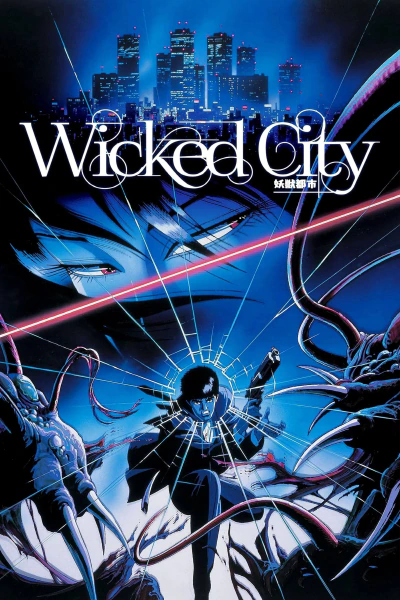
Name(s): Wicked City / Youjuu Toshi / Demon Beast City / Supernatural Beast City / Yoju Toshi / 妖獣都市
Format: Movie
Studio(s): Madhouse
Wicked City can’t compete with Ninja Scroll and isn’t even close to Vampire Hunter D, but it delivers on the qualities those other two did so well. Namely, despite all of these being best related as action-centric, they all excel in having a damp, dour atmosphere that makes all the events heavier than the light plots provide on their own.
Wicked City takes place on an Earth that currently lives in peace with the hidden demon world. The time to renew the peace treaty draws near, and a human and demon guard are assigned to work together to protect a mystic who will sign the treaty from demon extremists. The entire movie takes place over the night before the treaty should be signed, and constant drapes of cool blues and violent reds cover the scenery.
The ratio of action scenes here is roughly equal to that of the two previously mentioned movies, and those scenes are similarly kept enjoyable through the downtime where the setting can be soaked and the characters made likable enough. Taki is a fairly typical secret agent stereotype, a womanizing loner who keeps his true emotions hidden.
Makie is an icy badass demon woman who looks great in a suit and slices enemies with razor-sharp, long fingernails. The two serious types unfortunately have to guard a lecherous old man who’s more interested in seeing the womanly sights of Tokyo than stay hidden from his assailants.
The most concerning aspect of Wicked City isn’t its graphic violence so much as the amount of sex in the movie and the way its used. A dash of erotic sounds like something that could be made appropriate for a neo-noir horror combo, but it crosses well over the line into exploitation for its own indulgent sake. Imagery of sex contrasting with distant things to provide a subconscious connection where there might not be normally can stir feelings of passion and discomfort in a unique way, but it takes a deft and tactful hand to pull off.
When Wicked City‘s sexually-charged scenes target a female character, it’s always especially malicious and disgraceful. When Taki’s taken advantage of he overcomes sex, but when Makie is targeted she’s made helpless and gratuitously, literally raped to no benefit of the movie’s narrative. It’s very disappointing, since I loved her strong character but had to watch it be dismantled for no adequate reason. Therein is the biggest issue with Wicked City, because when the sex is simply exploitative it’s not only possibly offensive – it’s a straight up waste of our time to watch.
Though that’s not a problem I can easily put aside, I do find a lot of other qualities to enjoy here in spite of that. Again, the general mood of Wicked City is the main reason to watch it, and when that’s capable of drawing you in the movie’s pace becomes a smooth ride. It’s an entertaining, easy watch. Mostly. I did enjoy the first half or so more than the second. It gets brisker as it goes along, appropriate as it approaches a climax, but too soon for my taste. I missed the amount of dialogue and downtime of the beginning of the movie.
The animation quality’s mostly just adequate. The style is excellent, but when computer-assisted animation techniques are used in Wicked City they stick out like a sore thumb. The character drawings are often blurry, and the rare use of CG is obviously out of place. Movement looks fine, but anything slow is particularly hampered by these problems. There’s some occasional poor scene composition with bad perspective, but nothing too frequent or egregious. The soundtrack is a bleating synthetic symphony, but isn’t abrasive and gains points for when it sounds like Castlevania music.
This adaptation of a novel, the first in a series of six, was Kawajiri‘s solo directorial debut and it shows a fitting immaturity. Nonetheless, it tells a fun, self-contained story in a memorable and engrossing way. Emphasis on “gross.”
Leave a Reply