








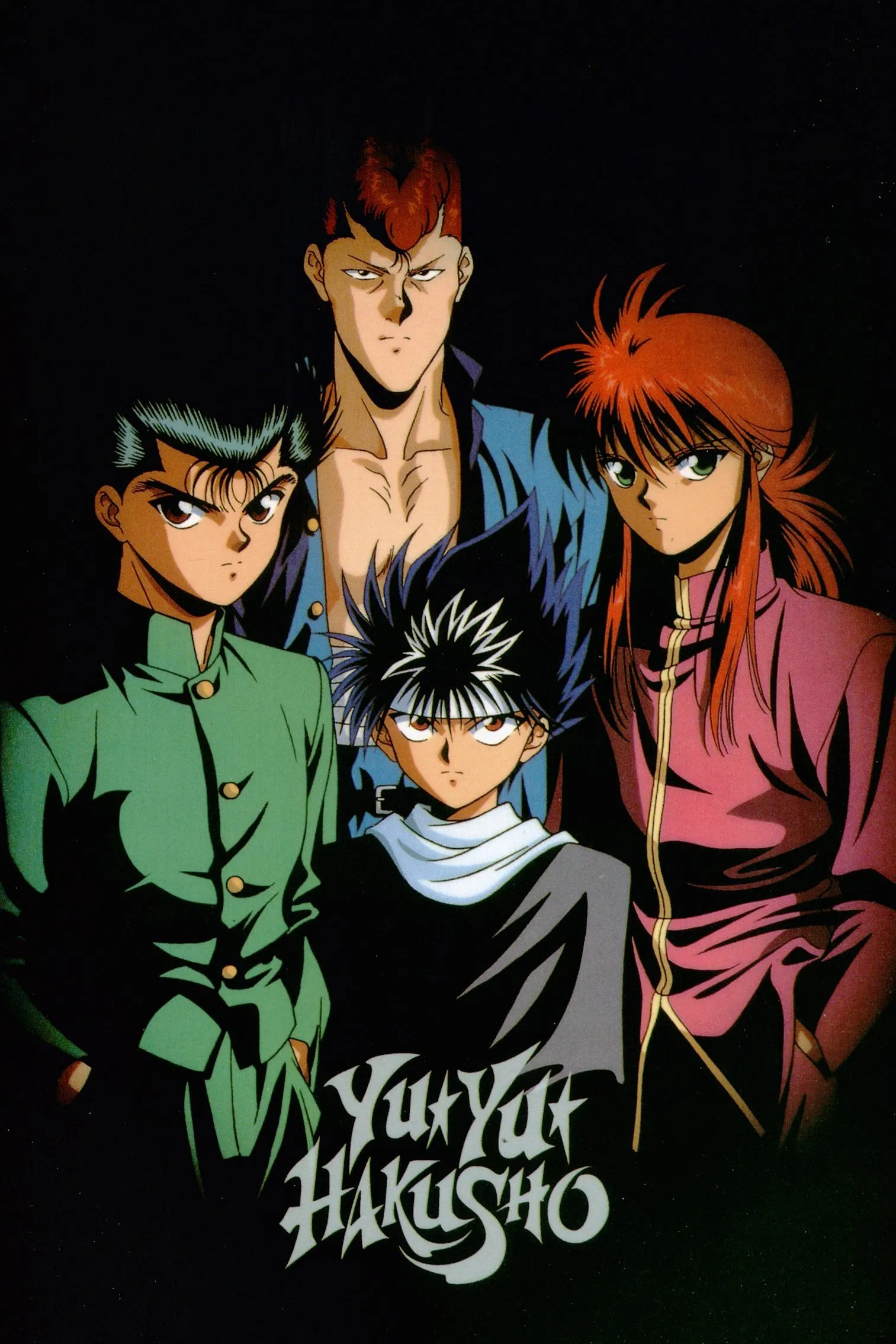
Name(s): Yu Yu Hakusho: Ghost Files / Yuu☆Yuu☆Hakusho / Yu Yu Hakusho / Ghost Fighter / Poltergeist Report / YuYu Hakusho / 幽☆遊☆白書
Format: TV series (112 episodes)
Studio(s): Pierrot
Related: Yu Yu Hakusho: The Movie / Yu Yu Hakusho: Chapter of Underworld’s Carnage – Bonds of Fire
As of writing, it’s been 24 years since Yu Yu Hakusho first made its appearance in Weekly Shonen Jump: 1990. Doesn’t really seem that old, does it? It would only take two years later for the hit series’s anime adaptation to start airing. In a rare turn of events, the Yu Yu Hakusho anime is not only an adaptation of a sizable manga but is also of an older era, and yet it’s an uncommon breed of battle shonen anime adaptations that follows the entire manga very faithfully and reaches about the same conclusion. It really was/is a miracle, so let’s get the fact that Yu Yu Hakusho is one of the best straight anime adaptations of a manga ever made out of the way.
Dragon Ball Z arrived in the late 80s and pioneered the battle shonen genre, which would be defined by a focus on one-on-one fights typically fought using special powers, with drama and other such exposition taking a backseat to the high energy action. DBZ paved the way for a smash formula that would prove to be the dominant genre of anime for years to come. And yet, Dragon Ball Z, while very special for its time, has since been surpassed by other battle shonen anime that offer a more satisfying balance between fights won with clever tricks in addition to the brute strength (brute strength often being the only thing shown in DBZ), and more universal aspects such as drama and comedy. When it comes to art, many of the “firsts” that lay down the groundwork for their genre are often still cited as some of the greatest classics of that type, but in this case it’s Yu Yu Hakusho that would give to the anime/manga world the successful blueprint for a superbly executed battle shonen anime that still stays entirely true to the genre’s roots.
Something that succeeds at a formula by completely adhering to its basic principles without doing anything too maverick can seem unimpressive at first, and indeed Yu Yu Hakusho‘s execution of the fairly typical battle shonen tropes is so rightly done that it should be seen as common sense for any aspiring battle shonen series and nothing to write home about. But this would be in an ideal world. I’ve seen countless battle shonen after Yu Yu Hakusho repeat the same mistakes of the genre over and over, and thus Yu Yu Haksuho still remains a shining example of its breed that will always hold up over time as long as it remains as one of the highest standards.
The basic premise of Yu Yu Hakusho is as simple as you would expect from a battle shonen anime: Teenage delinquent Yusuke Urameshi dies prematurely and is allowed to come back to life if he performs duties as a Spirit Detective on behalf of the Spirit World government. The details of these vary, but as you’d imagine they always culminate in a battle against super-powered monsters (demons, in this case). He’s eventually joined by rival-turned-comrade Kazuma Kuwabara and demons-turned-comrades Kurama and Hiei. These four are the main team from beginning to end. 112 episodes without introducing half-baked side heroes that’ll be tossed aside at a whim to maintain a revolving cast of fanservice characters that are difficult to become attached to or value. Bleach, eat your heart out. Let’s put this down as the first thing Yu Yu Hakusho still does right among long-running battle shonen series.
As I’m implying, Yu Yu Hakusho‘s main team of four is an expertly crafted and balanced team with no members feeling pointless or detestable. Between Yusuke’s brashness, Kuwabara’s heart and naivete, Kurama’s intelligence, and Hiei’s raw strength, the team’s personalities bounce off each other perfectly. Their chemistry is so organic and their roles all so defined and always relevant that it’s easy to ignore the conceptual tropes that make each of them up and they simply come across as great individual characters. Though Yusuke is the main character and handed the biggest fights, Yu Yu Hakusho is a rarity in action anime in that it feels like a cast of main characters rather than one main character and three side characters.
In other words, they’re all major pillars that hold up everything that makes the series enjoyable. If Yu Yu Hakusho‘s team wasn’t as well-made as it is this series wouldn’t be half as good as it currently is. I couldn’t go without mentioning Botan, Kayko, Genkai, and Koenma, and while I won’t go too much into the supporting cast I will say that I loved them all almost as much. If there are any really noticeable flaws in the characterization, then it’s the fact that Kuwabara isn’t given as much glory as he should, and Hiei’s stock strong silent type personality doesn’t measure up well against the more impressionable characters.
One of my favorite things about Yu Yu Hakusho is how the series is split up into four arcs that actually impact the narrative structure in meaningful ways while still always ties to each other, forming a single unified adventure. In many battle shonen anime arcs only exist to represent the time spent fighting a particular enemy. For all intents and purposes, these play out the same only with different fights and characters. In Yu Yu Hakusho, though the series is always about the fights when it comes to the bottom line, the arcs change the formula up slightly each time.
The first arc is generally simply called the Spirit Detective arc. This arc mostly consists of episodic encounters where Yusuke is getting the hang of his new abilities and always discovering more things about himself and the Spirit World. This is the hardest arc to generalize because so much happens in it, such as Yusuke trying to come back to life and the first encounters of the main characters, but that’s precisely its strength.
Though it doesn’t stay in one place too long and isn’t building up to anything specifically, the Spirit Detective arc is full of rapid-fire plot and character developments that the rest of the series can’t match in the same way but do with their own strengths. Among the Spirit Detective arc are several “mini-arcs” that are about defeating a particular enemy, but these are minor compared to what would follow.
The Dark Tournament arc is the most well-known segment of Yu Yu Hakusho. The team competes in a tournament where the winners will have a wish granted. The catch is that Yusuke’s participation is forced by a much stronger foe who promises Yusuke that he’ll kill his friends and family if he doesn’t train to become strong enough to possibly defeat him in the upcoming tournament. The second catch is that the tournament is known for its extreme brutality, with the demon audience clamoring for blood and there being little in the ways of rules during the matches.
While this arc is characterized by its extreme focus on 1v1 battles, there’s a truly great atmosphere to all the proceedings. The tournament area takes place on a secluded island constantly being weathered by storms with dark clouds always looming overhead throughout all hours of the day, and the arena has a fittingly rundown musky look to its gladiator-like stone structure. The setting feels as ruthless and apocalyptic as its name implies, and due to the length of this arc (the longest in the series) the tournament building can actually begin to feel like a second home to both the characters and the viewers.
With a threatening goal always in sight with the final match (the viewer knows who the team will be facing), there’s an extremely comfortable pacing, real sense of progress, and scaling threat in this arc. We’re occasionally given a breather to see what’s going on outside of the ring on the island or the lounge areas of the building which goes further to establishing the Dark Tournament setting as a surprisingly assuring one.
Normally a series of episodes primarily focused on just putting two characters in a ring and having them fight could seem boring, but Yu Yu Hakusho‘s penchant for creative battles and character designs ensures that it’s anything but. This would be the most appropriate place to talk about the strength of Yu Yu Hakusho‘s fights and the ways they get us invested more than other battle shonen wish they could. I’ve said already that the entire series revolves around four main fighters. It’s far from unusual for a battle shonen anime to have one main character and a supporting cast of other fighters, but it’s also unusual for a battle shonen anime to balance their usefulness as well as Yu Yu Hakusho does. Yu Yu Hakusho is not a fan of the Deus Ex Machina, Yusuke and co. will not win most of their battles simply by being beaten into submission, remembering they need to “protect” someone and pulling a super strong finisher out of their ass. The damage the heroes take in battle is not merely an aesthetic, because the heroes actually come pretty close to losing several times in the anime, and in some instances they actually do, always bringing some tension to whether or not they’ll be the victor in each match they’re in. In addition to this, though power levels exist, they’re never given as the sole reason for a victory. This isn’t DBZ where one of the characters will enter the fight with a higher power level and will simply win by punching harder. In most of Yu Yu Hakusho‘s fights, the enemy has some sort of special gimmick attack they use to catch the heroes off-guard. The heroes can’t simply scream and bust their way through it, but instead usually have to counter it through a trick of their own or turn the trick against them. This leads to many situations where the battle isn’t about whether the heroes will win (they most likely will but it’s never guaranteed), but how they’ll do it. Each of the main characters have their distinct ways of fighting, and fights are spread very evenly between them unlike your generic battle shonen anime that will give the vast majority to the main character. The entire Yu Yu Haksuho team is extremely likable, and there’s always plenty of room to root for each of them ensuring it never gets tiring as their star roles are always rotated around at a fair pace. Phenomenal to see, really.
After the events of the Dark Tournament conclude, we’re dumped into the Chapter Black saga shortly afterwards. I won’t give away the set-up as it’s a very nice surprise, but this takes us to a narrative similar to that of the Spirit Detective arc. There’s less character developments because we’re in the middle of the series now, but the adventure vibe is back as the heroes have to travel all over the city to find (and fight!) people with some very unique powers. For a while we’re given an episodic-like structure again with a new fight in each one, but there is a main goal in mind this time so no effort feels wasted. The Chapter Black arc displays perhaps even greater than the Dark Tournament arc Yu Yu Hakusho‘s talent for creative fights. The reason for this is that, even more so than many Dark Tournament matches, fights are rarely won by overpowering the opponent. There are episodes with relatively little violence here (though still as much danger), where the heroes will spend most of the time trying to find a way to outsmart their opponents’ very specific powers and defeat them in one shot. The Dark Tournament arc had many battles of attrition with a core of wits, but in the Chapter Black arc the balance is reversed for most of the arc. It’s very fascinating and I loved how much of it took place in a normal city this time around. One of my favorite episodes of the series is when Yusuke and companions are chasing their enemy around in a hospital after dark. For an action anime, the atmosphere in some of these episodes is, again, superb. Many people complain that Yu Yu Hakusho gets worse after the Dark Tournament arc, but seeing as how I’ve never been given a single decent reason for this opinion I’m going to assume it’s from simple people not liking the change in direction despite the fact it’s a return to form, still full of many fights, and the stakes are even higher this time around. The Chapter Black arc keeps the quality going strong, if not peaking it even higher.
The final arc of the series is the Three Kings arc. Again, I’m not going to give away too much of the set-up as it’s pretty intense and is a satisfyingly appropriate finish to the series that’s full of events even more serious than what preceded. Yet, the Three Kings arc is easily the weakest part of the series. Why is this? Well for one, it’s the only arc that feels like pandering. Yoshihiro Togashi unfortunately listened to the one-track minded people who were underwhelmed by the Chapter Black arc and made the Three Kings arc center around a tournament as well. His heart’s not in it this time around, however, and the arc is significantly shorter than what came before. When the tournament begins it’s suddenly rushed and finished giving the impression that Togashi just wanted to be done with the series while satisfying the fans by doing something he had already done. There are a couple of very hyped-up fights in this arc, and with the exception of the last one we see, they’re all shorter than you’d expect and disappointments. I won’t give the reason why (it’s a poor one rest assured) but we never even get to see the final match. Perhaps the biggest letdown of this arc is the fact that Kuwabara is absent for almost all of this. He gives a reason for this, but it’s a very lame one that could have easily been written out or moved somewhere else with no cost to anything. It’s of course, just Togashi being lazy and ignoring the least popular character of the four (for some strange reason). In spite of all this, the Three Kings arc is too short for its disappointment to frustrate, and outside of the tournament nonsense there’s some fanservice here anyone will actually want to see. Some popular fan characters return without feeling forced, and we get some great backstory on the Demon World, Yusuke, Kurama, and Hiei, and the new characters introduced are very, very cool. There’s enough potential here with the setting and plot to make it a great ending had it been expanded upon, but as it is it’s simply acceptable and far from undermines the greatness that came before it.
Before closing out this eeeeeeeeeeeeeexpansive review, I’d like to express that I have the same love for the audio as everyone else does. The soundtrack is one of my favorite in anime ever, and all the openings and endings are top notch causing me to still listen to them regularly. The Yu Yu Hakusho dub is legendary for how good it is, and they’re completely right. Make no mistake, the dub voice actors ARE the characters. The original Japanese cast lost on this one when it came to heart, and it’s just the truth. The openings and endings were also all redone in English with likely a better translation than anything a subber would’ve came up with and can completely compare with the original Japanese versions. I won’t go into detail about any specific songs or dub jobs right now, just know that I think they’re both fantastic. If I had a complaint about any of this, it’s that the soundtrack is fairly small for a 114 episode series, so you end up hearing the same songs all the way from the beginning to the end. Fortunately they’re so good you won’t mind, but it’s slightly unfulfilling. Also, some songs on the soundtrack are either unused or not used often enough compared to other tracks. So it goes, I guess.
Yu Yu Hakusho takes up a large part of my heart, and as a member of the super elite my criticisms are immune to nostalgia. The series really is that charming and a shining example of battle shonen anime that all battle shonen to follow should use as a basic blueprint. It’s long but never bogged down by filler or any padding whatsoever so it’s just 112 episodes of battles of strength and wits among one of the most generally lovable casts ever put in an anime (or anything?). When I finished Yu Yu Hakusho for the first time I did something very rare and cried out of both complete satisfaction and having to say goodbye to something I loved that had become a part of my daily routine. It’s moments like those that I spend so much of my time watching anime for in the first place. Though Yu Yu Hakusho still ended up being quite popular, I sometimes imagine a world where it deservedly took Dragon Ball Z‘s place in pop culture and we got numerous spin-offs, videogame adaptations, and westerners and easterners alike recognized its greatness. A man can dream.
Yu Yu Hakusho: Nightmare Hakusho
AKA: Yuu☆Yuu☆Hakusho: Mu Mu Hakusho – Nightmare Hakusho / Yu Yu Hakusho: Mu Mu Hakusho / Yu Yu Hakusho: Eizou Hakusho III / Yuu Yuu Hakusho: Eizou Hakusho III / 幽☆遊☆白書 夢夢白書
Format: Original video animation [OVA] (4 2-minute episodes)
Studio(s): Pierrot
A series of short comedic OVAs that chronicles nightmares Yusuke has about his friends in really absurd, surreal scenarios. It nails the weird dream logic pretty well, which makes it a little more than just an excuse for a gag reel, and the humor is sold through the dedicated dub voice cast. The original cast alone makes this worth a watch—not to mention, it is kinda funny.
Leave a Reply