








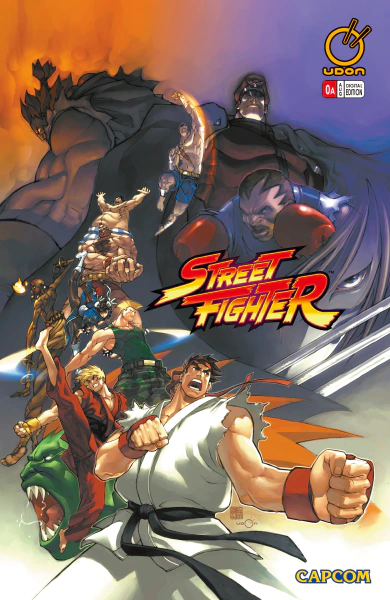
My Background with Udon’s Street Fighter
Bet you didn’t see this review coming! Well, maybe you did, if you follow me on social media. I’ve been in the mood for fighting games ever since my work for Old School Gamer Magazine had me once more cross paths with some classic titles. I’ve always been a fan of fighting game lore, primarily motivated by the fantastic character designs the genre leans so heavily on. It helps that I’m terrible at the genre, so this element gives a scrub like me something to latch onto. For many years, I’ve planed to dive into the extensive supplementary material around various fighting game IPs: anime, manga, and everything between. Well, any live-action stuff might stay on my backlog indefinitely…
I knew that whenever I chose to do this, I would have to start with the Street Fighter comic series published by Udon Entertainment Corp. When I was growing up in the early 2000s, video game merchandise was exceptionally rare. Maybe it’s hard to imagine for younger generations, but it used to be that seeing Mario’s face even on crappy, overpriced candy was a sensory shock. Games just existed in an entirely separate cultural space from other fiction; considered too niche, despite all contrary evidence. The prospect of characters and worlds that meant so much to me being put into other contexts was something too powerful for my child self to resist—I’d literally buy a damn kitchen sponge if it had Kirby’s mug on it. No, really; I still have that exact sponge.
Still, any encountered merch was mostly tchotchkes of some kind. With such low standards, you can imagine my reaction when I entered a local comic book shop and saw Street Fighter in literary format via Udon’s adaptation. If I could shit Hadokens, I would have. The store practically asked, “can we have your money,” and I thought, “Shoryuken!”
As it so happens, I received an ideal primer on the series. I had bought a compilation of short one-offs of character backstories originally published in the back of each Street Fighter issue. The revolving subjects, artists, and standalone nature of the stories gave me a kaleidoscopic preview of the comic at large. I loved what I saw, and my curiosity for the expanded lore of the games was at least somewhat satisfied. I made it a point to one day read more.
And I never did, but not for lack of wanting. I mean, I sort of did. I bought one or two random standalone issues whenever I found them. Thing is, at that age, I almost never saw comic book shops and was entirely reliant on family to take me to them. I also grew up in poverty, so the fact I even got a whole graphic novel was unusual; I must’ve been really excited. Buying things online wasn’t a given like it is now, and seeing Street Fighter on my rare trips to comic book stores was always unlikely.
As I aged and gained further control over my finances, I was routinely outpriced whenever I checked online listings. Physical comics are something I’ve always considered a luxury, which truly pains me to say. I understand why they’re priced the way they are, and the creators deserve every cent, but I’ve simply never had enough money to go around. Even now, I tell myself I’ll build up a healthy library of my favorite tiles should better times ever come my way. Hopefully they will—maybe with your help!
Alleviating some prices is the increased normalcy of digital distribution. The reduced production costs make comics more accessible than they ever have been. I don’t know if that necessarily equates to positive outcomes for the creators, but it’s certainly convenient for consumers like myself. So, here I am, once again hankering to finish round two with Udon’s Street Fighter and armed with knowledge of how to actually get the damn thing.
That said, my reading experience still wasn’t ideal. Finding the digital versions of the comic was simple enough, but I like to read the extra material from the original printing: letters from the editor, fan art and mail, even advertisements. For all art, one of the few things truly impossible to replicate is context, and reminders of it help me appreciate the work on multiple levels. The digital Street Fighter issues are slender and retain nothing beyond the actual comic stories.
I often wonder why this is a common practice, but I suspect it has something to do with not wanting to tie the product’s identity to things no longer associated with it. If the digital versions came out later, the editorials could have been written by someone no longer working with the publisher, and there may also be legal snafus with promoting licensed properties past a certain date. I’m just guessing. If anyone knows, please drop a comment.
So, trying to find scans of those sections was rough. I located some, but many other sources gave me nothing beyond 404s. This is admittedly a minor problem—obviously the most important element is the fiction—but I got warm fuzzies in my tummy whenever I could read the records of decades past. The early 2000s, with whatever legitimate problems they carried, represented an American optimism in the inertia of our socioeconomic systems. Everything could be comfortably taken for granted. It was still a time where independent artists could get their stuff in a brick and mortar store and have it sell, however modestly. It was before every last cent had to be squeezed from our drying bones in the impossible pursuit of infinite profit. That optimism could be characterized as arrogance and blamed for negative situations ongoing at the time of writing this, but I digress.
History is interesting, is all. And if there ever were better times, returning to them at no expense of modernity is only gatekept by our collective imagination and sensible regulations against incentive structures that promote negative behavior and its outcomes. Moving on…
Malibu Comics: Acknowledging Our Predecessors
You might assume that the Udon Street Fighter comic series is the franchise’s debut in the medium; at least, I did. But any of us would be wrong. Street Fighter first hit ink with Malibu Comics’s eponymous adaptation, a three-issue series that ran throughout the second half of 1993. It’s infamous for this meme image of one of its pages that you may have seen circulating online:
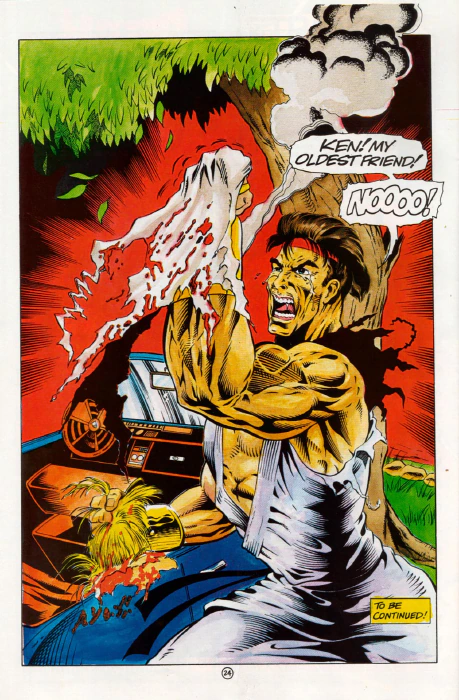
The scene is straight out of a war drama, and the juxtaposition between it and Street Fighter‘s standard persona is intrinsically hilarious. From just this, you may assume the comic to be one of many Western “reinterpretations” of Japanese games in the late ’80s and early ’90s, twisted and warped beyond all recognition to sculpt anything into something perceived as more palatable for commercialized American machismo.
Perhaps that characterization is apt to some degree—I’ve yet to read the series—but reading the Wikipedia summary of its plot, Malibu Comics seems to have mostly been on-point with series canon. Sagat seeks revenge against Ryu for his tournament loss, Chun-Li is an Interpol agent; the basic plot points appear correct. To me, the funniest details other than Ken’s gruesome scalping are the fact Ryu and Chun-Li have a romantic relationship (because you gotta have one, and there’s only one girl who’d work), and Ryu and Ken’s master, Sheng Long.
Yes, that Sheng Long, birthed from a misinterpretation of one of Ryu’s victory quotes in Street Fighter II: “You must defeat Sheng Long to stand a chance.” That awkward syntax had some assume Ryu was referring to a then-unseen character of high status, and who’d fit the bill better than Ryu’s master? In reality, Ryu is meant to be referring to his Shoryuken technique, i.e., if you can’t handle his Shoryuken, you have no hope of defeating him. Personally, I’d give more credit to the Hadoken, but whatever.
It’s easy to mock the ’90s fandom in hindsight for running away with this theory that led to no shortage of hoaxes on how to encounter Sheng Long in Street Fighter II. Beat every match without taking a hit, etc. Looking at it now, I feel like even the quote’s assumed context doesn’t make any sense. Why would Ryu suggest that his opponent defeat his master before him? In fiction, isn’t a student’s master always revered as stronger regardless of their age? A “master” character would be saying this about their pupil, not the other way around. Either way, it’s kind of disrespectful, no? Why would either entity downplay a revered figure? Yes, I am smarter than teenagers during the ’90s.
And I guess I’m not the only one to be “offended.” Malibu Comics’ Street Fighter was cancelled after the third issue because of Capcom’s own dissatisfaction with the material. Ouch. An “epilogue” in the back of the final issue confirms as much while also providing text summaries of how each character’s arc would have continued if given the chance. The explanation of the series cancellation is curt and professional, offering no specificity as to what Capcom disliked. Could it have been that bad? Maybe I’ll find out sometime. But if Capcom intervened to that extent, perhaps it’s a miracle that Udon was given another chance about a decade later.
What IS the Street Fighter Comic, Exactly?
I don’t know the circumstances surrounding Udon’s Street Fighter adaptation and how it came to be. Did Udon make the pitch to Capcom? Was Capcom shopping around for affordable publishing contracts? Of all Japanese video game publishers, Capcom is (or was) probably the most willing to finance spinoffs of their more successful games, even when the venture made zero commercial sense like a 51-episode Viewtiful Joe anime adaptation.
Given that, and provided the information doesn’t currently exist out there in some editorial or podcast I didn’t track down, I’m inclined towards pragmatic explanations. Someone at Capcom noticed a market gap for one of their most popular IPs, thought comic book demographics would overlap with Street Fighter, and then gave a small team the publishing rights as opposed to whatever cost giant entities like Marvel or DC would quote. This is all an assumption, mind. The editorials in each issue begin with generic statements about their excitement in being chosen to adapt Street Fighter; nothing about the primordial ooze.
What I can tell you is that the 2003 series doesn’t follow the franchise’s exact chronology. For one, the events of the first Street Fighter are glossed over in a manner similar to the franchise’s own handling of its legacy. “Ryu fought Sagat and won” is the most interesting part of that narrative, and it’s likewise the only detail that remains in the comic.
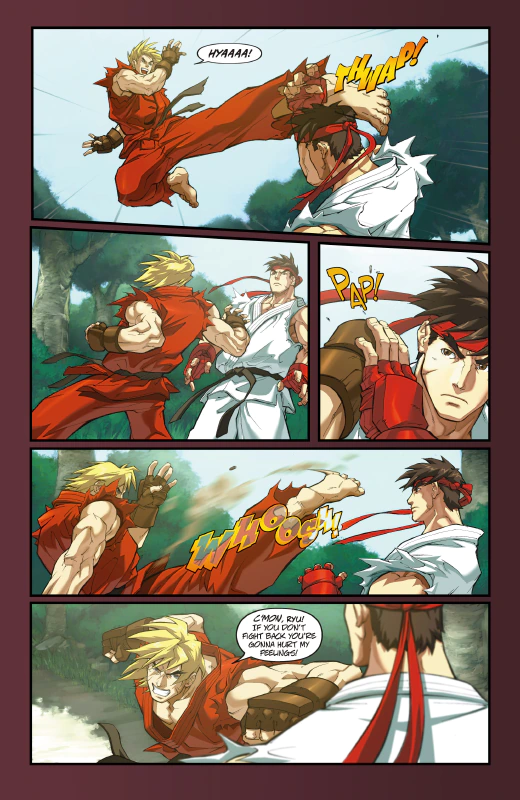
Our plot interweaves character backgrounds largely sourced from Street Fighter II and Street Fighter Alpha lore, with some teasing of Street Fighter III elements. Ryu is predictably the central character all others relate to in some manner, and he struggles to repress his dark, violent side throughout a globetrotting quest to avenge his fallen master Gouken, slain by his own brother, Akuma. Akuma isn’t the only one interested in drawing out Ryu’s latent power; M. Bison, leader of the global, underground criminal enterprise Shadaloo seeks to use Ryu to his own ends of conquering the world.
Our deuteragonists include the other most iconic faces of Street Fighter. Guile and Chun-Li work together to track down and arrest Shadaloo, each spurred on by a missing loved one; Guile’s best friend and mentor, Charlie, and Chun-Li’s own father. Ryu’s eternal rival and brother-figure Ken is just as eager to find Gouken’s murderer, but has to contend with the obligations of an ordinary family life. Ryu, virtually a traveling monk, has no such albatross—that is until Sakura, a high school girl obsessed with martial arts, comes to idolize Ryu and insist he be her teacher.
If all of this sounds familiar to you, then let that be evidence of how much Udon respects the original canon. Every step of the way, the Street Fighter comic always oozes the reverence only true fans could muster. If you’ve ever obsessed over a fictional world, you’ve probably imagined how it would fare if properly adapted to other contexts; not to create something totally unique, but to bring the qualities you recognized out to never-seen heights.
“What if Street Fighter existed in a format more conducive for telling its story?” This is a question seemingly not asked by other Western adaptations like the infamously bastardized live-action film, and it’s wonderful to see the property stay true to itself in this comic. Perhaps things aren’t rendered precisely as they would be if helmed by the original Japanese creators, but this series is nonetheless recognizably “Street Fighter.” Of all its aspects, I think that might be the most praiseworthy. This is meant for Street Fighter fans.
Putting aside a bite-sized issue 0 prologue story, the 15 issues follow an identical structure: a main story, a five or six-page character background story, an even briefer gag comic, and an assortment of publisher letters and shared fan material. The final issue teases a sequel series, Street Fighter II, which while a mildly clever title is a very confusing one because it chronologically can’t be covering the events of the actual Street Fighter II. I think that was poorly considered.
Udon: The Specter of Chud
I feel obligated to discuss at least one of Udon’s recent controversies, because I suspect that if I don’t, I’ll receive comments along the lines of “did you know they did such and such cringey thing?” Hell, when I brought up that I was reading this comic to my friends, the literal first thing they did was bring up their controversies. I think accountability is good, so I don’t resent that, but I don’t want to radically shift the focus of my review. I’d rather tackle specific issues as they become contextually relevant, and right now I’m in a 2003 time capsule. But as a civic duty, I will get into things a little bit.
Matt Moylan, current Director of Publishing at Udon, has expressed some really bad takes on social media for at least a decade now, and to my knowledge, he’s never issued an apology or shown recognition of why he’s wrong and platforming horrible beliefs. At best, Moylan is another reactionary who’s been fooled by an oligarch-led culture war that’s in the inadvertent (?) process of destroying mankind, and at worst he’s an ideologically-driven bigot. I’m not interested in litigating which would be worse, because either is unacceptable given the apocalyptic consequences we’re made witness to. If you want to see some examples of what I’m alluding to, click here.
I personally don’t blame anyone for avoiding Udon comics based on this information. Your reasons for whether or not to engage with certain media are your own. I can compartmentalize some factors, myself, but I don’t present that as a superior attribute. If I didn’t see any value in accountability, I wouldn’t even be talking about this issue; I just express my distaste in a different manner. I refuse to allow Moylan to take the Street Fighter comic away from me or anyone else.
I do think it’s important to note that there likely are people who work at Udon that find Moylan’s statements to be shameful, but are pressured by their work hierarchy into silence. I implore you to see this review and any praise therein of Udon’s work as not an endorsement of Moylan’s beliefs, but of the life-affirming qualities and efforts that persist in spite of them. Whatever Moylan says, “DEI” is baked into the DNA of Street Fighter and therefore Udon itself. This review exists as a reminder of that truth, not as an excuse of his reactionary rhetoric.
See, Matt Moylan? I can express all of this and still be horny on main for R. Mika.
Characters & Story Thoughts: A Roster Too Big for One Series
I think the Street Fighter comic bit off more than it could chew for its allotted 14 issues. It might be funny to think about, given the in-game source material probably totals a couple paragraphs of text, but in a structured, literary narrative, things need much more room to breathe. Setup and backgrounds cannot be bespoke manual biographies or entirely inferred; they’re now a necessary part of a complete character arc consisting of a beginning and an end, motivation and change. An incomplete story in the audience’s mind doesn’t necessarily hamper the audience’s enjoyment of a Street Fighter video game, but there’s no gameplay or even ludonarrative to fall back on here.
As it turns out, establishing 30-some characters and pleasing every fan by giving them some time to shine is a monumental order, and the artists necessarily have to cut corners as they run their marathon. I don’t blame them for their enthusiasm and wanting to deliver on as many fronts as possible, but the consequences of their approach don’t vanish in the face of any justifications.
Things develop extremely quickly in SFC to keep the plot moving and rotate the revolving door of characters, but it’s not dramatically satisfying for setup and payoff to be in such close concert. Charlie attacking Guile as Shadow while under M. Bison’s mind control, regaining his memories, reuniting with Guile, and dying again all happens in the length of a single issue (albeit split across halves of two issues). It successfully covers all iconic narrative beats, but there’s no time left for the characters to process the events whereby they might be explored in greater depth than what the original lore of Street Fighter already gave us. There’s definitely something more here, but is it enough to raise our appreciation for the cast, or does it just reaffirm it? For me, it was more of the latter.
Ryu
No shame on anyone who likes Ryu, but he’s often overshadowed by the franchise’s more exotic characters, and that extends to his portrayal here. Ever stoic and contemplative, Ryu is primarily reactive rather than proactive. Whenever he’s not fighting, his purpose in a scene is often to serve as the butt of jokes: Ryu is a weirdo with a one-track mind who doesn’t know how to use a computer, etc. That sort of thing.
Ryu’s immediately set up as having some kind of Star Wars-esque internal conflict between his good side and bad side, but it’s never made clear what that bad side actually is. What nature is Ryu repressing, and why wouldn’t his partner Ken also experience this conflict? Does Ryu hold some kind of special power? What about him is so unique other than being a talented martial artist? If that’s all it was, that’d be fine, but Street Fighter has supernatural elements, so this begs definition. It’s possible this is a figurative, spiritual depiction of blind ambition’s temptations, but what Ryu is actually struggling with is anyone’s guess. Maybe a future series will outline why everyone finds him so intriguing.
Ken
My favorite of the classic Street Fighter roster has always been Ken Masters. As far as I’m concerned, he’s Ryu with more flair, showmanship, and pyrokinesis. That’s just a mathematical upgrade.
Ken gets a considerable amount of pages dedicated to him—proper deference to the series’s deuteragonist. But he feels a little declawed from page one. In the series chronology, Ken is already engaged to his girlfriend Eliza and in the process of putting his martial arts legacy on the backburner. At least prior to this, Ryu and Ken are supposed to have been relative equals in strength and skill, a true rivalry derived from Ken’s origins as a second-player palette swap for Ryu in Street Fighter‘s versus mode.
Yet because of when the story is chosen to take place, we never get a true sense of Ken’s ability compared to Ryu. Ryu is shown taking his training far more seriously than Ken, who’s necessarily compromised by his personal life. Ken, whether unfair or not, perpetually comes across like a guy who’s neglecting his homework. If this was a later story arc where we were seeing the two characters develop in different directions, that would be perfectly fine. But this is Ken’s first and so far only appearance, and it’s impossible to see in him what his legacy ought to suggest; that he’s capable of being Ryu’s equal. When Ryu mentions wanting to hunt down their master’s murderer, Ken wants to come along but is tethered by his home life.
It’s a justifiable excuse in-universe, but narratively unsatisfying. We only see Ken in his twilight years instead of in his prime. A fight with Vega shows Ken is hardly too rusty, but almost as if to prove otherwise, Ken loses his final fight of the series parallel to a hard-won victory by Ryu. Perhaps this arc will be followed up with some introspection and wavering from Ken about when he wants to slow his life down and how much, but so far, all of that has led to him taking a backseat. He’s supposed to burn with passion! Literally! Give us some blazing bouts before extinguishing it all. Ken was my favorite part of the comic, regardless. I just felt he deserved more respect relative to Ryu.
Guile
Character priority in the Street Fighter comic follows a logical hierarchy. Ryu and Ken are the two most-enduring characters, so they get the most spotlight. Following their rung are Guile and Chun-Li, each nearly as iconic as the lead duo.
Guile is introduced to us as a man wracked by mourning and vengeance. His old war buddy and mentor Charlie has been declared MIA and is presumed by most to be dead. Unable to accept this, Guile has pursued Charlie’s whereabouts at the expense of his marriage and relationship with his daughter. His wife, who happens to be Eliza’s sister, is estranged by Guile’s investigative obsession and the two teeter on separation.
The “gay jokes” practically write themselves. Har har, Guile loves Charlie more than his wife. It is kind of funny, if only because we’re not given a reason as to why Guile can’t find work-life balance. His investigation doesn’t exactly appear to be progressing at a rapid pace. Anyway, Charlie saved Guile’s life and taught him how to fight, so a desire to return the favor is a passable justification for Guile’s descent into brobsession.
I wonder if Guile die-hards would be turned off by seeing him act like such a sad sack in this series. He’s not mopey or acting helpless, just distant and utilitarian. When his wife gives him shit you can feel for her, but it can get tiring to see Guile silently take her verbal abuse out of guilt rather than responding with the fact that he’s A. some high-ranking law enforcement guy (or something like that) and B. directly responsible for saving civilian lives multiple times. Like dang, the entirety of Guile’s history shows him on a career path that values other people’s lives over his own. You punched that ticket, sister! Spare me the draaaaaama.
Ironic when considering his personal controversies, Guile is probably the most upstanding, moral person in this series. He’s a gentle giant who helps people on first instinct even while trying to find his old war buddy. This isn’t the most badass rendition of Guile one could imagine, but he’ll Sonic Boom his way into your heart.
Chun-Li
I don’t have too much to say about Chun-Li, because her role in the story as an Interpol agent investigating Shadoloo is mainly a means to connect cast members to the larger plot; there’s little room for characterization over exposition. She does have a personal stake in her work, mind, given that Shadaloo is responsible for the disappearance and potential murder of her father.
I did like Chun-Li’s characterization upon reuniting with the now un-brainwashed Cammy and recognizing her for one of the agents who kidnapped her father. After an initial, instinctual fit of rage and assault, Chun-Li is quick to absolve Cammy of responsibility after learning she’s not of the same mind that took her family away. There’s a tendency for amnesiac storylines to really get hung up on this detail, and it’s often exhausting because the moral answer is just so obvious. When you’re dealing with essentially two different people who happen to look identical, obviously someone should not be held accountable for actions they didn’t consciously make. In this scenario, the “new” Cammy is basically a stranger to Chun-Li, which Chun-Li recognizes. Refreshing.
Cammy & Rose
Speaking of Cammy, she practically becomes the main character for the last third or so of the series. Prior engagements have her under M. Bison’s mind-control as she stalks and/or interferes with our heroes. This abruptly changes upon her capture by Rose, who removes M. Bison’s hold over her and dumps her in the streets of Britain. Now with no past and nothing but her instinctual fighting abilities to guide her, Cammy joins Delta Red, a special military force that’s surprisingly lax on security. No background? No problem!
It was quite a shock for me to learn Delta Red weren’t an Udon invention. I don’t know where they were first canonized, but they’ve appeared in the Western ’90s Street Fighter cartoon and Cammy’s ending in X-Men vs. Street Fighter. This means Udon is completely off the hook for one of Cammy’s teammates being a child computer whiz who’s constantly with a mute, jelly-like octopus creature with a single, suspended eyeball. I don’t know what that’s about.
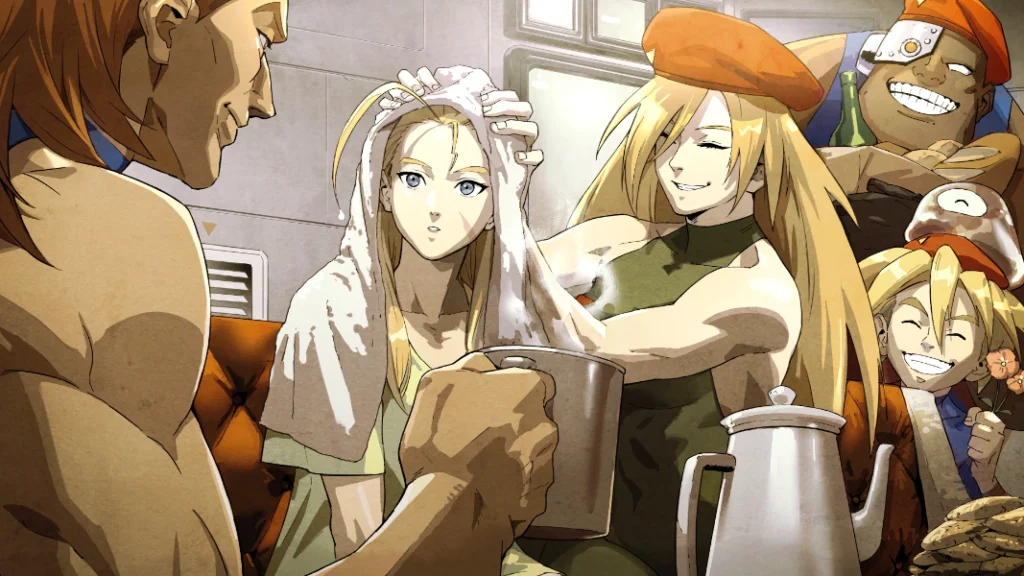
The extended cast of Delta Red get quite a fair bit of attention, as they’re usually the only people around when Cammy needs to ruminate about her dark past and progress her character arc. I’m not really a fan of just how much they’re featured; I didn’t pick up this comic to read about Street Fighter‘s fifth-string characters. At least I’m familiar with Dhalsim’s wife—not that she shows up. That said, Lita is cool and hot. Make her playable in a Street Fighter game.
Anyway, Cammy’s story might generally be my least-favorite part of the comic. There’s so little to latch onto, even down to its logic. Rose is only ever shown occasionally peering into her crystal ball from places unknown, cryptically muttering about fate or some nonsense, and we’re never given a reason as to why she’s so hellbent on freeing Cammy. What, are the other Doll soldiers not worth saving? Is Cammy special? Maybe, but they should at least foreshadow why as to not make Rose look like a capricious weirdo.
For some reason, the duo’s final confrontation isn’t even covered in the main storyline, but in one of the bonus stories located at the back of the issue where Cammy is first shown to be free of her brainwashing. Seriously, the continuity doesn’t even line up. You last see Cammy as a generic enemy, then bam, Rose is cradling her on the streets of London. It may have been better to save Cammy’s heel-turn for the sequel series, as it feels like time constraints were an issue.
Fei-Long & Gen
I never particularly cared about Fei-Long before reading this series, but Udon turned me into a fan. I really like his depiction here. A short arc sees Chun-Li tracking down movie star and martial artist Fei-Long after learning Shadaloo is targeting him.
For his exceptional career path, Fei-Long is possibly the most relatable character in the Street Fighter comic. He’s totally blindsided by Shadaloo’s kidnapping attempts, kicks their asses anyway, and insists on assaulting one of their bases alongside Chun-Li. He could’ve just stayed on the sidelines since he’s not law enforcement, but he wants to risk life and limb getting revenge against Shadaloo simply because they annoyed him, and attacked one of his industry friends. What a bro.
This arc also involves Gen, Chun-Li’s martial arts teacher in Street Fighter Alpha canon. He forms a trio with the other two during their Shadaloo raid, and it’s easy to buy into his status as a legendary, former assassin. He’s revealed to be dying of cancer even while showing everyone up, which while adding to his coolness, doesn’t bode well for his future involvement in the comic series. I’d really like to get more of Gen, but is there enough fan demand? I suppose I’ll have to wait and see. Hopefully not too long, though, depending on Gen’s prognosis.
The last thing I’d like to comment on is the arc’s decision to close on a fight involving two leader-class Dolls that aren’t Juli and Juni. So, uh… why? Juli and Juni actually don’t appear anywhere in this initial series despite the Dolls showing up by the dozen. It’s baffling to me, because I can’t recall anything from the duo’s lore that would conflict with their usage here. Instead, we’re given original characters whenever any Doll soldier than Cammy is called for, when the series could be setting up characters the audience is familiar with and expecting. I fully expect Juli and Juni to show up eventually, but that doesn’t necessarily explain why they can’t show up now, too. Such a bizarre decision.
Everyone Else
In one of the few letters to the editor pages I was able to recover, a reader expresses concern that some Street Fighter characters will necessarily not receive spotlight in the series. The staff assures them that every character will get their time in the sun. While the existence of several sequel series prevents me from calling this an unfulfilled promise, I wonder how many people were prepared for the treatment of their personal favorite characters in the first go-around.
E. Honda
There’s no better example than E. Honda’s treatment, who’s reduced to a borderline cameo role where Vega crashes the sumo champion’s meet-and-greet. Ever egotistical, Vega taunts the art of sumo wrestling by implying it’s a lesser martial art, which erupts into an improvised fight with the prideful E. Honda. What follows is a one-sided thrashing from Vega, and the Street Fighter legend is turned into a mere jobber to establish Vega’s strength prior to an upcoming encounter with Ken.
Oof. E. Honda isn’t one of my personal favorites, but it makes my sumo tummy hurt imagining a fan seeing him in this pitiful state. He doesn’t even get a few good whacks in against Vega! He’s made a complete fool of! Why didn’t he just spam Hundred Hand Slap? Possibly because of that error, E. Honda shamefully never shows up again. Is he out of the series? I doubt it, but it’s hard to feel optimistic.
Zangief & Blanka
The big boys aren’t eating well all-around. Zangief gets even less time than E. Honda, but it’s at least to such an extent that you know the writers aren’t done with him. Bit of a diss, but someone had to be, and there hasn’t been a great place to put Zangief.
Blanka suddenly appears near the end of the series to attack the heroes during another attack on a Shadaloo base. Blanka has seemingly been kidnapped and forced to fight for Shadaloo, and the protagonists only briefly react to his strange physical attributes before the plot moves ahead. They express mild sympathy and interest in where he came from, and all of this definitely reads as setting Blanka up for a greater role in the sequel.
Yun & Yang
These brothers are shown working in the background of a restaurant where Chun-Li and Gen are having their reunion. Again, this is obviously not meant to be a proper introduction to these characters, but I feel for anyone at the time who thought this would be all they’d see of them. For the record, this cameo is basically the extent of Street Fighter III‘s lore in the series thus far. I don’t blame the writers for that, as III does advance the franchise chronology quite a bit, and they have to cover Street Fighter II and Alpha plotlines first.
Sagat & Adon
For one of the first-introduced characters in Street Fighter canon, Sagat is surprisingly absent from the comic series. Ryu’s first victory over Sagat is shown in a small bonus story, and Sagat is otherwise almost entirely spoken of in passing as the first opponent to test Ryu’s limits, and as a former champion of Muay Thai whose fighting spirit has been broken following his title loss. When Ryu attempts locating Sagat to train for a showdown with Akuma, Adon appears instead, expressing frustration at the listless attitude he’s seen in his teacher after falling to Ryu. Ryu wipes the floor with Adon, so he’s another cast member to not get much focus… but does anyone really care about Adon?
What worries me about Sagat is that he appears to be in the middle of his self-reflective, redemptive arc. My understanding of the game canon is that Sagat became obsessed with revenge against Ryu, which is what led him to pursue strength through any means necessary, including allying with M. Bison’s Shadaloo.
In the comic, Sagat has no history with Shadaloo, so is the series just going to skip over Sagat’s tryst with his dark side? Or will he be recruited by Shadaloo later? Does that not mean his progression will be from prideful champion, to reflective martial artist, to villain, back to reflective martial artist?
That doesn’t sound like a satisfying arc, especially since it would make Sagat feel more like a fool if Shadaloo manipulated him in his current state. If he were in a heightened emotional state following his loss to Ryu, that would make sense, but now it’s required that a lucid Sagat be duped into evil. I’m pretty concerned, since Sagat’s story is one of the more compelling in Street Fighter and he elevates the main character Ryu by proxy. Time will tell if Udon can salvage this.
Vega
Well, Sagat is AWOL, Balrog is too simple-minded to make for an effective leader, and M. Bison can’t be overused since he’s the ultimate villain, which means Vega takes the reigns as the Street Fighter comic’s main antagonist.
I love Vega, so I’m all too happy with this decision, but it is funny to see him going around in a suit operating as Shadaloo’s second-in-command when in the games he’s a high-pitched, screaming psychopath. It’s like seeing the Joker from Batman at an office job. I guess you do what you gotta do.
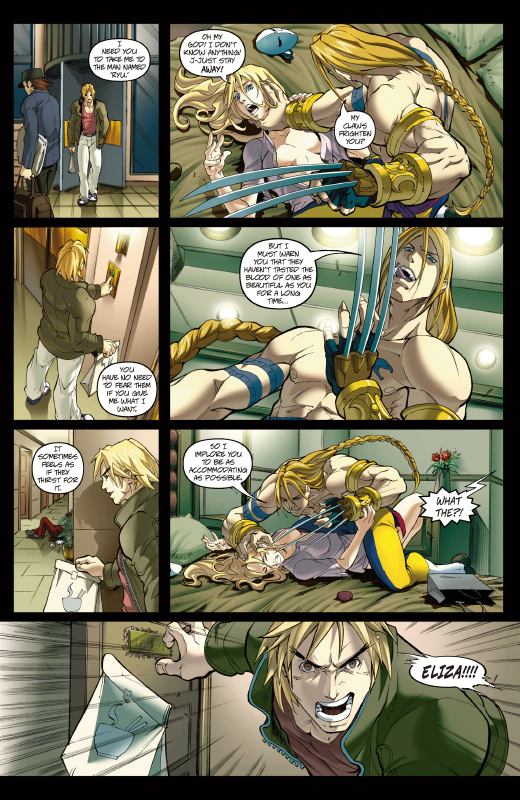
Anyway, this depiction of Vega is necessarily more sociopathic than psychopathic, but that just turns his aesthetic obsession into something along the lines of Patrick Bateman. I enjoy this debonair and Machiavellian side of Vega, as I’ve always been a sucker for high-class villains. Vega is shown fighting possibly more than any other character in this series, but as I said, it just kind of makes sense. Granted, Udon wrote themselves into that hole by not starting with Sagat in Shadaloo. Vega’s a treat, so it feels weird to criticize his overuse, but yeah, it’s a little lopsided.
Birdie
On that note, Birdie appears very early on as a standard thug-jobber and introductory fight between multiple main characters. I think Birdie is a perfect choice for a low-level villain, as that’s basically what he canonically is, but I don’t think he needed to be written out of the series so quickly. It would’ve been very easy for Shadaloo to recruit him for at least one other appearance instead of the same gaggle of Dolls or another Vega throwdown, but alas.
Balrog
It takes Balrog a surprisingly long time to show up, but when he finally does during the series’s final fight, the wait is worth it. I’m not a particular fan of Balrog, but I loved him here. His mob-boss mentality is an archetype absent from the hitherto seen villainy, and the brutality of his fighting style captures the most literal meaning of the term “Street Fighter.” After a slew of fights predominately concerned with deft acrobatics and technique, Balrog muscling through a showdown with Ryu via raw power makes him the most intimidating foe yet, and it’s the first time Ryu feels like the underdog in a fight that’s not deliberately mismatched (Akuma).
Appropriate for a character inspired by Mike Tyson, you really feel Balrog’s strength. I also love his capacity for fighting dirty. He’s fine with throwing furniture in a fight, but only his underlings show a willingness to use firearms; you could buy into the belief that Balrog sees the former as “fair” because it still uses his own physical strength. I think Balrog thrives in the comic’s setting and hope to see more of him. I’m also unfamiliar with his lore post-Shadaloo, so I’d like to see that covered as well.
Akuma
Just like in the games, Akuma serves as a shadowy antagonist that may or may not be even more threatening than M. Bison, yet is always out of reach of Ryu. It remains to be seen whether Akuma or M. Bison will be the ultimate villain, but I like the concept of M. Bison being a world threat while Akuma is more of an interpersonal one. Akuma’s role climaxes in a two-on-one fight against Ryu and Ken, and predictably, Akuma tosses both around like ragdolls. Uninterested in killing weak foes, Akuma spares his brother Gouken’s former students in anticipation of a more challenging confrontation. I look forward to it.
Sakura
Sakura is played pretty straight. An avid martial arts fangirl, Sakura spends half the series spectating fights between the rest of the cast as she seeks out Ryu, a name she overhears and assumes reverence of. When they meet proper, Sakura becomes Ryu’s impromptu student, unwilling to take no for an answer. As Ryu travels to improve his skills to a level where he can defeat Akuma, Sakura grows from a complete amateur to… something resembling a legitimate fighter. Her dynamic with Ryu is quite charming, as she challenges many of his conservative ways, like teaching him to use email so he can coordinate coming to Ken’s wedding. It’s cute.
Dan
As far as jobbers go, I suppose none are more excused than Dan, the franchise’s iconic “joke character.” Pretty much all he does is get beaten by Sakura at his independently-run dojo. Unlike Capcom’s canon, this doesn’t lead to Sakura becoming Dan’s student, and he exits from the series (so far). It is established that Dan seeks revenge for an undisclosed reason, but whether or not it’s attached to Akuma like in the games remains to be seen. It’s hard to imagine Dan not showing up again, but will he be given a proper character arc? I hope so.
M. Bison
The big bad himself, yet I’m not too interested in talking at length about M. Bison. I mean, what’s there to say? The guy is evil incarnate; practically for its own sake. He wants to rule the world, begins the series with an evil underground organization already established, and he has some kind of special power (Psycho Power). There’s no background on him whatsoever, and he mostly serves as motivation for the rest of the cast whose lives he ruined in some way or another. I don’t need a morally ambiguous M. Bison or anything, but I do hope to eventually see some backstory on him and his rise to power.
Side Stories
This section features character background stories that seemingly wouldn’t have a chronological place within the main series plot. Compartmentalizing them avoids having to accommodate them lest the writers risk a non-sequitur. These one-shots are where the bulk of guest artists are assigned, and this fact combined with their natural variation in tone makes them wildly inconsistent in quality.
At their best, these contain some of my favorite moments in the entire series. Their brevity necessitates a “show, don’t tell” approach that’s heightened by some of the incredibly detailed artwork certain illustrators bring to their stories. There’s a weighty atmosphere to both stories Sagat appears in, and the realistic style informing Ryu and Gen’s backstories emphasizes their contemplative parables.
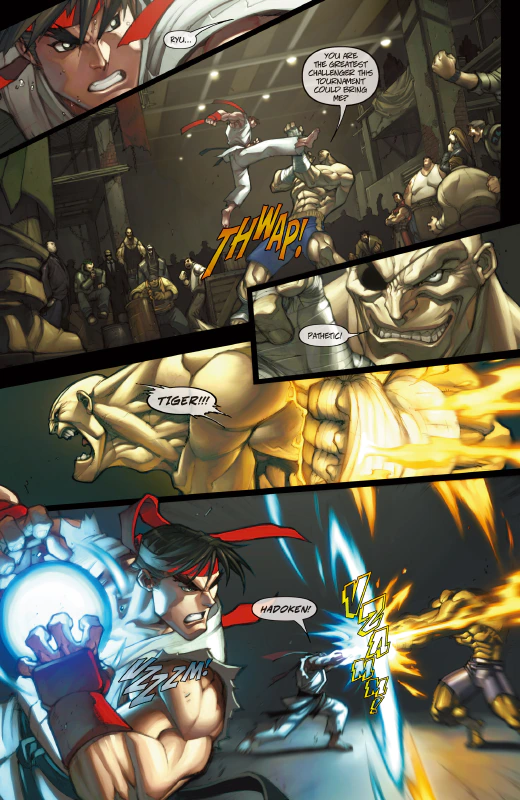
Beyond that, lore is what I came to this series for. Learning how Ryu got his headband? I’m totally here for that. Not every story is interesting or able to stick the landing, and I personally don’t care for a couple art styles demonstrated at points, but they’re of little consequence when considering the length of these stories.
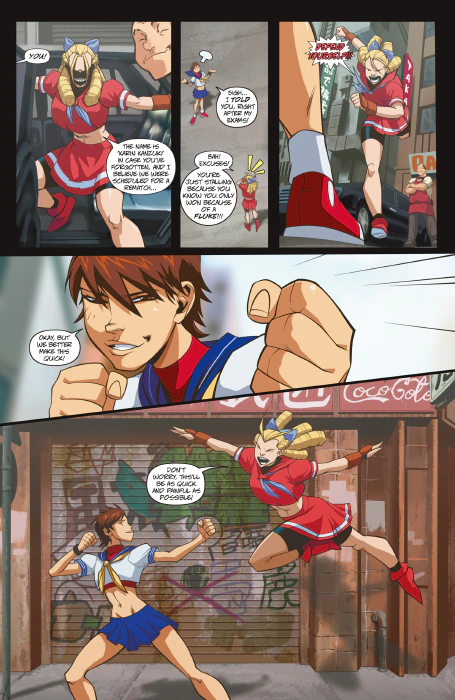
Alé Garza draws Sakura’s one-shot, and since Street Fighter is a pre-established property with an understood visual design language, Garza’s heavily-stylized work transforms the characters into something borderline unrecognizable. The expressions look like something Jamie Hewlett would draw for Gorillaz. I love that style in that context, but this series pitched “Street Fighter” to us, so it feels like it ought to deliver in every respect. It’s not like there’s an alternative, more faithful Street Fighter comic. I’m okay with experimentation, but an adaptation should default itself in convention first, I feel.
Cheap Shots
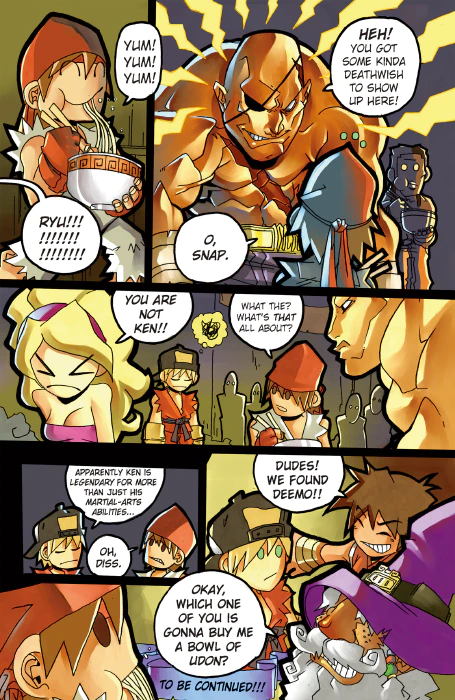
A mainstay of this series is Cheap Shots, a gag comic to unwind you following the main story’s inevitable cliffhanger and the gravitas of the extra, background story. These come to us by Corey Lewis, credited under his pen name, Rey. Corey Lewis is a prolific comic book creator in his own right, his most well-known original series being Sharknife, and having contributed to several popular IPs: X-Men and Avatar: The Last Airbender, to name a few. It looks like he’s best tracked via Patreon nowadays, and you can check his work out here. As of writing this section, he released a new issue only yesterday!
Now, if I can be a little uncharitable: I would describe the style of humor in Cheap Shots as “2000s-era webcomic at home.” Those of you who know what I’m referring to may have reflexively sunk back a nanometer. It’s not a compliment. Cheap Shots rubs me the wrong way. I don’t care for its pop-art visuals in this context, and most of the punchlines are not at all specific to Street Fighter, but “gamers be gamers” bits with Ryu somewhere in the background. Suffice it to say that I’m surprised no character ever describes something as “1337 r0xx0rz.”
After a few standalone joke-fests, Cheap Shots transforms into an actual story arc where main characters (and hXc gamers) Bobby and Larry are magically transported through their TV to Street Fighter Town! Can the duo make it back home with the support of Street Fighter characters who resemble their original counterpart in form only? An early running gag is Eliza mistaking Larry for Ken due to his clothing, only to walk away upon realizing he isn’t Ken. It’s implied she found out because Ken has a larger penis than Larry, and Larry is shown insecurely discussing this in the next installment. I’ve nothing against raunchy humor, but like the rest of Cheap Shots, I find it to be too basic and just lame.
Despite my distaste for Cheap Shots, I like the idea of an unserious bit to close out each issue, and I don’t mind them that much because they’re so short. If they were more present, I may consider them as dragging down the overall experience, but right now, I’m just rolling my eyes. Cheap Shots has been with me for a while, by the way; it was compiled in the same anthology as the character backstories. The moment I saw the first Cheap Shots again, a legitimately repressed memory fought to escape its confines. I knew I had seen this somewhere before, and my brain had until now successfully resisted committing it to memory.
Artwork
I have a personal bias towards consistency when it comes to art style. That might sound like a given to some, but with the brutal production cycle behind Western comics, it’s commonplace to rotate artists in and out of issues to meet quotas. In some cases, opportunities can emerge from this. Talented, if not “legendary” guest artists can be temporarily brought on board when they might not otherwise be able to dedicate time towards an entire project. Long story arcs can take inspiration from a variety of genres, and certain artists may have an affinity for what a specific issue is trying to capture. If Batman has an issue particularly devoted to film noir-style detective work, a staff artist adept at heavy shading and contrast could bring the most out of that setting until its focus shifts again.
It’s nice when things line up that well, but not every production has an assembly line of artists on call to meet their specific needs, and this can lead to many artist appearances feeling arbitrary—because they often are. Issues have to come out on schedule, and you have who you have. Sure, you can request artists adhere to some general style guide, but technical differences between artists can still be obvious, and maintaining a specific style becomes more difficult relative to the quantity of details that must be captured. Hence why this employed practice is harder to notice in serialized animation. It’s not too difficult to draw characters and locations from The Simpsons consistently because there aren’t many junctures to deviate from the formula.
This preamble is to say that I understand why the Street Fighter comic uses this practice and I empathize with their motivation, but I still don’t personally care for this approach. The artists behind Street Fighter are constantly changing—sometimes within the same issue (though never for the same story section). Like anyone, I have personal preferences and criteria for what I consider to be quality artwork, which necessitates I don’t view everyone as equally skilled. My judgment isn’t objectively correct, nor is anyone else’s, but if every artist can be qualified as a different general quality, then that extends to the comic issues themselves.
It’s typically not considered to be a positive trait when fictional media is of an “inconsistent” quality, and I think that extends to comics just as well as anything else. Creators partially set the audience’s expectations and bear responsibility for any disappointment, even if the ultimate catalyst for such is the capitalistic tendencies and possibly unreasonable turnover rates of their industry. I’m loathe to tear into anyone’s art here, so I’ll just say that I would prefer a more consistent art style that captures the essence of Capcom’s original character designs and official artwork. This comic is absolutely capable of doing that; just not 100% of the time.
Insert Credit to Continue
Well, you know how it is. You sit down to gather your thoughts on something for posterity, then you end up with an 8000-word article because you’re terrified of overlooking details and “wasting” your media experience as you inevitably forget the finer points. But if I don’t want this article to join the swaths of reviews put on indefinite hiatus, I should force myself to take a break.
At the very least, opportunities to cover old ground will emerge should I read and review the sequel series, which I currently have every plan to. For the time being, I want to close out some other long-awaited reads before moving onto the sequel. Some of those reads are even other Udon works I became interested in as a child, so stay tuned for those.
Do I recommend the Street Fighter comic up to this point? Absolutely. Maybe there are areas where one would want for more, but I truly can’t imagine any fan getting nothing out of the experience. Udon did their homework and it shows throughout. This is a comic by fans and for fans.
If you liked this article, please consider donating to the site. I pay hosting costs out of pocket, and I don’t have much to spend. The more people express their appreciation for my work, the further I’m compelled to put valuable time into it. I often have to force myself to not be a perfectionist to get articles out in any reasonable timeframe, but if this could ever become my full-time job, I might be able to meet my highest standards.
Leave a Reply