




The Single-Player Campaign
Progression
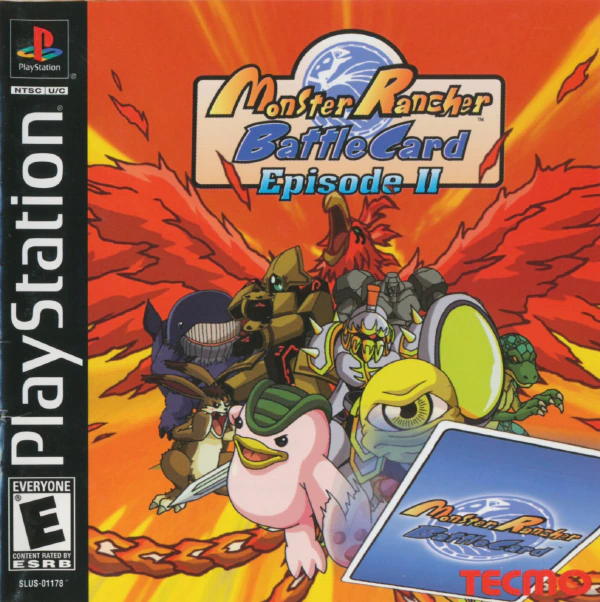
Monster Ranger Battle Card: Episode II is a very straightforward game. Your objective is to obtain all Monster cards by defeating opponents across different locales and winning tournaments. The order in which opponents are encountered is fixed, though if multiple locations are unlocked, it’s possible to choose between several available opponents. Some events only trigger after having won certain tournament ranks, so try to gradually work your way up the ladder. If there are no available events at a location, you can replay previous opponents from that area and attempt to get specific cards. If you just want to progress the story, you can return to the world map and check another area.
With the exception of Phoenix, all Monster cards can be obtained outside of tournaments. However, some Monster cards are given by opponents that can only be encountered after defeating several players before them, including those during tournaments. If you see an opportunity to win a Monster card you want from an upcoming tournament, consider saving your game and reloading until you win the tournament, as you may otherwise be waiting a long time to use certain Monsters.
The Champion’s Cup, where you can obtain Phoenix, can only be won if you’ve obtained all other Monster cards. Your team will be forced to lose in the final round if you haven’t met this condition. Consider resigning from the tournament in the first round should this be the case, as you’ll be wasting your time (unless you want the Phoenix Skill cards from reaching third or second place).
Starting Out
For an explanation on how the personality quiz determines your starting team, as well as how the game’s difficulties function, please view this guide by ZeoKnight. It also provides optimal strategies for obtaining all cards as fast as possible, if you’re interested.
As for which starting team is the best: all possible Monsters are pretty good, so I wouldn’t stress too much about it. It’s very easy to get Mocchi, Hare, and Suezo cards, so there’s an extra incentive to aim for them. Golem and Tiger are somewhat common, too, while Pixie and Naga can be augmented with early low-rank tournament wins. Golem, Dino, and Hare have high-attack cards relative to their GUTS cost, so it’s possible to easily defeat many opponents by converting most or all of your cards into GUTS each turn and hammering away with powerful attacks.
You should also consider getting Tiger because you can earn an additional, secret Monster, Grey Wolf, from visiting the Laboratory a combined total of 50 times throughout the game. You can do this nearly as soon as the game starts. Both Monsters use Tiger Skill cards, so you have a greater chance of always holding playable cards. Tiger/Grey Wolf/Golem would be a tough team to beat. Gali and Henger are worthwhile Monster cards to start with because they’re normally some of the last starting Monsters to be obtained. Naga likewise comes relatively late, as does Pixie, unless you complete their tournaments early on.
If you’re not speedrunning the game, it’s a good idea to focus on low-level tournaments for Monsters you already have, just to get three copies of each of their Skill cards and open up your deckbuilding options.
Difficult Opponents
Inevitably, some opponents will directly counter your strategy. Unless you build a deck to do the same, prepare to refight these decks many times until luck goes your way. Basically, accept having to change decks sometimes or deal with the consequences.
Many fights will force you into a rematch after losing, trapping you in an endless loop until you win. If you need more cards to help you win, you won’t be able to leave and fight other opponents. As such, I recommend saving at the start of every day so that you can reload if needed and go to a different location. There doesn’t appear to be any rhyme or reason as to which opponents force rematches.
General Strategies
Holding onto cards at the end of your turn rather than making them GUTS is a riskier play than it might seem. Not only are you losing out on the GUTS that card could have been converted into, but you’re lowering the likelihood of drawing your most desired cards for the next turn. This has a compounding effect, as having less GUTS makes it so fewer cards in your deck will be playable, so you would want as many draw “attempts” as possible to fish for affordable GUTS costs.
As a rule of thumb, you generally shouldn’t hold onto more than one card per turn. Sometimes, holding two cards can be justified, but anything greater than that cuts into your GUTS generation way too much. When you hold cards, you should do so with the intention of using them within the next turn. For example, don’t hold onto Pixie’s Step Dodge card forever, hoping to use it on a lethal attack. Instead, consider using it ASAP to free up your hand for an extra drawn card.
Base Monsters
Base Monsters (BM) are the standard Monsters used for the vast majority of the single-player campaign. Standard Monsters can only use one set of Skill cards, and it’s unique to that Monster. Looking at each Monster’s specialties and putting it in a team with Monsters that have chemistry with those specialties is the most fundamental skill of deckbuilding.
On that note, it’s critical to remember that you don’t have to use every Skill card a Monster has. Some of them aren’t going to fit with the “flow” of the rest of your deck/strategy. It’s important that you draw the cards most relevant to any situation your deck finds itself in, and your odds of drawing the right cards are better if your deck isn’t cluttered with exceptionally situational cards. For example, does your deck regularly rely on Dodge/Block cards? Then you shouldn’t be using too many cards requiring high GUTS, as retaining defensive cards in your hand necessarily means you’re generating less GUTS per turn. If you’re not often reaching the GUTS required for cards you’re running, then remove them from your deck.
Monster Breakdowns
Durahan
Strengths
Weaknesses
Special
Durahan defines the “glass cannon” archetype. Its 7 HP puts a huge target on its back, but in exchange, it has some of the best GUTS to power ratios in Battle Card. Landing one Deathbringer or Thunderbolt can KO most Monsters in the game for a relatively trivial 4 GUTS. Durahan is especially potent going first, as you can all but guarantee being able to KO at least one Monster before your opponent gets enough GUTS to KO Durahan.
Conversely, this does mean Durahan really struggles when going second. Its defensive cards have 0 cost and are a flat damage reduction, usually extending its survival by another turn. Monsters that can protect other Monsters also pair well with Durahan for these reasons. If you can’t get a kill from Durahan before it’s taken down itself, you’re in a really bad spot.
Durahan doesn’t have much in the way of utility; it’s very straightforward. Its undodgeable attacks are predictably cheap and powerful, making them quite good. Its two SPE cards double its INT damage next turn unless it takes a hit, while another prevents moves that lower GUTS for a turn. The damage boost is pointless without ways to protect Durahan, obviously, but it does turn Aerial Strike into a guaranteed KO against anything without a BLK.
Meditate: The cheapest GUTS protection in the game and doesn’t require you to potentially waste a card in your hand, unlike Persistence. Its biggest flaw is the fact it has to use up Durahan’s turn, which also necessitates you have a way to keep him alive to get a kill. Otherwise, what are those GUTS for, right? Pair it with Monsters that can protect Durahan, or other heavy-hitters that can make up for its lost turn.
SilentStance: Durahan’s next INT attack deals double damage, but the buff is lost if Durahan receives damage. I don’t like this card. It encourages you to hold onto INT Skills, which slows down your GUTS generation in addition to the GUTS lost from not converting SilentStance. Durahan only has two INT Skills, and if you can’t draw into them before it takes damage, SilentStance is wasted. Thunderbolt doesn’t really need a power boost. The biggest benefit is Aerial Shot, which would become a 10 damage undodgeable attack; instant death to anything that can’t block it, and most things that can, besides. Still, it’s a lot of set up for that. Like, you could just lead with a lower-damage attack and have Durahan follow up with Aerial Shot for a KO.
Hybrid Monsters
Hybrid Monsters (HM) are a special class of Monster card able to use Skill cards from two different Monsters; a “two for the price of one” deal. Additionally, they may have different HP than one or both of their source Monsters, giving them different strategic implications. HM combinations are predetermined, and not all possible Monster combinations are represented. For example, there is no Mew/Dragon HM, nor can you ever get/make one. You’ll have to make do with what exists in the game. Monsters also have inequal representation. Pixie appears a whopping four times, while no HMs exist for Zilla or Phoenix.
HMs aren’t simply able to use all Skill cards of both Monsters. HMs have two components, a Main and a Sub. Its Main Monster component determines which offensive Skill cards it uses, while its Sub Monster determines its defensive Skill cards. You can see this reflected in the Monster card’s frame colors: the top half of the frame is the color of its Main, and the bottom color is its Sub.
Because of this restriction, HMs aren’t necessarily superior to their base counterparts. A good example is Allure (Pixie/Naga). Allure has 1 more HP than Pixie, so it should be better at surviving enemy attacks. However, it loses access to Pixie’s powerful defense cards. On the other hand, Naga’s Counter allows it to deflect POW damage, a generally rare effect. Is it worth the tradeoff? That’s for you to decide when building a deck.
HMs are extremely rare; so rare, in fact, that they can only be acquired in the post-game (i.e., after obtaining all base Monster cards). Their rarity is reflected in their usefulness. The biggest advantage to HMs is slightly more subtle: they decrease the number of possible game states where you have unplayable cards. If you have two Monsters capable of using Pixie Skill cards and one is KO’d, remaining Pixie cards in your deck can still be used by the surviving one. It’s possible to compose teams where your opponent can’t lock you out of using cards by KOing just one of your Monsters. This is a significant benefit, as it reduces the “snowball effect” applied to whichever player is the first to KO an opponent’s Monster, normally nullifying a bunch of their Skill cards that they might need to make any comeback.
The potential complexity HMs add to the game via allowing greater combinations of Skill cards in one deck can be offset by how much harder it is to balance them. Basically, HMs add more variables to the game, and as things become exponentially more complex, it’s nigh impossible to test every possible combination of Monsters and Skill cards. While a cursory look at the metagame post-HMs may appear more diverse and strategically rich, there’s a higher likelihood that a dominant strategy emerges that eclipses the viability of other strategies HMs could allow for. This contradiction is one of the most complicated to solve when it comes to strategy game theory.
Notable Cards
Draw Power
Battle Card has extremely few ways to grab specific cards. If something like an ENV card is essential to your strategy, consider running cards that increase your draw power for low GUTS. This “thins” your deck and makes you likelier to draw what you’re looking for. Don’t stack your deck with too many of these cards, however, as you risk decking out or giving your opponent too many turns to gather resources while you draw through your deck.
This bit of game theory might seem complicated at first, but it’s important. With draw effects, you often don’t actually want to immediately draw into the card you need. Consider you’re looking for a card like Close Up, but you won’t have enough GUTS to play it if something like Powder instantly draws it. Instead, it’s preferable to draw something you don’t need so that you can convert it into GUTS, then hopefully your draw power results in you getting Close Up at the start of your next turn. If you get Close Up too early, then you’re incentivized to hold onto it, which means 1 less GUTS at the end of your turn. Always remember that losing a single point of GUTS generation per turn can be extremely impactful.
When deciding whether or not to use draw cards, you’ll want to do quick math in your head referencing the cards in your deck you’ve already drawn, as well as the ratio of cards remaining in your deck. You shouldn’t need to whip out a calculator or anything, but you should gain a “feel” for the odds while being cautious of confirmation bias. If this seems like too much effort, don’t worry about it. It’s not like draw power makes or breaks Battle Card, particularly because the need to discard for GUTS means draw power is more capable of working against you than it is in something like Yu-Gi-Oh!
Transform (Henger)
For 0 GUTS, Henger can change to either Ground or Aerial attribute until affected by another card. You then draw one card from your deck, making this the freest draw power in Battle Card. The Ground/Aerial change is mostly useless outside of hyper-specific strategies. For me, I found it practical for allowing Zilla to use Tidal Wave without hurting my own Monsters, as my third team member was already Aerial. Regardless, I think any team with Henger should consider Transform, as it lets you reach important cards faster. Remember, you don’t have to use Transform if you’re worried about decking out versus a stalling opponent; just convert the card into GUTS.
Powder
For 0 GUTS and inflicting 1 point of damage on any of your Monsters, you can draw one card from your deck. This may seem pointless, but the true advantage is in drawing through your deck faster, making it more likely that you pick up important cards earlier. The true cost is obviously the damage, but high HP Monsters can easily afford it, especially versus the AI, which is highly biased towards low HP Monsters. This means you might not even feel the impact of Powder’s cost unless your other two Monsters have been KO’d.
Cool Judge
What makes Cool Judge interesting isn’t the fact it draws a card for 1 GUTS, but that it’s an ENV card. Cool Judge is the most cost-effective option for clearing your opponent’s ENVs, as other ENVs cost a minimum of 2 GUTS. Not only that, but you sidestep your opponent potentially benefitting from whatever ENV you may have played. Cool Judge has no effects other than its initial draw, so its only downside is its 1 GUTS cost.
My Competitive Format Suggestions
Handling Different Monster Types
I think it’s impossible to argue against HMs having their own format, as they create too much of an incentive to build monoteams, or teams of one Monster species). This would cut into deck variety amongst viable strategies. The typical nuance of balancing the Skill card ratios of your three Monsters can be mitigated, if not outright ignored, by building monoteams. I believe this would cause the metagame to have less depth.
The simplest way to segregate the formats would be one only for HMs and another just for base Monsters. This could work, and it would nearly omit the aforementioned “monoteams,” but I don’t necessarily think the existence of base Monsters in the HM format would pose a problem. If they go unused, that’s fine, because the base format would still exist. If they’re used sparingly, then they just open up deckbuilding variety. If problematic team compositions appear, then it might be better to ban individual teams than all base Monsters. It depends entirely on how the meta emerges after testing an “anything goes” format. Of course , a clause preventing multiple species on one team, or even just more than two, could also be explored.
I don’t think it’s a good idea to start with too many formats, as it divides the already-niche player base and makes it difficult to gather data on the metagame. I believe the two main formats ought to be Anything Goes and Base Monsters, and then utilizing a “whack-a-mole” approach with any degenerate/broken strategies that arise. Maybe three Pixies on one team has to be banned but other monoteams turn out to be fair, etc.
If too many things have to be banned or regulated, then a third format should be considered. I think it’s inevitable that any competitive scene will develop a minimum of three formats, unless Battle Card is the most balanced TCG ever created. It would be astonishing if no broken strategies develop that necessitate splitting the two formats into three. When that likely happens, I do think there should exist some space where people can play with the entire card pool. The ultimate goal is accommodating as many players as possible while allowing for the game to exist in its complete scope. This compromise is only possible with multiple formats, but there’s incentives to keep the number of formats as low as possible, as previously described.
Literal Grey Areas
Two special Monsters, Grey Wolf and Gentlemocchi, have the same Skill card pools as their source monsters (Tiger and Mocchi). It stands to reason that they should be allowed in any format permitting those Monsters, but that overlooks the benefit of repeating Monster types on one’s team. Just as outlined above, it’s a major advantage for Skill cards to not become unplayable from one Monster being KO’d. So, in a Base Monster-only format, is allowing two Tiger/Mocchi on one team too powerful? Hell, is it too powerful for even an HM format to allow for three Tiger/Mocchi on one team? It just has to be experimented with.
Cards to Consider Banning
Close Up
I think Close Up is the most degenerate card in the game, because it’s one of the only ENVs capable of being entirely one-sided. It’s functionally a floodgate-type card that shuts down a huge number of decks; essentially anything that’s not a haymaker, heavy-hitting strategy. All defensive Skill cards become literally unplayable, turning off an entire game mechanic, and it means any deck not compatible with Close Up is more likely to draw unplayable cards, dropping their chance of winning even further.
There are ways to deal with Close Up, like other ENV cards, but the “just draw the out” defense for card games has been so thoroughly debunked that I think it’s a waste of time to humor it. The simple fact is that this never evens strategies out, because Close Up decks can only benefit from drawing Close Up, while other ENVs have the potential to be complete deadweight. If an ENV isn’t immediately available to replace Close Up, then you’ve drawn an unplayable card or one that might benefit your opponent, anyway. If that player is incentivized to hold onto their ENVs just for Close Up, then it restricts them to generating a max of 4 GUTS per turn. In other words, even if someone is running Close Up counters, the Close Up player still has an inherent advantage. Counters make that advantage smaller, but the point is that the advantage shouldn’t exist to begin with.
In a tournament setting, where players don’t necessarily know their opponent is running Close Up, counters are guaranteed to be bricks. If that disincentivizes playing counters to Close Up, then said counters may as well not exist. In summary: Close Up is bad for deckbuilding variety and turns the game into a luck-driven race to draw Close Up. If two Close Up players run into each other, it becomes a chicken game, because the person to play Close Up is actually in a worse position, because they’ll be perpetually down 5 GUTS (Close Up cost + not being able to convert that card into GUTS that turn). It’s a braindead card in a game ostensibly about strategy.
Busy Time
I think Busy Time could end up being fine, but I’m suspicious of it for potentially allowing stall decks to ignore an element of gameplay: decking out. Stall decks have a huge advantage versus decks not prepared to counter them, and while they’re countered by a much wider variety of cards than Close Up, that may still be a concern. One potential way of dealing with stall decks is by coercing them to use Skill cards that would consume GUTS and force them to draw more cards per turn, ideally with the outcome that the stall player is drawing at a faster rate than the other player. This grind game would be one of heavy resource management, bluffing, and risk assessment; all very skillful.
But, if the stall player has Busy Time, this situation is potentially unwinnable for the other player from the outset. All the stall player has to do is hold onto Busy Time, which they have a high chance of drawing in the longer games they create (and holding cards is way easier for a stall deck), and then proc it before decking out. Odds are, the other player will not have enough cards left in their deck to make up the difference from Busy Time. And God forbid there’s additional copies of Busy Time.
Maybe there’s a better way to play into the possibility of a stall player having Busy Time than I realize, or the strategy isn’t as consistent as it seems for some reason. From my current perspective, Busy Time is a card that only exists to lower the required skill level for stall decks, while having virtually no application for broader strategies. The metagame would not miss its absence.
Nice Fight / Lock Tight
Two more floodgates. They’re not as degenerate as Close Up, because they don’t eliminate entire game mechanics; they prevent the use of some Skill cards, but not all of them. I think having an effective ratio of 4+ damage cards is a natural deckbuilding consideration to deal with conditional DGE/BLK cards, so most decks should have some way of fighting back, even if the situation is unfavorable. It’s also possible to force a Nice Fight / Lock Tight player into decking out with some decent “trades,” unlike Close Up, which prevents any trades due to neutralizing DGE/BLK cards. Nice Fight is definitely the more problematic of the two, as low GUTS cost cards are necessarily a more intrinsic part of the game than high GUTS cost cards. It’s very possible that Nice Fight is banworthy while Lock Tight isn’t.
So, these might end up being fine, legitimate strategies. There’s also a greater risk to using them, because it’s much harder to predict whether someone on the receiving end has a Skill card composition that’s relatively unaffected by these cards, as many Monsters have a diverse range of power amongst their Skill cards. Meanwhile, identifying a Close Up player from the Monsters they use is often extremely obvious, so a mirror-match Close Up player should know when not to use Close Up.
If it comes down to it, it’s worth remembering that limiting cards to two or fewer copies is something to explore versus just banning strategies outright.
Leave a Reply