








This is a general advice and tips guide for Super Robot Wars: Alpha Gaiden. I wrote it to consolidate information, and to detail strategies I didn’t see commonly discussed.
Updated sporadically. If there’s something you’d like to see me cover, please let me know.
For more tips, check out my mech guide.
Noteworthy Bugs/Glitches/Oversights
While a great game, Alpha Gaiden is one of the buggiest Super Robot Wars titles. Most are minor in impact, but some can be quite harmful and/or greatly influence how you should play the game.
Mech Terrain Ranks Are Always “A”
Regardless of what a mech’s status screen says, every mech effectively has an A rank in every terrain, which means that they experience no stat changes from terrain based on their ranks. Basic terrain modifiers, such as forests granting additional Defense and Evasion, function normally and should be utilized.
This means that anything regarding a mech’s terrain ranks does not need to be considered, whether that be pilots, Parts, or even the mech itself. However, weapon ranks still work properly. Beam weapons, for instance, will be mostly ineffective in water terrain, as intended.
There are opportunities to exploit this on the player side. A common one is that, because most weapons perform worse in water terrain, it’s often worth putting your units in water. As your mechs won’t suffer a Defense or Evasion reduction from having a B rank or lower in water, weapons that do less damage in water will be even worse than usual. This applies to you as well, so be careful.
The Limit Stat
The Limit stat places a hard cap on a mech’s Mobility stat. If a pilot’s Evasion stat plus their assigned mech’s Mobility stat is greater than that mech’s Limit stat, their Mobility will be reduced to equal that of their Limit. The Limit stat “limits” things, if you will.
Example: A Pilot has 100 Evade. Their mech has 50 Mobility, and a Limit of 100. 100 Evade + 50 Mobility = 150 effective Evade. However, because that’s higher than their mech’s Limit, their Mobility will be treated as if it’s actually 100; the same as their Limit. Anything “extra” is wasted.
This can be rectified by simply upgrading a mech’s Limit stat, or by equipping Parts that increase Limit. Because Limit is a relatively inexpensive stat to upgrade, the impact this mechanic has on a player is generally minor. It takes a significant amount of time for pilots’ Evade stat to exceed even their mech’s base Limit stat.
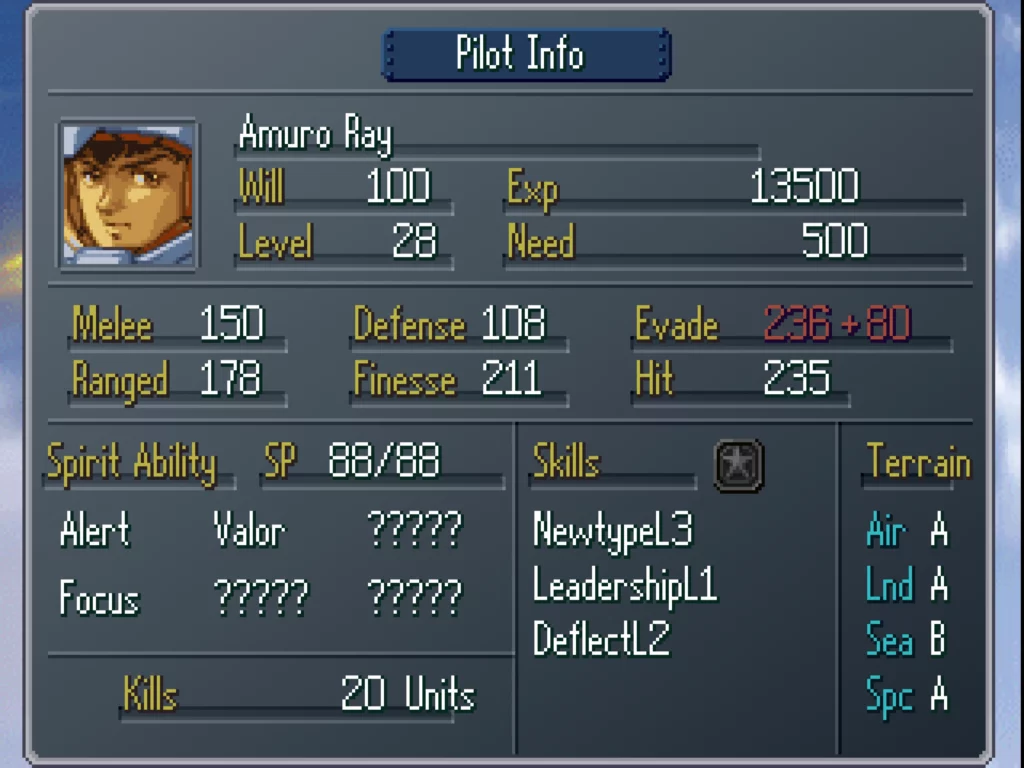
Still, there’s no sense in simply ignoring Limit and compromising your Evade. While looking at a pilot’s status screen, their Evade will be displayed as the same equation used for checking Limit: Evade + Mech Mobility.
Unfortunately, you do have to do the math in your head—sort of. If a mech’s Mobility exceeds its Limit, i.e., the only thing you care about, the equation text will be colored red. That means it’s time to raise your Limit, ideally to where the text becomes white again.
Simply check your pilots during each intermission for any red text, and raise Limit appropriately. Raising Limit in advance can help for avoiding going over the Limit from mid-Scenario level-ups, but this would only temporarily let you avoid a reduction of Evade in the single digits. It’s just not very important to be that attentive.
Pushing the Limit: The Despicable Lies of Pilot Skills
That is, unless, we’re discussing a pilot with the Newtype, Artificial Newtybe, Cyber Newtype, or Psychic (TK/ESP/Telekinesis) Skills. All of these Skills increase a pilot’s hit and evade rates relative to the Skill’s level; the higher, the better. However, Alpha Gaiden incorporates them into its formulas in an odd way.
Instead of these boosts being final adjustments to your battle forecast’s displayed hit and evade rates, they are actually invisible stat modifiers for the pilot’s Hit and Evade stats. Because these bonuses are not counted in your pilot’s status screen, the game will not tell you when your true evade exceeds your Limit stat, thus obscuring when you optimally should upgrade your mech’s Limit. Keep in mind that Limit does not determine a pilot’s Hit in any way, so there’s never any Hit “loss/waste” to worry about.
Here’s an example:
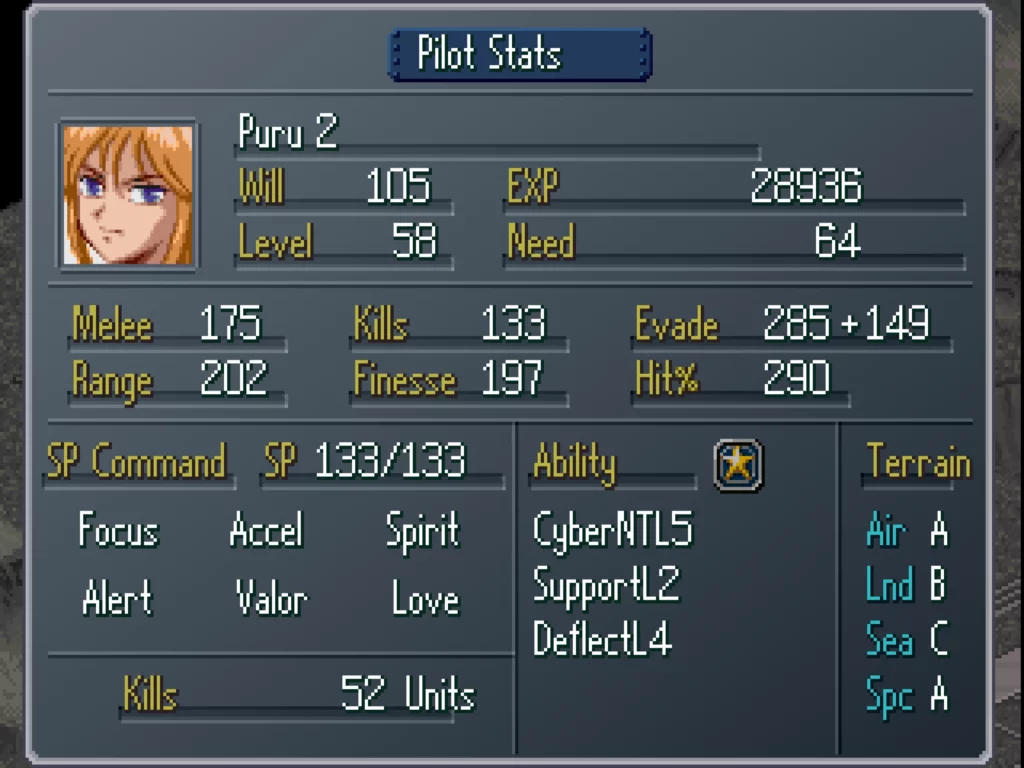
Puru 2 is piloting the Hi-Nu Gundam, and she has the Cyber Newtype Skill at level 5. According to her status screen, her projected Evade stat is under her mech’s Limit stat. This should mean that none of Puru’s Evade stat is being wasted, as it’s not exceeding her mech’s current Limit of 446. All is right in the world of Super Robot Wars… or so it seems.
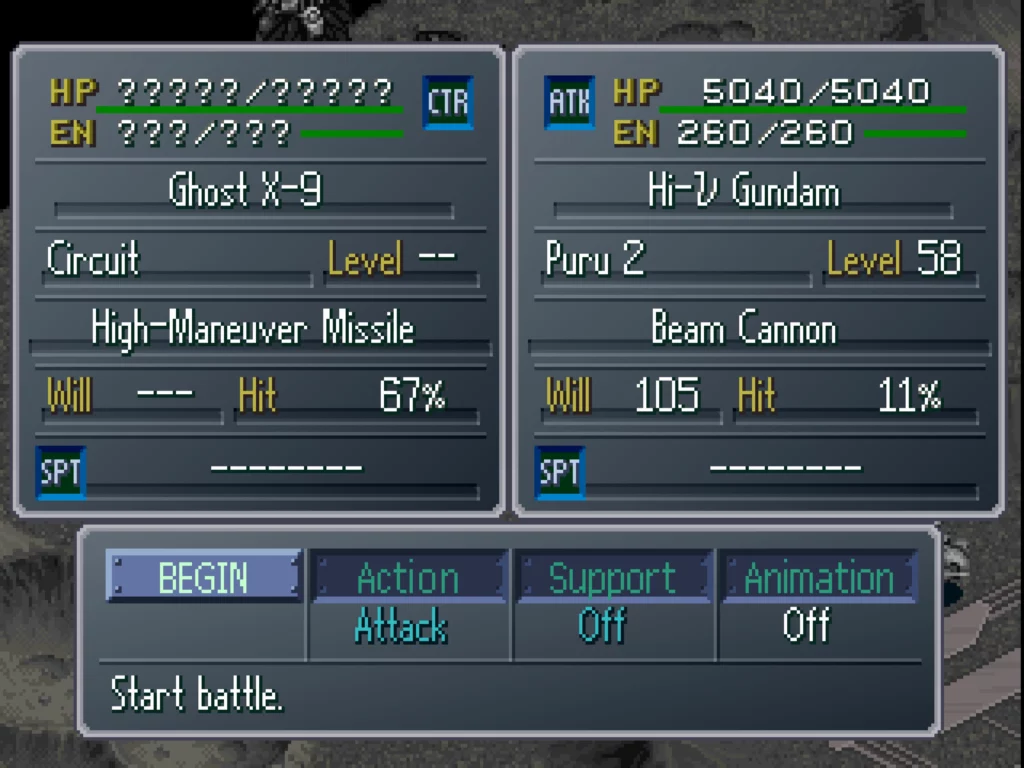
Let’s take her out for a spin and target this Ghost X-9 enemy. Uh oh! It has a favorable chance of hitting Puru 2 at 67%. The Ghost X-9 is an extremely agile enemy, so it may not seem inappropriate for it to fare well even against a Newtype. Many players would not sense anything was amiss. However…
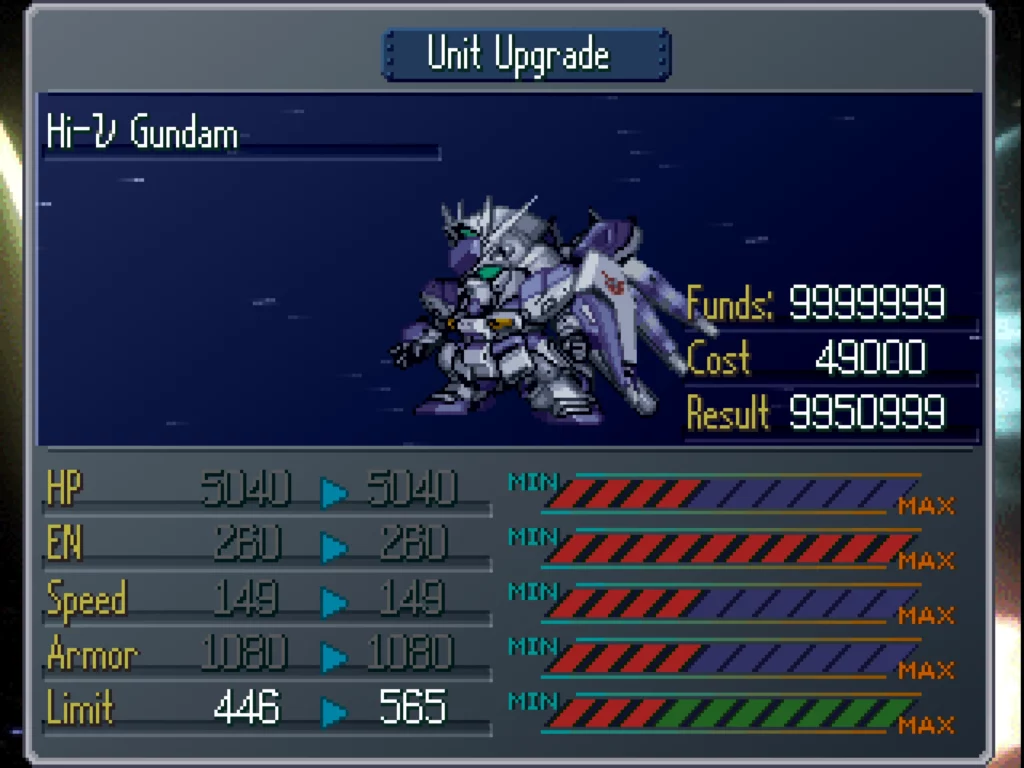
We’ll upgrade and max out the Hi-Nu Gundam’s Limit stat. On the face of things, this would be pointless beyond providing Puru 2 a huge preemptive buffer for when her Evade increases, either due to leveling up or upgrading the Hi-Nu Gundam’s Mobility stat. But what happens when we target that Ghost X-9 under otherwise the exact same conditions?
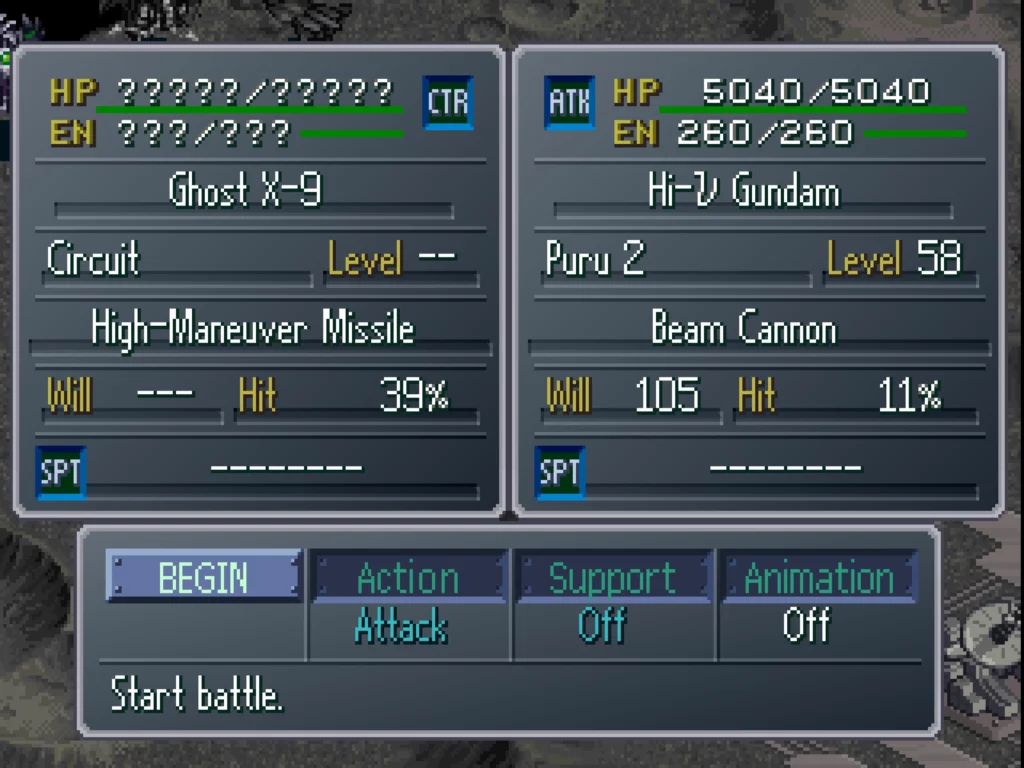
Jiminy Christmas! Its chance of hitting us was nearly cut in half! Oh, we were all lied to. How could they.
So, yeah, if you’re using a pilot with any of the aforementioned Skills, you’re going to want your Limit to be higher than it would normally be; an addition equal or greater to the boost your Skill provides. If Cyber Newtype gave 5 Hit/Evade per level, and I had level 5 of the Skill, then I would want my Limit to be at least 25 higher than the minimum needed to make my status menu’s Evade stat display as white text.
At least, this is my pending explanation. I haven’t hashed out the exact numbers involved, but it’s obvious that Limit does more than what it portrays. If it needs to be said, this means Newtype etc. pilots are even better than you might think, provided their Limit is upgraded appropriately.
Splitting and Combining: Better Than You Think
While mechs are generally stronger while combined, splitting allows for a great number of strategic options; you don’t even necessarily have to give up the combined form to utilize these tactics.
In Alpha Gaiden, a combined mech can take an action so long as its main pilot has not yet moved. Because of this, you can Split a mech, have its components take actions, then have the leader Combine (provided they are still adjacent) and move and/or attack.
There are a ton of ways to exploit this, so bear with me.
- Movement. Some mechs, such as Getter G, have components with greater Movement than its combined form. A mech like Getter G can therefore Split at the part of its turn, move its typically sub-pilots first, then move its main pilot and Combine at the end of their action. This effectively gives the Getter G 7 Movement instead of 6, so long as it doesn’t need to attack, as it’s not possible to move, combine, and attack in the same turn in @G.
Keep in mind that flying units consume 1 EN per space travelled, so you can potentially expend more EN than you’d like from moving multiple units instead of one, as the combined unit’s EN is partially based on the EN of its components. - Repair/Resupply. Certain combined mechs, like Combattler V or Voltes V, have either a Repair or Resupply module on one of their components. It’s possible to Split at the start of a turn, Repair/Resupply a mech, then Combine to take your normal action at no cost. This effectively gives these mechs a slight, built-in HP Regen. Of course, you can Repair/Resupply other mechs as well.
- Support Attack. If you start a turn where units aren’t ideally positioned for a Support Attack, you can Split your combined unit and have one of the components initiate an attack while next to a unit with Support Attack to get in some extra damage. If Voltes V wants to be directly next to an enemy to use its strongest attacks, but its the only unit close to someone with Support Attack, this technique allows you to enable that Support Attack without giving up Voltes V’s own, stronger attack.
- Split attacks. This one’s pretty basic, but easy to overlook. As a combined unit’s action is only taken when the main pilot acts, acting without using the component units is effectively wasting their turn(s). It’s technically optimal to Split, have every component attack (or whatever else), then Combine. It’s potentially free bonus damage at virtually no cost.
- Split shenanigans. This is more of an odd byproduct of how Split works. In order to prevent some Movement exploitation, the game will remember where each component was positioned before combining, until the combined unit has moved, which resets the Split components to their default positions (usually a cross or line shape).
This can lead to some weird behaviors, but rarely anything practical to take advantage of. For instance, let’s say Combattler V combined after all of its components were arranged in a diagonal line, and that Combattler V didn’t move to reset that positioning. On the next turn, it could Split, and all components would be in that same line formation. Since Combattler V has five units, any non-main component could potentially be as many as nine spaces away from where it would normally be after Splitting, potentially doubling its Movement before it has even taken an action that turn.
Taking advantage of this requires a considerable amount of forethought for what’s rarely that impactful, but it’s worth keeping your options in mind. - As an addendum to the above, you can use component mechs to grab Containers, visit Mountain Cycles, and other such busywork. At times, this is preferable to expending more, stronger units to do these jobs. Sometimes, you can even do these for free! If a space you need to land on is within a number of spaces equal to one less of the number of your component mechs times two (because of diagonal positioning), you can Split, have a component land on the space, then draw a line between that unit and the Combined main pilot, and have the main pilot Combine while still being able to take an action. It’s as if you didn’t even have to give up a turn!
- To avoid losing Will on your Combined mech’s main pilot when docking, Split and dock your components onto your battleship, and let them recover HP/EN instead. If you want to maximize your recovery and don’t mind the Will loss, go ahead and dock the main pilot’s unit as well.
- Lastly, you can manipulate the Split formation by having non-component mechs occupying spaces that those components would normally be on after Splitting. This forces those components to occupy a different space, as there has to be somewhere for them to go. By doing this, you can do some pretty funky things with positioning, but since you’re often giving up the turn of units stronger than the components, this isn’t always useful. If you can do this without compromising your offense or positioning by moving and attacking, however, you can exclusively benefit from this quirk.
While attacking with components, keep in mind that they tend to be extremely frail. If you can’t virtually guarantee a component unit will survive a counterattack, it might not be a good idea to have them attack, even if it otherwise means you’ll waste a component’s turn. It’s up to you to properly assess the risk of each potential action.
The Bazaar
After a certain Scenario, players can access a new intermission menu option, “Bazaar.” This is a shop where Blue Stones can be exchanged for Parts and even new mechs. Nearly every mech sold through the Bazaar is worse than what the game gives you for free, but if you have a personal favorite “generic” mech, this is an opportunity to use them.
The Parts and mechs that are sold change after each Scenario. Check back often, as buying Parts can be very useful.
You have a limited number of slots to hold Bazaar mechs, and if you reach full capacity, you will have to sell a mech to buy another one.
DO NOT EVER stay at full capacity. This has been purported to cause game-breaking bugs that prevent progress. Always stay AT LEAST ONE MECH BELOW full capacity.
Units Sell at Full Value
While Parts sell at a fraction of what you paid for them, similar to most shops in RPGs, units sell for the exact amount they’re worth. This means that there’s essentially no downside to buying units, as if you decide later that you want the Blue Stones, you can simply sell it back at no loss.
Of course, this doesn’t hold true for Funds spent on upgrading a Bazaar mech, so keep that in mind. Otherwise, feel free to upgrade your grunt mechs (especially Walker Machines) the moment you see a superior Bazaar mech. Likewise, mess around with these units free of cost (other than using a deployment slot on something so weak…)
Misconceptions
Hovercraft (Part)
I’ve heard people claim that the Hovercraft removes movement costs while on land, but this isn’t the case. Equip a Hovercraft to a unit of your choice and see how far it gets you in a stage with dense forests, such as Scenario 21; you’ll barely be able to move.
Frankly, I’m not entirely sure how this Part works. I just know that it’s incorrect that it eliminates movement penalties. I assume it at least reduces penalties, but to what extent, I have yet to test.
Hovercrafts do allow you to avoid diving in water, essentially treating it as neutral land terrain. Since you aren’t in water, you’ll have full movement range. However, units with a Hovercraft outright lose the ability to submerge in water, thus also preventing them from using Support Attack or Support Defend on underwater allies.
Leave a Reply