








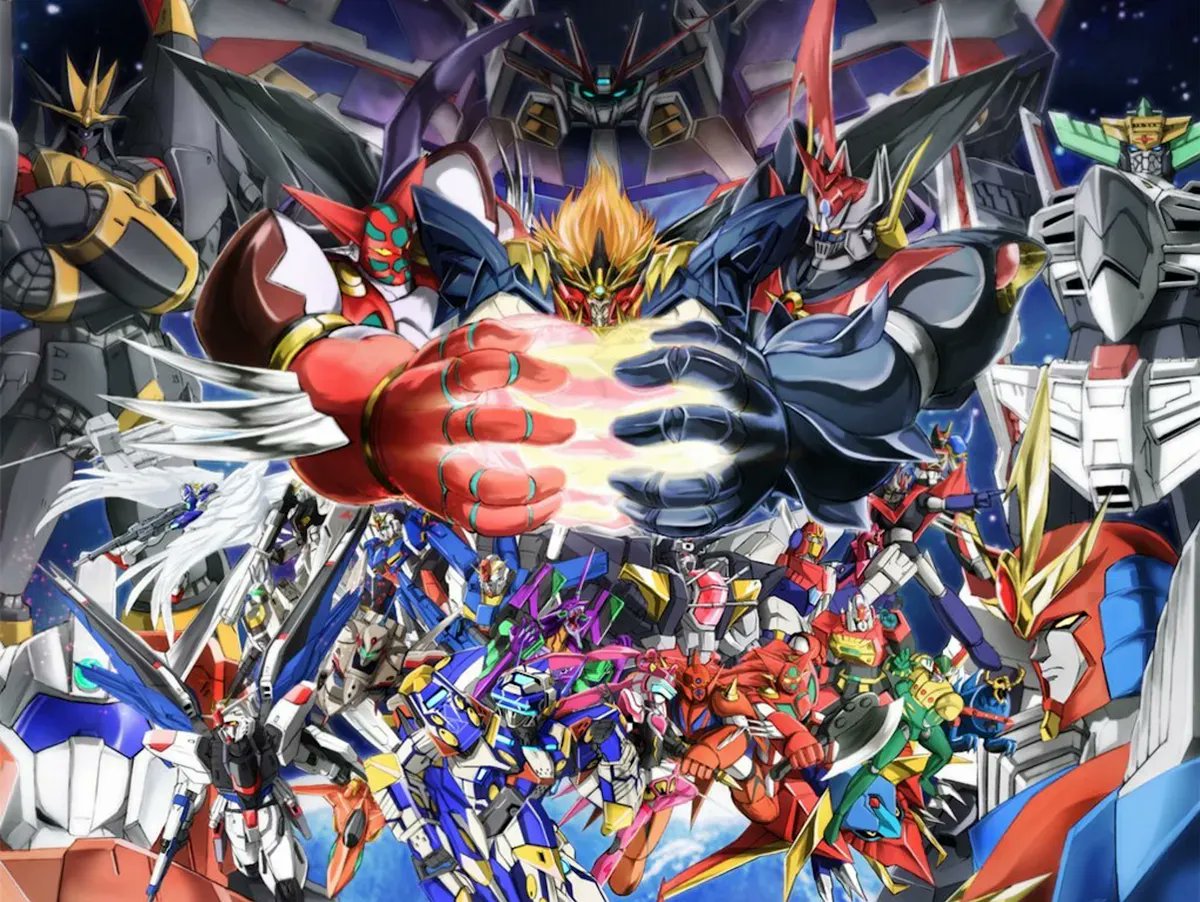
This is a general guide for the Super Robot Wars (SRW) franchise containing fundamental advice meant to assist anyone of any skill level with nearly every Super Robot Wars game.
While some Super Robot Wars games have unique mechanics and/or alterations to existing mechanics or formulas, they have shared more commonalities than not across their many titles. Most of what you read here should hold true for almost every game in the series. The extent to which some advice is necessary might change, but that’s roughly it. Naturally, the largest exceptions are SRW games in entirely different genres. I imagine this page won’t be helpful for people playing NEO, Super Robot Pinball, etc.
This guide is always in the process of being updated. Keep checking back for more! Feedback is welcome.
Glossary (Abbreviations, Acronyms, etc.)
Click any word or term to see its definition.
The Big 3 (TB3):
This refers to three pilot Skills: SP Regen, Attacker, and Concentrate. In any game where these Skills exist, acquiring them should be your top priority; especially SP Regen. The recommended priority of the latter two is more debatable. I’d say go for Attacker if your specific SRW has lots of fleeing bosses that require you to defeat them in single, high-damage attacks, or other such secrets related to your raw damage output. Naturally, Attacker is less relevant for support-oriented pilots who prefer to assist by using Spirits and/or Repair/Resupply modules, so you can consider forgoing Attacker for them. Still, damage is damage, and support pilots often have the Support Attack Skill, so any increased damage on their end pays dividends.
Real Robot (RR):
Refers to a particular type of mech, and the finer details of the term vary heavily based on the context in which they’re used. In a gameplay context, “Reals” tend to be relatively small, light and agile units that easily evade enemy attacks. To compensate, they often have low Armor and general durability when compared to their “Super Robot” counterparts. In the context of mecha anime, some IPs are categorized as “Real Robot” anime. These are known to focus more on science-fiction elements in their writing, as well as having a greater emphasis on interpersonal drama. The tech of these IPs is usually portrayed relatively realistically, with theoretical explanations given for how their machines and energy sources function.
It’s important to remember that these are just stereotypes and not strict rules. Very often, mecha anime will feature traits from both Super and Real Robot anime, though they may subjectively lean more towards one side than the other. This applies to gameplay as well. Some units might be classified as Super Robots based on their aesthetic stereotypes, but in gameplay have high agility and light armor, and vice-versa. Keep in mind the context in which “SR” and “RR” are used, and remember that they are mostly just rough guidelines of things sharing common traits.
Super Robot (SR):
Refers to a particular type of mech, and the finer details of the term vary heavily based on the context in which they’re used. In a gameplay context, “Supers” tend to be relatively large, tanky units that can take a lot of damage and dish out the same. To compensate, they often have low Movement, Mobility, and require EN and high Will for their attacks when compared to their “Real Robot” counterparts. In the context of mecha anime, some IPs are categorized as “Super Robot” anime. These are known to have less science-fiction elements in their writing, with mechs being powered by abstract things like willpower and emotions. In contrast to “Real Robot” mecha anime, SR anime are commonly more action-oriented and aimed at younger audience.
It’s important to remember that these are just stereotypes and not strict rules. Very often, mecha anime will feature traits from both Super and Real Robot anime, though they may subjectively lean more towards one side than the other. This applies to gameplay as well. Some units might be classified as Super Robots based on their aesthetic stereotypes, but in gameplay have high agility and light armor, and vice-versa. Keep in mind the context in which “SR” and “RR” are used, and remember that they are mostly just rough guidelines of things sharing common traits.
Mechs
Upgrading Mechs
With rare exception, upgrade bars follow a pattern: each “bar” increases that mech’s stat by a percentage of its current value. This is extremely important, as it means your stats have exponential growth—the more you upgrade them, the more powerful each upgrade is. You can think of this as a “snowball effect,” if it makes things more clear. If you upgrade a mech’s stat that has a naturally high base value, it will receive appropriately big gains.
There are caveats to this, but they are rarely significant enough to go against the general principles behind optimal upgrading. For one, your exponential growth might be limited by a certain stat only having a small number of upgrade bars. Also, some games use an upgrade formula that results diminishing returns in order to offset the snowballing stat gains. Past a certain number of bars, gains may go from 5% of the current stat to 4%, for example. This usually doesn’t stop the increase in dividends, but rather just slows it down. In other words, it’s nothing to majorly change your habits over.
Don’t Go for a “Balanced” Approach
Because of the above, for almost all mechs in any game, you are best off upgrading them based on their strengths. Tanky, slow units should have their HP and Armor upgraded while their Mobility goes entirely ignored, and vice-versa. There is no point to upgrading an SR’s Mobility if the enemy’s hit rates will still always be over 80%; it’s entirely wasted Funds. Use your Funds to make your mechs’ performance more predictable. Make yourself confident that when they take a hit that you expect them to, they survive it. Know that if they can’t survive a hit, that they are able to dodge it. And if a mech rarely uses EN, you can likewise ignore it.
Now, there are some mechs that are almost perfectly balanced between agility and endurance. While it’s more acceptable to spread out your upgrades on these, I would still advise staying in one lane. Which you choose depends on other factors. Does your pilot gain more Will from being hit or by dodging? Upgrade Armor for the former, and Mobility for the latter. If your balanced mech comes up short in a stat when compared to your most defensive or agile units, use Parts to push them over the edge.
Of course, one good reason to upgrade all of a mech’s stats is to receive its Fully Upgraded Bonus. More on that later.
EN Is Massively Undervalued; Take Advantage of That
When you’re considering what to spend your Funds on, EN (Energy) should be your top priority. The biggest reason for this may be because EN often has the best Funds-to-benefit ratio. That is, you get more out of increasing EN than you do other stats, and you spend less money for it too. EN is typically ridiculously cheap to upgrade. It’s not uncommon for even an early Scenario’s Funds to pay for a mech’s entire EN upgrade bar. You’ll almost never be able to do that for HP, Mobility, or Armor.
As you might expect, upgrading EN is most useful when it comes to being able to repeatedly use strong, heavily EN-dependent attacks. The ability to do so can overlap with justifications for upgrading other stats. For example, if you’re able to more frequently defeat enemies thanks to increased use of your strongest attacks, then you’re necessarily taking less counterattacks, which lowers the need to upgrade your HP, Mobility, and Armor.
Now, this rule of thumb isn’t universal; not all mechs rely on EN to the same degree. Check your mech’s weapons. Many RRs utilize ammo-based attacks, and sometimes exclusively so. For those units, EN would be a virtually useless expense. Maybe they only have one or two EN-based weapons and use them so rarely that they aren’t often in need of more EN.
On the other hand, mechs can sometimes guzzle EN outside of what they use for weapons. Various Barrier Abilities consume great amounts of EN, and that could justify investing in EN, even if none of a mech’s attacks use it. And of course, mechs sometimes want to max out their EN simply to reach their FUB—relevance of EN be damned.
Just consider the stats your mechs use the most. If you’re ever in doubt as to what to spend your Funds on, default to EN. It’s so valuable relative to how much you pay, that it might as well be free.
HP vs. Armor
As both of these stats affect a mech’s durability, it might be hard to decide which one to prioritize. Your defensive units will want a little of both, but there are ways to determine a preference. HP is particularly useful for pilots with the Potential Skill, which increases various stats as a mech’s HP lowers. This is based on percentage of remaining HP, so more HP increases the “buffer” you have for the Skill to kick in.
Potential also is only updated after taking damage. That is, if you go from 100% to 0% in a single attack, Potential never activates and is wasted. As Potential increases your defensive abilities the more HP you lose, you can also offset not having upgraded your Armor, as long as your Skill level for Potential is high enough, and if you have enough HP to continue going over Potential’s HP thresholds without suddenly dropping to 0 HP. It’s a balancing act.
Armor is best on units who make heavy use of terrain. Your units should be landed most of the time, as I will rant about later, but some are more keen on it than others, like those that outright cannot fly. Defensive terrain increases your defense by a percentage of your Armor, so you gain a bigger boost with a larger Armor stat. Terrain effects can be immensely powerful, so using Armor to get even more out of them is a wise decision.
Pilots
Pilot Skills
In SRW, pilots typically come with various Skills that give them specific advantages. These Skills can be used when determining which mech best suits each pilot, and how a pilot or mech ought to be used strategically. A pilot’s Skills are often far more important than their stats.
Eventually, SRW games began to allow players to give their pilots additional Skills. The methods for doing this vary across games, but the optimization principles behind deciding which pilot receives which Skill have remained consistent. Skills names and effects are usually reused between games, though their names sometimes change depending on translation choices or storyline context.
Not all games have all Skills. Even newer entries might have removed previous Skills due to game balance concerns. Keep this in mind while reading this section.
The Important Ones
As with any game, there are always Skills that are considered to generally be the most useful. With extremely rare exception, the top tier of Skills ought to be prioritized for every pilot. These are:
SP Regen: Restores a small amount of SP per turn (usually 10). Spirits are the most powerful tool in your arsenal, and Skills that allow you to use them more often are naturally valuable. Unequivocally the best Skill.
Concentrate: Reduces Spirit costs to 80% of their original value. Same logic as SP Regen; it’s just not functionally unlimited SP. The extent to which this is necessary varies depending on how dependent a pilot is on costly Spirits. It’s especially good on pilots with Soul or Drive, for example.
Questionable Skills: More Harm Than Good?
Counter: Counter gives a pilot a chance to attack their enemy first during a counterattack, dependent on the Skill Level of Counter. On paper, the value of this Skill is logical; if you hit the enemy first, you might defeat them, thus saving you from taking damage while still making progress fighting enemies.
If that was all there was to it, Counter would be a fine Skill. However, Counter runs contrary to how Will gains work. Many pilots gain Will by being hit or dodging an attack, and neither has the chance to happen if Counter triggers. This negative influence can add up over the course of a map, and may prevent you from being able to use your strongest attacks when it really counts.
Even if that’s not a concern, having higher Will results in more damage across the board, so it’s a net benefit to get it as high as possible, as fast as possible. For this reason, I recommend almost never purchasing Counter, and even removing it from certain pilots.
Assigning Pilots to Mechs
Default Isn’t Always Best: Don’t Be Afraid to Experiment
It’s generally true that a pilot’s default (or “canonical”) mech will suit their specific stats and abilities, and that you’re usually safe sticking with them. However, it’s very common that these default placements are not optimal, whether it be in regards to the pilot’s ideal mech, or the mech’s ideal pilot.
There are numerous subtle ways in which the two can be incompatible. Let’s consider a few.
- Will gains: This is a big one. Sometimes a pilot will default to a mech that is poor at dodging, but they gain more Will from dodging than being hit, which results in lower Will over time and decreased damage output. As most games hide a pilot’s Will gains, this can be easily overlooked despite it having a significant impact on pilot/mech performance.
- Skills: A pilot’s Skills might not suit their default mech. Consider, for example, Hit & Run on a pilot placed in a mech with short-range, post-move attacks. In this case, the opportunity to use Hit & Run will rarely come up. Meanwhile, Hit & Run is a Skill that’s high in demand for many long-range mechs.
- Stats: This is a basic one, but important nonetheless. A pilot’s default mech could be almost entirely Melee weapons, while the pilot has a much higher Ranged stat. Same goes for Defense vs. Evasion and so on.
- Spirits: This is also important. Spirits like Drive to quickly increase Will become wasted on a mech with little to no Will requirements. Persist is preferable on mechs that dodge well, as it isn’t immediately used up like Alert. Accel saves you a Part when it comes to fixing a mech’s low Movement, etc. If you have a mech that has some difficult-to-manage traits, a pilot’s Skills should be where you look first.
Terrain
Land Your Damn Units
One of the most common mistakes I see players commit is never “Landing” their flight-capable units. To be fair, most SRW games default flight-capable units to “Flying” status, and many players simply don’t bother messing with default settings. However, it’s almost always better to be on Land than in Sky.
However, landed units can gain a monumental advantage when compared to flying. Flying units don’t receive any terrain effects from the tile they are on, and these effects are typically beneficial. Forest and mountain tiles are extremely common, and landing a unit on one of these files frequently nets you about an additional 20% to both your Evasion and Armor.
To put that into perspective, this basic terrain type gives you nearly as much Evasion as using the Focus Spirit. Combining these boosts can put your units into nigh-unkillable territory. Moving units that are flying also costs 1 EN per space moved. While this is typically negligible, it’s not that uncommon for a unit to find itself unable to use its preferred attack one more time due to expending EN from flying.
Flight should usually only be used when needing to move long distances, or when accounting for terrain rank. Flying units ignore decreased movement from “rough” terrain, such as forests and mountains, which often allows them to travel their entire movement range. However, unobstructive, basic terrain like plains may still offer a small bonus to Armor/Evasion. In that case, it is still purely beneficial to be moving on Land. Even if no bonus is given, a unit with an equal rank in Sky and Land will still conserve EN by not flying.
Some units also have better terrain ranks in Sky than on Land, which can offset the advantage gained from terrain. For example, a unit with an S rank in Sky and an A rank on Land will usually receive an extra 10% to their Armor and Evasion. If the Land terrain offers a bonus of less than 10%, then the unit is likely better off flying.
Another fundamental convenience of being landed is compatibility with Support Attack/Defend. A unit supplying a Support Attack/Defend must be capable of being on the same terrain as the unit it’s assisting. Not all units capable moving on land can fly, but nearly everything that can fly is capable of landing. Therefore, by being on land, you increase the likelihood that your units can provide Support to their allies.
When I start a map, the first thing I tend to do is land every one of my units, because it’s almost always better to be on land. I suggest you do the same, while also learning which situations are more suited for flying.
Water Is Your Friend, Not Your Foe
I think a reliable litmus test for an SRW player’s experience is how they react to seeing water terrain. If they recoil, they might have some learning to do. Of course, it’s always somewhat understandable; water terrain can be annoying. Water often slows your units down, making maps take longer to complete, and it renders some mechs and weapons horribly ineffective.
However, the player has a huge advantage concerning water when compared to the enemy: they can actually do something about it. Whereas enemies are at the mercy of their compatibility with water, players can take advantage of this weakness by improving their terrain ranks and/or picking and choosing their combat engagements.
This all comes down to water terrain ranks having the greatest disparity of all terrain ranks. On land, the vast majority of units have an S or A rank, and it is exceptionally rare to see a C or lower. With water, every rank letter can be seen on some unit or another. It’s your imperative to take notice of which enemy mechs and their weapons perform the worst in water, then engage them with your units that have tolerable water ranks. Your unit having a B rank in water compared to the enemy’s D rank is a massive difference that should not be overlooked due to a B rank being unexceptional in most other terrains.
Seriously! Player units on average tend to have higher default water ranks, partially due to generic enemy pilots having horrendous water ranks. Water has incredible defensive properties even for units without S ranks. If you equip your mech with a terrain rank-boosting Part, such as a Water Jet, your unit will basically be a god while they’re in water. S ranks are always valuable, but again, it’s often a difference of an S to an A, not an S to a C or D. Abuse water! Do it!!! Now!!!
Of course, sometimes there aren’t enough resources to make all of your most hydrophobic mechs functional in water. If you only have one Water Jet but multiple of your units have entirely beam-based weaponry with D ranks in water, then yeah, some units won’t contribute as much on a water-heavy map. Take note of how adaptable your units are with water before assigning a water jet. Is it a typically evasive mech that will have its performance plummet in water? Maybe that’s a priority then. Is the unit’s strongest weapon beam-based, but its second strongest weapon has a B rank in water? Maybe that mech’s fine without a Water Jet.
Some SRW games’ auto-selection for weapons during counterattacks do not reference terrain rank. Keep that in mind, because you will have to manually select a better-performing weapon for each battle when playing those (usually older) titles. More commonly, enemy AI is too dumb to realize when poor water ranks make its attacks ineffectual, which is another reason why defaulting to water terrain is just good practice.
Having movement problems because of your mechs being incompatible with water? Board them on your battleship and have it ferry them across! Yes, it costs 5 Will, but they’ll gain much more Will by not being out of the action for as long. Battleships often have good water ranks, so not only can they move more spaces, your units also might be especially safe while in one.
Leave a Reply