








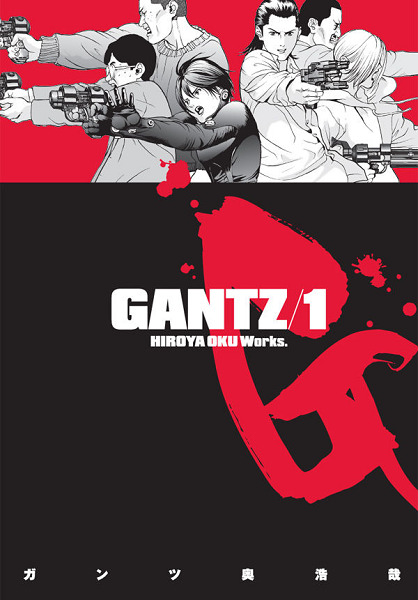
Gantz
MAJOR SPOILERS
The final arc kind of sucked. It was the bland, hollow action I’d seen Gantz criticized for, but correct for once. It was really hard for me to not dock the score another point just because of how limply the story ends.
The mysteries the world of Gantz sets up are so intriguing, but the final arc takes the blandest explanation to absolutely everything. The supernatural elements introduced earlier such as telekinesis and vampires have no resolution within the plot, and therefore feel like a sloppy mishmash of influences that don’t fit into the setting by the end.
Prior to the final arc, there was a feeling of mounting chaos that allowed for just about anything to appear justified, and the surreal insanity and willingness to go anywhere made it feel like the author could come up with some unique conclusions to everything. But the series culminates in a save-the-world from aliens plot that’s shockingly basic. Moral treatises about how neither species is inferior or superior, aliens that are 90% identical to humans, it’s all so stock.
This coming all after completely unpredictable aliens that actually felt like foreign creatures that couldn’t be communicated with. Out of the many unanswered questions, one of the foremost on my mind is why nearly every alien species that was shown is based on human pop culture. These are migrants from across the galaxy, but they’re inexplicably dinosaurs, yokai, and onis? Props to the dinosaurs for getting to other planets somehow, even if they apparently needed to come back and populate Earth again. Fucking hell.
The prior arcs were about using wits to survive, and anxiously getting attached to characters you knew could be gone in a second when the series quickly established that it would pull no punches. The reactions from characters to their situation felt realistic, and that was crucial to the sense of involvement in the story to where you find yourself asking what you would do in the same situation of entrapment. By the end, every character is an unstoppable super ninja, there’s no conflict between the characters anymore, and we know the explanation behind previous events. Now everything is just Hollywood gore and explosions that can’t distinguish itself from the numerous alien invasion flicks.
It’s just such a letdown. After 30 or so volumes of being unpredictable, everything goes in the most obvious, basic direction possible. It barely even feels like the same series. My high score represents the peak of my enjoyment in the series, where I empathized with Kei’s insatiable inferiority complex as well as his desperation and fear, and I tensed up at every threat of failure and the inevitable failure itself. And through it all were twists that made the setting even more compelling. There was a suggestion of something deeper in Gantz for a long time, but a suggestion was all it turned out to be.
Also, the art is a fucking incomprehensible splotch of black on black on black on black on black by the end. I could spend up to a minute or two trying to follow the movements of an action scene or figuring out what I’m supposed to be looking at since the abundance of pitch black dark shading over extremely busy backgrounds erased all three-dimensional depth.
How fucking out of character was it that Kei and everyone else just completely forgets Kishimoto existed? Instead, Kei wastes a revival on a psychopath who has always been a dangerous element at worst and worthless at best. What is in character, however, is that Nishi supplies virtually nothing towards anyone’s interests. Because that’s what he always did. But no one calls attention to Kei’s stupid decision or brings up the possibility of reviving Kishimoto. I seriously cannot wrap my head around how little she was on everyone’s mind despite numerous chances to revive her.
Also, introducing a way to revive people was a terrible plot device that undid emotional sacrifices. It also makes no goddamn sense. If Gantz can infinitely revive people without cost, why is an alien invasion even the slightest bit of a concern? Why aren’t people just being revived endlessly? This has nothing to do with Nishi bombing the HQ, because a transfer to the mother ship near the end reveals the black balls still have the power to heal all wounds, and someone states those who died in the final battle can be revived after a transfer. It begs an explanation.
This overlaps with how we get next to no insight into the motivations of the Earthlings who manage the death game, so we can’t even so much as infer an explanation to any of these things. Are they just sadists who love watching humans struggle? Then why are they shown several times to have their main interest be winning the war against the aliens? If their main motivation is winning the war, why aren’t they constantly healing and reviving their soldiers? If the war is lost, we’re lead to believe all of humanity is going to die.
Having no confrontation with the bureaucracy behind Gantz and everyone’s suffering, the true villains of the entire series, is perhaps the worst thing about the plot. And the grain of comeuppance we do get is done by the one person who got the most enjoyment out of their actions with complete disregard for the damages, Nishi. Awful ideas.
Gantz/Nishi
Nishi is bar none the worst character in Gantz: a two-dimensional psychopath with no redeeming qualities who inexplicably gets so much time devoted to him and a bunch of second chances that lead to nothing. Here’s another second chance that leads to nothing. Nishi is just as uninteresting as he always is, and the author’s inscrutable interest in him resulted in both some of the most baffling moments in the series, as well as this throwaway one-shot.
Gantz Origins: Oku Hiroya and SF Movie Stories
Hiroya Oku talks about how watching Back to the Future, apparently his first movie at 19 years old (?), changed his life forever. Great movie, but this anecdote isn’t terribly interesting to me as a reader of Gantz. I can’t exactly see a connection, beyond them both loosely being science-fiction, and Gantz wanting to be a Hollywood blockbuster by the end. Unfortunately, Gantz wasn’t as good at it.
Leave a Reply