





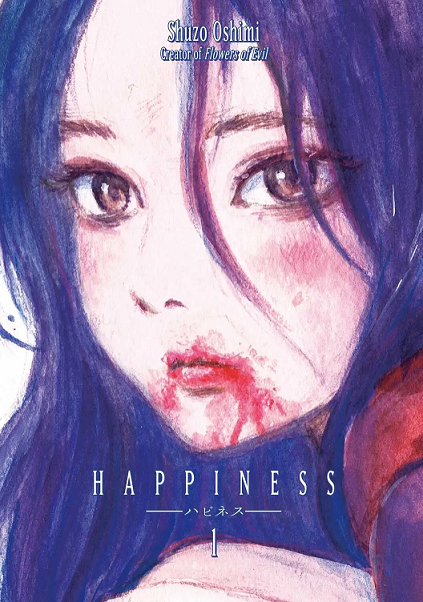
Happiness is surprisingly (and disappointingly) shallow by my standards for Shuzo Oshimi. Vampires are a subject that combines easily with sexual subtexts and themes, yet that potential is squandered by a man whom in the past had among the most tactful and realistic usage of sex I’ve seen in Japanese anime/manga.
In Happiness, the sex psychology is never more than mere window dressing at best. It’s touched upon, particularly in the early chapters, making you think that there’s going to be some metaphorical or symbolic use of vampirism and blood to denote burgeoning pubescent lust and other bodily fluids. But none of this goes anywhere.
Try as I might, I can’t draw any consistent link between sex and the base vampire story, making it totally shallow. Again, the last thing you would expect from this author. The main character doesn’t undergo any sexual transformation either, being as naively romantic at the end as he is at the start.
This would be a forgivable letdown if the new thematic focus was handled well, in this case, the vampire transformation, but it isn’t. The first half of this manga contains a compelling fast-paced thriller with constant answers and new mysteries, and as usual seeing one of Oshimi’s pitiful protagonists blossom into someone with inner strength is endearing, if rote by now.
Even this high point of the manga struggles with balancing its action and suspense with character drama, and relationships are developed at such a breakneck speed as to make them less personal and believable when compared to his former, stellar work, Flowers of Evil. The dialogue still excels at feeling natural, which makes the characters compelling at a base level, but there’s a complexity and nuance missing that makes them difficult to identify with. Fun to watch, not so much to actually think about.
Perhaps this lack of focus was inevitable considering the chimera of genres on display, with Oshimi’s previous works being pure dramas all plot development was directly tied to the growth of the characters. There was no need to dedicate any precious time to action scenes or an overarching narrative. You had compelling characters in various combinations trapped in one room, and you watched them grow off of each other constantly. This isn’t an excuse, however. Oshimi still made the decision to bite off possibly more than he could, and everything suffered for the ambition.
It’s sad to say, but I don’t think Happiness even goes as far as to be an interesting departure worth the abandonment of previous storytelling strengths. It just kind of languishes around being unexceptional in every department. I would never call it mediocre, as it succeeds in many ways at being pure entertainment, but it fails to prove Oshimi to be a master of any new genre. A swing and a miss.
There is one category in which Oshimi shows remarkable improvement, however, and it’s in the place you might expect the least. Oshimi’s art has always depicted a sort of bland realism. That’s not a critique, as it always meshed perfectly with his honest depiction of the world in his writing, but his art rarely ever elevated his material. That changes in Happiness, as Oshimi expands his artistic palette to convey abstract feelings through sheer imagery.
It’s such a stark evolution that it can almost feel like Oshimi is showing off for the sake of it, yet the shifts from his typical art style to new directions is done tastefully to create a contrast between the human perspective and a second reality visible only to vampires. One of the more blatant displays of the latter is how obviously Oshimi recreates Van Gogh’s A Starry Night to convey the new, alluring twilight, but as fun as that is, there’s more general, less derivative growth in his illustrations as well. Intense emotions are drawn with such heavy, violent sketch work that it almost goes too far in taking you aback. Perhaps it would for anyone else, but I was too amused by seeing Oshimi pushing himself to mind.
It’s overly dramatic, but because this is a thriller story that needs brief, less developed emotions to feel effective, it needs to overcompensate to some extent. Lastly are the rare occurrences when Oshimi nearly becomes Picasso, distorting the human form with such a lack of restraint that the images provided genuinely evoke disgust and discomfort, as they always intend to do.
Much of these dynamic stylistic shifts can be called superfluous, but it still stands favorably against the other attempts at broadening his material (such as genre), as he can sometimes gain a type of expression he’s never had up to this point. With more refinement, particularly when it comes to tactful usage, these new art styles could serve him well as an artist and writer. This much, I hope he continues to work on.
Going back to what I said earlier, the first half of Happiness is a very engaging albeit shallow thriller about a vampiric transformation coming at the cost of humanity. As a horror fan, it all feels familiar, but I have a particular fondness for stories about alienation. After the halfway point, this goes from a personal story about the main character into a generic battle of good and evil centered around a character whose development got mostly ignored in the first half, and the time spent on reestablishing her as the protagonist uses up further precious time that’s already slipped away from previous characters and plot threads.
The villain is so uninteresting. So much time is spent on investigating his plans, that Oshimi’s strength of character-building that was already thinner in the first half becomes practically dead and buried. I find myself losing the energy right now to even talk about this portion of the manga. It’s just so limp. Not terrible or anything, but it almost all falls flat and for seemingly no justifiable reason. The use of a certain structural device around the halfway point is completely unnecessary and the story only loses out from applying it.
It’s baffling directional shift, perhaps only understandable if you consider the serialized format putting pressure on the author to create twists to keep readers engaged in stay in print. If said plot device was pulled out of nowhere just because it’s something that feels significant when used, then it’s another factor ensuring that Happiness ended up being as shallow as it was. This work is enjoyable, but it’s blandly enjoyable. “Bland” is an adjective I never hope to ascribe to an Oshimi work ever again.
Leave a Reply