








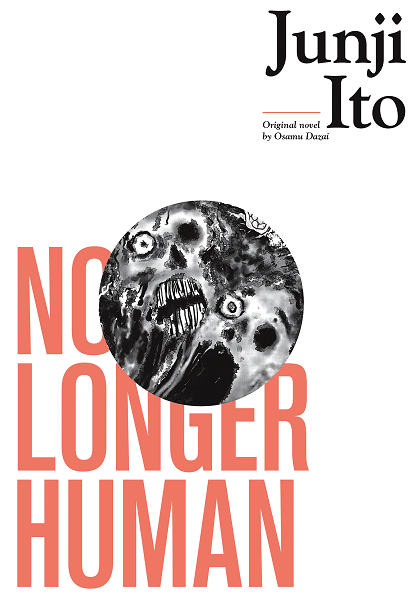
I haven’t read the original No Longer Human, but it’s certainly on my shortlist after reading Ito‘s adaptation and it possibly becoming my favorite work of his. So I can’t contrast this with the source material, and I see many negative reviews disapprove of Ito’s take on it. But that novel must have been truly sublime for Ito to be able to allegedly cleave and twist so much of its content and still have it affect me.
Following his stellar adaptation of Frankenstein, I have reason to believe Ito is only improving as he ages, taking his artistic talents to depict the derangement of human drama. Ito’s talent lies in how his art contrasts by nature. From the beginning of his career, this is a man who depicts people as flawless porcelain dolls and in the next instant changes them into monstrosities. Despite this, their original form somehow always remains recognizable, and in that lies the shock value of Ito’s art.
What I’m getting at might sound obvious. Ultimately he’s employing a technique typical of horror “stingers” by paring the mundane or attractive with the unexpected and repulsive to create a whiplash of emotion that makes the desired effect of fear all the more palpable. On a surface level, that’s what Ito’s done his entire career, but his cult following suggests someone greater than an artist who knows the most basic structure for effective horror.
Again, it’s specifically Ito’s unique talent to depict not only the normal to contrast with the strange, but his uncanny ability to go beyond the normal and into desire. In the work of horror, the ability to be able to pull the audience is directly equivalent to how strongly they can be pushed away, but I don’t feel the opposite holds nearly as true.
A mind that can depict the most undesirable aspects of life is already a rare talent, but rarer still is someone who can create flawless beauty right alongside it without the two clashing styles seeping into each other and making a uniform, neutralizing mix. There’s an element of restraint with how strictly Ito separates his nightmarish details with his immaculate ones, and that’s a skill just as impressive as being able to tap into both sensations at once.
What I’m getting at is that Ito’s talents are a surprisingly natural fit to more dramatic material. Humans are inescapably paradoxical, everyone trying their best to live a life free of hypocrisy while unconsciously betraying themselves all the time. That’s not me being nihilistic, rather I find that aspect to be very compelling and its depiction to be at the heart of the greatest character writing. To depict that hypocrisy visually, Ito can pair perfection and chaos better than just about anyone can. When taking on classic works of literature, he can depict the bipolar insanity of humans with a starkness that reflects a reality that feels frightening in how true it is to people, rather than it feeling like pure sensationalist revulsion.
That’s not to say he’s perfect at it. As I alluded to by mentioning adaptations, Ito’s storytelling skills typically lie in visuals. That isn’t to say he can’t create a compelling narrative, as he has done so many times with numerous imaginative premises, but his duality in his art can often be carrying the weight of his character drama, covering for his weakness in text rather than symbiotically expanding its quality. When the text is supplied by someone else, Ito feels perhaps at his creative peak and most personal, rather than the expected result of compromise via clashing artistic visions.
He can really tap into the sudden shock of anxiety’s razor thin line between ambivalence and fear with his whiplashing artwork, and that’s the nuance that made No Longer Human so affecting. I related significantly to the main character, which probably isn’t a great thing for me, but it was thanks to Ito’s excellent display of how suddenly human emotions can turn in the variety of his expressions. Those expressions aren’t used like they are in most of his own stories, to show reactions to horrors or the horrors themselves, but to communicate emotions directed at other humans. It’s a subtle change in the kind of stories he’s drawing for that makes an enormous difference in the nuance of his art even when it’s the same style and application it’s been for years.
Hopefully, I didn’t express myself too vaguely. Anyway, I was gripped by this character study of a sociopath unable to piece the puzzle of human interaction together, his rearranging of the pieces always causing collapses around him. It’s a hyperbole of what it feels like to be an outcast, feeling obliged to give everything a delicate touch yet not even being sure of the accuracy of the social skills at your disposal, let alone which to specifically use. It’s a spiral of fear and guilt creating themselves, and through someone who is simultaneously a victim and a villain. Beyond the strictly existential, I also perceive some Japanese cultural commentary about a maverick who is being suffocated by incomprehensible traditionalism.
Leave a Reply