








Background
Comix Zone
Comix Zone is a video game originally released for the Sega Genesis (Mega Drive) in 1995. Controlling comic book author Sketch Turner, the player must help Sketch fight his way through his own comic book after he’s magically trapped inside by a villain of his own creation. It’s a beat ’em up game, which is a genre where you beat (punch) ’em (them) up (kill). With its novel conceit and presentation, Comix Zone has gone on to be considered a classic Genesis game, and has been rereleased many times since its launch.
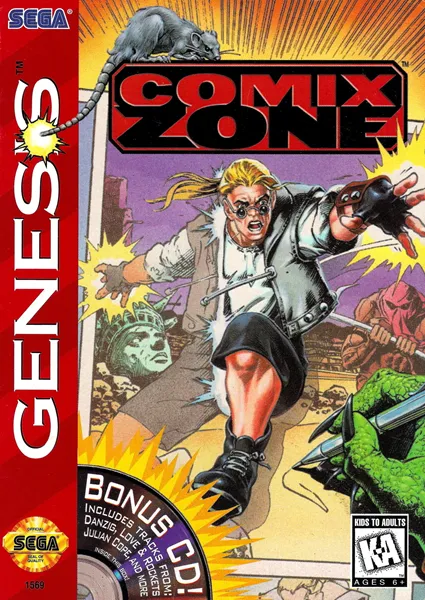
Developed by one of Sega‘s North American branches, Sega Technical Institute (STI—yes, I know), Comix Zone obviously and proudly displayed its Western cultural influences. In one sense, it went above and beyond, as STI (I know) collaborated with the American Recordings music label to include a bonus music CD, which was advertised on the game box’s front cover.
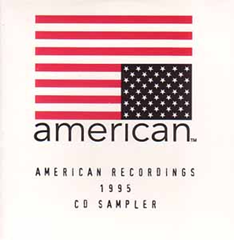
This CD, which would be exclusive to North American releases of Comix Zone, was American Recordings’s 1995 sampler CD. For anyone reading this without an uncooperative bladder, sampler CDs were an old practice where music labels would release compilations of their signed artists at a low cost, if not free, in an attempt to promote their label and talent. It was, if you will, a “sample.” Everybody wins. Hell, everybody wins more, because music albums usually last longer than a child-sized serving of a cracker with some weird shit on top of it.
I’ve recently been working on a giant Sega retrospective, and part of it contained a review for Comix Zone. That should’ve been simple enough, but the ancient Aztec curse which compels me to go in-depth on absolutely everything demanded that I cover its bonus sampler CD. As always, I went into so much detail that it warranted a separate article. This is that. This is me doing that thing I described.
What the Frick Is American Recordings?
A natural assumption would be that a sampler CD for an unproven video game IP would likely need to compromise on budget, thereby dealing with a relatively small indie label with mostly—if not all—unknown artists. As it so happens, this is extremely far from describing American Recordings. The label was founded by none other than Rick Rubin, one of the most prolific music producers in… well, history. He’s that important.
While Rick Rubin is generally a celebrated figure for his massive influence on the industry and dozens upon dozens of collaborations with major artists, he’s not free from controversy. On occasion, he’s been criticized for his personality by those he’s worked with, seemingly becoming more distant as his popularity grew, and perhaps haughty as a result.
Tangent: Rick Rubin and the “Loudness War”
Click to expand
A more common critique, and one I happen to ascribe to myself, is of Rick Rubin’s production techniques.
Now, I’m not going to make some absurd claim like, “I know general audio production better than an industry professional like Rubin,” but there is a very specific area that is demonstrably contentious.

Sometime around the turn of the century (coinciding with the popularity of digital formats, like CDs), Rubin began prioritizing loudness in his production. While that sounds like a basic preference, the implications of this with regards to audio mixing can actually be quite complex. There are various production techniques one can use to artificially raise the volume of a recording.
If a recording is pushed to maximum amplitude when the original music wasn’t intended for it, the audio can clip, essentially cutting off the music’s peak, as it’s literally unable to go beyond the recording’s original, limited digital information. While some artists occasionally use clipping for dramatic effect, when achieved unintentionally, it can alter a song’s composition in addition to just sounding unpleasantly harsh.
Another negative side effect lies in a technique known as dynamic range compression. To make a piece of music sound louder as a whole, audio engineers can increase the volume of quieter parts of music relative to its louder sections. For an example, think of a composition that’s meant to have a quiet bass riff giving textural accompaniment to a louder lead guitar melody. You probably have songs you enjoy precisely because certain moments have subtle instrumentation that add depth to the emotion conveyed by the surface instruments. In other words, the intended contrast in volume directly contributes to making that music resonate with you.
Well, you can probably imagine the downside of equalizing volume in such a composition. The result can be a “brick wall” of noise where no instruments particularly stand out, and parts of the music that were meant to be punctuated by their volume have their impact reduced accordingly. This, speaking frankly, can completely fuck up the organic sound of the original recording, as well as any aspects of music composition directly related to volume or acoustics.
In a natural audio recording, you should be able to pick up some of an instrument’s reverb, for instance, as it bounces off the walls of a recording studio. This gives the instrument’s sequence more resonance as each note lingers in the air, and it can providing an intimate impression that the music is live and taking form as you’re listening to it. In a brick wall production, little details like acoustics are the first things to go.
That’s a simplification, and if I got some of the technical details wrong, I hope someone tells me so that I may amend my explanation. You might be wondering for what reasons a music producer would so intensely subvert the intent of the original recording. And, uh… there aren’t any. Opinions on “brick wall mastering” range from “it’s bad” to “I don’t care.” It’s almost universally considered to be a mark of lazy, hacky production, as individually adjusting specific parts of music to highlight certain elements is naturally far more complex and delicate a process than “turning a bunch of knobs up to max.”
To nip a common misconception in the bud: you and everyone else with ears can hear the consequences of excessive brick wall mastering with even the most basic of audio equipment. While there are details of audio production that are difficult to pick up without high-end equipment, this isn’t one of those. An obvious distinction would be the aforementioned acoustic example. I don’t have a convenient sample on hand, but there’s a veritable mountain of recordings from the ’60s and ’70s that have been remastered dozens of times throughout the decades.
A direct comparison between a mastering done around the time of their release, when such volume-increasing techniques weren’t possible, with a “brickwalled” modern remaster can be incredibly noticeable. The latter will have a much more consistent, “flat” sound to it than the original, but will play at a louder base volume. Of course, for that original, you can simply turn your device’s volume up and retain those dynamic sounds. However, there is nothing you can do to “fix” the louder master, as the digital information on it has been fundamentally altered. You might recognize the difference and not personally mind it that much, but that’s not the same as there not being a difference.
Just to clarify, modern music production doesn’t necessarily have these bad practices; it’s simply more likely that they will due to the existence of these techniques, and the relative accessibility of music production compared to knowledge of its best practices. And even if you don’t care about brick wall production, you should know that you don’t benefit from it. If a piece of music isn’t loud enough for you, just turn your volume up. There’s no need for that to be done within the music itself at the expense of detail you cannot get back if you ever want it.
I know there are people out there who will always play their music at the maximum volume possible, but I’m gonna come out swinging at them. As someone with significant, legitimately-tested for hearing loss, no one needs max volume. Like, basically ever. Anyone doing it is almost certainly sexually insecure and doing it as a way to exercise indirect power over anyone within earshot. It’s not done for the sake of enjoying the music, and as such, I have no sympathy for what they want. They should stop making their weakness the problem of others, and the “loudness war” only assists them with their bullshit.
So, running it back a bit: why would anyone, especially a professional like Rick Rubin, do this? Frankly, I can only speculate. Maybe Rubin was compensating for hearing loss he had accrued by the time he first started these practices. Rubin cut his teeth on in-your-face underground artists, and I would assume their performances skewed towards the loud side of things. Maybe he was just enamored by emerging digital technology and it blinded his objectivity. Maybe it’s because a brickwalled master can sound better than a measured one to those unfamiliar with a specific composition, as they don’t know what details have been lost. It’s probably a combination of those.
Anyway, being positioned against this production style shows respect not only to your ears, but also the artists, whose compositions were almost certainly not written with the expectation every note would be played at a comparable volume. Inertia has been on the side of the loudness war arms race, with your average person not even being aware of what’s being done or its consequences, but there’s always hope that being openly critical of these practices will drive their most influential users into obscurity or higher audio standards. Rick Rubin himself might be too far gone to change, but no one’s ever too old to be told to fuck off.
American Recordings has worked with Slayer, Johnny Cash, and Tom Petty, among many other cultural touchstones. Their most notable release might be Reign in Blood, the classic Slayer album credited with transforming a huge part of the metal music landscape. In 1995, American Recordings was in its seventh year of business when they put out that year’s sampler, which would be the bonus CD packaged alongside certain copies of Comix Zone.
Though American Recordings mainly focused on rock music and its subgenres, they would often feature hip hop, industrial, and electronic artists. It appears the label had no hard rules as to what they did or didn’t cover, and as such, their sampler contains a fairly eclectic mix of ’90s alternative acts.
Track list:
- Danzig – “Going Down to Die“
- Lordz of Brooklyn – “Saturday Night Fever“
- MC 900 Ft. Jesus – “Buried at Sea“
- The Jesus and Mary Chain – “I Hate Rock and Roll“
- Love and Rockets – “Words of a Fool“
- Lords of Acid – “Do What You Want to Do“
- Stiffs, Inc. – “Chelsea“
- Julian Cope – “Try, Try, Try“
- God Lives Underwater – “No More Love“
- Ruth Ruth – “Uninvited“
- Laika – “44 Robbers“
- Lindsey – “Got It Goin’ On“
I also wanted to find some images of the actual, original packaging; the CD, its envelope. But I found nothing. I was wondering if the CD looked different from its normal American Recordings pressing, but I can only assume it didn’t, in the absence of evidence.
The Breakdown
Lordz of Brooklyn – “Saturday Night Fever“
“Saturday Night Fever” is the opening track to their debut album, All in the Family, and it’s a suave gangsta rap rollcall. LoB are an all-white group, which was obviously not especially common in the genre at the time, but they’re nonetheless multicultural. Michael McClear (AKA Kaves) named the track after the John Travolta film of the same name—his personal favorite. It’s a great movie, so he’s cool in my book.
MC 900 Ft. Jesus – “Buried at Sea“
Reading about him, it’s kind of a surprise, as he seemed mildly successful. Another single off the same album as “Buried at Sea” had a music video directed by Spike Jonze, which was featured on Beavis and Butt-Head. His Wikipedia biography is littered with bizarre minor details, like one of his songs being blamed for influencing arsons in Baltimore.
The same article credits his disillusionment with the music industry, but one of its sources suggests otherwise. It sounds like Griffin suffered from a lack of confidence, enthusiasm, and writer’s block. While losing a passion for something isn’t necessarily concerning, Griffin’s future history of working various retail jobs while moonlighting as a DJ paints a sadder picture. At one point, he wanted to become a pilot instructor, but supposedly demand for them waned following the 9/11 World Trade Center attacks. I feel like that should increase demand in pilot instructors, if anything, but I digress.
It’s sobering to have this nostalgia trip interrupted so early by the cruel reality that the rebellious generation of the ’90s ended up in the same ruthless grind as any average person. An artist was ground down by the system, and we’re all a little worse off for it; every time.
I know I haven’t talked much about “Buried at Sea,” but I don’t have a whole lot to say. The song features a delectable, rippling bass riff with Griffin’s stream-of-consciousness vocals skipping across the water, but it is a repetitive, if meditative groove. There’s a bit of a beatnik/freeform jazz vibe to the whole thing. There’s probably a lot of people who could really get into MC 900’s style if they simply encountered it, and hopefully this review gets at least a few more.
The Jesus and Mary Chain – “I Hate Rock and Roll“
The Jesus and Mary Chain (JaMC) are undoubtedly my favorite band on this sampler, but they were not at the top of their game in 1995, and “I Hate Rock and Roll” does not do them justice.
Oddly enough, this single wouldn’t appear on one of their albums until 1998’s Munki. It came out in the four-year gap following the band’s previous album, Stoned & Dethroned.
I haven’t had the heart to listen to JaMC’s 2017 and 2024 albums, and that’s mostly to do with how bad I thought Stoned & Dethroned and Munki were. I don’t want to get too off-topic, but it feels as if at some point, JaMC’s performative disaffectation started to infect their compositional quality. Their persona seemingly hadn’t gotten in the way of them crafting great hooks for their first couple of albums, but by this point, it was like they actually felt they were too cool to bother. If that’s too much armchair psychoanalysis, let this suffice: I just think their songs became boring and forgettable.
It feels appropriate that my description of the band would coincide with me covering a song obstinately titled “I Hate Rock and Roll.” JaMC’s antagonistic relationship with their fanbase is well-documented and known, and if the song’s not meant to be their personal perspective, they have quite the history working against their case. You guys hate rock and roll? Don’t worry, I believe you. Am I supposed to give you a medal or something?
Aimless noise with a melody far too weak to contrast against and rise above it—it’s almost like the JaMC is trying to hide how bland the song’s melody and structure is by screeching over it. Even this very kind of indie noise rock was pretty dated by 1995.
“I love the BBC / I love it when they’re pissing on me” is probably not a lyric these guys would’ve chosen were this recorded today.
Love and Rockets – “Words of a Fool“
Boy, I was not feeling this one by Love and Rockets. A shame, since I’ve had their album Express on my to-listen list for probably (at least) a decade at this point.
“Words of a Fool” is a lengthy, repetitive, droning, psychedelic rock mantra with heavy guitar feedback and the occasional stock breakdown before settling back into the same old. I think it’s boring. Maybe if you “do” those so-called “drugs,” you’d “trip” on it, but I would never go against the advice of Smokey the Bear. I won’t go as far as to take Express off my itinerary, but it’s somehow even less of a priority now. Kind of reminds me of some of Primal Scream’s work. Namely, the stuff I don’t care much for.
Lords of Acid – “Do What You Want to Do“
I had to hide this one, because the album cover thumbnail shows illustrated nudity of red demon girls. Thanks for ruining the symmetry of my article, Squires of Acid. (Click to expand)
Said album cover was illustrated by Chris Cooper, AKA “Coop,” a “hot rod artist” based in Tulsa, Oklahoma.
I am slightly surprised that being a hot rod artist is specific enough to warrant its own designation.
If you brought this guy a Camaro and asked him to draw a red devil girl with a fat ass on it, would he just spit in your face? I’m offended even thinking about it.
The Oklahoma Cooper has done work for the likes of Nirvana, Foo Fighters, and of course, our very own Lords of Acid. “Do What You Want to Do,” or “Do What You Wanna Do” (taking their own advice?) is a breakbeat hardcore number with dense, industrial flavorings.
If I asked you to think of a generic early ’90s underground EDM song, you’d probably imagine something like this. I’d consider this decent background music in some score-rush video game on the Dreamcast, but on its lonesome, it lacks a killer hook to make it stick. It’s one of those “bweeeaaooww bweaarrroww” songs. You know what I mean. You might think you don’t know what I mean, but you absolutely do.
God forbid the Lords of Acid and Lordz of Brooklyn ever go to war. The sheer amount of bloodshed would forever paint this country as red as the butts on their album covers. Though I am making an assumption when it comes to Lordz of Brooklyn.
Stiffs, Inc. – “Chelsea“
Stiffs, Inc. would be a great name for a strip club, and you might be able to get the rights to it for cheap, since the band didn’t achieve much success. Or any.
In fact, I was surprised to see they even had a Wikipedia article, which describes them as “an ostensibly morbidicesque American, Victorian-themed New York City punk band.” Suspicious that “morbidicesque” was, in fact, not a word, I googled it and found the only other usages of it were from copying and pasting this exact description of Stiffs, Inc. It’s used on their YouTube channel, as well as their profile for Muziekweb, the latter of which looks like a fake web page you’d use to front a money-laundering scheme. I’m not saying that’s what Muziekweb is, of course. It’s not my job to prove that.
Anyway, these punks wrote their own damn profiles! The nerve of them. I’m definitely not upset because I’m not noteworthy enough to write my own Wikipedia article. Anyway, “morbidicesque?” What the fuck? I’m all for neologisms, but the suffix “ic” and “esque” would serve the same purpose of describing something as “morbid” in nature. So that’s redundant, but I can only imagine it’s what the author was attempting to do.
Even then, morbid is already an adjective, so you don’t need to modify the word. “Ostensibly morbid” is just a weird descriptor, as morbidity tends to not be subjective, even if it technically is. You’re not going to get pushback for describing something concerned with death as “morbid,” for instance, even if two people disagree about the seriousness of its tone.
I’m not familiar enough with Stiffs, Inc. (i.e. I’m not a band member) to reliably describe their sound, but I would consider writing “an American, Victorian-themed New York City punk band often dealing with morbid subjects.” I dunno if that’s ideal, but it’s better.
Whoever this “Chelsea” is, I hope she’s a “stiff” herself so she’s not around to witness this catastrophic blunder. In all seriousness, good on you, entrepreneuring ex-Stiffs, Inc. member. I’ve learned all about self-advocacy since starting this site, believe me. Get that bag. Get stiff.
Oh, right, this is ostensibly a musicicesque review. “Chelsea” is a ’60s British mod/garage rock send-up, with some ’70s punk thrown in for good measure. Whatever you might call it, it’s certainly very English. Pop punk is rarely a genre I care for, as I find its songwriting tends to blend together from lacking variety in tempo, guitar tuning, mood, and… everything?
I feel like part of the reason why Green Day’s Dookie was such a success is often overlooked, which is that the band actually wrote different songs. “When I Come Around” and “She” are instantly distinguishable and evoke entirely different feelings.
Having only heard one song from Stiffs, Inc., I can’t personally critique them for repetition, but I do find it broadly uninteresting, though not bad. The song’s pop rock structure is hindered by the constant, undynamic energy throughout the track, as the chorus’s arrival isn’t punctuated by anything. The bridge in “Chelsea” is one of the only parts that got my attention, as it actually does pump the brakes for a moment.
But even if all of this was tweaked, would the guitar riff and vocal melody stand out? I don’t think so, unfortunately. At the very least, the raw straightforwardness of this rocker serves as a good palette refresher for this compilation.
Julian Cope – “Try, Try, Try“
Hey, I know Julian Cope! Wow! Isn’t it great to know things? We should all aspire to know more things.
I’ve listened to three of Cope’s albums, and they’ve all been pretty good. I’ve yet to become a dedicated fan or anything, but I’m not against that happening.
“Try, Try, Try” is off his 1995 album 20 Mothers, which just makes me like him more, ‘cuz we’re seemingly both into MILFs. Anyway, this is a little after Cope’s mid-to-late ’80s heyday, so I was curious to see where he went. Granted, that’s not saying a whole lot, as this psychopath has released nearly one album a year from 1984 to (currently) 2024. Yeesh, play a video game or something instead of releasing art all the time. You’re making us average people look bad!
I was originally worried about Cope following up “Chelsea,” as his music often has British inspirations that are adjacent to the previous track’s. Fortunately, “Try, Try, Try” is comparably stripped down, nearly beginning as a folk rock crooner as it gradually crescendos into a wailing call for help. Cope lives up to his surname as he narrates the futility of trying to get over an old flame.
Unfortunately, that old flame does little to give this song the fire it needs for me. The Brits are striking out twice for me. This is another pop rock song I find to be competently structured and performed, but this genre lives and dies on its hooks, and I’m certain that nothing about “Try, Try, Try” will stick in my head no matter how much I… eh, nah.
I counted, by the way. There are indeed 20 (alleged) mothers on that cover. Everyone said to Julian Cope, “you can’t put 20 mothers on one album cover,” and the crazy bastard did it anyway. To this day, this remains the most amount of mommies ever on an album cover. It’s the Sgt. Pepper’s of moms.
God Lives Underwater – “No More Love“
Once again, the name God Lives Underwater is unknown to me. It kind of sounds like what you’d name a hip hop group inspired by the works of HP Lovecraft. Cosmic horrorcore, if you will.
It also reminds me of a band named Breathing Underwater, who performed at my high school during a midday assembly.
I can only assume they were some staff member’s nephew’s band or something, but you won’t hear me complaining about nepotism for once, as we got to attend their mini-gig instead of our usual classes. I’d guess that it was the day before we went on break or something, but hell if I can remember. I think this was the same assembly where I tried and failed to get the girl I liked to sit next to me prior to the show.
Though I was romantically unsuccessful, nobody bombed harder that day than Breathing Underwater themselves. Their vocalist appeared to be singing at a register far beyond his ability, and his pitch vanished into the ether to become nearly inaudible, with only occasional squeaks escaping via dimensional ruptures in the waking world. As a singer myself, I do empathize with the disappointment of not being able to bellow your favorite songs in their original key, but you gotta work with what Cthulhu gave you, man.
I don’t remember all of what they played; I think it was a few originals and one or two covers. The quality of those originals is potentially spoken for by the fact that the only melody I remember from the entire show was the guitar riff from their cover of Michael Jackson’s “Beat It.” How does Michael Jackson keep finding his way back to discussions related to Sega things?
When the show was over, scores of students, possibly including myself, gathered ’round to ask the band for autographs. This must have been very humbling for the group, but I heard of nobody doing it because they liked their music, and instead they were all hoping to profit off of reselling the autographs in the incredibly unlikely event Breathing Underwater hit the bigtime. The grift economy has always had its fangs in us, eh? If it were somehow possible, I’d bet those autographs managed to depreciate in value since then.
The moral of this story is that everyone failed that day, so… don’t feel too bad?
Oh, oops. Nearly forgot to cover “No More Love” by God Breathes Underwater. Part of me was hoping it would suck, so I could comically end with a dismissive one-liner, but I can’t. I actually really dug this tune. Of all songs on this sampler smorgasbord, the production is some of the most ’90s shit you will hear, which is purely a compliment as far as I’m concerned.
When I read the name God Breathes Underwater, I imagined the band being some kind of industrial metal group, and I feel pretty smart for being at least partially correct. “No More Love” is certainly some kind of industrial-influenced dirge, with its dense, obfuscating wall-of-sound being populated with clear synth flourishes and repetitive, funky, EDM beats.
Most of the music wouldn’t be out of place on a ’90s rap rock/metal track, with only the vocalist’s submerged, melodic, cascading delivery being too comfortable for that space. Also, he’s not rapping. That matters. I really love the murky, mildly distorted sound of ’90s EDM production, and the distilled shoegaze-y vibes of this song are so attuned to me that I am tempted to return to this one. However, “No More Love” lacks a hook powerful enough to punctuate its sonic tsunami, so it ends up being a groovy mood piece rather than the alternative pop anthem I suspect it was aiming to be.
“In his house at R’lyeh, dead Cthulhu waits dreaming… so turn that goddamn shit down.”
– Harry Potter Lovecraft
Ruth Ruth – “Uninvited“
Woah! Talk about coming up for air. “Uninvited” is an in-your-face, punky alt-rocker. What can you expect from a band that’s so worried you’ll forget their name that they said it twice?
That album cover is great, by the way. Very Goosebumps-esque, which is definitely what they were going for.
I’m getting burnt out on this compilation’s alternative rock songs. Do you ever get the feeling that some artists believe that as long as they shout their chorus with enough energy that it’ll be catchy? As mean as that is to say, I do think that out of “I Hate Rock and Roll,” “Chelsea,” “Try, Try, Try,” and “Uninvited,” Ruth Ruth’s track is the best. Their sound is the most contemporary, which makes their raw stylings feel more authentic, engaging, and relatable.
Not to say that I think “Uninvited” is great or anything. Returning to Wikipedia for another crash course, apparently the band’s first album, where “Uninvited” appears, was co-produced by Ted Niceley of Fugazi fame. I actually really like Fugazi, and after the fact, I want to say I can recognize some similarity in the mixing. The vocals on “Uninvited” even sound like one of Fugazi’s singers. I’m not sure which one though, as Fugazi has like, four vocalists that sound pretty similar in the right circumstances.
“The album was co-produced by Ted Niceley, who has produced Fugazi, Girls Against Boys and Kennedy separately.” Well, yeah. Would anyone have thought that sentence meant that all of those artists had their production done at the same time, or were doing some epic collab? Also, the unintentional (?) bitterness conveyed by the second half of this sentence was pretty funny: “Their debut 1995 album was titled Laughing Gallery, which was seen with critical acclaim from those who heard it.”
Spoiler alert, but this is the last rock song on the compilation. I’ve surprised even myself at the fact that they’ve routinely been my least-favorite tunes on the whole disc, as that’s usually where my preferences lie. I just don’t think these are stellar examples of the craft. What more can I say?
Laika – “44 Robbers“
Laika is one of the artists I recognized when going into this album. I listened to their 1997 album, Sounds of the Satellites back in… 2012? Oh, god.
Anyway, it was a trip hop album featuring an extremely diverse range of influences from psychedelia, ambient, and electronica, all united in their goal of creating an ethereal, soothing soundscape.
I never reviewed the album, but I remember quite liking it. “44 Robbers” did not appear on it, so this song is new to me, at least. And it’s, uh… different. The biggest surprise was Margaret Fiedler’s entirely rapping vocal. Looping electronic beats put this squarely in the realm of hip hop, though it’s more spacey and lightweight than the usual genre associates.
This isn’t really my style, as I prefer melody-driven music over a rhythm focus, but I don’t dislike it. The drum and bass-adjacent beat makes “44 Robbers” quintessentially ’90s, and I could imagine the backing instrumentals fitting in a hypothetical, futuristic Dreamcast game.
If Laika’s goal was vibes, I’d say they nailed it. The texture this adds to the sampler as a whole is worth its conclusion, and it serves as a nice comedown, being the semi-final track. It’s a shame Laika is the only female-fronted act on the disc, for variety’s sake, but at least there’s one example.
Lindsey – “Got It Goin’ On“
The name of this artist and song title collectively gaslit me into thinking that other classic number was actually about Lindsey’s mom instead of Stacy’s, and that I would be hearing it despite it not being recorded until 2003. To be fair, Lindsey’s mom could also have it going on, but I haven’t met her.
Lindsey can find solace in his massive biceps as I reveal him being the only artist I could not find on Wikipedia. Pretty rough. Am I surprised “Got It Goin’ On” didn’t rocket him into stardom? No, not really. It’s a typical bass-heavy, chanting party bopper, and the only part of it I found pleasant were the brief seconds where the song’s title is given some soulful delivery. Even then, the backing vocalist sounds like he’s straining his range.
“Got It Goin’ On” strikes me as a lesser version of “Whoomp! (There It Is),” which isn’t a song I hold in especially high regard. There’s a time and place for it, though, and that place simply has no room for Linsey and his bodacious biceps.
When I was a kid, I had some stupid VHS tape that was live footage of some summer/spring break event held at Disney World’s beaches. It bored the shit out of me whenever I tried to watch it, and my only retained memory is of a costumed Donald Duck dancing on the beach over Kool & the Gang’s “Celebration.” “Got It Goin’ On” could have been on that VHS tape, is all I’m saying. Especially since I wouldn’t have remembered it.
The person in that Donald Duck costume could be dead now. Oh, not from old age, I mean. From heat stroke. Psychotic shit, that industry.
Conclusion: Turning the Page
Full disclosure: while I did listen to every song on this comp in full, I also jumped around a bit; I didn’t listen in its original track order. I’m sorry, okay? Reflecting back, almost every song I didn’t care much for was in the second half of my arbitrary order, which makes me wonder if I was harsher on them because of exhaustion.
Probably not, but it’s still a bummer to come away from the esteemed 1995 American Recordings Comix Zone bonus sampler CD Hawith such mixed feelings. It started off as a fine time capsule of ’90s trends, and even demonstrated the qualities that made them so infectious. Gradually, more and more songs sounded akin to an average local band’s effort, and it took me out of this quasi-pastiche celebration into feeling like American Recordings was just offloading some of their junk onto me.
Jeez, that’s harsh. To be fair to some of the artists I dissed, King Rasta Mon AKA Vince Thornburg was a big fan of “Try, Try, Try” and “Uninvited,” which demonstrates how much of my personal taste factors into the whole thing. That should be obvious, but I want to make it clear that I’m cognizant of it, myself.
If I had to pick my top three favorite songs off of this sampler… hm… “No More Love,” “Saturday Night Fever,” and “Going Down to Die.” Probably in that order, too. I genuinely might listen to a full release by God Lives Underwater. Eventually. Before I die. Maybe. If you’re reading this on my personal website (as you should), I’ve included embeds of every song for you try experience for yourself. What do you think of my opinions? Am I stupid? Cringe? What were your favorite songs? Let me know in the comments or whatever.
At the very least, I was reminded of how much fun it can be to listen to a sampler CD, never knowing what you’re going to hear next and potentially finding new favorites. I know I’ve listened to compilations from the Creation label and Rough Trade retailer. Rough Trade Shops: Indiepop 1 is, for my money, the best I’ve ever heard among these.
If you’ve never attempted to go through a sampler compilation, I highly recommend giving it a try. Seriously, just go find a label common to some artists you like, and look up some of their “various artists” releases. Almost any label will have a few, and it’s a much faster way of discovering new bands to like than going through a bunch of random albums.
All of these collections were curated by someone with an incentive to show you what they think is their best stuff, whereas subpar material can sneak onto standard studio albums just to fill time. Not to say these compilations aren’t immune to that practice, as my assessment makes clear, plus there’s always personal taste to account for.
Having at last explored another pop-cultural facet from one of my childhood video games, I feel my curiosity sated and some weight lifted from that Aztec curse. Possibly to achieve some level of parity, Comix Zone releases in other regions were sometimes packaged with different CDs; typically a version of the game’s OST.
Maybe it’s blasphemous to say, but I think those regions actually missed out by not getting this little historical artifact that could’ve broadened their horizons. I can absolutely see myself as a kid, playing this sampler over and over between bouts of getting my ass handed to me by Comix Zone proper. In that context, I don’t think I would’ve been in the mood to listen to the game’s actual music…
“Well done, Turner!”
“Oh, yeah!”
Leave a Reply