








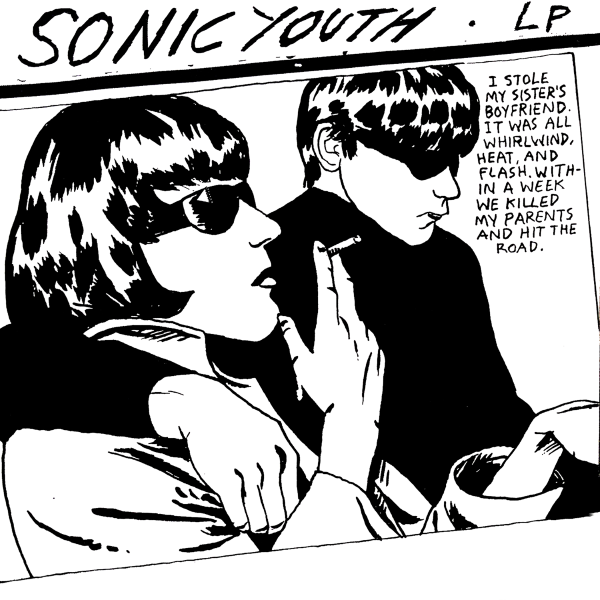
“I stole my sister’s boyfriend. It was all whirlwind, heat, and flash. Within a week we killed my parents and hit the road.”
Often considered to be Sonic Youth’s “sell-out” album, (even though Sister was their first album to combine their experimental tendencies with digestible pop song structures, all fans regard that as a classic for some reason—myself included), Goo was criticized by some long-time Youths for having more in common with popular ’90s alternative rock. Sonic Youth continued to move away from their roots in the No Wave scene and their long, extended free-form jams.
In what could be considered downright oppositional, Goo finds inspiration in the raw, dirty underground grunge/punk movement of the late ’80s and early ’90s. What detractors may overlook is that Goo actually pre-dates Nirvana‘s Nevermind forever shifting the rock landscape. It wouldn’t have been very smart of Sonic Youth to expect a big profit off this style shift. In other words, if Sonic Youth intended to sell-out, they did a terrible job at it.
And make no mistake: this is pure, unthrottled Sonic Youth. Goo is raw. Goo is nasty. Goo is dirty. Hell, when considering some of these hooks, Goo is downright sticky. Pitch-perfect audio production emphasizes the songwriting’s rambunctious choruses and stylish riffs without downplaying the abrasive, rebellious noise permeating beneath them. This probably convinced many a teenager to tear their shirts and rip some holes in their jeans for the first time back in the summer of 1990.
The album’s opener, “Dirty Boots” starts quiet and coy, revving engines as Thurston Moore promises us the momentum proposed on the album’s cover: “here we go to another candle I know”, and soon after, “time to take a ride.” The track chugs along in a typical verse-chorus-verse format where Moore chants the title in solidarity with other teenage rebels. The tune certainly takes the most influence from grunge out of any other song here, but that’s by no means a criticism.
The album continues to accelerate with “Tunic (Song for Karen),” an echoing, haunting tune dedicated to Karen Carpenter of the legendary pop band The Carpenters and her struggle with anorexia nervosa, of which she eventually succumbed. This is possibly the song that originally sold me on Sonic Youth. The guitar playing and tone of “Tunic” billows like an icy breeze; every quasi-surf rock riff gliding over other sonic drafts, weightless and just downright fucking cool. Kim Gordon’s vocals have her narrating from the perspective of Karen, nonchalantly following her mortal tragedy by greeting other legendary artists in heaven. It’s an ethereal experience, and the song’s ghostly countenance suits its morbid subject matter without miring the song in a depressive mood. Without a doubt, it’s one of Sonic Youth’s greatest, most unique accomplishments.
“Mary-Christ,” though not a particular highlight, is a solid song that has Gordon return for a fun, shouted backing vocal. While not topping her performance in “Tunic,” Gordon second lead vocal in “Kool Thing” resulted in one of Sonic Youth’s best-known singles. Chuck D of Public Enemy makes a cameo appearance to deliver an (unfortunately) listless verse—the guy sounds downright tired. I guess they just caught him on one of “those days.” Though humorously blasé on its surface, “Kool Thing” is a jab from Kim Gordon directed at LL Cool J, who she had gotten in an argument with while the two were interviewing for Spin magazine.
The band’s secret weapon, Lee Ranaldo, takes the lead on “Mote,” a veritable sonic tornado. As common with Goo, Sonic Youth’s stream-of-consciousness lyrics imply the atmosphere of reckless speed: “when you see the spiral turning through alone / and you feel so heavy that you just can’t stop it,” or “from nowhere – to nowhere / cut together – cutting through.” The seven-minute epic even struggles to skid to its halt: “you’re just in time to watch the fires burn / it seems a crime but your face is bright – you love it.” Indeed, we do.
“My Friend Goo” is a little goofy throwaway song featuring guest vocals by peers such as J. Mascis of Dinosaur Jr.. “Disappearer” was another single off this album, and is the only competition for “Tunic” with being my favorite track. Moore channels a disenfranchised youth yearning to escape mundanity (“seems to have a new kind of same / been playing on a simple rhyme”) who decides to leave his home and hit the road (“pick it up and turn it on / and head on out to a western starland.”) A repeated phrase is “you’ve been away too long,” alluding to a long-overdue personal awakening; “a disappearer.”
“Mildred Pierce” and “Scooter + Jinx” are quick, wild instrumental noise jams; evidence that Sonic Youth had not completely abandoned that original aspect of their sound. However, these are much shorter freakouts than those on Daydream Nation which demonstrates Goo‘s relative immediacy. Those could frequently overstay their welcome, but these intermissions keep up with the album’s breakneck speed.
A fitting closer, “Titanium Exposé” is a murky, lurching track that signals the album’s closing with a powerful stop. Thurston Moore’s drawn-out vocals stretch along the accompanying guitars in a duet with Kim Gordon. As the two trade off on the lead, things suddenly dissolve in a burst of feedback that gradually fizzles and fades—looks like we’ve reached our destination.
Goo is a tour de force of an album that possibly consolidates Sonic Youth’s best qualities more than any other work. At this point in time, Sonic Youth were icons of teenage rebellion and reckless overconfidence. Goo‘s motor starts up quickly, and the album defiantly maintains momentum as every riff chugs and pummels its way to the end with the wind whipping against their licks. Each drop of screeching, hissing feedback only cements the uncontrollable speed of rubber against asphalt.
Sometimes, it seems like every person on the cusp of adulthood reaches a point where they’re fed up with all the bullshit. They might not know where they want to go, but they do know it’s somewhere else. Maybe they start to feel that way because they’re acquiring responsibilities, but in reality, you can’t simply up and leave those without destruction trailing behind. It’s still fun to dream about the escape—to just have those thoughts, that unbridled energy that makes you feel like you could—should—go anywhere. To quell those feelings just for a while, crack open a beer or whatever you happen to have, lay back, and play Goo at the highest possible volume. Hit the road. Disappear.
Leave a Reply