








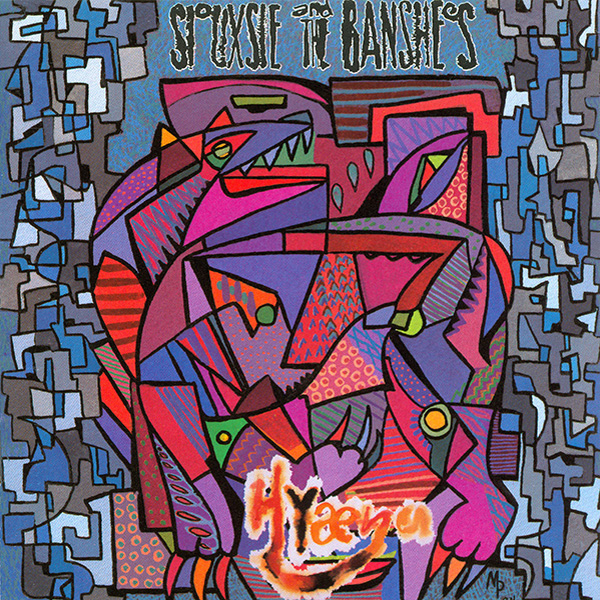
Hyæna is probably Siouxsie and the Banshees’s most underrated album. It’s in sort of a rough spot, sandwiched between their best and most fully-realized albums and best general sound, but that’s also why it’s reliably more than meets the eye.
It can be tempting to downplay how genuinely adventurous the Banshees were because they had very few equals in the post-punk scene when it came from combining pop with style, but their alternative honor is evidently obvious at the same time. They had several (relative) hits without ever falling into a formulaic sound. The breadth of their songwriting language proving these sensibilities weren’t an accident can be found in the various, tiny production inflections throughout their psychedelic era. You could almost make a game out of picking out background noises in A Kiss in the Dreamhouse and seeing how they fit the song’s imagery. It’s something the Banshees have always been excellent with, never receiving their due credit.
Anyway, this provocative imagery is half of what holds Hyæna together. It’s their most mystical, mysterious album due to the other half of the album being the Banshees at some of their most impenetrable. We’re tempted at this point by our previous knowledge of the band to downplay Hyaena immediately and call this pop, and because even though the album breaks typical verse-chorus structure the soundscapes the band makes still tend to crescendo eventually, albeit at sudden (and thus more subtle) moments, and the steps to get there are composed with strikingly magical chord progressions that hook regardless of their simplicity and a wide range of influences (such as the jazzy chanteuse of “Take Me Back”).
The production job is a very elaborate, natural evolution of A Kiss in the Dreamhouse and makes every note glimmer like a quick glint across glass. Part of the reason it sounds so good is that it’s the first Banshees album to actually be mastered for CD. The earlier albums had a notoriously muddy sound to them despite the quality underneath.
“Dazzle” is the most popular one here, and going back to the jazz mention earlier shows that the classic pop influences may have been intentional. This one is thoroughly baroque in its lush and surprisingly fast tempo orchestration, a galloping bed appropriate for Siouxsie Sioux’s solemn but resonant lullaby voice to create dreams in. You can generally expect an opener to a Banshees album to be one of their best ever songs, and that trend is kept alive here. The song only really evolves into synthetic brass that makes the strings jump in excitement, but by keeping the composition simple it doesn’t take you out of its environment. And considering how lovely it is, you wouldn’t want to go.
Though I’d still insist that the star track of the album, both in general quality and the perfect pick to demonstrate the unique voice of it, is “Swimming Horses.” About half of the song is driven by an extremely brief piano hook that feels like it’s perpetually about to jump off into a different movement, which gives it a tensive, hypnotic quality when the foreground is covered with Siouxsie’s naturally morphing phonetics.
In the background, a single guitar strum goes off inconsistently like ripples in what has already been set up as an aquatic environment. The song breaks this delicate form around the halfway point when the track picks up energy without dropping structure because the guitar gradually adds more notes in under your nose. Combined with the increased reverb on Siouxsie’s vocal around this time, “Swimming Horses” gains a really subtle progression that it’s gradually pulling you deeper underwater. It’s almost inexplicably effective at its trance. Then it stops as suddenly as that piano riff came out of nowhere.
The rest of Hyaena isn’t as evocative as the two top examples, but it all inherits that same spirit and free-flowing sound and structure where melody is always emphasized. It’s true that every Siouxsie album (other than Tinderbox) is propped up by its singles while the difference in quality is carried by the band’s sheer force of character and personality, so the only reason I can see why Hyaena is seen as one of the band’s lesser outputs is because it has a deceptively high amount of eccentricity than what you’d expect from the band at this point.
What I’ve recently discovered is that to obsess over Siouxsie and the Banshees means really getting into those hidden eccentricities in their pop hits whose flavor elevates them to the point of true classics, then getting that same flavor out of the more unassuming album tracks. This band are probably a lot, a lot better than history gave them credit for. This was their fifth good album (and not the last), and they didn’t even need to repeat themselves. How many classic post-punk bands had more than two good albums? I still don’t know what the hell “he gives birth to swimming horses” means, but somehow this convinces me I like the sound of it.
Leave a Reply