








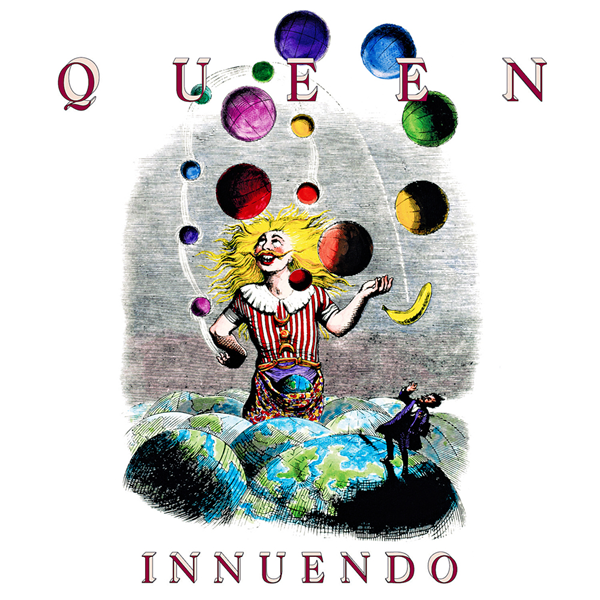
Innuendo is often called a return to form for Queen but that’s, quite literally, only half true. Innuendo is split right down the middle between Queen’s progressive touches from the ’70s, and their schmaltzy ballads of the ’80s. Predictably, this leads to an album that’s varied in quality.
Regardless, Innuendo is properly hailed as one of Queen’s best albums since the glory days of the seventies. For all of its problems with still not minding quality control outside of the singles, it’s the most important album they’d made since A Night at the Opera and certainly the most emotionally charged, ever. Freddie Mercury was visibly at death’s door before the album’s recording and the album echoes with an unusual amount of pessimism. The keyboards, which were no stranger to Queen at this point, now drip with a dour tone that blotches what’s otherwise bold AOR-inspired stadium art rock with black uncertainty. And uncertainty is never really an emotion Queen had associated themselves with, hence their undeniable reputation as the world’s victory music or the confident declarations of victories to come.
“Inside my heart is breaking/My make-up may be flaking/But my smile still stays on” is a line from the album’s ultimate track, “The Show Must Go On” and characterizes the album. “I’m Going Slightly Mad” seems jesting and humorous on the surface but purportedly reflects Freddie’s despair at his inevitably close death. “Innuendo,” the album’s most progressive track, which recalls their other mini-suites is a blatant critique of worldly problems. It’s a basic one at that, but it’s the chosen tone that matters here, and beyond that it offers diversely hooky melodies as it freely plays with genres outside of rock, a shocking opener at this point in their career that showed us that Queen were back to not giving a fuck about convention or making the music anyone expected from them.
These dark and pessimistic moments contrast heavily with any optimism on the album, of which is mostly contained in the aforementioned ballads. This is arguably a poor choice that compromises the album’s identity, and yet if it weren’t for them we would have a high-spirited, life-loving band giving into their deepest bouts of despair. It wouldn’t be like Queen to forget the joys of being alive even in the face of death, and these reminders let us know that the band and their frontman went down fighting for that unrestrained free-spirited performance that characterized their career and inspired countless others. That, no matter how many false steps Queen would take in their reckless creativity that they would be steps worth taking in order to make a show worth watching.
Queen were a band that never once compromised who they were or where they were going, nor did they bow to any laws of tastefulness those demand out of what they pointlessly declare as “high art.” They were a band that drew most of the world together yet repulsed so many others in the shadow of that world, and the only thing that inspires such a response is the purest honesty. For a band often labelled “pretentious,” Queen were clearly too fearless to mind the boundaries other people wanted to set on them or their music. They became so boundless that the heart of the band became too much for this world.
Leave a Reply