







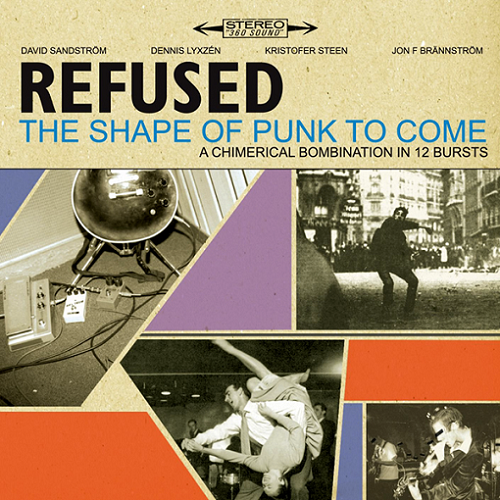
You ever see one of those movies where there’s an intense scene in an underground fight club and it’s really dimly lit by blue/white lights and there’s constant camera angle shifts and close-ups to the dudes fighting and they’re scowling and sweating and whenever a rough punch is delivered there’s slow-down to show you the impact of it and you can see the sweat fly off the guys and due to modern special effects in film the sweat is for some reason really pronounced and almost looks three-dimensional? You know those scenes? The Shape of Punk to Come is that scene in sonic form.
The Shape of Punk to Come has a reputation for being one of the most aggressive, most progressive punk albums ever made. It’s an accurate reputation even today. The riffing is amazing and as heavy as punk could get without bluntly being metal. The repetitive chords are hypnotizing and drill into your head, and the band is aware of this when they title the first track of the album “Worms of the Senses.”
As far as the progressive elements go, outside of wildly changing song structures and some time signature changes there’s also a bit of jazz and electronic beats scattered throughout. Here is my one complaint about The Shape of Punk to Come: these elements always complement the songs, but at times the juxtaposition between them and the punk rock elements is too obvious. They always work, such as the jazz intro to “The Deadly Rhythm,” but then then they go all out punk and don’t look back. But then they prove me wrong again in the middle of the song where they switch back to a jazzy standing bass—but where are the punk guitars? It’s often back and forth instead of a true “chimerical combination” like the album’s subtitle suggests where everything comes together at once at the same time in the song.
Again, I still would not have these non-punk elements ever removed from the album. They genuinely add to the songs and I couldn’t imagine liking “New Noise” as much if they removed the big beats that separate themselves from the aggressive rockin’ parts. The songs are built with all these parts in mind and they fit naturally, I just wish there were times when they were working together in tandem with the punk guitars instead of just tag-teaming, though very effectively.
But my complaint doesn’t lower my opinion of this album that much because it’s all still performed with such ferocity and a spirit of adventure, and all of the songs are well-written and structured to be both memorable and ear-opening. The Shape of Punk to Come is an album that should be listened to by everyone interested in music in general because there simply isn’t anything else like it; that has done the same thing as well or has done it better, or has even done the same thing at all.
It’s true that Refused’s nod to Ornette Coleman’s The Shape of Jazz to Come turned out to be only a nod—this album certainly didn’t bring out a new dominant style of punk music, but many times the ambition and intent of the action is more admirable than the final impact of it. This is one of those times.
There’s reasons The Shape of Punk to Come didn’t catch on at the time of its release, and one of those reasons had to have been that fellow punkers were simply just intimidated. It’s clear a lot of effort and stress went into this dense album (so much so that it broke the band up immediately afterward), and it goes against one of the timely punk ideals of a more stripped-down, simple, direct approach that brings so many to the scene in the first place. But by that trade, Refused display arguably the most important ideal of punk music: the willingness to against “the grain,” the “status quo,” what’s “popular.” Like capitalism. Fuck capitalism.
Leave a Reply