




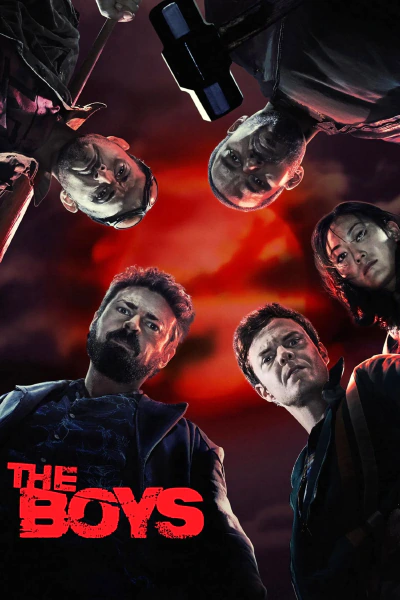
Oh, boy. Oh, boys! The Boys is rough. 2019 to 2026; after nearly seven years (and it feels like much longer), this loose adaptation of Garth Ennis’s and Darick Robertson’s outlasted the original’s six-year production run (2006-2012). I was on board before the second season dropped, and I ended the first feeling rather satisfied. But warning signs began showing in season two, and while I wish I could say something cutting like “it got worse with every season,” I think the reality is that it stayed consistently unimpressive throughout. Any quality differences are so minor that they may be more easily explained by audience fatigue. Fatigue brought on by the show itself, mind, but still.
I’m in the mood for a rant, so please permit me some loosey-gooseyness throughout this article. I’m starting this fresh off of finishing the final episode, and I’ve necessarily watched some of the previous seasons years apart. I can’t remember everything I want to talk about, good or bad, and it mostly sits in my memory as an ooze of Karl Urban shouting “oi, cunt” while punching Antony Starr in the face.
The rest of this article will contain unmarked spoilers. If you want to know if I recommend the show, then my answer is “not really.” It’s bloated to absolute Hell, ludicrously farcical at times for how high its stakes are, repetitive, and the payoff for one’s cost of admission just isn’t worth the investment, in my opinion. For me, continuing the show was far less about sating my excitement but wanting to see Homelander get his comeuppance because he is such an asshole.
SPOILERS (click to reveal)
There are some things I want to get out of the way so that you know where I stand as a reviewer. First, I have no love for The Boys comic. I didn’t know it existed prior to the show. I likewise have no reverence for Garth Ennis, as I only read the first couple issues of The Boys after season one’s conclusion left me wanting closure. I didn’t enjoy what I read, but I haven’t completely written off returning to it. Point is, I don’t care that the adaptation significantly differs from its source material. I have no knowledge for which to care with.
Second, the politics. Oh man, the politics. I’ve been around the e-block enough to know that some people (not all!) will dismiss my criticisms of The Boys to being rooted in ideological differences. Not only is that not true for me specifically, but it wouldn’t make any sense, because I generally agree with the incredibly obvious political positions in The Boys. My politics lean left. That’s not what any of this is about.
But on that note, I can extend to my first broad critique: The Boys is one of the most patronizing shows I have ever watched. Is “patronizing” the right word? What I mean is, the political disposition, satirical subjects, and messaging of The Boys are all so unbelievably obvious that I constantly felt as though I was being talked down to, like I wouldn’t pick up on shit unless it was burned into my brain like the brainwashing scenes in A Clockwork Orange. “As subtle as a sledgehammer” is a common idiom, but also understated. The Boys is as subtle as being hit with an ICBM carrying anvils.
And yet, can I even blame the writers, really? I can when it comes to my personal enjoyment of the show, but for art as something that performs a public service—something I believe in? I don’t know. Like, media literacy, or rather the commonness of media illiteracy is a genuine fucking problem; at least in Western social media. People are profoundly ill-equipped with the reasoning skills needed to assess both fiction and nonfiction, undoubtedly largely due in part to a systemic push to restrain public education, but whatever the reason, it’s there.
There hundreds of thousands of people so unbelievably incapable of reasonable inference that they believed a person who’s spent their entire life wealthy and befriending other wealthy, powerful people would, for some reason, act against their own social class’s interests if given the political power to do so. And we’ve seen the reaction of some of those faith-minded people post-disappointment, with one infamous case of regret stemming not from the fact that their plight was ignored, but that their savior didn’t completely get rid of all taxation. That’s a level of socioeconomical unawareness that I would expect to intersect with the cognition needed to dress one’s self in the morning, yet here they are, completing a survey; walking among us. Horrifying.
For a more direct comparison within fictional media (not that many mainstream news sources deserve the distinction), I’ve seen people argue that Metal Gear Solid 2 is pro-nationalist. The axiom of free speech and public discourse has been abused to the point that many have neglected the importance of being dismissive and contemptuous of statements that are downright wrong. It turns out platforming bad voices does matter, because we cannot just assume the average person shares our reasoning skills or values of truth. The Grapes of Wrath is not “pro-Great Depression,” and it’s a waste of my and everyone else’s time to pretend you have a serious defense of that take.
But again, here we are. And The Boys proved its heavy-handed approach was “correct.” That’s the worst part. When season two began adopting political allegories that changed one word from last month’s real-life talking points, many returning fans were quick to dismiss them on ideological grounds. The first season was obviously left-leaning; you’d think it couldn’t be more blatant that Homelander was meant to be a villainous personification of capitalism and American chauvinism, yet here were people being like, “woah, what changed?” I feel like I attended a party where everyone demanded McDonald’s, and I’m upset that I wasn’t served a five-star meal. Though to be fair, the party promised high standards with the first season, so I guess the strangest part are all the morons who showed up in the first place. Maybe illiteracy extends so far that they misread the invitation. That’s kind of my point.
Eventually, Homelander became Donald Trump. This was a weird pivot to begin with, because any fictional character written to be exactly like Trump would be criticized for being too unrealistic. If Homelander shared his intelligence, he’d be completely nonthreatening, so instead his personal shortcomings mostly come from him being a whiny pissbaby. Which is fair, but now it puts the satire in the weird position of giving its opponents more credit than they deserve. Like, it’s indirectly doing propaganda for them in a desperate effort to remind the audience that this shit is still really dangerous. Which, like, it is. But do you see how fucked this immediately got? The Boys wants almost a 1:1 direct parallel to reality, but is narratively constrained from doing so, which weakens its messaging while simultaneously sane-washing its subjects. You can’t really have it both ways.
At the end of the day, the satire is just too weak for how self-righteous the show’s themes are. It almost feels like the writers view themselves as the heroes saving us flock from oblivion—and in some respects, artists are—but considering what we’re up against, The Boys has to hit way harder, and someone, somewhere pulled its punches.
The show’s criticisms of capitalism and how its self-interest is only capable of being destructive are apparent, but it can never, ever commit. There’s a very telling scene in the final season where a character monologues about how the world’s problems wouldn’t end with Homelander’s defeat, because the economic incentives that created him will continue unabated. This concern is objectively true, and The Boys never addresses it. Jack Quaid simply gives his perennial “did someone just fart” stare as the scene shifts focus to something else. It would not surprise me if someone on the staff wanted to write “capitalism” somewhere in the script, but Jeff Bezos nervously tugged on his collar and Amazon, the show’s producer, put its foot down.
It’s intrinsically disgusting how The Boys has the gall to present corporate control as a negative thing but stops short of ever acknowledging it’s something that needs solving; meanwhile, one of the most powerful corporate entities in world history financed production and only become more powerful from the show’s success. I know this limpwristed behavior is likely not the writers’ fault, but if we’re to follow their own messaging, should we not give a bit of a shit? If I were to totally excuse it, would that not be the ultimate insult to their work?
There’s another scene—from season three or four, I can’t remember—where we’re being given background on a character that’s revealed to be a literal Nazi. They’re unrepentantly racist and evil, as Nazis tend to be, and this comes to a head in a flashback where they’re shown murdering African American people in cold blood. This plot point had been set up for a while, and realizing how much corporate money was breathing down the show’s neck, I wondered if the full extent of her racism was going to be exposed with her dropping a slur. The scene frames her next line delivery as such, structuring her labored sentence delivery in a way where the subject matter is given last. Her evil actions would overlap with her language, aligning the audience’s contempt with her own racism.
Then, she refers to her victim as “a black piece of crap” and I could not help from laughing at the studio’s cowardice. The racism is not what’s funny, to be clear. That aspect is as deplorable as ever. But the scene has a literal Nazi moderate their hate speech for a metatextual committee that doesn’t exist in-universe. It makes zero sense why this character would hide their racism in this scene. Part of the reason we’re teed up to expect a slur is because this is our first time seeing the character alone and in a position of power over a minority. There is not a chance in Hell that the writers of The Boys are not conscious of racist figures attempting to downplay their prejudice in public by using dog whistles or what have you, so this scenario constructed to remove all public inhibitions is obviously meant to demonstrate one such person’s true nature—only for them to still moderate themselves.
By trying to avoid being accused of racism themselves, Amazon, the staff of The Boys, or whoever’s responsible has whitewashed racism by neutering the harshness and relative, suggested hatred of their language. Let’s not kid ourselves or infantilize the writers; we know why this was done. Someone would have thought a slur would be more contextually accurate and true to real-life prejudice, but some force considered not being concern-trolled by morons to be a higher priority; to avoid being the meaningless discourse of the week.
And once more, can I blame them? Again, people are often media illiterate. It’s not that uncommon for audiences to act like media depicting something immoral is the same as an endorsement. This might come from a place of reflexive skepticism in the face of the aforementioned dog whistles and the like, but it’s none more rational for any legitimate origin. Being unable to discern racism from context versus signal words is why dog whistles work, and if you narrow your focus to only be on language, then the code phrases will just endlessly shift and escape scrutiny when it’s needed the most.
Anyone who would’ve hypothetically criticized The Boys for using an actual slur would’ve been in the wrong. The narrative’s opinion on racism could not be any more clear. The Nazi in question is unambiguously portrayed as a villain and is even morally punished for their transgressions. We know they think racism is bad. Even then, any bad actor could still run with criticizing the scene in its current form. Like, it’s obviously still reprehensible to call someone a “black piece of crap.” Is the show wrong for “promoting” that phrasing? Why is one of them okay and not the other, if they’re both racist in nature?
If you follow this to its logical conclusion, the only winning move is for fiction to never depict racism, which is insanely fucking dangerous and completely indistinguishable from how actual fascists want to portray American society as one of no strife, conflict, or dark history. It’d be doing the worst people in the world a favor regardless of good intentions. Mark Twain didn’t inspire controversy because he was racist for depicting how Americans at the time actually spoke about black people—it was because he was forcing people to confront their uncomfortable reality in a place of escapism. Twain believed art could challenge people to be better, which necessarily means he believed in people’s capacity for reasoning and growth. The Boys does not have such faith in people; at least, not faith that overcomes its desire to avoid clickbait headlines.
To really drive this point home, a scene in season five has two black characters conversing, and one of them refers to two white people as the “c-slur.” You know the one. I don’t unilaterally object to this for the same reasons I outlined above. But the inconsistency cements any theory that The Boys was motivated by self-preservation rather than ideology. They didn’t object to the concept of racial slurs, but rather accountability. People don’t care as much about the c-slur, which is completely understandable given historical context and existing social hierarchies, so the studio felt comfortable with letting that one swing.
I would’ve had more respect for the show if it used a euphemism in this context as well just to be morally consistent. I’m not saying anything like “racism against whites is as serious a current problem as racism towards blacks.” That’s an outrageous, misinformed, and paranoid position. I simply want racism as a concept to be presented as a bad thing in its totality. I think it also counts for something that the character delivering the c-slur in this context is depicted on the “good side” while the people being referred to are undeniably more villainous. A reversal of the situation with the Nazi dumbass mentioned previously. The person saying the slur is definitely more of an asshole than most of the cast, but they’re never held morally accountable for it, so we know where the writers stand on their use of a slur, here.
I know some people are going to be super uncharitable and still take away my point as being “think about the poor white people” even though I’ve explained why it’s not. My heart does not break for white people offended by this scene. You can suspect me of being disingenuous, but if you do, I have no idea how I could ever convince you otherwise unless I were to just ignore this inconsistency. Remember, my ultimate point is that The Boys is too nice in its depiction of racism. I believe racism is more disgusting and reprehensible than the show’s own narrative does. My gut tells me most of the staff would share my stance, too! I think the show is once more negatively influenced by capital interests here, but justifying hypocritical messaging doesn’t excuse it. Recall the dozens upon dozens of times Vought is shown releasing propaganda films that revise history to be less offensive than how it actually happened. Wasn’t the show telling us that practice is bad?
Ugh. That took the wind out of my sails. Let me shift gears to discuss a more general problem I have with TV shows, especially those of the streaming era: they’re rarely allowed to end on their own terms. So many seasons of TV shows nowadays are written to have ambiguous finales. Main plot threads will be tied up, but their implications are kept unseen. This is so story arcs can function simultaneously as endings and cliffhangers. If any questions remain unanswered as a result of a series cancellation, you’re usually given just enough to logically infer the outcome past the story’s existing chronology. One character doesn’t survive a life-threatening situation because they’re the bad guy, and that’s how stories work. You may not see the epilogue where everyone lives happily after, but you’ve seen enough to imagine what one would look like.
So much fiction, particularly TV, is structured in a way where the producers are always hedging their goddamn bets on whether something’s going to be popular. Y’know, just a reminder that everything in the goddamn economy is gambling now. One foot always in the grave while another is queued up roll the dice on another financial venture. Art has always existed for commercial purposes in some capacity, and I genuinely don’t begrudge creators for engaging with it outright. People deserve money for their time and labor in giving us something of entertainment and/or intellectual value.
In fact, I’d suggest that the undervaluing of artists and their labor is partially why we’re in this mess. If artists could reliably earn and save enough finances to afford their living expenses and creative endeavors, one project falling through wouldn’t be such a huge deal. By giving artists just enough to where their financial future is perpetually uncertain, artists are incentivized to milk whatever success they find down to the last drop. If anyone ever put their foot down at any point, who’s say even years’ worth of revenue won’t dry up before they’re removed from an informal corporate blacklisting. Like what, you tell Amazon that you only have enough great ideas for one season’s worth of storyline and cut loose? Good luck finding work with anyone else once word spreads of how unloyal you are.
In any case, I don’t know about you, but it became quickly apparent to me following season one that The Boys far outperformed the expectations of its producers, which now meant it had to go for as long as possible in order to keep those Amazon Prime subscriptions rollin’ in. You could tell just by how plots were structured from then on. Characters were never allowed to die off, let alone develop, with any progress being rolled back to the status quo each season so it could be done all over again!
It’s weird, because you’d think this would be done under the belief most people wouldn’t notice, but it feels like everyone did. Yet we kept watching anyway, so are we any better for it? Really, they might as well have had each season start with Billy Butcher having a paint can fall on his head and causing amnesia so he becomes a reckless prick again. It’d be more believable than the actual hamster wheel they had us watching.
The repeated plot points are readily apparent to many people, but other “padding” methods can be more subtle. Establishing shots take longer, cameras spend more time following people from room to room, etc. I don’t want people to misinterpret me as criticizing the show for being “slow” or “boring.” Generally, I think fiction underutilizes silence and space, but there’s too many corroborating elements in The Boys that suggest this direction was done for pragmatic purposes rather than narrative ones. Whenever a scene stalls in this fashion, I ask myself how it might contribute to characterization, mood, or tempo, but I sincerely couldn’t come up with anything plausible for much of the like in The Boys.
Also, did anyone else realize how often the first few seasons relied on threats of social media exposes to move the plot forward? I lost track of the amount of times a character said something like, “if you don’t do this thing that’s against your interests, I’m going to post this video of you fucking a turkey all over InstaPost.” It’s such a deus ex machina. Instead of contriving dilemmas where people could be motivated to make compromised choices, they have to keep falling back on threats of social media sabotage. I vaguely recall a moment where someone being threatened responds with “do it” and the other party just looks aghast in total silence like, “wait, that’s supposed to always work.”
But I think I feel more personally annoyed by what I perceive to be excessive self-indulgence on the part of the staff. Such scenes are what could be considered the more “experimental” elements of The Boys, like Black Noir’s hallucinations of animated critters or Kimiko’s Broadway dance number. I kind of hated most of these? Maybe this actually is just me being super cynical, but it felt like the staff were using the requisite space needed to pad out a season to flex their technical abilities. These scenes often demonstrated character details that were already made apparent by preceding characterization, and their unique qualities exist as a way to justify these diversions going on for several minutes’ worth of material. Like, wow, you can stage and choreograph a musical number. That’s some impressive production value, sure, but does it make the show better? Personally, I felt like I was watching an intermission I didn’t ask for. Get on with the show!
Some might say that they were clearly willing for the show to end, since it did, so the bulk of this alleged padding had to have artistic purpose behind it. My counterargument would be that it hasn’t ended, but rather the model for making profitable IPs last forever has just shifted. What’s partially a way of mitigating audience fatigue and a method by which to have multiple productions going at once for a constant supply of content, The Boys has adopted the typical trend of now having an onslaught of spinoffs. The plural is important; remember, studios always have to hedge their bets! Art can’t just exist primarily for its own sake, turn a profit on the side, then move on. That doesn’t generate infinite money. What, you say infinite profits are objectively impossible? La la la, I can’t hearrrrr you. The sword of Damocles will never fall on my corporation, because I can afford infinite umbrellas!
From Wikipedia:
“As part of a shared universe, a spin-off web series, Seven on 7, premiered in July 2021; an adult animated anthology series, Diabolical, premiered in March 2022; and a second live-action television series, Gen V, premiered in September 2023. A prequel series, Vought Rising, is in production and set to premiere in 2027.”
Heaven fucking help us. You just know they chose a prequel series so Karl Urban and Tomer Capone et al can come back. Are there that many people out there impressed by this shit? When Jensen Ackles was revealed to still be alive as Soldier Boy, were you excited? When Elisabeth Shue collected another paycheck as an apparition in seasons two and five, did you cheer? When they got another Black Noir to stand around silently, were you happy? When The Deep got mocked for being a freaky fish fuckhead for the five-hundredth time, did you still laugh? Or were you exhausted once again by the knowledge that nothing from the previous season as of any consequence, that it was nothing in the face of needing coal for the gravy train?
Speaking of humor, is it just me, or did The Boys go completely off the rails with its ratio of comedy to drama? Maybe I was just more prickly towards it given I would have hoped for the final season to be treated more seriously. But having finished the thing, I’m literally going to slap the “comedy” tag on this article. At what point is all of this gore just straight out of fuckin’ Evil Dead? I feel like a central theme of The Boys is the fragility of humans versus the technological, corporate, economic machine, but such a horrifying premise doesn’t seem taken very seriously by the end of the show when it’s all being undercut with insincere Marvel Cinematic Universe “well that just happened” reaction shots.
This isn’t to say the jokes aren’t funny—they often are—but a show should have a tonal focus. If your characters too frequently respond to awful situations like they’re just incredulous at the inconvenience or grossness of it all, we’re going to have a harder time believing in their personal struggles and motivations. You have to give a shit for us to give a shit, even in fiction. Hell, especially in fiction, because the notion that any of this has real consequences is entirely an illusion that has to be kept up.
There’s an episode in the middle of season five that’s entirely in a vignette format as perspectives swap between characters. I have nothing against this approach, and important events do transpire in these scenes, but the format further excuses the writers to experiment with their brand of absurdity. This is most notable in the section starring Terror, a literal dog, and his lewd desire to hump his Homelander plush doll. His fantasies deliver us scenes of the unfortunate Antony Starr on all fours caressing his own ass and asking Terror to fuck him. Is it funny? You can decide, but lampooning our Omega Hitler villain in this way just hours before he threatens to kill all of humanity doesn’t feel appropriately timed, to me.
Another section has Seth Rogan appear as himself alongside other television staff members to riff about working as a writer/producer in the industry. Typical fourth-wall breaking shit. There’s some funny lines in their banter, and I’m too out of gas at this point to reiterate, but my earlier accusation of self-indulgence extends to this entire segment. Seeing the “actual” Seth Rogan get murdered by Homelander is lowbrow humor to begin with and something you’d expect from a Jason Friedberg and Aaron Seltzer parody film. It’s again, made worse by the fact this is the final season. We only have so much time left, and we’re spending it on watching unrelated famous people deliver their fifteen-minute pseudo-improv skit? Please stop dicking around just for one season.
The whole structure of season five is pretty frustrating. The goal is constantly shifting when, because this is the finale, there ought to be a constant crescendo towards a climax. Instead, the ever-changing focus means tension goes shorter lengths without being released, and less tension means a weaker release. The actual final fight with Homelander is no more exciting than the previous three or four fake-outs we’ve been treated with. It just so happens that a killing blow is actually delivered this time.
Man, I’ve barely touched on the characters and performances. Honestly, most of them are fine on a conceptual level. The performances carry Karl Urban and Antony Starr a long way even as the poorly thought-out script prevents them from ever hitting new heights. The bulk of the problem really is the writing. I could go on about how I think Billy Butcher and Homelander are great foils, and how Homelander does accurately embody American exceptionalism and its folly, but so much good will has been bled out of me that I don’t feel inspired to do so. After all, even the good qualities of this cast are largely wasted in the screenplay’s trembling hands.
I kind of don’t like how Kimiko is handled. Karen Fukuhara does an excellent job, but I think the writers often tried to make Kimiko a focus of scenes even when there wasn’t any interesting, fresh material for her. The “will they won’t they” relationship with Frenchie was exhausting for how long it lasted. Her only other dynamic character relationship is with her brother, and he’s one of the few people who actually does leave the series, leaving her little to work with. Not a great plan, there. The diversity Fukuhara brought to the cast alongside Kimiko’s representation of sign language was cool to see, but the uniqueness of those qualities aren’t five seasons’ worth of compelling on their own.
I guess the writers felt similarly by the time of season five, because they made the unfortunate decision of having Kimiko get her voice back. I think we all knew it was coming; if anything, I was shocked to see it take this long. But this newfound outspokenness is merely used to make Kimiko a running gag of vulgarity. She constantly speaks her antisocial thoughts aloud on accident—which I don’t think has anything to do with whatever cognitive disability was making her mute—and she has a new obsession with pornography for… some reason? It’s just funny because it’s wacky, and since The Boys apparently needs a comedy quota, you can bet she says “dick” and “pussy” a lot!
How does any of this behavior connect to her previous characterization? Isn’t she a trafficking victim? The enthusiasm for porn takes on a sinister undertone, considering. Having a diverse character devolve into such an annoying joke seems to undermine any goals of positive representation, and it leads to tonal whiplash when this same moron is the one responsible for stopping the main villain of the entire series.
I also don’t think Frenchie and Kimiko should’ve ended up together. An unsuccessful tryst motivated by their shared loneliness, maybe, but them becoming actual soulmates or whatever? One of my least liked tropes in fiction is every female cast member having to end the story in a relationship with someone else. Why can’t Frenchie and Kimiko just love each other platonically? I spent most of the series hoping they wouldn’t end up together, and it taking so long to confirm what I felt was going to happen only made it worse.
Hughie’s narrative function as the well-intentioned everyman is executed well-enough. I personally dislike Jack Quaid as an actor. It’s not that he doesn’t have skills, but I think he has an overly relied on mildly confused expression that he uses in response to any emotion. I alluded to it earlier as a “did someone just fart” face, and I really think that’s a flawless description. I’m such a talented writer!
I’ve been dreading writing this next part, but I really hated Sister Sage and I think she’s the most obnoxious character in the entire show. None of this has to do with Susan Heyward—she didn’t write her character—this is entirely a critique of Sister Sage. Anyway, Sister Sage’s power is that she’s the “smartest person in the world,” which I instantly detected as being an issue, because I didn’t think the show’s script conveyed the intelligence necessary for depicting a believable super genius.
Good God, was I correct. Well, “God” plays no part in this, as my best generalization of Sister Sage is the “I’m 15 and this is deep” Redditor that sits alone in the back of their High School class internally ruminating on how much smarter they are than the clueless masses because they’re an Atheist.
I dunno if this is a common take among viewers, but I found Sister Sage to be ruthlessly insufferable. Her endless condescension and reputation is never earned. Every plan she has and every personal analysis of someone she defenestrates are of the most basic reasoning possible—on par with that of any other cast member—but are paradoxically depicted as exceptionally insightful. She’s on the right of literally every single issue except one and is never held accountable for pushing people’s buttons because she’s calculated every impersonal reaction to the slightest detail in order to completely predict their outcomes.
When she’s introduced, one of her “genius” ideas is to escalate a public demonstration by disguising herself as her opposition and doing something violent. Wow, fucking unprecedented. Move over, Sun Tzu. She’s so smart that she even did the violence herself despite being an extremely recognizable public figure, which could immediately compromise her false flag attempt. But I’m sure she just clocked the exact demographics that showed up at the protest to be of the type that wouldn’t know who she was or some bullshit. There’s always an excuse for why Sister Sage is the smartest one in the room, even when she isn’t.
Poor Sister Sage is so burdened with her encyclopedic knowledge of Sociology 101 that she chooses to lobotomize herself just to enjoy being around us moronic plebians. Have you never considered the existential torment of being so smart that you realize the person at the cash register is only being nice to you because it’s their job? What an endless Hell.
Making matters even worse is how the narrative sympathizes with Sister Sage at every point. She’s maybe the only cast member to escape with zero consequences, and this is despite the fact that she’s one of the most villainous. She has genocidal plans for longer than Homelander does and never actually turns back on this belief. She wants everyone in the world to die so she can live alone in a bunker and read, which is something she can’t do without ending the world for… some reason?
She claims she’d never be able to escape Homelander, but she existed in isolation before Homelander recruited her, and other characters are shown successfully hiding from Homelander under an alias. This is the smartest person in the world, who can supposedly predict almost everything, remember. Also, her little bunker escape plan is never explained. Is she going to set all of that up after the virus has been released? That doesn’t sound very smart, given how fast it supposedly spreads. What, are you gonna procure materials from potential carriers? If the bunker is already made, where is it?
After her plans working with Vought and Homelander result in any number of untallied, innocent deaths, Sister Sage is able to successfully lobotomize herself and go live happily, never having atoned for her crimes or genocidal ambitions. No one has any problem with this, which reflects poorly on them as well. The moral implication is that Sister Sage is such a poor, tortured soul that all of her evil is uniquely permissible. Stan Edgar (Giancarlo Esposito) walks away without consequence too, but at least the cast expresses contempt for him. What a horrific character; seriously reads like a teenager’s self-insert.
I can’t help but feel like, whether done so intentionally or not, The Boys represents a large quantity of everything that’s wrong with the world. I don’t like those things. So, I guess I don’t like The Boys. Remember, Homelander isn’t the true enemy, it’s the ability of and incentive for entities to amass an unrestricted amount of resources. Homelander, with all his power, cannot make 2+2=5.
Well, I think I’ll call it here. After all, working too hard can give you a heart attack-ack-ack-ack-ack-ack. Get it? It’s a fucking Billy Joel reference. You oughta know by now.
If anyone in the television or film industry feels like making their stuff better, feel free to request my help using my commissions page. Inquiries are always welcome.
Leave a Reply