






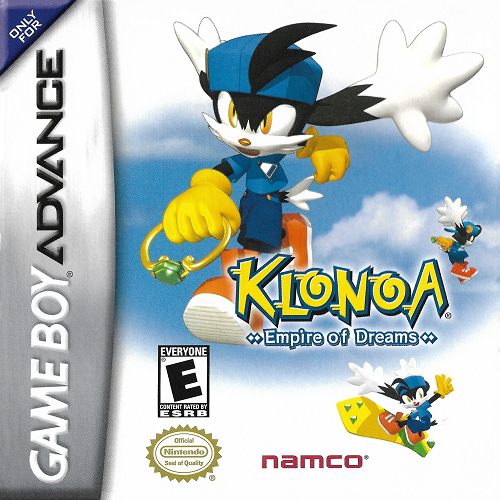
Time to bring attention to one of the best and most overlooked games on the Game Boy Advance (GBA). Klonoa is a platformer series by Namco that has been around since the PlayStation, but when bringing the series to the GBA, they made some changes to game. While the mechanics are the same as ever, Klonoa: Empire of Dreams and its sequel, Klonoa 2: Dream Champ Tournament, are puzzle games carefully disguised as platformers.
Klonoa is a cat/rabbit hybrid animal thing (he actually received a slight redesign for this game) that has a special bracelet with mystical powers. He travels around with the spirit in the bracelet, a blue orb-like creature known as Huepow. The game starts out with Klonoa in the middle of a dream. He is awoken by soldiers and dragged out of his home to Lejimba Castle, where the king tells him that dreaming has been outlawed because the jealous king is an insomniac. Klonoa barters for his release and the king agrees on the condition that he travel to many different lands and take care of complaints of monsters in the area.
There isn’t much story in Klonoa, and there’s hardly any depth to it either. However, the story is told in very nicely detailed cutscenes as shown in the screenshot above. The cutscenes are semi-animated which is very impressive and they are cool to look at even if the dialogue is not impressive, which is certainly something. There’s a cutscene at the start of each area and one before and after each boss battle. Not much, but they replay every time you go to the area and are skippable, which means that you never have to start a new game of Klonoa to see everything again, which is kind of nice.
Each of the game’s five areas has seven levels and one boss stage. In most stages, your main goal is to collect three golden stars. Once they are all found and collected, the final door in the stage will open and you can exit and clear the stage. Also spread throughout the level are several small crystals. These are totally unnecessary, but unlock bonus stages after the game if you have enough, and if you get all the crystals the level marker on the world map turns blue to indicate it is 100% clear, and fully clearing all the levels changes the color of the overworld map for that stage. Odd, but kind of cool.
Each stage also has two special levels, which the game calls “action stages”. As they imply, these stages rely on your platforming skills and reactions. On one of the stages, Klonoa will be reading a surfboard of sorts that never stops moving once the stage starts, and he will have to make correctly timed jumps in order to avoid enemies and grab all the crystals before he rides past them. Collecting all the crystals on the surfing stages nearly drove me fucking nuts at points, but oh well. There’s another stage that is also a scrolling stage, but you have full control over Klonoa, so it’s a bit different. Sometimes the stage will scroll to the right, left, and up depending on where you are in the stage. It’s just a matter of being quick and not having the screen outrun you and cause you to die.
As I was saying before though, the real strength of Klonoa’s gameplay comes from the puzzles. Klonoa has only a few abilities at his disposal. He can run and jump, of course, and pressing and holding A while in mid-air will allow him to use his ears to float for a short distance. By pressing B, he shoots out a short-range blast from his bracelet. If this hits an object or enemy Klonoa will grab hold of it. He can then press B again to throw the object, or press A while in mid-air with the object to double-jump (though this leaves the object behind).
There are a bunch of enemies scattered in stages. Most are called Moos, which are those little red things you can see in the screenshots. They are mostly harmless and walk back and forth aimlessly. Klonoa can grab them and use them as weapons or double-jump material. There are green Moos, which fly instead of walk, and will fly constantly up and down or side to side in a strict pattern. There are indestructible black spike enemies, and bomb enemies, that when grabbed, will start a visible timer and explode when that timer reaches 0 and possibly hurt Klonoa or be used to blow up a wall or block.
Because almost every enemy is used to get past an obstacle or solve a puzzle, they usually have very strict paths the AI follows. If any enemy is destroyed, a blue portal opens up immediately where it was and spawns another one. So this makes it obvious destroying enemies has no real purpose. You have to use them to beat the levels, which is an interesting and fresh idea as they can still hinder and hurt Klonoa if he is not careful.
There’s an even greater variety of special blocks Klonoa can grab or use to solve puzzles. There’s the standard red Moo block, which has the face of a normal Moo and is indestructible, meaning it can be used as a stepping stone and things like that. There are destructible arrow blocks that guide the direction of bomb blasts the way they are pointing, green blocks with white circles in them that stick and attach to similarly colored walls when thrown at them, and a few more besides these main ones. There are also several switches that change the environment Klonoa will have to use to solve puzzles, and some stages have keys Klonoa will have to obtain to access the whole level. Klonoa‘s gameplay is unique in the sense that the player gets all their power from the environment rather than the character itself.
Most levels are not very linear. Often you can get the stars in different orders, and many parts of the stage are accessible to you at one time. Some stages start you off right in the middle of a room and already there may be a fork in the road. Though these levels aren’t too big, this does add a fun exploration element to the game. Klonoa will have to time his jumps, throws, and the player will have to use their head in order to solve the puzzles in each room and get all the golden stars needed and find the final door to complete the level.
Sometimes you can find hearts to restore Klonoa’s health or gold coins to increase his amount of lives. Because this game is puzzle-oriented, you will most likely not find yourself dying very often. It didn’t take me long to build up a huge stock of lives. Boss battles are nothing too surprising. They each have their own attack pattern and every once in a while they will spawn some standard Moos that Klonoa can grab and throw at the boss’s weak point to hit damage. Bosses are typically very easy.
The graphics and music for this game are just phenomenal. The Klonoa series has always had a very “magical” feel to the games that has been the main thing in garnering its cult fanbase. The backgrounds look gorgeous, and the foregrounds and sprites of Klonoa and the enemies are very colorful and detailed. The sprites in particular have that sort of mock-3D effect that some GBA games do, but Klonoa is one of the rare games that manages to combine that with a 2D background and make it look great. As I already said, the cutscenes are very animated, and I like how the Moos in level stop to move their heads and look around every once in a while. The music is usually very soft and elegant, and I love it. It sets the mood of the game perfectly.
Empire of Dreams is a game that just exuberates charm and I love every second of it and has a unique take on puzzle-platforming. I consider this to be the greatest game in the franchise, because the main console games focus on standard platforming and the childishly easy difficulty of them can often make them boring to play. If you are at all interested in this game, then I cannot recommend it enough. It’s one of my favorites. The sequel, Dream Champ Tournament, would continue this game’s style of gameplay. While it is still very fun and worth playing, I think it had less charm than the first game.
Leave a Reply