








Release Date(s): October 5, 2000 (JP) / December 26, 2002 (Legends JP)
I generally do not care one bit for traditional RPGs. There was a time in my life when I was just starting out with RPGs that I could generally enjoy playing even the first Final Fantasy. Times have changed since then and I think my standards have evolved with JRPGs. There are a few traditional RPGs though that I still think are excellent. RPGs that, with all of their common settings, characters, storyline, and battle systems, still manage to be at the top of the pack when it comes to RPGs. These games still manage to pay an uncommonly large amount of attention to the detail of their world and creating a charming and likable setting and story that make up for their lack of depth with charisma Among these are two personal favorites: Final Fantasy IX, and Skies of Arcadia: Legends (SoA).
My introduction to SoA was when I rented it for the GameCube, a system that just like the Nintendo 64 lacked great RPGs. I was only a kid when I played it, and was still in that phase where I’d enjoy any JRPG I played. I got to the first Gigas fight and thought it was impossible to win and eventually had to return. It wasn’t until years later after searching I found a copy that was actually priced reasonably at a GameStop. I paid $20 for it even though the box and disc were scratched to shit, and was excited to see if the game still held up.
Well, it does. I think I like it even more as an adult. Partially because I actually beat it that time. Frustratingly enough, because the disc was so scratched my game froze fairly often and skipped a lot as well, but I persevered. That’s how much I was enjoying myself.
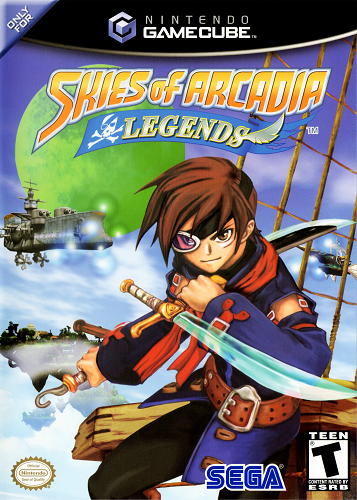
Though traditional RPGs generally have medieval settings with knights and wizards and all that, Skies of Arcadia puts a slight twist on those themes. The story is centered around Air Pirates, who quite literally ride on flying boats similar to airships in the Final Fantasy series. The entire world is a seemingly endless sky with no top or bottom, with floating islands scattered about that people live on. You play as Vyse, who is a young Blue Rogue, along with his female partner and best friend Aika.
A Blue Rogue is a “good” type of pirate (you didn’t think you’d get to play as the bad guys, did you?) that only robs the military vessels of Valua, a powerful country that exploits the weak, and Black Pirates, who are immoral pirates that will attack any ship regardless of their flag. There are several different crews of Blue Rogues and Black Pirates, so it’s not as if they are two giant groups working together or anything like that.
The Blue Rogue group Vyse is a member of is led by his father (making this one of the few JRPGs where the protagonist has both parents at the start of the game and none of them die or turn evil). While raiding a high-ranking Valuan flagship, the crew come across a mysterious girl named Fina that is not allied with Valua or any pirates. Fina will not reveal her past, but due to her kind demeanor the crew trust and befriend her. When the Valuan army attacks Vyse’s home island for revenge and kidnaps the rest of the crew and Fina while he is away. Vyse and Aika vow to rescue the crew before their execution and head to Valua. Along the way they meet many more allies and foes and naturally get involved in a deeper plot that threatens the lives of the whole world.
Skies of Arcadia has many cliches in its plot. Most are obvious, like the fact for most of the game you are going to elemental dungeons gathering crystals. You go through a fire dungeon, beat a fire boss, get the fire crystal, then it’s off to the earth/nature part of the game, etc. It does avoid too many cliches, thankfully. There’s the obvious original setting of the whole pirate theme, for starters. Some are less subtle, like the previous mention of how the main character doesn’t have any dead/evil family members that haunt him.
Skies makes up for its predictability with how upbeat and charming its plot is. The music is fantastic, for starters, with much of the songs perfectly portraying the feel of free-spirited adventure Vyse and the other pirates have, and the freedom of flying and being high up in the air. The dungeon themes all sound mystical and foreboding. The fighting themes are all dramatic and catchy, and match the scale of the battles (especially the ship battle theme, which has all of the attributes I just mentioned).
The soundtrack and characters both have a constant energy to them that completely washes away all the possibly mundanity that may come from Skies of Arcadia‘s otherwise traditional and uninteresting settings and events. There’s no voice acting in Skies of Arcadia other than the usual Legend of Zelda-like grunts during dialogue and in battle and after battle, with each character having a couple of great spoken lines after a battle is won.
Instead, the emotion of the characters is shown through a variety of animated facial expressions that change with each dialogue box. It’s very cute and entertaining and can get anyone attached to the characters and story. It’s certainly much better and more expressive than a character turning towards someone and moving their right hand all over the place as they speak to them while never changing their expression, as was the common standard for JRPGs before/around the time of Skies of Arcadia. Honestly, most characters didn’t even move their limbs during cutscenes. All of this makes me think Skies of Arcadia is still more detailed than most JRPGs coming out today.
The town and dungeon areas of Skies are nothing new in concept, but are also more detailed than most games. There is, quite literally, no building, room, or character model in the game that is repeated. The textures are done very well. For example, there is a town you visit early on called Sailor’s Island, which has a reputation for being a pit-stop town for coming-and-going sailors to restock and trade information.
The side of the buildings all look decrepit and very old, and its clear the town has seen a lot of visitors and use just like the game’s lore says it does. It is small details like these that come together to make something that is more than the sum of its parts and make an RPG world seem believable, identifiable, and engrossing (and in that order). And if you don’t play role-playing games to get drawn into the detailed settings and worlds, then I wonder how you can be a fan of the genre.
As for the graphics, they’re obviously dated by now, but they’ve aged much better than say, N64/PSX polygonal graphics. The models are all well-rounded, there’s a good variety of colors and appropriate textures, as mentioned before. For their time these graphics looked fairly nice, so they still do with the knowledge you’re playing an older game. The water effects are also very nice for the time. But as I said before, the visual appeal comes mostly from the amount of detail in the graphics, not the quality of the graphics themselves. You know? The resolution or whatever. I don’t have much of a vocabulary when it comes to videogame tech.
The whole cast of characters is also quite likable. Vyse is one of my favorite JRPG protagonists of all time. He doesn’t have a mysterious past or anything like that. He’s just a normal boy who loves to rise up to the challenge and do what anyone else would consider impossible. He is extremely charismatic and his confidence regularly inspires other people around him throughout the story. But he’s still not your typical hot-blooded protagonist.
Vyse is actually as cool-headed as he is bold, and consistently explains through logic and reasoning why he believes in himself . He comes up with clever plans before taking action, and uses his intelligence, along with his strength, to win battles. He isn’t a “chosen one”, he has no special background that gives him particular powers or abilities. He’s a hero who comes out of nowhere and touches several people throughout the world. There is nothing about Vyse that feels inauthentic, and he’s one of the most entertaining and inspirational videogame protagonists I’ve seen. In that regard, I liken him to Zidane from Final Fantasy IX.
The rest of the cast is a lot of fun. There are five other player characters. There’s the spunky Aika and the quiet and serene Fina (definitely the most cliche and boring character, but not unlikable) who join Vyse for the entirety of the game. There are three other party members that come and go and fill the fourth slot of the party at times, such as the stern, old, ship captain, Drachma, the sarcastic and cool Blue Rogue, Gilder, and a certain other character who I can’t give away due to spoilers.
It’s too bad you never get full control of these characters and can choose whatever party you want, but near the end of the game you will get to choose a permanent fourth party member. Like I said before, the NPCs in the towns are never repeated and all have individual names and titles, which is very cool and makes them actually seem like people. Each one has a different personality that comes across in their dialogue, as brief as it may be.
So, on to the gameplay! Typical fare, there are random encounters (a lot of them, even if you’re playing the enhanced GameCube port, Legends) you run into while sailing around the world map or walking around in dungeons. You have up to four party members who fight and all characters on the field move in order according to their speed (I always prefer this to player/enemy turns). I think there’s a button you can press to see the upcoming turn order, which will help a lot as it seems to be just a bit randomized.
A thing I really like about the battle system that I won’t be able to mention anywhere else is that characters move around on the battle field. It makes the fights very animated. When you select an attack, Vyse might walk up to the enemy and attack it with his sword, but he stays there after he moves. Even when not on his turn, you can move the camera around and see Vyse and the enemy trading blows with each other and constantly missing so it doesn’t affect the battle and just gives you something to watch. It makes the battles seem like they’re constantly happening, unlike in other JRPGs where everything simply freezes while a character selects their move and everyone else on the battlefield just politely waits.
Skies of Arcadia does turn-based RPG battling in a way that makes sense, even if its just an aesthetic thing that doesn’t change the gameplay (with the exception of some special moves that will be mentioned later). Each character has a variety of attack animations, too. Vyse will sometimes not go up and slash the enemy and instead shoot a sideways laser-beam from his sword that hits the enemy from a distance. Like before, it doesn’t affect the gameplay, but it’s fun to watch and makes watching the same old battles a little more interesting. Just another one of the many details of Skies of Arcadia that makes it more engaging than most JRPGs even if the core gameplay is nothing too special.
You can use regular attacks to dispose of enemies which are nothing unusual, special moves, and magic attacks. Let me explain how those last two work. In Skies, you have a gauge at the top of the battle screen that resets with each battle called the SP gauge. Your SP gauge starts at a certain number and can reach a certain maximum number, both depending on your party’s average level. SP is used for both magic and special moves. Stronger/better attacks naturally cost more SP, and you gain a little SP with each turn or by having a party member use the Focus command which charges the gauge a little more. With that in mind, I’m going to go into detail about special moves and magic attacks.
Special moves (actually they might have been called super moves in the game, I don’t remember) are special techniques that cost a demanding amount of SP. Each character has a different number special moves with their own effects. Not all special moves are attacks. Some are defensive and can protect you against certain attacks or boost your stats. Some can target multiple enemies on the field, and the only other way you can do that is with some magic spells.
Vyse for example has some strong one-target special attack moves, one that targets all enemies, and a defensive move that makes him counter all attacks for a turn. Aika starts with a move that attacks all enemies on the field and gets stronger ones later, and also has a very useful defensive technique that blocks all magic attacks during the turn it is used. There is an even greater variety of special moves on all of the other characters.
One thing I really like about Skies of Arcadia is that you can choose which spells you want each character to learn. I love it when a game has skill customization because like I have said several times before, the feel of winning a battle is much more satisfying when you realize it’s because you raised your characters effectively. It allows you to come up with your own battle plan and makes you feel clever.
There are several elemental crystals that you gain through the course of the game that can be equipped on your characters. At the end of a battle, you gain points towards each element level and when you get enough, that element level increases and you learn a new spell of that element. By ending a battle with a certain crystal equipped, you get more points towards that element than normal. Each character has an elemental preference and will naturally learn some elements faster than others, but crystals help you curve that a little.
Also interesting about the magic system is that it uses both MP and SP. Characters have a very small amount of MP, usually in the single digits through the whole game. Every spell regardless of rank uses 1 MP and uses a different amount of SP based on how powerful it is. I like this a lot, because it means your characters never get so much MP that MP cost becomes totally irrelevant, like most other JRPGs. You have to consider when is a good time to use your spells and rarely do lower-ranking spells become worthless, also partly due to the fact they use SP too, which is always scarce and important.
It’s unfortunately undermined by the fact you get plenty of items that can restore 1 point of MP and can buy them easily later. The fact that the spells still use SP is good, though, because it means you can’t just go buckwild with special moves and magic because there might be a point where you need a good amount of SP to use an emergency defensive spell or special move. You have to pace yourself well or pay the price.
For your regular attacks, there is one thing not typical about them. Like mentioned before, you can change your elemental crystals during battle when on that character’s turn. You can press a button to cycle through all the elements without any consequence. Each enemy has a certain element, and there is an elemental wheel like in Pokemon where each element is strong against something and weak against another. Enemies cannot change their element, so all you have to do to win a fight is enter a battle, check the enemy’s element (which takes no time because you can tell their element by the color of their portrait’s border that is displayed on the screen) and switch your weapon to the color that it is weak too.
Not only will enemies deal terrible damage to you now because your element is better, but you will deal much higher damage. Because of this, you can have the advantage in every single battle. That’s ridiculous and obviously unbalanced. The only things holding this back are the fact not all elements are available to you at the beginning and that you want your characters to finish battle with a certain element equipped so they learn it faster, and that element might not be the stronger one.
Stat-wise, all of the characters are pretty well-balanced and can be used effectively in any party. Vyse is mostly well-rounded and is the strongest attacker when you take into account his super moves. Aika is fast which generally makes her a good utility member, even if she’s middle of the road when it comes to strength. Fina cannot attack well, but has even better magic than Aika and a variety of supporting special moves. Drachma is a slow character with strong regular attacks and high defense, even though he can miss often. Gilder is another well-rounded character like Vyse, except with more stamina and magic power and a little less attack. The sixth character is well-rounded, and the second strongest character after Vyse but with lower defense (he basically is a lesser Vyse, but it works and he’s still useful as Vyse is the best party member as is).
Skies of Arcadia‘s biggest problems are actually the several balancing issues the battle system has. Let me explain them all in an easy list.
1. The element crystals giving you a big advantage in every fight, like said above. You do not have all crystals at the start of the game, but this is a double-edged sword because it also means you don’t get to fully customize your skills from the start of the game because you don’t have access to all elements, which is a little a lame.
2. In a random battle, there is never a reason not to use Aika’s super moves that attack all enemies on the screen. Every enemy is susceptible to them (with a very very small amount of exceptions) and you generally start out with enough SP at the start of a battle to use them. Not to mention, Aika is the fastest character and will always be moving first. 90% of your random battles will have Aika starting out by using one of her super moves, which will kill all or severely cripple your enemies and then having the other characters mop up whatever is left with normal attacks.
3. There are many special moves that target multiple enemies, but not necessarily all enemies. For example, Aika’s first special move, Alpha Storm, targets enemies in front of her in a triangle zone that spreads outward from her and hits all enemies in its path. The problem? You can’t aim it.
Being able to control the movement of your characters on the battlefield to both aim your attacks and avoid your enemy’s special attacks would have been a great addition to the game. Instead, it’s all totally random where your character is positioned because it’s not controlled by you when they move to attack an enemy. The most control you have over aiming a special move is which enemy you choose to target it with, because that enemy becomes the proximity of the special attack. It helps, but it would be better to just be able to aim the attack itself.
4. Stat boosting moves are too powerful. Mostly for the reason that they last for the entire fucking battle unless your character dies in which case you can just recast it on them. Increm is one of the first spells you learn with the red crystal, and it boosts your attack and defense by 25%. For the entire fight. This is your saving grace in boss battles, and when combined with being able to change your crystal to the one opposite of the enemy’s gives you an even bigger advantage than normal. Once you’ve cast Increm on your whole team (which is even easier once you get the upgraded version that can hit your entire party) you’ve basically won the battle.
Things not easy enough? Cast the blue spell, Quika, which boosts your speed for the whole fight! Better yet, cast Driln, which reduces the attack and defense of an enemy by 25% for several turns. Okay, so it’s not the whole battle, but one turn is all you need to fire off an Increm-boosted special attack against a Driln-weakened enemy and dispose of them in one attack, whether they’re a normal enemy or boss. Good god.
5. Special moves are slightly unbalanced. All over the place. Most of these are minor. Some are too strong for their SP requirement, like Aika’s hit-all attacks. Some are just too strong, period, like most of Vyse’s. Some characters lack a good utility special move that makes them match the usefulness of other party members. Actually only Drachma really has this problem. Poor guy only has three special moves, two of which are just attacks that pale in comparison to Vyse’s who is always on the team, and one that is actually pretty helpful as it is essentially just a stronger Focus command that he defends during. But that just turns him into an SP battery at best for Vyse to spam Pirate’s Wrath (his strongest attack) more often.
Gilder has two attacking moves, but his last one is the strongest all-target attack in the game, even if it’s too costly to ever use effectively. And his middle one is a defensive move that blocks all status effects for a turn. It won’t be useful that often, but at least it’s an effect that no other party member can replicate. The sixth party member has two single-target special moves that pale in comparison to any of Vyse’s, making them totally useless as they cost too much or about the same as Vyse’s. On the other hand, his middle move is the cheapest defensive move in the game. It costs a measly 4 SP and cuts all damage in half for the turn it is cast, and is cast the same turn he uses it. Ugh. Too much. The balancing issues should be obvious by now.
6. Compounding balancing issue 5 into this, there comes a point where there’s no reason to use anything other than the occasional defensive move and Vyse’s Pirate’s Wrath attack in a boss battle. You have every character repeatedly use Focus and defend, cast Increm on Vyse and Driln on the enemy, then have Vyse use Pirate’s Wrath once he has enough SP which is usually enough damage to outright kill any boss. Vyse’s Pirate Wrath is so powerful that it makes any other strategy irrelevant, even other offensive strategies, as explained in 5.
7. Item boxes. Around the game you can find these and buy them in shops. They are boxes that are used like items but cast specific spells free of charge No MP or SP required. And they have several uses each. There are boxes for every element, but not every type of spell. That is certainly enough though, as with boxes you never need to cast attack spells and can just use all your SP for support skills like casting status boosting moves which are already too powerful on their own. Did I mention that there are boxes for healing spells, and there are also items you can buy that work as normal healing items? You can buy both boxes with multiple uses, and healing crystals. Boxes should not be in the game or should be super rare.
8. The nature of spells. Attack spells go off your magic stat, while recovery spells heal a fixed amount. Because of this, it makes more sense to teach the low magic high attack characters healing spells because they’ll heal for the same amount as anyone else despite their low magic stat. This is contrary to their nature and they’ll learn healing spells slower than other characters, but it pays off. Besides, you can just use items.
9. This isn’t really a balancing issue, but i don’t like how all the characters learn spells at different rates. Some people will argue that this makes each character unique, but I think it is unnecessary as each character already has their own stats and special moves. Having them all learn spells at the same rates wouldn’t turn them into blank slates or anything. It would just allow you to customize them more without being penalized because that character just happens to have a poor affinity in the element they’re trying to learn.
10. This is a placeholder because I assume that there’s something I forgot I’ll have to edit in later. The game is pretty unbalanced, unfortunately.
Oh yeah, I haven’t even mentioned ship battles yet, have I? Over the course of the story there are several mandatory ship battles. These are different from normal battles and are more similar to a turn-based strategy game. I’m too lazy to explain the whole thing right now, but I’ll put it in layman’s terms. Each character can perform an action during that phase (each character is shown as a row on the side of a grid) and you can set when during the turn you want them to perform that action (each turn shown by a row at the top of the grid).
You can predict what will happen each turn by the color of the square on the top of the row. Green means its a good turn for you to make your move, yellow means caution, generally a turn where an enemy will be preparing their attack, and red is a turn that is advantageous to your enemy, either they will dodge your attack or fire a strong one of their own.
You can cast magic spells on your ship like in normal battles, use special moves with the help of your crew members (not party members, more on that later) or defend or Focus or whatever. You can also choose whether you want to attack with your normal cannons or special weapons like torpedoes that can hit on a turn in the future so you can attack several times on one turn for massive damage. After all turns are over, a new phase begins and you can set new orders.
Ship battles are a welcome change of pace compared to normal battles, but they suffer the same problems. Balancing, and lack of depth. You can cheese ship battles the same way as normal battles. Use status boosting moves (which don’t last the whole battle but around three turns), then once you have enough SP, use your ship’s super weapon that deals so much fucking damage that it makes wasting SP on your smaller cannons completely worthless. Nine times out of ten this will destroy the enemy with one blow. God. As for depth, there should be a greater variety of special weapons to allow for more strategy, and more variety in the enemy’s maneuvers.
Sometimes during ship battles, message prompts come up where Vyse will have to make a decision on how to fly based on what the opponent is doing. There is one right answer and one wrong answer that will put the following phase in your or the enemy’s favor. There should have been more of these, because as it stands there is only one particular prompt that shows up in a ship battle if at all, and the correct choice is always the same.
Once you figure out the enemy’s pattern either by guessing right the first time or choosing the wrong one, you’ll never answer the dialogue prompt incorrectly again, so it’s kind of pointless how they keep asking you what to do because the answer never changes. There should be different prompts that rotate to keep you guessing, but they didn’t do that and the potential for ship battles is ultimately wasted. They remain fun however, because there are very few of them so they last just long enough to be fun while not sticking around long enough for you to get sick of all their flaws. You can upgrade your ship with special items earned from winning ship battles and equip it with cannons and other weapons bought from stores.
Later in the game you get your own ship and island and can begin sailing around the world collecting crew members to work on your ship and/or island. You usually have to do something for them to get them to join, as a sort of mini-sidequest. A lot of these characters make appearances in the plot at some point, so having them become relevant again is pretty nice. Some crew members can open up a store at your island, for example, so it’s a good idea to recruit as many as you can for all the benefits.
You can customize your island base to a certain extent and can improve the way it looks and how big it is by paying your builders (who are also crew members you have to recruit) a certain amount of money. Having your own base and ship is really awesome, but I wish you could customize them more. Still more than most (all?) traditional JRPGs. Each crew member has a special move that can be used in a ship battle for a varying SP amount. Each special move is different, so this adds some strategy to ship battles (read: just use the skills that allow you to use your super weapon faster and win immediately).
Other than battles, there’s a bunch of other sidequests you can embark on, which is great. There are Discoveries, various special places on the world map that you can encounter that include old monuments, ruins, or special geographical formations that have earned a reputation among the citizens of Skies of Arcadia. When you’re next to a Discovery and press the confirmation button, it will be added to your list of Discoveries, have a small blurb written about it, and the world map will change to reflect the Discovery, which is pretty cool.
Even though you typically can’t actually land on and visit Discoveries, you can sell the information to a sailor’s guild for a cash prize, that is if you managed to discover it before another sailor (so you should always try and find it the moment you see a hint for it in a sailor’s guild). Added to the Legends port are the Moonfish quest and the bounty hunts.
A merchant sailor has a shy daughter who finds a little duck animal thing she’s become attached to that has come down with an illness or something. It only eats Moonfish, so the merchant asks Vyse to find them. Around towns and dungeons, the GameCube controller will vibrate and the screen will beep alerting you that you’re close to a Moonfish. Vyse can then use zoom-in and if he is close enough, press the button to shoot out a net and capture it. Bringing Moonfish back to the merchant can get you pretty good rewards.
Bounty fights are certainly the funnest sidequest. At the sailor’s guild there is a wanted list of criminals that Vyse can hunt down for rewards. When he finds them, he gets in an optional boss fight. All of these bosses are very interesting and have unique design and fighting strategies. They’re also by fucking far the hardest fights in the game and can actually be very challenging, even with all of your usual tricks. It’s great and helps make up for the very easy normal battles. They’re a lot of fun. There’s even a fight against an imposter group of heroes that look like you and even use knock-offs of the same special moves as you. I love it.
Finally there are some gigantic monsters you can run into on the world map that can only be fought in ship battles. They’re usually pretty easy and give mediocre rewards, but it’s pretty surprising when you run into them by accident. There’s a creature in the game that keeps track of your total game completion, including how many treasure chests you have found. But some areas can’t be revisited, meaning you’re fucked for 100% completion if you don’t find all of them in that one area. And that really fucking sucks and will piss you off as it did me.
During the course of the story, there are several dialogue prompts for Vyse. If you choose the “right” prompt, a noise occurs and your Swashbuckler Rank goes up. This rank is displayed on your status screen and doesn’t affect much. Characters talk to you differently, and some crew members only join if your rank is high enough. Winning battles increases your rank, and running lowers it. It’s a nice little thing. I think it might have an effect on your buying/selling rates at stores, but I’m not sure.
I’d like to conclude with just a little more griping. You get your ship far too late into the game, and you never get enough time to really enjoy your island base and crew. That is very disappointing. The latter half of the game also goes by too quickly, with much shorter dungeons than the first half of the game. The good thing about these complaints is that they are both problems because of how great the game is and me not wanting it to end as early as it does. But, it really shouldn’t have to some extent. Also the final dungeon is super lame and is literally nothing more than a brown cave.
Though Skies of Arcadia has plenty of flaws, they are all flaws that are under the surface, and the surface of Skies of Arcadia is very inviting and charming, and will always override any of those flaws. There are plenty of great ideas in Skies of Arcadia that show you the game’s heart was in the right place, even if they weren’t executed perfectly. These ideas make Skies of Arcadia ripe for improvement in a competent sequel, but I doubt we will ever see one.
Maybe it’s a good thing that Sega weren’t overly self-aware when making the game; even though it lead to a lot of flaws, it also allowed them to capture lightning in a bottle with Skies of Arcadia, and it is one of my favorite JRPGs ever. In every way, Skies of Arcadia mixes traditional RPG gameplay and story-telling with professional execution and progressive ideas that expand upon older, “classic” JRPG mechanics and themes. The result of that perfect balance is an adventure that is truly captivating.
Leave a Reply