




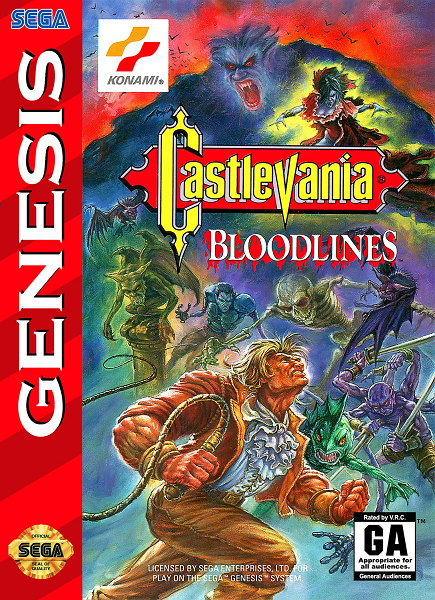
Name(s): Castlevania: Bloodlines / バンパイアキラー / Banpaia Kirā
Platform(s): Sega Genesis
Developer(s): Konami
Publisher(s): Konami
Genre(s): 2D Action–Platformer
Release Date(s): March 17, 1994 (North America) / March 18, 1994 (Japan) / March 25, 1994 (Europe)
Related: Castlevania (Franchise)
Castlevania: Bloodlines is one half of Konami’s Sega Genesis underdogs. The other of course is Contra: Hard Corps. Both games aren’t nearly as well-received or well-known as their SNES counterparts but any fan of either franchise that’s sought them out would say they at least do them justice. I know where I stand on the Contra debate, even if Hard Corps is too damn difficult for its own good, but in a recent back-to-back playthrough of Bloodlines and Super Castlevania IV (SC4), it’s a tougher choice to make.
How do I even begin comparing these games? Bloodlines came out three years after the SNES’s Super Castlevania IV and only a few months after the PC Engine CD’s technologically superior Rondo of Blood (RoB), and yet Bloodlines still predated Rondo of Blood‘s reimagined “port,” Dracula X, by a year as it went back to the SNES. A very non-linear and confusing time for the Castlevania franchise indeed, which saw it flip-flop between gameplay standards and consoles without any sign of actually plotting ahead, despite delivering a series of consistently quality games.
Super Castlevania IV appeared to innovate with its more fluid physics, whip aiming, and greater emphasis on platforming, but Rondo of Blood ended up going back to the simpler style of the NES games. For once it’s fitting that the next chronological game, Bloodlines, sticks to Rondo of Blood‘s plan. The jump arcs are still stiff even if they’re not to the level of the NES games and there’s a greater starting lag to your weapon swing that’s similar to the older games.
Weapon aiming has partially returned, though it requires a very precise input to work and the down diagonals don’t do anything, meaning the quick physics that defined Super Castlevania IV can’t be relied on. This returns Castlevania to the pace it is in most games with a greater need to stop and engage individual enemies rather than moving and attacking at the same time.
Like in Rondo of Blood, you have two playable characters, but their differences border on simple aesthetics (and after how overpowered Maria was in RoB, that might be for the better). John Morris can use his whip to grapple onto ceilings and swing across gaps, while Eric Lecarde can use his spear to do a high jump. These movements occasionally offer split paths unique to each character, but nothing major.
Item Crash from Rondo of Blood returns where you can use a greater amount of Hearts (or in this game, Gems) to perform a super attack unique to your sub-weapon. There are only four sub-weapons this time around which is very disappointing, but the often useless Knife is substituted by the new Boomerang which has a nice horizontal arc that turns it into something helpful while not diminishing the value of the other sub-weapons. It’s too bad the Knife had to come back.
True to Bloodlines sticking to the series’s classic roots, the game has much more modest level design than Super Castlevania IV. Stage screens generally stay within an immediate horizontal range and scroll vertically only very rarely. On the plus side, this straightforward layout also diminishes a lot of the opportunities SC4 allowed where you could attack enemies from outside their range to cheaply remove a threat. Since Bloodlines is almost always forward progression, there’s not very many cases where you’ll get to attack an enemy from below for instance, even if it does make the level progression dull in comparison to SC4.
Despite being one of the shortest Castlevania games yet at a meager six stages, Bloodlines extends its playing time by punishing you harshly for mistakes. On the default setting you’re allowed three lives and two continues. All of these start you back at the screen you died on, but if you use them all it’s straight back to the beginning of the entire game. Sure there’s passwords, but they save your lives and continues.
This pushes what would have been one of the easier Castlevania games into a very frustrating one unless you increase the amount of lives. The infinite continue system other Castlevania games used worked perfectly fine. It punished you but didn’t put you far enough away from where you stopped to make you not want to keep playing, and it meant you didn’t need to play for a long amount of time completing segments you’ve already proven you can beat just to practice on the stuff that actually matters.
With the mostly by-the-numbers Castlevania gameplay explanation out of the way, it’s time to cut to what actually makes Bloodlines notable: its sense of style. Bloodlines is the missing link between the Castlevania platformers’ cartoonish, comic book sense of horror and the more ballsy Gothic, grotesque horror and art style that defines the best modern Castlevania entries starting with Symphony of the Night. This style is vastly preferable to me as a horror fan and more than anything else is the reason why I prefer the RPG Castlevania games to the classic-style platformers. But that’s getting a little offtrack. Point is, Bloodlines is where that all started, and it’s goddamn awesome.
One of the most immediate realizations of this is when you notice simply how much more gore there is in Bloodlines. Stage 3 introduces flying harpy-like enemies that you can dispatch normally, but if you happen to hit their head at the right trajectory it’ll fly right off while the enemy continues flying erratically, blinded. A big, extra “1000” point moniker pops up to reward you on your cruelty and it’s downright badass.
Bloodlines‘ secondary antagonist is Elizabeth Bartley, Dracula’s niece (what), who plots to resurrect the dark lord. As a cool aside, Bartley is based off the countess Elizabeth Báthory, and if you don’t know her mythos I implore you look it up, as it’s a hilarious example of the Castlevania series’s subtle sense of humor. What I’m getting at is she’s portrayed as a beautiful young woman, yet after you defeat her in battle she flies into the background and lets out a piercing scream as her head fucking explodes in a spray of blood for literally no reason.
Bloodlines was censored and re-subtitled in Europe and Australia as The New Generation while it received a “General Audiences” rating in North America, the equivalent of the ESRB’s E rating. I’m not at all a guy who demands gore for the sake of gore, but I don’t think there’s a game series with themes as synonymous to gore as Castlevania, and I love it. Gore and Castlevania should go hand-in-hand.
Bloodlines isn’t just flashy in the gore department, however. It features a wide array of bright, dazzling colors that are the total opposite of Super Castlevania IV‘s bland neutral palette. The game also doesn’t shy away from strangeness for the sake of more interesting art design. Most of the game takes place in neither Dracula’s castle nor the outdoors, but rather historical sites, lending a lot of unique locations to the series.
My favorite stage would have to be the third, which is centered around the Leaning Tower of Pisa. It starts outside at night with green grass and a shaded blue background. Fairly typical stuff, but at the end of the screen you see the Tower come into view in the background. The next screen takes you inside where the background is suddenly tilted to match the tower with a bright red color scheme that’s in 100% contrast to the scene just set outside.
The following area is also tilted but features a much darker red with some purple. It’s not as surprising on the eyes but the initial transition from a contrasting scene to one that’s close on the color spectrum still feels very natural as it’s setting the color theme for the Tower as opposed to the outside of it.
Later in the stage, you’re suddenly taken outside of the Tower where you’re inexplicably climbing a series of floating platforms around it as a light purple background surrounds you. It’s a suddenly very surreal appearance that makes it feel as if the demonic presences in the Tower are changing the outside world that looked completely normal at the stage’s beginning. It’s eerie and atmospheric in a way Castlevania games had never been before.
In addition, Bloodlines cutely tries to make up for the Genesis’s lack of Mode 7 graphics with a few special effects of its own. Stage 2 has a very nice reflection on the water of the upper half of the screen, and it’s consistent as the water rises up and down. Stage 3 makes the Tower further disorienting by making it tip back and forth as you climb certain screens. Unfortunately, the Genesis’s hardware isn’t completely sophisticated, and some of these special effects have a certain cheapness to them.
In the previously mentioned tilting tower, the animation is choppy and blocky. The sixth stage has a gimmick early on where the screen is cut up and divided into two planes across four horizontal sections. You’re constantly caught between both planes and have to piece them together in your head to be able to make jumps and avoid enemies. While this is a very cool idea in theory, it’s nauseating in practice because it looks so unnatural and more like a game glitch than the influence of some spell. The fourth stage’s boss is a sentient bundle of gears that seems to only exist to show off a 3D gimmick, and it’s a little tacky.
Michiru Yamane composed a Castlevania soundtrack for the first time with Bloodlines, and while it lacks both the stunning quality and eclecticism of the soundtrack she did for Symphony of the Night, it’s nonetheless good throughout and surprisingly smooth and warm-sounding for Genesis music. It fits the gloomy yet up-tempo sound of the Castlevania platformers perfectly.
While Super Castlevania IV‘s ambient music allows me to focus more on the gameplay, Bloodlines‘ music does a better job at priming me for the action, and I think they just got a better sound out of the sound chip overall. The sound effects are far less impressive and a very stock array of Genesis bloops and squelches. Not off-putting, but not memorable, either.
Though Bloodlines struggles through taking some steps back in gameplay and level design for the series at this point it trades those qualities for a fantastic visual style that’s both pretty and distinctive beyond its series, genre, and console. Bloodlines easily gets in my top 10 best-looking Genesis games, but it’s more than that. Its combination of gruesome gore and flashy colors strike me as influenced by Italian Giallo films, which is a very interesting design choice that’s just as pleasing in a game as it is on the big screen.
It’s a bold tone for the series that I wish came back eventually, but at least the more extreme nature it took in general would be reflected somewhat in later sequels. And just as it gets me excited there, it gets me excited here. Bloodlines‘ aesthetics combined with another Castlevania‘s superior level design and gameplay could’ve yielded an action-horror masterpiece, but as the Castlevania franchise went on we only saw glimpses of one or the other, never together. I’ll keep dreaming though.
Leave a Reply