








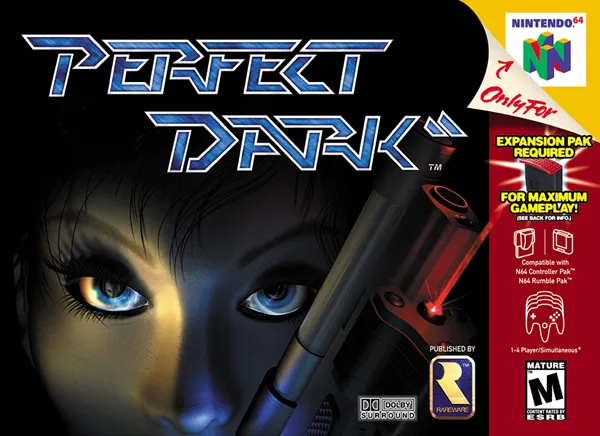
NAME(S): Perfect Dark
PLATFORM(S): Nintendo 64 (emulated via Nintendo Switch)
DEVELOPER(S): Rare
PUBLISHER(S): Rare
GENRE(S): First-Person Shooter (FPS)
RELEASED: May 22, 2000 (North America) / June 30, 2000 (Europe) / October 21, 2000 (Japan)
History
Like most people who consider themselves fans of the Nintendo 64 (N64), I have a certain fondness for developer Rare‘s output on the system. While the company’s bread and butter for the era was 3D platformers, their two first-person shooter (FPS) games were just as much of an integral part of their legacy. GoldenEye 007, released in 1997, was their first attempt at the genre and hit the ground running. The reasons for the game’s success are difficult to count in their entirety.
One possible explanation is the culture of the time. Nintendo‘s reputation as a casual, “less hip” console manufacturer and publisher was gaining momentum due to the perceived gap in technological prowess, and therefore prestige, compared to the multimedia CD-utilizing Sony PlayStation. A maturity-conscious audience would still find its way to the system one way or another through personal interest or acquaintances, but would be broadly met with family-friendly aesthetics and IPs. Much of those games were nothing short of phenomenal, as history has vindicated, but outside of the occasional bridging of demographics with narratively ambitious titles such as The Legend of Zelda‘s two seminal releases, a certain set of players were often left out to dry.
In comes GoldenEye 007. Not only is the 007 license among the most recognized in western culture, it is one often considered synonymous with masculinity, class, and respect via the way of its suave international superspy. We could dissect the truths or merits to that for decades (and people have), but it was true. Any potential hokeyness accompanying such a worn property would be cleansed and revitalized by the tie-in game’s source, the 1995 film GoldenEye.
After the franchise’s more recent films often ranged between the mediocre and downright embarrassing, GoldenEye lead actor Pierce Brosnan would spearhead a renewed interest in the James Bond character with an approach that’s been commonplace since—an original, modernized storyline not beholden to the original novels penned by Ian Fleming. The results spoke for itself: box office returns nearly six times the amount spent on the movie’s budget.
Rare’s opportunity to cut into that pie with a video game tie-in were jeopardized by developmental snafus, ending up in a somewhat embarrassing two-year late release. It wasn’t a completely unsalvageable attempt at multimedia marketing—GoldenEye‘s sequel, Tomorrow Never Dies, would release only a few months later—but Rare would find it difficult to ride the hype train of the film when it had already left the station. They would need to draw an audience by the game’s own merits.
Against all odds, fighting an uphill battle against unenthused pre-release coverage, GoldenEye 007 was a smash hit. By carving out a genre and tonal niche for the Nintendo 64 alongside clever mechanical game design, Rare had ensured their game would become a defining moment in FPS history. It had demonstrated the potential for “shooters” to reach a wide audience on consoles without significantly compromising their quality or complexity. The game’s multiplayer was a particular selling point, further introducing hordes of people to the genre and its future potential in the medium and market.
Not long after, the original director of GoldenEye 007, Martin Hollis, would reprise his talents to lead the development of Perfect Dark, an original IP that would be a spiritual successor to James Bond’s adventure. A three-year gap would separate the two games—even longer than GoldenEye 007‘s inconveniently long development time—but once again, the team at Rare would demonstrate their capabilities. Whereas GoldenEye 007 was, in some ways, impressive for a console shooter, Perfect Dark was the console shooter.
My Experience
I consider myself an N64 aficionado. At least, I don’t have many blind spots when it comes to the system library, and Perfect Dark represented possibly the biggest remaining one. I was never really into shooters of any kind growing up. The focus on realistic settings was unappealing to my anime-addled brain, and encounters with the genre were scarce on the platforms I owned.
I’ve done some catching up ever since, as this ought to demonstrate, and I’m pleased to say I generally have liked all the classic FPS games I’ve played. They tend to have addictive, snappy gameplay, as well as interesting level structure that attempts to marry open-endedness and exploration with the urgency and fast-paced gameplay one would expect from a firefight. It’s good stuff that ticks many boxes, and even in my 30s I have yet to lose that feeling of being a badass while just mowing down virtual enemies with bullets or lasers. That helps.
Perfect Dark hit the Nintendo Switch‘s subscription-based emulation app in 2024, and I was excited to finally take this one down. I played the single-player campaign alongside my friend, Stevie, who was much more experienced with the game and genre in general. Completely on my own with no difficulties or help needed whatsoever, I finished the game’s lowest difficulty and wanted to just jot down some thoughts.
Before I go deeper, I’d like to acknowledge the restraints of my engagement with the game. While it was fun playing alongside a friend, it did make it difficult for me to follow and judge the game’s storyline. Additionally, I understand the game’s lowest difficulty heavily compromises much of the game’s design. It’s easy to tank bullets for most of the game, and options to utilize stealth and strategic approaches are undermined in the face of this fact.
I have yet to experience the game in its full depth, let alone the multiplayer, and I’m fully aware of that. I enjoyed the game enough that I intend to return to it on my own and tackle the higher difficulties in the future. When I should do so, I will update this review. Until that time, please excuse my somewhat shallow chronicling of my impressions.
It’s difficult to overstate just what a technical marvel Perfect Dark is. It’s often the first thing people tend to praise about the game. Though it did come at a cost. The game had one of the more interesting interactions with the Nintendo 64’s Expansion Pak, where it was required to access (according to the back of the box) 65% of the game. Those without this 4 MB increase to RAM capacity would be relegated to the game’s multiplayer mode, and even then, unable to access all its features. It’s an understandable compromise, given how much of Goldeneye 007‘s popularity was owed to its multiplayer mode.
Of Perfect Dark‘s high production values, one that immediately stands out is the game’s full voice-acted cutscenes. The Nintendo 64 wasn’t a total stranger to voice acting, but at times it would make you wish it was. Another heavily voiced game was Mega Man 64 (Mega Man Legends on PlayStation), which had the audio quality of a gagged man trying to act on Ambien while underwater. In truth, Perfect Dark doesn’t completely solve the issue. Audio can still sound a bit muffled, but it’s leaps and bounds superior to contemporaries and more than acceptable given the constraints.
In general, I would say the game suffers problems with audio mixing. Fidelity is one thing, and it’s possible this was all intentional to disguise compression, but virtually everything outside of sound effects felt buried in the mix to me. For the voice acting, this is tolerable due to being able to turn on subtitles, but the music is left out to dry. It’s a real shame, because when I did notice the tunes, they were quite catchy electro beats that were understated enough to sell the spy motif without contradicting the intense action on display.
As for the quality of the acting—it’s pretty decent. We’ve come a long way with voice acting in video games, and everyone knows it. But those at Rare should be commended for generally taking the task seriously. Persistent characters read the script with appropriate enunciation, and voices appear well-casted with regards to their character designs and personalities. Occasional immersion breakers can occur in the form of bit-part actors delivering lines that feel more at home with the humorous English dubs of the era, but knowing Rare, it’s entirely possible this is part of their trademark sense of humor. I would have preferred a consistent tone if that were the case, but it’s not a significant setback.
And the story? Uh… I’ll be honest. I barely understood what was happening throughout the entire game. I found it difficult to focus on the cutscenes due to my joint-playthrough, and the sketchy mix didn’t exactly help to commit dialogue to memory. My understanding is that you’re a super agent for some kind of technology conglomerate called DataDyne that handles top secret work pertaining to alien life. Some other company wants to steal your data to conquer Earth with the power of different aliens. There’s also a grey alien named Elvis. I don’t know why he’s named Elvis. I feel like I still wouldn’t know even if I followed the plot fully. Maybe this story is really fun and well-executed, but I have to withhold judgment for now.
If nothing else, the level of detail in the narrative is commendable. One particularly entertaining touch is that the game’s main menu is contextualized through a computer interface, and it’s possible for the player to exit out of it in their environment to explore the DataDyne facility. Contained within are some character interactions, written profiles for characters and items, tutorial missions, and other easter eggs. This goes a long way to make the world feel alive rather than to have it only exist as window dressing while you shoot people.
Further doing so are the game’s branched mission paths. Levels are objective-based, meaning you receive tasks at the start of a mission and have to fulfill all of them until you can progress. Typically, these are cleared successively, but you’re often allowed to do some out of order, should it suit your strategy or you simply want to see what will happen. Dialogue will sometimes change to accommodate this, rewarding your exploration of agency within the game world. Your missions, along with their fail conditions and potential flexibility, are detailed in your pause menu and contextually written as characters in the story—another opportunity taken to add flavor to Perfect Dark.
All of these touches, at times, make the game feel almost like a pseudo-immersive sim. Helping this comparison is the game’s graphical and stylistic similarities to the seminal Deus Ex, which would be released only a month later. It was in the air, I suppose. One final oddity is the game’s fail state. Upon botching an objective beyond recovery, such as failing to protect an NPC, you will receive the typical message of shame telling you to restart the mission.
However, you can simply… not. You can continue playing the mission otherwise as normal, just unable to progress in an effective soft lock. In one mission, it’s possible to reverse a failed mission objective with a creative solution, resulting in the game’s characters lifting the failure mark and allowing you to proceed to level completion. It’s a nice reminder that Rare’s meta humor is (or was) capable of clever observations beyond that of passé lampshading.
I mentioned earlier that I still lack experience with the shooter genre, so my perspective on Perfect Dark‘s mechanics may reflect that. It also doesn’t help that I probably haven’t seen the full scope of Perfect Dark due to playing it on the lowest difficulty. Regardless, it’s time I touch on the gameplay as best I can.
At its fundamentals, it’s a fairly ordinary FPS. I’m not going to waste anyone’s time explaining it in too much detail. You walk, you run, you crouch, you strafe, you aim, you shoot, you reload, you pick up weapons, you pick up ammo. It’s all there. The game’s most noteworthy traits stem from its high level of polish, and the variety of mission objectives and their flexibility.
If anything, the game’s basic combat feedback loop is somewhat upended by just how easy the game’s lowest difficulty is. You may be thinking that’s a funny criticism, and I’d often agree, but Perfect Dark provides no direction on what’s an appropriate starting difficulty. Instead of the usual descriptors of easy, normal, and hard, you begin with agent, special agent, and perfect agent.
I found it a natural assumption that “agent” was the game’s default difficulty. It’s what the cursor starts on, after all. Games with their lowest difficulty being “normal” and only escalating from there aren’t exactly uncommon, either. And when you’re not familiar with a specific game, you can’t be truly sure of whether or not it simply has a slow difficulty curve when you’re starting out.
All this is to say that I wasn’t sure what to think of being able to run into hordes of enemies, eating bullets like the T-1000, and blasting away like ammo was a disease I desperately wanted to cure. I wasn’t too concerned, because I still found it fun on a base level, but as the number of missions increased that implied stealth, I began to felt I was missing a core component of the game’s complexity.
Your character, Joanna Dark, is a spy. Yet, I found mechanics like crouching, using cover, and monitoring enemy patrols to be things I could largely ignore. I could imagine higher difficulty levels being very rewarding, with having to scan each and every environment to determine where you can afford a firefight versus when you need to isolate or avoid specific enemies. It would reward critical thinking and creativity, and really bring the most out of the aforementioned flexibility in fulfilling objectives.
I suppose now’s a good time to talk about Joanna’s tools. While more unconventional weapons such as mines may have gone underutilized due to my choice of difficulty, I still enjoyed some of the weapon designs. If I had a criticism, it’s that I felt most guns played rather similarly even when they had different names and appearances.
Despite alterations to ammo count, rate of fire, and damage, I was usually just fighting everything the same way. A particularly funny example was the game’s sniper rifle, which I often forgot even had sniping capabilities and used as a standard gun. Again, I acknowledge that these differences could be more noticeable in higher difficulties, but I can only relay my experience.
Nonetheless, there are a few neat highlights. The FarSight XR-20 is one, a rare gun of alien origin that uses its esoteric origins to justify its physics-defying gimmick of being able to fire through walls! When combined with one of the game’s infrared scanner, you’re an unstoppable angel of death, taking out enemies that don’t even know you exist.
The Reaper, another alien gun yet this time belonging to the antagonist race, is a portable Gatling gun that mows down opponents with a constant spray of satisfyingly green laser bullets. What I found particularly neat, however, is the gun’s feature when it’s out of ammo. The player is able to spin the barrel as if firing, then make contact with enemies to skewer them with its high-speed rotation. Practical? Not at all. But the title of this secondary mode being “Grinder” ensures I’m going to at least try it.
Speaking of, that’s another mechanic that took me way too long to figure out—to the point where I almost never used it. Each weapon has a secondary mode that can be accessed by holding a button down. This changes its properties depending on the weapon. For instance, standard pistols can be used to pistol whip people, providing a non-lethal method of fighting that’s more practical than hand-to-hand combat. I love this feature, but as I discovered it too late, I can’t comment on it much further or discuss how it affects game balance. Another thing for another time.
I’d like to wrap this up, so I’ll mention now that another issue I had is the lack of direction on maps. I enjoy exploration, so I’m willing to forgive a lot, but the first-person angle you’re stuck looking at can make it difficult to get your bearings straight in large environments that look pretty similar. I got lost on more missions than not, and a mini-map or even a simple objective compass would have gone a long way to make this game less frustrating. This will probably be alleviated when I replay the game and simply learn the environments, but that would be from brute force. You would think DataDyne corp. would be able to provide Joanna with rough schematics or aerial reconnaissance for all of her infiltration missions.
Ah, brother. I’ve been writing this damn thing for hours, and it’s more out of a sense of obligation than anything else, because I want to give the game proper credit by playing on its higher difficulties before writing a more in-depth review. When I do, I’ll make sure to update this page.
At the very least, I quite enjoyed Perfect Dark. I thought it was an impeccable technical work, and I was engaged by constantly marveling at the sheer amount of effort put into it. Rare would end up merging its adult sensibilities with their trademark skill in developing 3D platformers in the form of Conker’s Bad Fur Day, their final Nintendo 64 game that would carry forward Perfect Dark‘s technical prowess.
Though we aren’t quite there yet in this chronology, it’s nice to be reminded of how genuinely talented they were at programming and game design. There’s a lot of revisionist history surrounding the developer due to their reputation after being acquired by Microsoft, but only a blind gamer could return to a title like Perfect Dark and not come away with respect. It would have been funny if they attempted a sequel after their buyout and we could directly compare its quality to their first attempt.
Oh…
Leave a Reply