








Note: I will be updating this article periodically to discuss more of the included games. Check the article’s most recent publication date and the article’s excerpt for the latest details.
Background
I believe I found this from some forum post while searching for “underrated” or “Japanese exclusive” Nintendo DS games. I bought a Nintendo DS flash cart long after the handheld was dead and buried, so I was having a field day slapping anything and everything on it. The Nintendo DS is similar to the PlayStation 2 in that it has loads of experimental, low-budget games due to its massive userbase and inexpensive production costs making it relatively low risk to publish games of any kind on it. No matter how niche you are, finding an audience is always more likely when you have a bigger crowd.
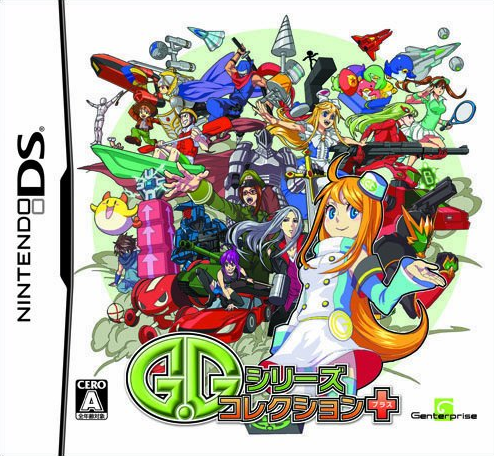
The G.G Series Collection+ (GGSC+) is a compilation of DSiWare games developed by Suzak and published by Genterprise. You may know Genterprise for making… uh… the G.G. Series games? Maybe for publishing the DS games Sideswiped and Iron Master: The Legendary Blacksmith, or for developing the multi-platform Chaos;Head: Noah (hey!) Compared to their development credits, their publishing credits appear more diverse but still relegated to the obscurity of Japanese exclusivity.
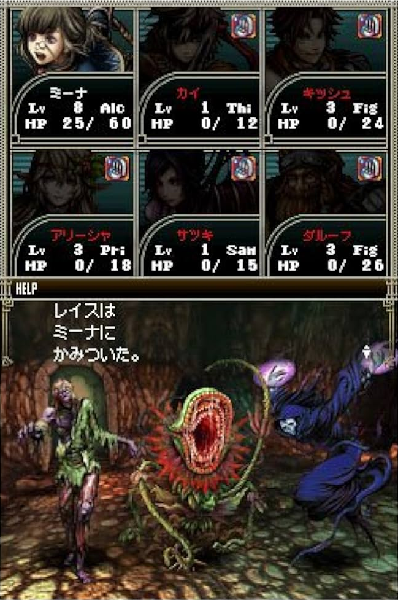
Finding information on Genterprise’s output was a bit of a hack job, so I didn’t delve too deep. One of the first things to come up was their involvement in developing and publishing Wizardry: Seimei no Setsu, an installment of the same beloved (in Japan) dungeon crawling RPG franchise that served as a major inspiration for the Megami Tensei franchise. I mention this in a desperate attempt to raise awareness of the game, as it seems to have an incredibly cool art style. Sadly, it appears the game was only sold through Amazon Japan. What an unbelievably cursed life. I wish I could play it. Check out this screenshot, and I would also recommend searching for more images. Maybe someone will become interested in translating it.
Suzak? Suzak are even stranger. This is the company that developed F-Zero GP Legend and its sequel, Climax, for the Game Boy Advance. Those games were a huge improvement over Maximum Velocity, so that’s a good sign. Ever play Dokapon Journey on DS? No? Well, they also made that. Do any other old fogeys remember the domo-kun internet memes during the mid 2000s? They would often use sprites ripped from Suzak’s first-ever developed game, featuring the eponymous meme mascot. Last and certainly least, they made Wario: Master of Disguise. That’s… a less good sign. Suzak appears to be defunct now, what with their last attributed release being in 2010, as well as having a dead website URL. I think they might have been absorbed by their collaborator and publisher Genterprise, as Genterprise would continue releasing G.G Series games until 2015. Since then, other than their name appearing for a rerelease of Chaos;Head: Noah in 2022, it seems Genterprise are also out of the industry.
So, what is this G.G Series—their main output and legacy? Well, the DSiWare platform itself was for digital-exclusive games sold on a storefront only accessible by the Nintendo DSi, the third and final model of the Nintendo DS. Releasing exclusive games at the end of your platform’s life cycle that can’t even be played by most owners of said platform always struck me as an insane decision, but that’s how you know it’s an authentically Nintendo decision.
Regardless, I have no shade to throw towards the developers making entertainment for us through DSiWare. Of those developers, perhaps the most prominent was Genterprise and their “G.G Series.” You may be asking what the “G.G” stands for, and why the second G lacks a period, but I can only offer a guess as to one of those questions. While doing research, I noticed GiantBomb referred to the series as “game like games.” The use of quotations, as well as the fact the phrase is something no native English speaker would ever create, makes me suspect they’re quoting a Japanese source.
I asked my friend Ryan, who’s fluent in Japanese, if he could find a source on Japanese search engines. He ended up finding a web archive of their official website which stated that the abbreviation began from taking the letter “G” from Genterprise. From there, they came up with “game-like games” as well as a double meaning for “general” and “global.” I assume “game-like games” is to imply that the G.G Series provides a simple, pure gaming experience. These aren’t just games—they’re the gamiest games to ever game.
The G.G Series of DSiWare games encompasses titles from many genres, be it platformer, puzzle, shmups—the fundamental “pick-up-and-play” styles you’d expect are all here. The games are often characterized by players as being retro-like, “throwback” games that recreate the feeling of classic 8 and 16-bit video games. I think this is a little inaccurate and that this sensation arises naturally from games designed to be simplistic and “small” of scope. These games were sold for about $5, so the production costs, development time, and player value had to be appropriate. A bunch of interlocking mechanics weren’t exactly on the table for an “assembly line” approach. Despite all of that, the “retro” descriptor does a fine-enough job giving you an idea of the style of games we’re looking at here.
And when I say “assembly line,” I don’t mean to imply the games are of low quality. They are certainly of varying quality, certainly, but there is of course no reason a utilitarian, basic gaming experience can’t deliver at least $2 worth of entertainment. Not only that, but there’s a kind of charm these games possess due to their sincerity. Genterprise aren’t getting the attention of DSiWare shop browsers using established IPs or anything—they just pick a concept, quickly make a game around it, and hope it’s enticing enough to sell based on premise, and of high enough quality for you to pay attention to further efforts bearing their G.G. Series brand. It’s the kind of honest exchange that reflects how the market should actually work, rather than the abstracted eldritch abomination that is modern day capitalism. But I digress.
While searching online, I found many English players with fond memories of many of these games. I enjoyed seeing the variety of opinions as well. One of the titles, Super Hero Ogre was considered by one player to be of relatively low quality, while another remarked that they had a ton of fun with it. I think the presence of that dichotomy suggests the general quality of the G.G Series. If something isn’t at the very least competently produced and functions as intended, you would typically find no defenders of it. Yet I could only find one game that seemed to have virtually universal criticism—and I’ll let you know which one that is when we get to it, don’t worry. I think it will be fun and interesting to compare and contrast which games are positively or negatively affected by their modest scope and to what extent. It may reveal my personal tastes, as well as what fundamentals need to be present in a game to provide positive feedback, or what plebeians call “fun.”
So in 2010, Genterprise compiled all of their G.G Series games up to that point and released them as a standalone physical cartridge collection. Players could now experience those games on any DS model, and would save a pretty penny from buying them bulk at standard MSRP rather than paying for all of the games individually on the digital store. To sweeten the deal, Genterprise even developed 14 original games for the collection, bringing the total of games to a whopping 30! Each game would only have to average out to about $1’s worth of value to justify the purchase. Surely they can do at least that much?
Now, here’s where things got kind of hard to track. Not every G.G Series game was localized and released in the North American DSi Shop. I thought determining this would be easy thanks to the existence of a Wikipedia article listing all DSiWare games—except it’s missing a lot of information? Almost every G.G Series game is listed as not having been released in Japan, which couldn’t be more wrong. I had to corroborate a lot of my information, and the Nintendo Fandom wiki proved a valuable resource. Thanks! This is to say, please forgive me if I share some inaccurate information, and let me know in the comments about corrections I can make.
By my count, 30 G.G Series games were released in English—every one of them on the G.G Series Collection I’ll be going over. These English versions were released from October 11, 2010 to July 16, 2015. That sounds like a long run, but the specifics paint a stranger picture. Only seven games were released from 2010 to 2011. The G.G Series brand would remain dormant in the US until 2015, where Genterprise seemingly threw their hands up and released everything else from May to July of that year—23 games in barely more than two months. To me, that seems like they risk oversaturating and cannibalizing their own market and sales, but I would assume the behind-the-scenes was more complicated.
For whatever reason, it seems Genterprise determined that releasing games past 2011 in the US was either not profitable enough to be worth it, or something prohibitive within the process came up. I don’t know if anyone related to the company has shared why this happened. What’s particularly strange to me about the close proximity of latter releases is that, I would assume, they’re still localized. As small as these games are, that’s still a considerable effort. We’re looking at many redrawn graphics and sprites across 23 games, and if these were being worked on consecutively, it means at times they would have as much as a week to localize seven games, such as those released on June 4, 2015. Not impossible, sure, but considerable work for a small company releasing extremely niche titles, especially when considering it could have been avoided with a more even release schedule. Could the localizations have been outsourced? Maybe. I just don’t know. The whole thing is just odd. Even odder is that the DSi Shop would close March 31, 2017. This would give customers just shy of a scant two years to purchase these 23 games. I really wonder what transpired and caused this happen.
I wanted to compare Japanese release dates, expecting those to have been more spread out, likely corresponding to the original development times of the games. Except I can’t find the Japanese release dates—at least not in English. You may have noticed a potential contradiction in how I claimed 14 games were made for the collection, yet the 30 games in the collection match the total of games released in North America, all of which are accounted for. GiantBomb gave me the 14 number, so if they’re not wrong, my assumption would be that the games were indeed originally made for the collection, then later sold separately on the DSi Shop like the other games. Maybe in both regions. Maybe just in North America, since Japan had the collection. Because the collection released only a short time after the G.G Series games would begin English localization, this would give the developer a healthy back catalog of games to release. Which they didn’t even take advantage of for four goddamn years!
You think I’m done talking about the weird release history? Hell no. See, some G.G Series games were neither localized nor a part of the collection. These include a couple of sequels to G.G Series games. One of them is a sequel to Super Hero Ogre, the first G.G Series game to be released in English. You might expect this to be of particular interest when it comes to localization, but it didn’t get one! So you may be thinking, well, it was likely a game developed towards the end of the DSi Shop’s life cycle. Nope, it came out on August 25, 2010. The collection wasn’t even out yet. Meaning not only did they pass up a huge window to localize it, but they specifically chose to not include it in their upcoming collection and instead opt to develop entirely new games in the place of it and the other unlocalized sequels. God help me. I have to move on. Some day I will review those scant sequels as well, but for now I’ll simply note when a game has received one as I cover them.
For full disclosure, this isn’t my first time playing this collection. I’ve put in plenty of hours for some of its games over the past few years. But I’ve always felt somewhat guilty for not giving a lot of the games more time, hence this new project. Another reason is that I used a cheat code in my first playthrough to unlock all games from the start instead of buying them from the in-game shop. This was to cut out grinding, but I want to report on a more authentic player experience. Plus, being forced to narrow my focus on specific games should contribute to my main goal. So, I’m starting a new file. No games unlocked, all records wiped—the works.
Before we embark, I’d like to give a small shoutout to Lunatic Obscurity, a Blogspot site where I enjoyed reading the opinions of its author on the various games in this collection. It’s a good blog, and I’ve picked up some game recommendations from it, so you might too. My most distinct memory of playing G.G Series Collection+ is while in a hospital waiting room, and I would break up play sessions by reading some of those blog posts about the same game. It was nice.
The collection
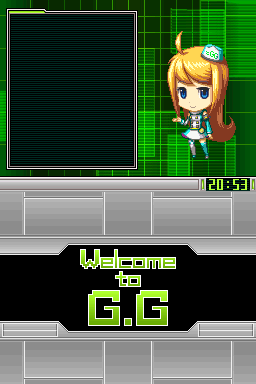
Well, here we are. Welcome to G.Ground zero. The root menu’s interface is a mock computer operating system, complete with fake load times. Could have done without that extra second or two of waiting just for flavor, personally, but I’ll survive. I’m a sucker for these faux-OS interfaces (Smash Bros. Melee, anyone?), so I’m giddy overall. You may notice that on the top right of the bottom screen is a clock, which is accurate to your DS firmware’s actual time! Even on my New 3DS XL, on which I’m playing the game, it’s on the dot. It’s a simple thing to be impressed by, but if it’s so simple, I wonder why more DS games didn’t implement it?
It’s a mild convenience, but the original DS didn’t allow you to return to the OS without shutting the game down, whereas its competitor, the PSP, allowed you to bring up an overlay containing the time and other details at any moment during gameplay. Even 3DS models switch to the original DS firmware when playing DS games, so I would still have to close the game to see the time. Or I could just use my phone. But damn it, at least Genterprise cared! Coincidentally, this gives all of the games a sort of Game & Watch vibe. Those were also dual-screen games that were (necessarily) simplistic. And recreated and sold through the DSi Shop! For the same price of $2! And far inferior to the modern G.G Series games! But they are a damn cool novelty.
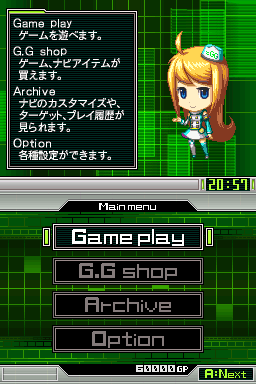
I thought it was implied, so I neglected to mention it, but the G.G Series Collection+ is exclusive to Japan. If you’d like to play the game yourself, you either have to import a copy, use a flash cart, or emulate the game. I can’t endorse the latter two options, obviously. As of writing this, there is no way to play the game in full English, patched or otherwise. Fortunately, this is of little consequence. As you can see, the most important menus are in English.
I expect players should have little difficulty navigating the collection and using context clues to figure out the rest, even if the phrasing and spelling used can be “off.” When you pause a game, for instance, you have the options “restart”, “retry”, and “title.” In English, it’s implied that restarting a game means to return to some initial state, but here the word is being used to mean “resume.” You can imagine how a non-native English writer might make that mistake. You started the game, paused by stopping, and now you are returning to your started game—a restart. I dunno, I thought it was amusing. I probably lost like 20 seconds of time from being fooled by this at the start though, so I will dock this game 20 points for my final score.
There are two major concerns when playing this game in Japanese. One of which I’ll cover later. The other is that each game has its own manual that is accessed from its title screen. These are fairly well-done, complete with the usual labeled screenshots you might see in modern digital manuals. Unfortunately, that’s of little help if you have no idea what you’re reading. You’re going to have to learn each game through trial-and-error during gameplay (or “game play”, as they put it.) However, because these games are so simple by nature, that’s often an easy task. Start a game, press every button once, and you’re probably good to go. Pick up and item and don’t know how to use it or what it does? Press every button again and find out. It’s not so bad, though I do find myself often wishing I knew how a game’s scoring system works. I don’t know if that’s even in the manuals anyways, though.
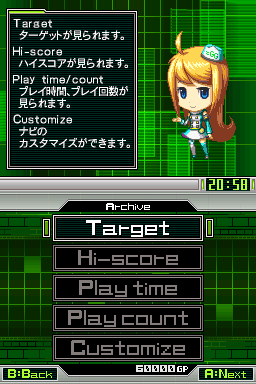
Selecting “Archive” takes you to a sub-menu that makes the curious design choice of having more options than its preceding menu. Most options here are self-explanatory. “Play count” shows you how many times you’ve launched each game. If you’re like me, it’s a good way to feel embarrassed by how many times you’ve launched Drift Circuit.
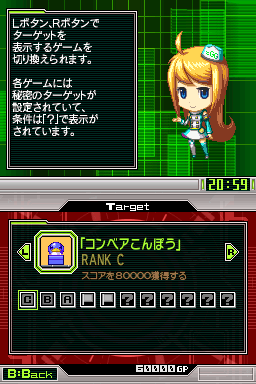
“Target” is a missions/achievements mode of sorts. Each game has a varying number of challenges unique to it, and clearing one then returning to the main menu provides you with GP relative to its perceived difficulty. GP is the game’s currency, and it’s most notably used to buy new games. The Targets are mostly what you’d expect. Some are bespoken for, like reaching a certain level in the game, while others require more specific play. This can be getting a high chain in a puzzle game, reaching a stage without ever taking damage, and so on. They’re all over the place and catered to the style of game they’re for. The Target system provides plenty of replay value and goals to shoot for, giving you some direction when it comes to mastering each individual game.
This is, of course, the other area where you’ll be wishing you could read the text. While you can easily guess what the nature of most Targets will be, there will come times where you’re unsure what you’re required to do. I ran into a case where I couldn’t understand what a Target wanted for a specific game, and it was a game I was really good at. I was never taking hits and beating levels as fast as possible, yet the game still wanted something else from me. In recent years, it’s now possible to take pictures of foreign text with your phone and have it be auto-translated, but even while using DeepL I would often receive unparsable text or it would outright be unable to recognize the text on my 3DS screen. There’s no perfect solution to this, and as far as I know there’s no fully translated list of Targets anywhere. I wouldn’t let that dissuade you from playing the game, however. Targets are your main way of getting GP needed to buy more games, but you don’t need to complete every Target.
With that said, let’s discuss the shop. Using your DS’s calendar, the shop updates its inventory every day to display four randomly chosen games: one from each category the games are sorted under in the menu. These are “Puzzle”, “Shooting”, “Action”, and “Sports.” There are 6 Puzzle games, 8 Shooting games, 10 Action games, and 6 Sports games for a total of 30 games. To start with, you are given one game from each genre, and they are always the same four games. From here on, you have to pay 30000 GP to unlock every additional game. You’re given 60000 GP to start with, so you can buy two games of your choice right away or wait until something more appealing shows up in the shop on a different day. You’re only given the game’s animated DSiWare icon and a description in Japanese to go off of for an idea of what the game is like, so English players will be flying particularly blind here. I will say, it is somewhat fun to imagine what a game is like from the icon and having no idea what you’re going to get until you launch it.
The shop is undoubtedly the most controversial thing in GGSC+. Read any forum thread or review for the game (few though they may be) and you’re likely to encounter at least one person bemoaning the cost of additional games. It’s not without good reason, but I do feel the issue is overstated a little. See, other than Targets, the only way to earn GP is to just… play the games. I’m unsure exactly how GP payout is calculated; whether it’s time spent playing, score obtained, game-dependent, or even a combination of the three—but it’s chicken scratch. You’re lucky to return to the main menu and break even 1000 GP from this method, and you need 30000 GP for one game.
I suspect a lot of players are just playing these games half-mindedly in short bursts and juggling different titles. They aren’t necessarily wrong for doing so, as that’s one of the appeals of these bite-sized games. But that style of playing just isn’t conducive to earning points. You need to engage with the Target missions to get GP in a timely manner. From my experience, if you aim to just beat games one at a time, you will get a steady enough GP payout from the Targets you automatically complete for a finished game without even aiming for them. Basically, for every game beaten, you ought to be able to afford one more. If not, check your Targets.
As for those, pay attention to the top screen, which flashes a messages whenever you clear a Target. Think about what actions you might have just taken that caused the message. Did you just defeat the last enemy in a stage? Then there might be a Target for defeating every enemy in a stage. You can then replay other stages attempting to do the same and earn oodles of GP. Targets can pay out 8000 or 10000 GP each depending on the Target, and I’ve had times where I returned to the menu from one game only to receive an onslaught of Target clears that gave me tens of thousands of GP.
It’s really not that bad. Just focus on beating games and improving in them, and you should make frequent progress. There’s no need to grind the small payouts. That said, I mentioned I used a code to unlock all games the first time I played. I bought into the idea it was too grindy, and it was only because of my latest playthrough that I had my mind changed. It’s also nice to not be overwhelmed with all of the games from the start. Not only does it give you something to look forward to with each new game, but you spend more time with games you might not have otherwise and, with that patience, discover new things to enjoy about them.
If you do decide to use an unlock code regardless, that’s your choice. Technically, spending more time on each game is something you can do by exercising self-control, but it is easier said than done. Also, with everything unlocked you don’t have an incentive to engage with Targets other than completionism, which I think makes your engagement with each game less dynamic. I’ve had my perspective on games altered because of their Targets and their associated meta-game. At times I decide which games to focus on based on how easy their Targets are, or how much they pay out. It adds more dimensions to GGSC+, all in exchange for some tenacity.
Before we move on, I want to mention somewhere that these screenshots are taken from a fresh game file. I don’t know of a way to take screenshots on my New 3DS XL hardware, so the records and the like that you will see won’t reflect my in-game ones—just in case there’s ever a disconnect between what screenshots display and what I claim to have done in my text.
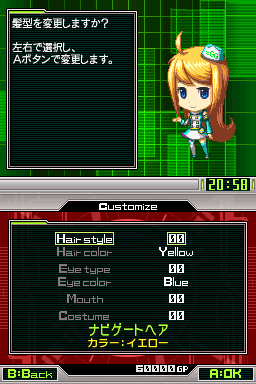
Now, I said there’s no other incentive to earn GP, but that’s not entirely true. There is another type of thing you can buy in the shop. For 1000 GP, you can do a gacha roll of sorts. There are two kinds of rewards from doing this. If you remember my screenshot of the Target page above, you may have noticed several question mark icons. These are hidden Targets. To know how to get them, you either need to meet their conditions and clear them coincidentally, or you can learn the requirements for a Target by pulling it from the shop gacha. You have no control over what game you’re given a Target for, so this isn’t an efficient way to learn all of a game’s Targets.
In my experience, you can often logically deduce the hidden Targets. Play the game normally, and when you unlock one, view the game’s Targets. Targets are organized based on their conditions. Say you completed a hidden Target that says “defeat level 3 without getting hit” and there are two question mark icons for Targets on the left of it. You can assume those are for defeating levels 1 and 2 without getting hit, and you’ll probably be correct. So this “hint” system isn’t too useful, but it can expose some of the more esoteric Target requirements, I suppose.
The real meat of the gacha is that you can earn dozens upon dozens of cosmetic options for your anime girl “host” that’s always on the top of the screen. It’s, uh, exactly what you think it is. Options to change the appearance of their eyes and color, likewise for hair, and clothing—there’s quite a lot to unlock. A cute detail is that your anime girl changes into a specific costume depending on the game you’re playing. A game about a knight will have her wearing a knight’s armor, for example, and hair style tends to automatically change as well. While I enjoy this detail, it does somewhat undercut the most major customization options because you’re going to be in a game 99% of the time.
This entire feature is just odd. I understand that they wanted to add replay value by having more things to buy in the shop, but it’s of such little consequence to the experience that I feel the effort is mostly wasted. Even if they couldn’t spare resources to develop more substantial unlocks, they could have made more interesting ones in the same nature as this. What if you could unlock alternate colors for your player character in some way? Or different menu colors? Minor palette changes like this would be just as easy—if not easier than—creating entirely new sprites for cosmetics, and they would be for things you’d actually notice while playing the game. There’s a whole other can of worms I could open about objectification with regards to this feature, but I don’t have to in order to criticize it, so I’ll let that dog lie. When I wrap up the collection, perhaps I’ll return to this and show off the monster I’ve created.
So, there’s the whole “framework” for this collection. The stylization is decent enough, and things are mostly logically organized. One gripe I have is the menu navigation speed, as selecting any option causes the options to slide off the screen one by one, and you need to wait for new options to slide back in to replace them. Including the fake loading screen when starting the game, it gets tedious not being able to skip these kinds of animations. It’s also genuinely annoying to have to go all the way back to the main menu to view Targets for the game you might be playing. I see no reason why those couldn’t be viewable from the in-game pause menus. I’ll also mention that neither the main menu or that of the games feature any customizable options whatsoever. Not even for audio, which would be particularly appreciated for games such as Drift Circuit. Furthermore, the anime girl takes up a significant amount of top screen real estate when they could have displayed more useful information there like unobtained Targets, controls, or whatever. All-in-all, s’all works, and s’all fine. My grievances don’t ruin the game(s).
Action
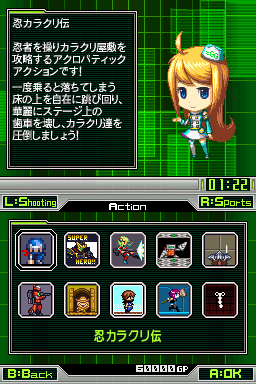
“Action” is the largest category in GGSC+, featuring 10 games. As the broad title would suggest, these games vary greatly in playstyle, which makes this a particularly exciting group of games—if not the best group of games on the whole collection.
Variable Arms
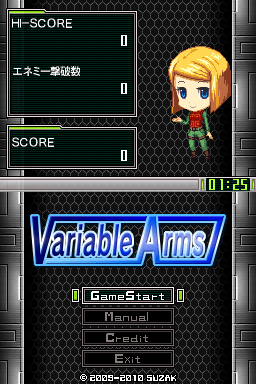
Much like the transforming player character mech, I find myself caught between two minds. How do I refer to this game? It’s one of the G.G Series titles written in English, so it should be obvious: Variable Arms. And yet, when the game was localized and put on the 3DS Shop on June 4, 2015, it was retitled to Altered Weapon. What gives!? It had a fine title to begin with. Did Genterprise think English audiences were stupid and would expect a game where you play as Avalokiteśvara?
I mean, it already made sense, right? You control a character with multiple armaments—arms—and they differ in function, so they’re variable types of armaments. Of course, it could also refer to the fact that you are the armaments, being a combat robot, and you possess the ability to transform—the second definition of “variable.” It works on every level. Then some guys who thought they’re better than us decided to retitle it Altered Weapon. I feel like that’s worse even with regards to linguistics. It’s in the past tense, but you aren’t controlling a weapon that was changed from any previously known state—you’re actively transforming throughout the game. I’m not here to argue whether it’s technically correct, but I’d like to exercise my degree in technical writing to assert that there’s more room for misinterpretation with the new title than the original. What an odd (and bad) change.
Does it ultimately matter? Well, no, but I’m worried I won’t have much to talk about with Variable Arms (VA). It’s not some bafflingly bad anomaly like Drift Circuit, but it’s not a remarkable achievement either. Regardless, it is one of my favorite games in G.G Series Collection+. I admit a bias there. I love mechs and think they’re just universally cool-looking, for one. Platformers are also my bread-and-butter video game genre, and this game features a fair amount of it. That means it’s the perfect game. Case closed.
While I am being comedically (?) flippant, I do honestly think that VA is a solid little game. I recall it being one of the first games, if not THE first game, I bought from the in-game shop, and I’ve returned to it many times when looking for something simple to play before going to bed. VA also bears the distinction of being the first game where I obtained all Targets. Do you understand what means? I am a Variable Arms master. So, listen closely, my apprentice.
Variable Arms is a 2D action-platformer in the vein of Contra where you control a transformable robot. In your default humanoid state, by pressing L or X, you can transform into an armored motorcycle, which changes all your properties. Have you ever seen the Japanese-exclusive Famicom game, Transformers: The Mystery of Optimus Prime? It’s like that, minus the “being in one of the worst games ever made” part. In general, the mech’s design evokes the vintage anime Genesis Climber MOSPEADA, which is a compliment.
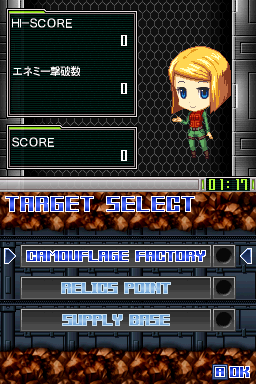
As is usual for the G.G Series, there is only the barest of plot justification. It appears that you’re tasked with destroying enemy weapon bases hidden deep within jungles and ruins. The moral ambiguity astounds: could our opponents actually be a resistance force against the oppressive military state our robot represents? So much to discuss! I tried to glean the DSi Shop description for more information but only came across a semantic annoyance: “Change from vehicle to robot and back while fending off enemy machines.” You start off as a robot not a vehicle, you cretins!
In any case, your goal in VA is to reach the end of three stages, then a final fourth one, with each stage consisting of three sections before ending with a boss fight. In your epic journey from left to right, you’ll have to blast down enemy defenders while doing occasional platforming. You have a solid health bar which provides you with an annoyingly vague amount of protection against enemy fire and stage hazards to damage you further upon failing platforming challenges. There is a health restorative item that appears at set locations, usually requiring some additional risk to acquire. Death will reset your score, but the game is otherwise extremely forgiving. You have unlimited lives, and the game allows infinite continues from any checkpoint, which are placed at every screen transition. With this in mind, I imagine even an unfamiliar player could complete VA in roughly an hour.
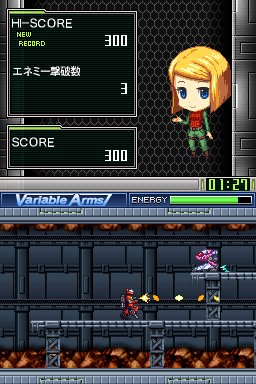
Naturally, Variable Arms differentiates itself the most with its transforming gimmick. To Genterprise’s credit, stages appear to be designed with sections catering to one of your two forms. The all-purpose humanoid form will be your default mode for most obstacles, but you will occasionally be required to transform into the bike. For brevity’s sake, I’ll refer to these two forms as Robot and Bike, respectively.
Robot has an omni-directional, rapid-firing gun, whose range covers about half the length of the screen, and a standard double jump. It’s a funny visual to see ostensible machine gun bullets just vanish a few feet from you for some reason. I feel like it would’ve made more visual sense to have you extend a laser blade. Then again, just holding a blade out in front of you while you walk around would look pretty goofy in its own right. Maybe rapid firing the blade would just have you perpetually slashing with motion blur to obscure the movements. Though it would contrast with the sense of weight the mech otherwise has—so maybe shit was gonna be awkward no matter what.
While transformed into Bike, you lose your double jump in exchange for a wider horizontal jump. Your gun becomes a cannon with a slower firing rate, but screen-wide range and greater firepower. You also move faster due to your wheels, albeit with less traction, and your shorter height gives you a smaller hitbox and the ability to squeeze through gaps.
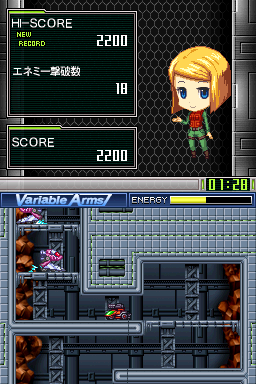
The game has a few ways of forcing you to switch between these forms. For instance, enemies often come towards you in a horizontal formation, but if there are too many in a row, then Bike’s cannon won’t fire fast enough to destroy all enemies before they reach and damage you, necessitating you attack with Robot. Although less common, levels can place immobile turrets to encourage Bike, as you can potentially blast the turrets down without placing yourself in their firing range. These are simple incentives and problem-solving, but at least they exist.
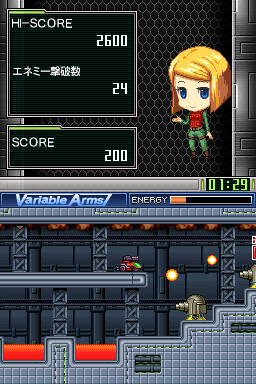
The biggest requisite to changing your form is the environment itself, as you simply can’t progress without doing so at times. This begins with the basics: double jumping with Robot or squeezing through low ceilings with Bike. As levels increase in complexity, lava, spikes, and bottomless pits are introduced to progressively punish you for failing to use your forms correctly. Damage from falls is particularly more severe than that of enemy fire, so you really want to get a handle on the two forms’ jumps. Eventually, you’ll need to use both forms in one jump, which can be rather tricky. This can entail making a wide jump with Bike, only to transform just below the ledge on the other side you can’t reach, then using Robot’s second jump to get enough height. If your timing isn’t perfect, you’ll miss the allotted window to transform and plummet to your (potential) doom. I never got a great handle on when this window was, which I found frustrating. A simple visual indicator like a flash to mark when the window opens and/or closes would have been appreciated.
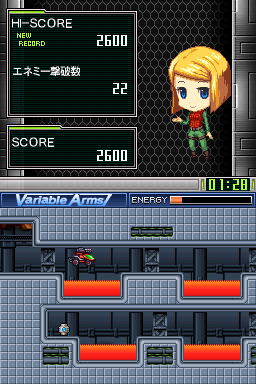
The endgame can also be quite demanding with Bike jumps. The most difficult section in the game might be when the game asks you to make consecutive jumps over bottomless pits separated by small platforms with the Bike. You can just barely make these, so you need to be holding right on the D-pad, yet doing so risks you sliding off the platform upon landing due to Bike’s wheels having less traction. Each platform also has a low ceiling, so you must begin your jump to where your arc isn’t prematurely cut off by the ceiling. This isn’t some top-shelf platforming challenge by any means—it’s not Dustforce or some shit—but it stands out in a generally easy game. Once again, you have unlimited continues to try until you succeed. The only real impediment is getting a high score or clearing certain Targets.
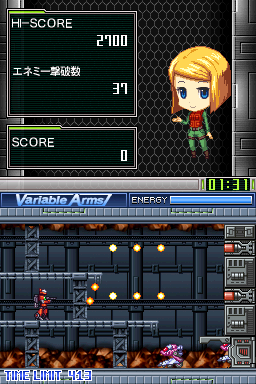
Each stage’s final room consists of a boss, though it’s always a variation of the same basic concept. You face an entire wall of defensive impediments; a mix between lasers, bullets, and hatches to deploy generic enemies. The exact arrangement of weapons depends on the specific level. The fun of these encounters comes from how each installation can be destroyed separately, providing a sense of strategy when determining what order to break apart the boss. First, you try to find a path of movement that allows you to weave between overhead lasers, bullet patterns, and homing fire while still being able to fire occasional shots. Then, you see which boss section’s destruction would result in a total blind spot so that you can eliminate some of the strict timing for dodges. From there, you’re given enough of a breather to further consider which destroyed parts would provide the most openings. It’s pretty fun. You only need to destroy the innate weapons (i.e. anything other than the hatches) to clear the boss, but the satisfaction (as well as points) gained from a total victory is hard to pass up. There is a timer going down while fighting the boss that will kill you upon reaching 0, but it’s extremely generous. I can’t imagine losing because of the timer unless you’re point-farming enemies deploying from the hatches, which is probably why the timer was implemented. I feel like they should’ve just turned off the point values for those enemies during boss fights, but whatever.
I mentioned early on that VA was the first G.G Series game I obtained all Targets in, so I suppose I’ll go over those. There’s the standard “beat the level” Targets. There’s three for destroying a certain total of enemies, capping out at 1000. This sounds like a lot, but I think it counts across multiple playthroughs and lives. The remaining Targets are just for destroying every enemy in each section of each level. You’ll probably get most of these playing normally, as almost all enemies are directly in your path, so of course you’ll destroy them. The only actual “tricky” part is remembering to destroy optional parts of the bosses. Me clearing VA’s Targets first isn’t just because of my fondness for the game: it’s also because they’re genuinely really easy. This makes the game an excellent source of GP, but I do wish it encouraged me to achieve higher mastery of the game. Not a big deal. Moving on…
Variable Arms is flawed in ways that it feels trite to complain about given its scope. First, let me sum up the positives. The fundamentals are present. The controls are intuitive and responsive. Level design is easy to understand, and one should be able to quickly discern the playstyle needed to best succeed. The game is forgiving enough to not be frustrating, but its short length and function to track your highest score provide incentives to revisit the game and refine your skills. I even find the audiovisual feedback endearing. Enemies explode into weird pseudo-3D metal flakes, and sound effects have this blunt clarity to them that tickles my senses without being obnoxious in their repetition. Everything about the game meets the standards you would expect from the premise and price.
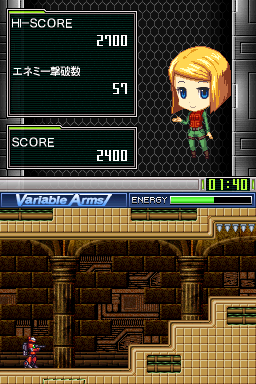
The trite criticism is this: Variable Arms just doesn’t go far enough. There are only about four or five repeated enemy types, and you engage with a few in identical ways. Stages likewise consist of the same assets, with differences generally stopping at palette swaps and escalating difficulty. It’s all understandable considering this is a very budget title, of course, but even at four levels, VA comes just short of wearing itself completely thin. The action lacks the intense dynamics needed for an evergreen score attack game, as well. The game’s tempo varies due to the platforming and shooting being heavily compartmentalized. That variety works well for a single playthrough, but less so on replays. You eventually figure out which sections you play as Robot or Bike, and the execution is simple enough to where you begin engaging with level sections in identical ways. The action in VA can be so quaint at times that it can feel like it’s testing skills closer to a puzzle game than action game.
I suppose I would say that VA lacks a range of skill expression, which really cuts into the potential of the transforming gimmick. Outside of possibly bosses, you’re pretty much never required to make snap decisions between what form to take. In an ideal game, enough would be going on at any moment to where you might instinctively transform into Bike to have a bullet whisk over your head, wide jump across enemies, transform midair, and shoot straight downward to clear an enemy before you land. That would require a mix of quick thinking, fast reactions, and precise execution. But that’s not the game we got. And of course it’s not the game we got. The game we got was meant to turn a profit from selling for $2.
That’s kind of all there is to Variable Arms. If you have even a modest interest in sidescrollers, you have definitely played at least one game extremely similar to VA. In that regard, it successfully captures the virtues of accessible action games from the 8 and 16-bit eras. Most of its progenitors still likely have it beaten in complexity and finesse, but I can’t help but recall the price point: a mere $2 for an hour of blasting and platforming fun. If I were browsing the DSi Shop back when this was available and dropped $2 for it with no expectations just because I thought the robot looked cool, I think I would have quite the smile on my face when it was over. I still kind of do, which is why this is among my favorite games from the G.G Series. Give it a try, lonely soldier boy.
Sports
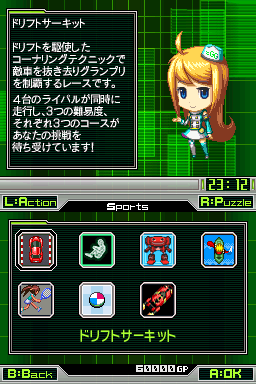
If you’re like me and prickle up at the slightest mention of sports, worry not. Those nerds won’t get us here. The “sports” category is for games that bear a superficial similarity to some sport or for games that aren’t necessarily about murdering your opponent. You shall find no Madden here—but you may find something far, far worse… Let the games begin!
Drift Circuit
Originally published: January 13, 2025
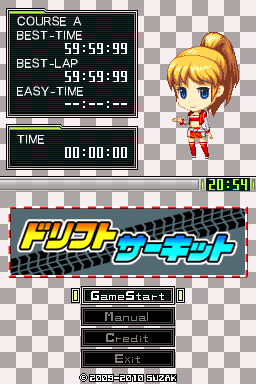
According to my records, I have launched Drift Circuit more than any other game in G.G. Series Collection+.
It’s also probably the worst game in it.
How did this happen? Frankly, I’m not entirely sure myself. I have a bizarre fascination with just how bad this game is. I’ll start by describing the gameplay.
You have four menu options on start-up. These are the three difficulty modes and a fourth choice to freely race on any singular track from the game. Each difficulty mode has three tracks unique to it, and you’re tasked with completing those three tracks three times each for a total of nine races per difficulty. To progress, you only need to place at or above the designated placing prior to the race’s start. In the first set of three races, you only need to place third or higher, then second, then finally first. Failures are lenient, as you can always restart from the beginning of the current race until you complete it. However, there is no saving mid-series, so all nine races ought to be done in a single session.
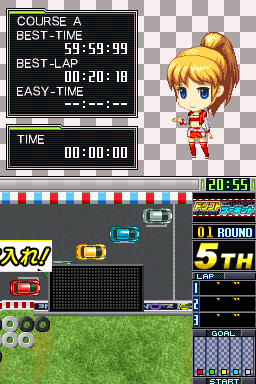
Nothing out of the ordinary with any of that. What is, however, is the racing style. Drift Circuit opts for a top-down perspective, which had been progressively phased out even back during the glory days of arcade gaming. I suspect this was done because it’s likely the simplest perspective to design for. Isometric or third-person perspectives require at the very least consideration towards sprite scaling, whereas a top-down perspective allows all visuals to be static and consistent relative to each other.
Beyond that, the style’s obscurity makes it novel, which is a plus for these simplistic games. There are five cars of varying colors competing in each race (even in the free course selection), and the player always controls the red car. The colors represent a sort of hierarchy (heircarchy?), with the cars always starting in the same position relative to their color. Red is always in the very back, of course, and silver is a cheating bastard that always starts out in front. Thus, the challenge.
And now I have to decide how to deconstruct this game’s design, because everything feels bad. Drift Circuit is comedically slow-paced for a racing game, and the screeching sounds of rubber tires from cars desperately trying to make any sort of turn gives the whole experience a sensation I can only compare to if “nails on a chalkboard” got a driver’s license.
I implore you to watch any footage of this game if only for a few seconds to understand what I mean, because whatever you’re imagining in your head is likely too generous.
Turning in this game in your worst nightmare. Your default turn ratio is on par with a jumbo bus, and tackling any curve even at your glacial speed will give you a long enough association with the course rim for a common law marriage. There are no Koopa shells to hurl at your opponents in this game. You have an acceleration button, brake, and the directional pad. That’s it.
Except for one thing: this is Drift Circuit, remember? This is how you’re meant to handle the corners in the game. Unlike Mario Kart, drifting is not optional—if you aren’t using it at every opportunity, your loss is guaranteed. But of course, the drifting mechanics are far from smooth. To execute a drift, you must double-tap the direction in which you’re turning. Sound simple? Well, yeah. It is.
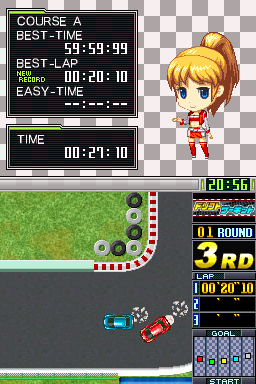
But damn if it isn’t awkward. The unintuitive controls are one thing, but getting a feel for drifting is another. In my experience, it’s rarely optimal to drift your way through an entire turn. Rather, you want to use the drift’s wider turn allowance to set your path forward on as much of a straight line as possible, letting up on the directional button once you’ve achieved such to prevent your drift from sliding you further away.
I should probably explain what a drift actually does. Yes, it increases your turn radius, but it also prevents your speed from decreasing while you turn. This is a critical distinction when it comes to the game’s feedback. I’m reminded of Retro Game Challenge, which has a game in it called Rally King. It’s a top-down racer similar to Drift Circuit, and it also features drifting as its main mechanic. In Rally King, performing a drift doesn’t prevent your speed from lowering—it raises it. You are given a brief burst of speed for every successful drift.
Comparing the two games, Drift Circuit withholds punishment for playing well, while Rally King actively rewards you for playing well. You’re maintaining a neutral state in one, and moving to a superior state in another. One is dynamic when the game is going well, the other is dynamic when the game is going poorly. It’s positive versus negative reinforcement, and science has demonstrated the former’s superiority time and time again. These design choices may seem insignificant at first, but it’s the kind of subtle, psychological effect that makes up the difference between having fun and not having fun. To quote a wise man: you may not have noticed it, but your brain did.
Regardless, drifting is where Drift Circuit‘s “complexity” comes in. You should always be going top speed in Drift Circuit, since you’re hardly going to be blown away by g-forces or anything. This means your drifting turn radius is fairly consistent, clunky though it may be. In essence, you have to memorize this turn radius and find straight lines through the course by beginning a drift at the right point. Obviously, “drawing a straight line” is a basic racing principle since a straight line is always the fastest path, but the level of abstraction in other racing games is done in Drift Circuit, and how literal that principle becomes is almost surreal.
Once you get used to it, it almost feels like you’re controlling a fucking protractor. Courses in Drift Circuit are always completely flat. There is not even the illusion of hills or bumps in any of the tracks. You generally want to draw a straight line playing a game like Mario Kart, but discerning that isn’t necessarily simple, because three-dimensional courses have varying inclines and dips that can affect the “length” of a driven line, and these can be subtle. It really is just that simple in Drift Circuit, however, which lends to the feeling of you looking over the picture, protractor and compass in hand, and drawing your perfectly straight line. The non-existent sense of speed does little to dispel this illusion. The top-down perspective means you don’t have any sensation of the terrain around you zipping past. It’s very weird.
And very boring. Drift Circuit just kind of flat-out sucks. That’s part of why I can’t stop playing it I guess. It’s an enigma. I keep hoping for something to make sense to where I can see the game the developers thought was fun enough to release. But I think this is just it. For whatever reason, just like me, Drift Circuit seems to have just came out wrong.
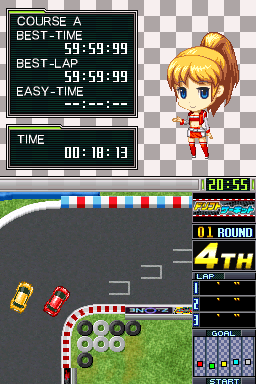
I was so desperate to crack this case that I made Drift Circuit the first game I beat in this playthrough. All three difficulties, felled by my hands. To the game’s credit, this isn’t especially taxing (at least, not any more than the basic gameplay already is.) Each course takes under a minute, so without any losses you’re looking at under nine minutes to complete a difficulty.
Well, in theory. On hard mode I found the last two courses to be an enormous difficulty spike. The semifinal course took me over a dozen attempts, if not multiple dozens. The final, when I had hoped that the previous had been a fluke, took me well over an hour to beat. Thank god for infinite retries, but still. There was nothing that special about the tracks themselves. The silver car simply got an unbelievable lead in these two, and you needed perfect consistency and borderline simple luck to overcome it.
The luck concerns the other cars. There’s five, remember? Always in the same order, each one blocking your passage to the next placing. Passing cars in this game can be positively infuriating. I should first establish that your car making virtually any contact with anything else, be it cars or walls, can completely stop your car. Emphasis on “stop.” This game has no “proper” physics, and inertia does not exist. Touching anything has a high chance of stopping you entirely and entirely resetting your acceleration. This is devastating enough to where a single crash can make first place unachievable.
If the game wants to be really punishing, fine. As I said, courses are quick to complete, which makes retrying not have too much of a sting to it. But retrying only helps insofar as correcting human errors. Drifting at the wrong spot? Fair enough. But what the hell do you do when your collision is unavoidable because every other car is hugging the same inside of a turn as you are? You can’t just fucking go through them like a ghost, nor can you shove them aside due to it stopping you.
This is the biggest obstacle to victory in Drift Circuit, and I still don’t have a reliable answer to it. This is the reason the final two tracks took me so long to beat. What was always a problem in the game became something insurmountable once the lead of the silver car was too extreme to excuse the time I would lose from taking a turn at a wider angle. See, having to do that isn’t necessarily bad. Your car has a higher top speed than the others, so once you’re back on a straight line you can pass the cars. You still need enough time to build that speed though, and you only have so much once the silver car starts bribing the race sponsors to let him teleport half a track ahead.
Thus began my innumerable attempts to finagle a path to victory, and I think I found one. I think. It seems to me that the other cars follow a set, optimized path through the course. They’re essentially on rails. Because each AI car has the same top speed and only their distance when the race start determines their placement, they will never overtake each other. Free of player influence, every performance of the AI should be identical.
As I’m implying, it appears the AI will change its behavior relative to the player once the player is in close enough proximity. Manipulating this is sometimes the only way you can cut down on times, as you need cars out of the way when making tight turns. The problem is that, because they’re on set paths, you need to make sure you’re influencing their trajectory at the right moment so that they’re in the place you want when the turn comes.
After dozens of attempts on the final track, I noticed that sometimes the AI would behave in identical ways depending on where and when I approached other cars. Normally, even when you’re getting close to them, an AI car won’t create enough of a side gap for you to pass them before you speed up and collide with their rear or side. But if you have them start making this distance just before a turn comes up, then their new position will cause their turn ratio to be wider, allowing you to (hopefully) make a tighter turn and zip through the widened gap. To sum up my point, it’s not necessarily enough to cut down on time in a race—you need to cut it specifically so that you’re in the right place when you come up on another car.
Again, this level of trial-and-error isn’t normally necessary. The final two tracks are just a huge difficulty spike. Your higher top speed is usually enough for you to race normally and do whatever you need to to safely avoid collisions. I suppose I should give lip service to the brake button, but I found no practical use for it. You already move so slow, so it’s not like you risk crashing into a wall from going too fast. Likewise, you have plenty of reaction time. The only use case I can think of is maybe avoiding a collision while trying to pass another car (before you figure out how their AI works to avoid this scenario), or realizing you have enough time to pass them on the outside of a corner, but those situations never came up much for me even when I was still learning.
To wrap back around to the presentation side of things, the game has next to no animations. Cars are static rectangles that slide around the screen, the top-down perspective being used as justification to not even animate the wheels turning. Combined with the skidding sounds, the visceral effect is that of metal scraping against metal. I’ve already used the “nails on a chalkboard” idiom, but it’s just so accurate. The only visual effects to speak of are the smoke trails left behind when drifting, and the brief clang and flash you see during collisions. No motion blur, no wind—nothing. “Speed” is only a philosopher’s dream in the world of Drift Circuit, and you’re not Plato, you’re Playslow. Click here to donate to my site.
As for the music, you get a unique song for each difficulty. The easy mode music is a hilariously mismatched eurobeat sendup with an overlaid high-tempo synthesized beat that kind of sounds like a kazoo got bitcrushed. Jokes aside, it’s not a bad composition. Normal mode ups the drama by underlaying a synthesizer that’s at a lower pitch than the main beat. Shit’s getting real. This song feels the most at home in Initial D for me. I can easily imagine it being an instrumental for a hypothetical credits song during the anime. Oddly, I think the hard mode song should maybe be swapped with the normal mode one. I find it to sound more “optimistic,” which was not the attitude I had during the game’s final two courses. It may be my favorite of the three anyway, due to each synthesizer melody having a constantly breaking, “staccato” rhythm—frenetic! I also have a fondness for the jingle that plays when you cross the finish line. It’s very reminiscent of 90s Sega arcade games. If you know, you know. I’d link all of these if I could, but there’s no OST upload for Drift Circuit on YouTube. Can you believe it!?
So uh, yeah. That’s Drift Circuit. It’s kind of just a bad game. I think I keep coming back to it because there’s a je ne sais quoi to the quaintness of the whole experience. The glacial pace of the game reminds me of analog toys I used to love as a kid. Part of me wants to compare it to slot cars, but even those are too damn fast. Have you ever seen one of those analog racing games that have the cars move on a treadmill belt? Something like this:
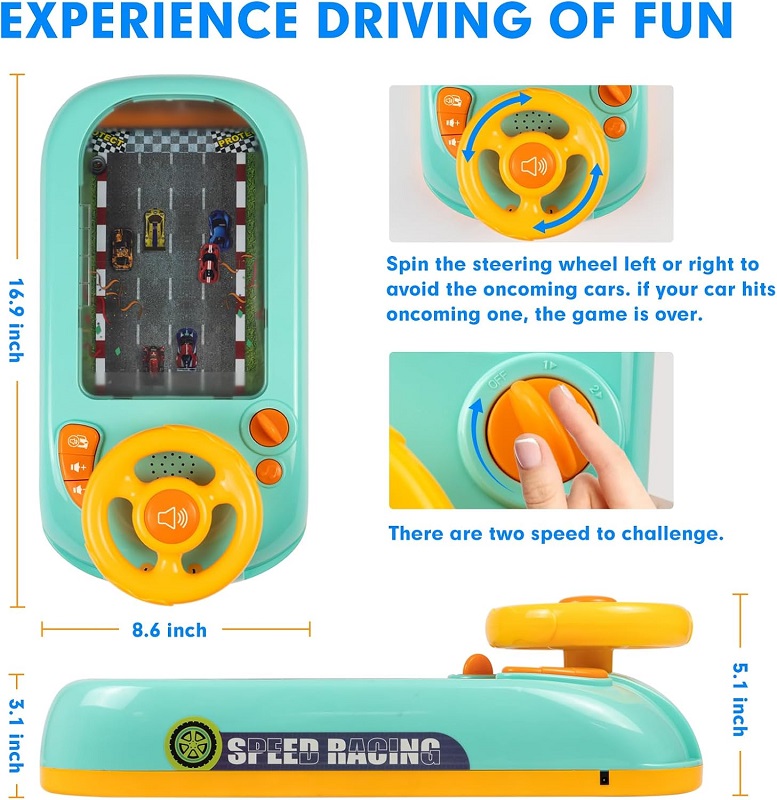
That’s it. That’s Drift Circuit. Now, if I may make a more personal comparison to a toy I actually had as a kid:
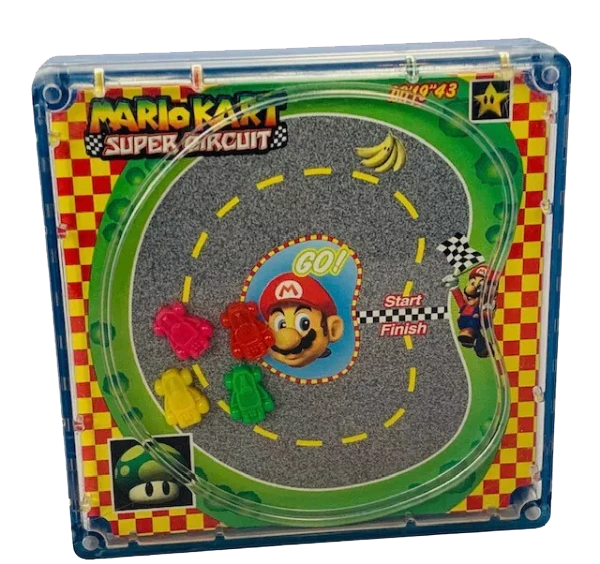
This plastic crystal was one of the possible toys you could receive in your Wendy’s kid’s meal while they were doing a promotion around various Mario video games. The back of this square has an image replicating the North American box art for Mario Kart: Super Circuit for the Game Boy Advance. In the bottom right corner was a red disc with a small indent allowing you to rotate it with your finger. The cars were magnetically stuck to the track, and they would follow along it as you rotated the magnet to simulate a race.
Amazingly, that image of a banana bunch actually had a function. If a car being dragged along the track crossed over the banana, they would lose some sort of contact with the magnet, causing them to fall behind. As a kid that blew my mind, but they probably just put a thin piece of plastic between that area and the magnet. Anyway—who will win? Place your bets! Gather your chums at the elementary school playground and learn the fun of gambling with Mario!
So yeah, I kind of loved that thing. I guess I’m not the only one who realizes its value, because I took the above image from an eBay auction currently priced at $22.46. That’s quite a return for your investment in nuggets. Now I’m kicking myself for not holding on to my useless junk toys until they became collector’s items. And there you have it: Drift Circuit is a fast food meal toy. Come to think of it, I believe they’re priced around the same amount; five dollars or so. Am I the one being unreasonable? …Nah, other games in the G.G. Series Collection are far superior—which is saying a lot.
Because I played this as part of the G.G. Series Collection, my racing days are not necessarily behind me. As with all the games in the collection, Drift Circuit has several missions attached to it that reward currency for completion. Most of the conditions are kept hidden, so I don’t know all of what it wants me to do, but based on the missions I’ve completed, it seems that they want me to get under certain lap times. In theory, that’s not too bad. But while getting first place in most courses isn’t a tribulation, getting certain times may require me to manipulate the AI as described above. Not very tantalizing. All the same, I don’t know if I’ll be able to eternally resist returning to see my adorable bright red toy car trudge along the paper-thin track like The Little Engine That Could—because I’ll eventually forget that only one of these stories has a happy ending.
Oh, and did I mention there’s a Drift Circuit 2? I’ll cover that in the distant future. Keep your engines running for that one.
The Ranking
Well, of course I’m going to rank the games as I play them!
- Variable Arms
- Drift Circuit
Leave a Reply