








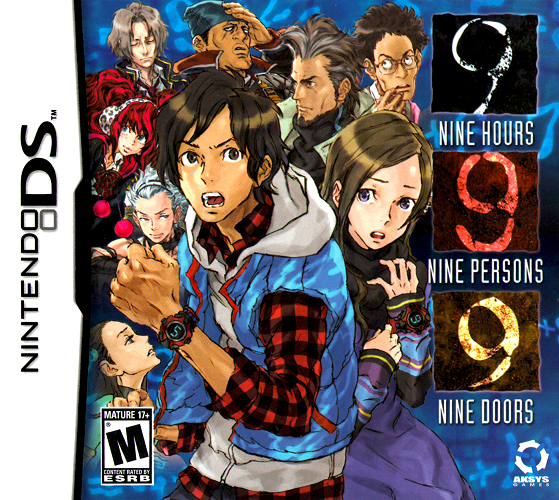
NAME(S): 999: Nine Hours, Nine Persons, Nine Doors / Kyokugen Dasshutsu 9 Jikan 9 Nin 9 no Tobira / 極限脱出 9時間9人9の扉 / Extreme Escape: 9 Hours, 9 Persons, 9 Doors
PLATFORM(S): Nintendo DS
DEVELOPER(S): Chunsoft
PUBLISHER(S): Spike (Japan) / Aksys Games (North America, Europe) / Spike Chunsoft (Worldwide)
GENRE(S): Visual Novel / Adventure / Puzzle
RELEASED: December 10, 2009 (Japan) / November 16, 2010 (North America)
Background
The premise of 999: Nine Hours, Nine Persons, Nine Doors (999) is excellent. I’m a huge fan of “life-or-death game” thrillers, and the ones with a mystery attached are even better. I don’t care about the explanation so much as I like seeing how people with no prior relationship or necessarily relevant skills cooperate and react to their predicament. There’s often clever attempts at rule-breaking too, which adds to the immersion. These narratives make you wonder what you would do if placed in a similar situation. It’s a setup that promotes character interaction and development, and it’s a premise that naturally sparks enough curiosity to give the plot momentum and purpose.
999: Nine Hours, Nine Persons, Nine Doors
Overall, I liked writing style. It’s contemporary and relatable to western culture, and despite the youthful anime character designs, the characters do act their age. It was occasionally off-putting to see things like sex jokes given the generally modest character designs and the gravity of the situation, but it wasn’t too groanworthy.
Gameplay
The actual gameplay is the weakest part. These puzzles are of a difficulty I would expect from those aimed at elementary school children, and I don’t think I’m exaggerating. Keep in mind that 999 is rated M by the ESRB, meaning the expected audience is at least 17 years old. Yet, with the exception of one puzzle—the blocks and the lifter machine—I remember always being able to look at the puzzle, figure it out immediately, and move on. If any more time was spent in each room, it was to pixel hunt for objects I needed in order to begin the puzzle. None of these felt as satisfying to solve as something like spotting a contradiction in an Ace Attorney game could be.
Atmosphere and Tone
The brooding, contemplative atmosphere is thus a poor fit for a game where you can just plow through all of the puzzles. The music and tone suggest hesitation and introspection, then neither are demanded of the player in order to progress. There’s further narrative dissonance when the game is written as if we’re the pawns of some meticulous mastermind, but they’re testing us with puzzles straight out of Highlights Magazine.
There is a bigger narrative issue with the game, however. After the introduction, the sense of a looming threat disappears until you begin to approach one of the possible endings. Past some initial tragedies with the bracelets, everyone just accepts the game’s rules and solves bland puzzles that do nothing but pad out the cutscenes and character development. There’s no antagonist like Danganronpa‘s Monokuma that shows up and taunts you in any way. The predicament the cast is in should be a volatile and uncertain one, but there’s nothing reminding the player of that for most of the experience. No element giving anxiety to the player undersells the merits of the setting I talked about in my introduction.
Audio & Visuals
The music seems to be considered to be one of the game’s highlights, but I honestly can’t remember one note. I never felt any desire to listen to a song on its own. The soundtrack suits the game perfectly fine, but in the grand scheme of things, it just sounds like average downtempo to me. With regards to visuals, the animations were impressively fluid. It’s in stark contrast to Ace Attorney‘s jerky animations that snap from one post to the next (which are fine there, as they’re often used for hyperbolic effect and comedy.) The animations seem to consist of many frames, and they demonstrate an effort to go above and beyond the DS’s usual 2D graphics. The DS hardware is not especially strong, but 999 shows how much more it was capable of with the right amount of effort.
Ending
SPOILERS regarding the ending.
As for some positives regarding the story, I thought the twists at the end were extremely clever, and I appreciated how they utilized the DS’s hardware gimmicks to further immerse the player. I vaguely recall at the relevant time thinking some story elements, such as the time travel, brought in some plot holes I thought were glossed over—but I’d be lying if I said I could remember specific examples.
Despite the initial shock value and appreciation for the twists, I do wonder how much of the meta-narrative really added to my retrospective experience. For example, the top screen is revealed to be Junpei’s perspective while the bottom screen was June’s. This makes sense in hindsight, and is very neat at first, but it doesn’t actually affect the interpretation of previous events, because all of June’s text was written perfectly for Junpei’s experiences. It’s a twist that’s ultimately immaterial to the narrative, and its exclusion would remove nothing but that “woah” moment.
That’s not for nothing, mind, but I think there was the potential for more to be done here. It might have been interesting if some of June’s text was occasionally “off” in its description of something to foreshadow the twist while potentially providing June some character development in hindsight once the twist was revealed. The revelation about Junpei reliving June’s experiences is handled appropriately and more meaningfully in the exposition near the end, so I can only see the dual screen twist as a neat side detail.
I personally didn’t feel a connection to any of the characters, which is probably the biggest reason why this isn’t one of my favorite adventure games. Don’t get me wrong, I enjoyed them all and felt they were a perfectly entertaining cast, but I didn’t empathize with them much. I think this is because so much of their individual struggle has to be left out in order to focus on progressing through the game and explaining how they’re related to all the events going on.
They had to be used so much for their roles in the plot that their individuality had to take a backseat. Other than their basic personality traits, I knew little about them outside of the context of the Nonary Game. I feel that 999 would have benefitted from some kind of system where you could casually talk to the other characters, like what exists in the Danganronpa games.
Verdict
In the end, this was a game I really enjoyed that had respectable ideas, but the lack of a relatable emotional touch left me a bit cold, and the atmospheric fumbling of having such easy puzzles ensured it wasn’t the kind of “cold” the developers were going for. I would still like to play the sequels some day.
Leave a Reply