








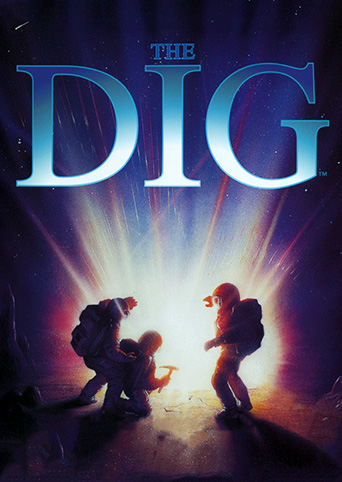
NAME(S): The Dig
PLATFORM(S): PC
DEVELOPER(S): LucasArts
PUBLISHER(S): LucasArts
GENRE(S): 2D Point-and-Click Adventure
RELEASED: November 24, 1995
I don’t know why I wanted to play this one so bad. I guess just because it was a lot newer and different from other LucasArts games. In The Dig, you and a team of astronauts go to bomb an asteroid threatening to hit Earth, but of course, they discover an unknown craft inside that takes them to an alien planet.
Your character must explore this seemingly-abandoned planet, decipher alien technology and messages to discover the planet’s past, and find their way home. Joining you, the commander Boston Low, are Robbins, a journalist who is basically Daria‘s titular character, and Brink, an elitist archeologist. Brink also has a heavy Russian accent, which permits him to be antagonistic in any western story.
The Dig spent six years in development hell, received constant rewrites, and almost never came out. It’s a mystery to me as to why, because Steven Spielberg came up with the original concept (which, after so many rewrites, means almost nothing now), and Orson Scott Card wrote the dialogue. The voice acting is all done by professional actors, and the whole narrative experience feels like a big-budget Hollywood project.
This both hurts The Dig and gives it its saving graces. To start with, the production values are excellent. The backgrounds are beautiful and organically consistent enough to feel like a natural world, despite its alien nature. The colors range from reds and yellows to shades of blue, making the planet either glow or resemble a neon desert. The characters are fluidly animated with little frame-skipping, no matter how minor their movements are. The soundtrack is an electronic orchestral score which, while super generic—it’s that music you hear in any sci-fi movie when characters discover something fantastic, and their eyes widen along to accompanying, rising string instruments—it’s effective enough in aiding the atmosphere, which is the game’s strong point.
Low is by himself most of the game. While he can always call his two partners, there is a persistent feeling of being inconsequential in a much grander, uncharted world. There are many puzzles that are actually puzzles with rules you can intuit that will lead you to a solution. While it’s awesome to see real puzzles in an adventure game, there’s still a ton of item-rubbing garbage and pixel-hunting. Unlike some older LucasArts titles, you can now quick move by double-clicking, but the option to skip any dialogue is absent, despite it being a company standard prior. Why?
What really drags The Dig down is its writing. At first, I enjoyed the serious tone, but it’s rather inflexible, and the serious, professional, robotic delivery becomes grating while wrapping around to being unrealistic. With the crew suddenly finding themselves stranded on an alien planet, one might expect formalities to break down in the face of survival. Instead, even the cast’s sense of wonder at discovering something unprecedented in all of human history is muted, treated like a mild amusement.
The Dig feels like a Hollywood production partly because it’s as sterile and flavorless. The dialogue is nothing if not straightforward and expository, and only Brink has a character arc. Brink carries the entire plot, as Low is a doofus that everyone treats like dirt for some reason, despite being their superior. I can only assume it’s because he’s so boring, constantly cracking awful one-liners and describing everything he sees with the blandest of metaphors. The Dig‘s writing is never the least bit eccentric. It’s Hollywood to its core, and made to appeal to what any dull person with minimal knowledge could appreciate. This doesn’t mean The Dig does a poor job at telling a consummate story, just that it’s boring and unrewarding for doing so.
Regardless, The Dig is short, has some decent puzzles, not too many frustrating moments, a solid atmosphere, and some plot intrigue, even if it pays off with too little too late. There’s enough ambition here to make certain segments impressive, and I’d recommend it to an adventure game fan. But to everyone else, it’s a decent big-budget sci-fi story that doesn’t stand much out from the hundreds of others you could see in theaters during the ’90s and 2000s.
Leave a Reply