




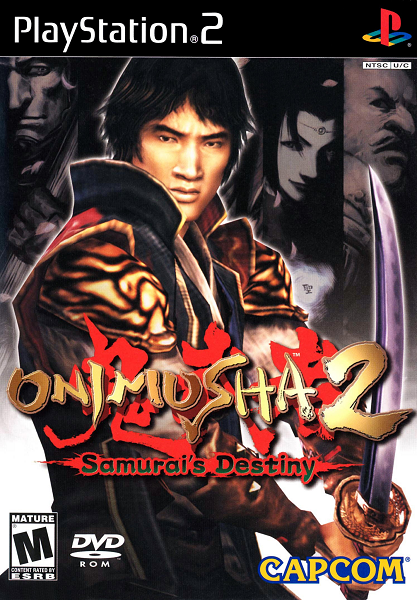
NAME(S): Onimusha 2: Samurai’s Destiny
PLATFORM(S): PlayStation 2
DEVELOPER(S): Capcom
PUBLISHER(S): Capcom
GENRE(S): Action
RELEASED: March 7, 2002 (Japan), August 27, 2002 (North America), October 4, 2002 (PAL)
After the sudden massive success of the first Onimusha game, it was only natural for Capcom to do as Capcom does and release a sequel only a little after a year had passed. In more typical Capcom behavior, Onimusha 2: Samurai’s Destiny doesn’t differ too much from Onimusha: Warlords. In it you play as a new Oni Warrior named Jubei Yagyu whose hometown is destroyed by the Genma. Seeking revenge, Jubei heads out to kill Nobunaga. During his journey he comes across four other warriors with a common enemy and joins forces with them. It’s a very simple premise, but that’s fine as Onimusha has never been a series respected for its storylines.
The biggest difference with Onimusha 2 when compared to its predecessor is that it sees the series taking more steps away from the survival horror base of the first game and adapting to a more general action/adventure style of gameplay. This transition would continue further with Onimusha 3: Demon Siege and Onimusha: Dawn of Dreams, otherwise known as Onimusha 4, which would take the largest leap of all and for that and many other reasons come out to be the greatest game in the franchise by a wide margin. If I had to generalize Onimusha 2‘s greatest weakness it would be that it’s still trapped in the survival horror traditions of the first game while trying to be a fairly different kind of game now.
The tone of Onimusha 2 is much less darker than its predecessor. It’s clear that the series has left behind the “horror” aspect of the survival horror moniker, which was a sensible thing to do as the first Onimusha game wasn’t really scary. The player was given more than enough power to fight any of the game’s enemies and not fear them any more than a standard action game, and although the nearly abandoned castle had a strong and ominous presence it wasn’t something unnerving. The threat level of both the enemies and environment wasn’t defined by frightening the player.
Onimusha 2 is no longer a single setting game, with many locations branching off from earlier ones and about half of the content taking place in the bright outdoors. Despite this, Onimusha 2 isn’t any less linear than the first game and these areas are still cleared in a specific order. This is to the game’s detriment, as Onimusha 2 has an incredibly odd pacing and cohesion, as I’ll cover shortly.
One of the more interesting additions to the game is a town area where Jubei can talk to civilians. It’s almost all irrelevant chitchat, but it adds more personality to the game’s world. Jubei can also talk to his four comrades he meets after the game’s beginning and give them gifts.
Gifts can be bought with money dropped by enemies and can be given to an ally whenever they’re around. Each ally has their own basic tastes although the player will have to guess on whether or not they’ll like their gift. A good response gives a partly randomized reward that can range from an herb to a Power Jewel to permanently increase health, and a positive or negative reaction will also affect Jubei’s relationship with that ally. The ally that likes Jubei the most will sometimes show up out of nowhere to help the player on the field and sometimes supply additional cutscenes. Since there’s a limited amount of gift items to buy there’s still a limit to how many healing items the player can have, but it’s much more lenient than the first Onimusha.
However, the trading system is something that feels very out of place in Onimusha. The player will be returned to the town very little throughout their adventure to buy or give new gifts, and running into your comrades on the field is very unpredictable and it’s an odd focus to be giving them gifts while in the middle of a dungeon. Though the town is very small with little to do, it helps flesh out the world and characters. Even though it ends up being a very minor and underdeveloped addition, it’s a welcome concept nonetheless that should have been improved upon in the sequels but was abandoned.
Earlier I said that you’re forced to go back to the town very little throughout the course of the entire game, and if I’m thinking correctly it only amounts to a measly two times. Not far into the game you lose your ability to go back to the town at all and talk to people and buy more gifts. Things being spaced out so poorly in Onimusha 2 as a side effect of it being a short game that wants to be grander than what it is.
The first Onimusha is a slightly shorter game, but its progression feels much more natural due to its single setting and straightforward narrative to its goal. Even though it doesn’t last long, there’s a definite sense of comfort and progress that sets in as you continually explore deeper into the castle. Onimusha 2 doesn’t have this because it retains the short areas while haphazardly linking them together because they’re of no natural relation. For example, the game starts out by you having to explore a mine inhabited by the Genma soldiers.
This is an appropriately modest beginning for your quest, but only an hour later you surface out of the mine to suddenly find yourself dropped in the regal Gifu castle which the player is immediately obligated to simply explore because there’s nothing else to do. After the castle a character introduced an hour and a half ago is written out of the story to no affect on the player and after a romp through another modestly sized forest area the player is put on a boat that instantly transports them to an island and a new indoor temple dungeon that connects directly into the final areas of the game that prevent the player from returning to the town.
The transitions, if they can even be called such, between the areas of Onimusha 2 are terrible and make you feel like you’re being whisked around with no regard as to what’s going on around you. You might ask yourself, “who cares?”, but this is important to a game like Onimusha 2 that values setting and ambiance similar to how the first game does, but because it flops at it in comparison, the things the game design sacrifices for that atmosphere can now drag down the overall experience, such as using cinematic fixed camera angles and little to no background music which can both take a toll on the spirit of the increasingly action-focused gameplay.
“Tank controls” are one of the first things that come to people’s minds when they think about old survival horror games. Tank controls refers to a movement method in videogames where the player has to rotate the character with the left and right directional inputs and then press forward to move them in the aligned direction. If they wanted to move back, they would have to rotate around again.
This system was created because many survival horror games have fixed camera angles, and if the player was holding down a certain directional input during which the camera angle suddenly changed, they would find themselves instantly going in a different direction, which would be very annoying. Tank controls are archaic design, but they’re generally very tolerable due to the fact survival horror games tend to place very little emphasis on combat. From the beginning, however, Onimusha was much more combat-centric than games like Resident Evil, and it’s here where the problems with tank controls are experienced.
To be more precise, the main problems stem from the fixed camera angles rather than the tank controls themselves. Onimusha 2 could be characterized as a hack and slash game due to its high spawning enemy count. A majority of the game’s areas are rather large before screen switching takes place, meaning they include multiple camera angles. Any player will find themselves fairly often being attacked by enemies that are barely visible, if they aren’t out of the screen entirely.
For example, if a player is facing an enemy towards the bottom of the screen that’s cut off, they’ll have difficulty seeing and predicting their attacks. The player can either try and back up and lure the enemy out, which is very cumbersome to simply see them, or try to run forward to the different camera angle and hope they aren’t hit by the unseen enemy and knocked back.
Like said, Onimusha 2 has a much higher level of action than the first game despite keeping these fixed camera angles and tank controls. Mobs can get quite large, and it’s far too easy to be ganged up and cornered. In a worst case scenario, you will be knocked down continuously and take heavy damage while trying to slowly rotate around to get out of a crowd because even if you tried to engage the enemy one of the many on your side will still have a clear opening to hit you and stun you.
With the level of quick reflexes some of Onimusha 2‘s more challenging segments can provide, it’s very easy to allow gaming instincts and intuition to take over in the heat of the moment and to naturally fight against the tank controls, only letting yourself take more damage from your mistake. There’s nothing more frustrating than getting killed or having the action stalled by something out of your control.
And that’s the keyword here: control. The player should never feel like they aren’t in complete control, but some instances of this are unavoidable in Onimusha 2. Onimusha 3 would prove all of this agony to be unnecessary by introducing free-range movement that worked flawlessly despite the fact that the game stuck to fixed camera angles at the cost of nothing, and Dawn of Dreams would introduce open environments and a freely movable camera. The original Onimusha also suffered somewhat from tank controls, but with its smaller enemy count it was far less noticeable and could be called a minor problem. In 2, it can’t be ignored as easily.
However the evident flaws of tank controls are still not enough to ruin the game’s fun combat that it inherits from the first game. During the times where you do have a handle on the controls and the camera angles you’ll find Onimusha 2 to be a reasonably challenging game that rewards fast reflexes and attention to enemies.
The Onimusha series is not centered around combos like the Devil May Cry series but rather parrying the enemy. The player will occasionally have to be patient and watch out for and block enemy attacks instead of simply charging at them, and a precise block or well-timed attack can lead into an Issen which is an instant-kill move that nets the player more Souls than usual which they can absorb to upgrade weapons and armor at their leisure.
Identical to how Devil May Cry‘s style ranking system encourages skillful playing with tangible rewards in the form of more currency, Onimusha‘s Issens will supply a hardworking player with Souls to make their equipment stronger and change their appearance. The Soul upgrade system is the primary motivation for involving the player in combat they could otherwise ignore and it’s very addicting as equipment takes a lot of Souls to increase in level but it always feels like you’ll eventually get there if you keep fighting nonstop.
New elemental weapons are given to the player in this installment as well. It’s awkward and disappointing that the player starts out with a thunder katana when the same exact thing happened in the first game, and a later weapon is also very similar to the wind naginata from the same game, but the ice lance and earth hammer are original and acceptable additions particularly because it nets you a higher weapon count than the original game. All weapons are decent enough to be worth using by any player that favors one in particular, although it’s upsetting that the very first weapon (thunder katana) is clearly the most useful in general.
The last notable change to combat is the addition of purple Oni Souls. These are the rarest color of Souls and are absorbed much slower than the other Souls. When five of these are gathered Jubei turns into an Onimusha, gaining temporary invincibility and increased attack power. The attack power boost is very small and it’s the invincibility that’s the real benefit here as the player also becomes immune to stun and knock down.
When saved for a proper moment, the Onimusha form can rescue the player from an overwhelming mob of enemies or a boss that has gained the upper hand. It’s easy to grind out four of these purple Souls before a known difficult segment and to get the final one there to help the player, but for the most part the Onimusha form isn’t really exploitable enough for it to be anything more than the occasional act of mercy towards the player. It’s not a big addition and makes the game easier but sometimes the player deserves a little leeway like this.
On the field things largely progress as they did in the first Onimusha. In getting away from the survival horror genre there are far less puzzles than the previous game and most roadblocks just amount to finding a key and placing it in its obvious destination.
Again, I’d like to state that I welcome this change as the Onimusha games are most notable for their combat and this allows Onimusha 2 to have a greater focus on that aspect. In getting to the boss of each area the player is compelled to fight hordes (literally, enemy count is very high) of enemies along the way.
I say “compelled” because most of these enemies can be entirely bypassed but the player will suffer greatly against the bosses if they have not been powering up their equipment with Souls. As stated earlier sometimes an ally will come and aid you in the fight. On much rarer occasions you will have to take control of said ally for a short while in order to aid Jubei. When this happens it’s completely mandatory and you lose control once their limited segment is over.
Though the other characters can’t power up their equipment using Souls, they do get sets of three weapons and armor each and fight in their own distinct ways, and can also gather Souls to give to Jubei when they are reunited. It’s very disappointing that the side characters were developed so well with their own fighting styles but they all play such minor roles.
This is further weakened by the fact that you likely won’t see every character’s playable segment during your first playthrough as only your comrade that likes you the most will show up for their scene and that comrade is likely to stay the same throughout the game since there’s no implication that these events aren’t scripted.
They really should have been, as they barely intersect (if ever) in the storyline and if they were all mandatory then they would’ve increased the game’s short length and added more to the shallow narrative and characterization. Keeping them separate also encourages the player to replay the game, but they likely won’t right away because Onimusha 2 is so short they won’t be tempted to replay parts they still freshly remember and will largely be the same experience as what they’ve gone through before. Even more than this I would’ve liked it if you could swap between the other characters freely, but it would take until the more progressive Dawn of Dreams for this to happen.
Onimusha 2 maintains one of the stronger aspects of the first game with its attention to its feudal Japan setting. The suitable traditional music, architecture, character designs, and pretty much everything all meld together as they should to really take you into its era of history. At the same time, the series gets increasingly anachronistic by introducing more elements that require you to suspend your disbelief.
The first Onimusha had these moments as well but true to Onimusha 2‘s strange pacing they’re placed at much more inopportune times and can come across as absurd and laughable, disrupting the setting and tone. The biggest examples would be the pseudo-technology of the Oni clan you need to activate using the orb items. It’s moments like these that make me wonder why anyone considers Onimusha‘s plot and setting so sacred as to disregard 3’s time travel elements or Dawn of Dream‘s brighter personality.
I also have to note that the English voice acting is pretty awful and easily the worst in the franchise. Few actors give any regard as to what the natural tone of their lines should be and often switch in the middle of a sentence unprovoked, and several of the voices are simply an absolute joke that could border on parody (Takajo). I wouldn’t be complaining so much if the game had an option for the original Japanese voices, but of course it doesn’t.
Onimusha 2 is a game that tried to expand the series in new directions but I can’t call its attempts admirable because the game is so clearly held down by the soul of its predecessor that none of its concepts come to any strong fruition and the game feels rather more like it’s lacking ambition. I’m at a loss for anything Onimusha 2 adds that significantly enhances the experience in comparison to other games in the series. Its stronger focus on storyline and plot is held back by a still very simplistic story that has to be rushed through a short game to begin with.
The combat requires a higher skill level but this is mired by having a base in survival horror game design which was never a friend to action focused gameplay. It tries to be a bigger game by having a town and more visually distinct areas to explore, but since the overall length is still very short you instead can’t get attached to any of these areas and the game’s lack of content only becomes more noticeable.
The first game has it beat for atmosphere, 3 beats it in combat while still maintaining the same style, and Dawn of Dreams beats it in… well, everything, but none of the games can stand up to Dawn of Dreams. There’s no reason for Onimusha 2: Samurai’s Destiny to not be the weakest entry of the four main games, and it’s not helped by the fact that it has the least significance chronologically (not that anyone should really care).
Truth be told, I’ve ragged on Onimusha 2 more than it really deserves in this review. It’s still a good game but I don’t feel comfortable singing its praises when they’re largely towards the same or improved features in other installments. There’s enough of the base elements that made the original game good to make Onimusha 2 still an enjoyable experience for a fan of the gameplay style such as myself, but in comparison to the rest of the series it’s a step off the plotted path towards a direction of nowhere. If you’re a player looking for somewhere to start in the main series of Onimusha games you should look at any of the other titles first.
Leave a Reply