





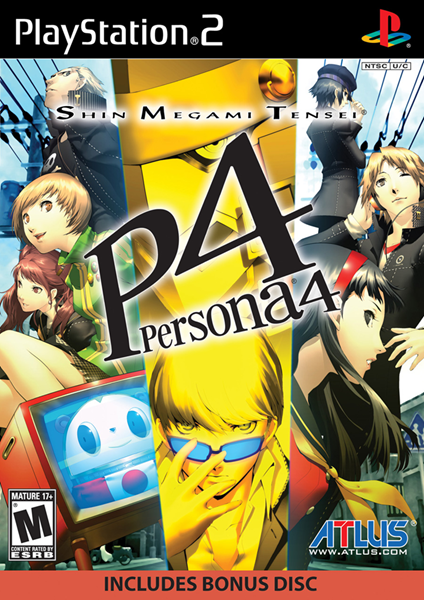
Ah, Persona 4. I have a lot to say about it. Persona 3 is one of all-time favorite games, and a contender for my favorite RPG. When a follow-up game was announced, I snatched that shit up faster than the sigh of relief from soccer moms all around the world upon realizing the characters no longer shot themselves in the head.
I was not disappointed. Persona 4 was more of the same of Persona 3, but more of the same isn’t bad unless something’s been the same for too long. Persona 3 was dramatically different from Persona 1 and 2, which bore more of a resemblance to most Shin Megami Tensei games, other than the Persona series’s distinct lighter tone than other Shin Megami Tensei games. Persona 4 is identical to Persona 3‘s gameplay and interface with some slight tweaks and improvements here and there.
The thing most people care about is the new storyline. You (or rather, Light Yagami or whatever stock name you chose from your list of anime to name the main character instead of your actual name and this always really pissed me off more than it should have when people did this) and a crack-team of other high school students must use their unique abilities to find out the person responsible for a deadly string of murders (two!) and attempt to save future people from the same fate.
I’m going to summarize the gameplay of Persona 3 and 4 real quick for anyone wondering. Following a calendar system, each day you can choose one activity to do. Most often this will be to talk to one of many selected NPCs (or sometimes party members) and hang out with them. There are several dialogue prompts, and you must choose the best possible one to make the other person like you more. If someone likes you enough, your relationship rank with them increases, which makes Personas you fuse to fight the enemy stronger.
There’s a series of dungeons you can choose to visit pretty much any day you want where your objective is to reach the end of the dungeon and defeat the boss and any enemies that stand in your way, using effective battle strategies that reward you for exploiting the enemy’s weakness and covering your own, and reprimands you for doing the opposite. It’s the great, balanced gameplay the Shin Megami Tensei series should be recognized for. It’s all the more satisfying when you defeat the myriad of challenging enemies knowing you did it by fusing the proper Personas and using them and your team strategically.
It seems there is an almost unanimous opinion that Persona 4 is superior to Persona 3. However, I disagree. While I will say Persona 4 is a stellar game that is on par with the Shin Megami Tensei series’s quality library, for me it does not match its predecessor, or succeed it. If I think they are both great games, then why am I bothering belittling either? Simple: because whenever I say I prefer Persona 3 to 4, people treat me as if I’m from Mars, saying that there’s no possible way anyone could prefer 3 to 4. I say without a doubt that there are plenty of reasons someone could prefer 3 to 4, and I will attempt my best to rationalize them here to prove I’m not just talking out of my ass or a nostalgia freak. While I outline the differences between 3 and 4, I will also compare them and explain why I think which one is superior to the other.
First off, the gameplay. 4 improves the gameplay of 3 in several ways, and definitely wins this round. So, if the gameplay is so much better, why isn’t it enough to win me over? Because I don’t think the gameplay improvements were all too significant, as welcome as they were. For starters, the biggest change is being able to directly control your party members moves, wherein 3 your party members’ moves were chosen by an AI.
You could, however, choose the AI’s “thought pattern” which would influence what moves they made on their turn. You had control over each individual member, just not directly. By learning how each of the thought patterns affected one of your party members, you could easily manipulate them to acting just how you want when their turn came around. When I think of any situation I lost a battle when another party member’s turn could have prevented it, I realize I had the opportunity to change their thought pattern and could have avoided a game over had I simply checked my party’s thought pattern and planned out my turn like I wanted it to progress.
I’ll show you what I mean with a real example: In a particular boss fight in 3, I was on the verge of finishing off the enemy. My main character was almost dead, and I was out of methods to heal myself. But it was okay, because combined with my attack and a supporting attack from my party members, the boss would certainly be dead before their turn came around to kill me. Everyone in the party made their attack, but when it came to Koromaru’s turn, he chose to use a Medicinal Herb item on me to heal me.
This did not heal me enough to survive the boss’s attack when his turn came around. If I had set Koromaru’s pattern to “Full Assault” instead of “Act Freely” on my turn when I knew what I needed to do, he would’ve used Agidyne on the boss and finished them. Because I didn’t fully think my turn out and act appropriately when I knew I could, I lost. Frustrating? Yes. Fair? Certainly. I lost because I did not plan out my strategy well enough.
This is not to undermine the undeniable improvement that controlling your party members is, however. It is simply to show that I believe many players did not realize how much control they actually had over their party in 3, and are unfair when bashing that certain aspect of Persona 3‘s gameplay.
I also realize that my previous example does not cover all situations. Many complained of Mitsuru’s AI often choosing to use her Marin Karin spell, a spell that inflicts the enemy with Charm status if you’re lucky enough, instead of simply using a traditional attack when she could’ve easily taken care of the enemy. Other players claim that even on Full Assault, Mitsuru may use Marin Karin at times. Others claim that even on Heal/Support Mitsuru uses Marin Karin.
I have not seen this personally, as I don’t use Mitsuru on my playthroughs, but if it is the case, then it seems there is simply no way around this problem and without ability to directly control your party members, a player simply has to deal with the misfortune when it happens. I’d also like to point out that, when an enemy as analyzed, an AI partner will stop attacking the enemy with it’s strengths and aim for its weaknesses. This holds true even for analyzing bosses. You are not shown a boss enemy’s strengths and weaknesses, but your party will act as if they know them, preventing you from having party members ruin your battle by attacking the enemy in futile ways.
In conclusion, direct control of your party members is a welcome improvement, but 3 still gave you a degree of control that allowed you to form a working strategy in most situations. In general, the direct commands remove the cumbersome method of having to change your tactics patterns often in the middle of battle to get your party doing what you want. With direct control, you can simply change what they’re doing when their turn rolls around. Much simpler to use, and more like traditional RPGs.
The plot of Persona 4 requires you to save a certain person from a dungeon about each month. While you get to choose the pacing you want to go at when rescuing that person, you have a time limit this time around. If you do not save this person by the end of the month, they will die and you will receive a game over, having to start from when you last saved. While a month is plenty of time to complete the dungeon, this adds a certain degree of linearity to Persona 4 that isn’t necessarily welcome.
In Persona 3, you generally went to the dungeon to train for a big boss you fought about once a month. You could argue that this is a similar system, but the mini-dungeons that those bosses hide in are much easier, with weaker enemies. Even the bosses themselves are much easier than the ones you are required to fight in Persona 4, Persona 3 instead choosing to put its most challenging bosses inside the regular “training” dungeons.
Because these timed fights in 3 are easier, it gives the player more leeway to do what they want and not focus as much on fighting if they want for a time to focus on things outside of combat. Thus, in 3, the player has a slightly greater degree of control over their pacing than in 4. Considering freedom of choice is a major selling point of the games, this is an aspect I feel does matter.
The other gameplay additions are mostly minor. You no longer get tired in the dungeons, which was a stupid mechanic in Persona 3 as you stopped getting tired often once your level was high enough. You can also pay a fox (for some reason) a ridiculous amount of money to fully restore your party’s HP and SP. Having this option is important, because without it, it’s possible a player would reach the end of the month under-leveled and unable to defeat the required boss. Though the prices are enormous, the option is there, so a player can fight weaker enemies to level up sufficiently and pay the fox to restore their health, so they can fight as much as they need.
Arguably, this undermines the pressure on the player to carefully consider their pacing regarding how often they visit the dungeon that month, knowing they can simply grind for more levels on the last day of the month if really necessary. However, this can be refuted by saying if the player goes to the dungeon more often in the month, they can avoid paying the fox for healing and save themselves a lot of money they can use for other things. This is true, though you generally have more money to spare in Persona 4 than in 3.
There’s also a new weather system. I cannot recall exactly what this effects, but I believe the player receives certain bonuses if they go to a dungeon under a certain weather that day. This also in theory removes more of the player’s freedom if true, because it heavily obliges the player to visit the dungeon on a certain day, instead of influencing equal personal choice over whether the player wants to go to the dungeon or focus on other things that day.
There are some other gameplay changes, but I don’t feel like they are worth mentioning or sway my favor of the game in either way all that much. I will say that I thought the addition of two more player stats to focus on (that influence what dialogue prompts you can make and whom you can form relationships with) were completely unnecessary and superfluous, adding more annoyance to the game than actual depth.
So with the gameplay out of the way, it’s time to focus on the main reason why I prefer Persona 3 to Persona 4: the plot and setting. I’ll start out with one that I admit is entirely personal. I prefer Persona 3‘s urban environment to Persona 4‘s rural one. One of my favorite aspects of Shin Megami Tensei is that they have a contemporary setting. That is, the settings are always set in a modern world, in the present or near-distant future, as opposed to an often medieval setting of other RPGs. Persona 3 was set in a large city area with modern buildings and skyscrapers. Persona 4 is set in a rural town, with houses often made of wood (even the school itself) and the town and areas are much more laid-back, with the exception of the burgeoning shopping mall Junes (which you barely ever get to see).
To say that Persona 4‘s overworld is lifeless would be wrong. It’s simply a more subdued energy than Persona 3‘s portrayed city bustle. However, just as I prefer cities in real life, I prefer them in my videogames. A lot of Persona 4‘s areas have less in them as well, particularly the bus stop area. Hardly any Social Links take place there, and you will almost never visit that area. It almost seems like a waste of space, not even getting well across Persona 4‘s rural setting considering it’s a simple road.
With less reason to visit an area like this, the game’s overworld seems smaller and only accentuates that there’s less going on in Persona 4‘s town than Persona 3‘s city. In a way, the game’s quiet town often depresses me going through it when I know it shouldn’t. Probably because I had a shitty time growing up in my own rural town. But I digress. Whichever setting you prefer is entirely personal opinion, but I think I’ve been very reasonable in explaining why I prefer Persona 3‘s city.
Let’s move on to the characters. Persona 3 had an overall fantastic cast of realistic and well-spoken characters. I can easily attach people I’ve met in my life to the characters displayed in Persona 3. Whether you liked Yukari or not, for example, she represented a very typical archetype of a high school girl. Often emotional and confident at the cost of a large ego. Junpei was the joker who struggled to earn the peoples respect he wanted. I could go on about this, but I want to keep this simple. Other than these realistic characters, there’s the android Aigis, who while obviously isn’t relatable, goes through her own problems and helps draw you into Persona 3‘s character-driven plotline. Other characters like Koromaru the dog, aren’t as integral to the plot, but add fun and life to Persona 3‘s world.
So, wanting to move on, let’s get to Persona 4‘s cast. Yosuke is a typical best-friend character. He’s arguably the most well-written character of 4‘s cast, being the most like a normal person. He portrays a different kind of high school male than Junpei, being more emotional and self-driven. Yosuke’s tendency to complain (though often within reason, thankfully) and get overly-emotional turned many off from this character, but I greatly enjoyed his dialogue and Yosuke was the most central character for bringing me into the storyline.
You also have Chie, an upbeat girl who is into Kung-Fu movies, the first character I have a problem with. Why? Because there’s not much more to her than what I just said. She’s as generic a female character you can get. The only personal trial she faces in the game is something trivial about her needing her “weaker” friend around her so Chie can feel superior or something that’s solved in five minutes and this aspect of Chie’s personality is hardly (or never) touched upon again.
Her love for kung-fu movies portrays her as a tomboy, but her dialogue is mostly tame. Rarely does she step out of line or “trash talk” or act tough like you may expect her to, so you are left with a bland character who has nothing more to them than a gimmick of liking and comedically imitating kung-fu movies. A joke that gets tired and old fast unless you are an equally dull person. The most Chie amounts to for much of the game is stating the obvious and reiterating what other characters have said.
Next up comes Yukiko, Chie’s best friend. The token “shy girl” character who stops being shy pretty early on to become yet another generic female character. Only difference is replace the kung-fu gimmick with an even more stupid and tired “laughing” gimmick (she finds some stuff funnier than most people and gets into these strange exaggerated laughing fits that would put any other person in a straitjacket) and an equally over-dramatic personality and you’ve got a character who, when they aren’t contributing anything to the plot past their initial appearance, is getting mad over stupid things and pulling a bad attitude out of nowhere to slap Yosuke in the face because he suggested studying with her.
You see, in this scene, Yukiko thinks, for no contextually accurate reason, that Yosuke is trying to hit on her and slaps him. Turns out though, when Yosuke said he wanted to study with Yukiko when everyone around them was talking about school, it meant he just wanted to study! Wow! What a simple mistake and a rational likable character response. I also felt that her personal drama with not wanting to inherit responsibility of the family hotel was extremely melodramatic.
Moving on, we have Kanji. The second best character in the game. Though a tired cliche, Kanji is a tough punk with a heart of gold and is sensitive on the inside. I don’t think I need to explain this, he likes art and stuff in addition to beating people up or whatever. This does however, give his personality depth and both sides of Kanji are displayed consistently throughout the story. A well-written character, though not the most imaginative. Kanji is a pass for me.
There’s also Rise, the extremely energetic pop star who ends up getting wrapped up in the team’s mess. Though Rise definitely has a more identifiable personality than Chie or Yukiko, she’s nothing too special. I generally like her confidence and playfulness, and she’s genuinely nice without a huge ego like you may expect. A likable character, but not too deep or relatable. Rise’s whole issue is that she feels ashamed for “selling herself” as a pop star. A reasonable concern, but not really relevant after it’s “solved” shortly after Rise joins the team.
Then there’s Naoto, a high school detective trying to find out the mystery behind the murder and naturally becomes involved with your crew. Though I can’t say Naoto’s personal issue without spoiling the game, I will comment that I believe it’s a very specific personal situation that is difficult for any player to relate to. Naoto does save face by having a likable personality, though and having a degree of competence that sets him apart from the rest of the cast.
Last up we got Teddie, a character actually from the “TV dimension” where the shadows lurk. Teddie is not an enemy and has sentience, unlike the other shadows. However, Teddie is curious about how he came into being and after becoming interested in the human world, decides to help his new friends out. Teddie is a unique, well-written original character that I compare his role in the plot that of Aigis, a character that bridges the surreal elements of the plot with the human ones.
However, much of Teddie’s character is ruined by his abrasive personality. Though it’s subjective, he has a tendency to be extremely annoying and the center of attention in any scene he’s in when he doesn’t necessarily warrant more than the rest of the cast. He also uses a lot of “bear puns” when you first meet him. Literally, plays on words revolving around the word “bear”. As you can imagine, this gets annoying quick. I’m willing to write off much of Teddie’s faults though, as a lot of people like him for the reasons I don’t. It’s a personality thing.
Identifiable characters are an integral element of any well-written story. Characters the audience can identify with and attach people and situations they know to are an extremely important aspect of getting said audience to buy into the story’s authenticity.
Authenticity is an important part of both games’ stories, as they both take place in the real world where things are meant to be taken seriously to some extent. Characters having relatable personal issues are important in the same regard, giving the player more empathy and pathos towards that character’s struggle.
With well-written dialogue empathizing emotions, a player can still feel empathy for a character’s uncommon situation that they realize is difficult for them, but it will still be less empathy than for a character’s situation they know they understand. For the reasons I’ve outlined above, I believe Persona 3‘s cast to be superior to Persona 4‘s. There are side characters I didn’t touch on for the sake of length, but even taking them into account, I maintain my position.
Now on to the plot itself. As stated in the beginning, Persona 4 is a murder mystery. An unknown person is pushing people into a surreal alternate dimension by way of a TV screen. This alternate dimension is unknown to all but a few people, including your friends who use their power of Persona to fight the shadows inside and rescue the victims as well as locate the perpetrator.
Without going too much into detail, the concept for this plot is very original, and I applaud it. But how the plot is presented is even more important than the concept itself. My first issue is how the cast reacts to the events as they happen. This is mostly a character issue, but I thought I’d address it here. In Persona 4, the cast is consistently very upbeat and lively, even knowing that there is a serial killer in their small town that is targeting people the cast knows. Optimism is one thing, I’m not asking for a totally defeatist party, but the cast acts very unrealistically towards these facts.
In Persona 3, the cast has anxiety. They have doubts over their new powers. They’re afraid of the shadows. This makes the cast feel more like real people, which makes them (the word of the day) identifiable. Because the player can empathize what it must feel like to be in a similar dangerous situation, it in a way makes the cast’s problems their own. Makes the player realize how high the stakes are, and root for people they feel are similar to them and others they may know. This was a major part of Persona 3‘s writing I feel 4 lacked.
A common complaint against Persona 3‘s plot is that it takes too long for the plot to unravel While it does take a few hours for Persona 3 to get going, I feel the same is true for 4. Persona 4‘s long intro is often mentioned (it takes over two hours for most people to reach the first battle), which factors into this. And though you often feel like throughout the course of the story you’re getting closer to finding the killer, the characters are often shown to be wrong and that they had a mostly false lead that doesn’t get them as close to the killer as they once thought.
Considering this, I believe the plots unfold at equal rates. I’d also like to point out that 3‘s plot, as I said before, is more character-driven. Each individual character coming to terms with the fact they may be fighting against an enemy they can’t defeat is a consistent theme in Persona 3, and as central to the plot as is simply defeating the enemy. Many complain that Persona 3 had an under-developed cast of villains.
While I do wish Strega were more fleshed out, I do think that them existing provides a human opposition to 3‘s cast that makes them (dum-dum-dum!) identifiable. In 4, you are fighting against an enemy you know nothing about. One one hand, this adds more intrigue to the enemy itself. On the other, that means you have a villain that opposes the party only in an indirect way.
I also don’t like the tone of Persona 4‘s plot compared to 3. In theory, 4 ought to have a darker plot, but as said before, the cast makes it more upbeat. They are also many exaggerated situations I felt were ridiculous, such as the spoilercross-dressing pageant that made me feel like I was watching a goofy high school anime. This may appeal to much of Persona 4’s audience, but not to me. I felt alienated by some of these situations (I’m not gonna say they’re less identifiable than 3‘s. Wait, shit). 3 had a darker plot, but there was still a friendly sense of humor to be found in normal everyday situations that expand upon the characters in ways that accentuate their realistic personalities.
There are definitely anime cliches to be found in 3 too, of course. I’ve seen some cite Aigis being an android as one. But Aigis being an android gives her a distinct personality and trials that would set her apart from any other human character possible in the game’s context. In addition, Aigis also makes perfect sense in the game’s context. A company investigating shadows naturally would create weapons to fight the shadows had they gotten out of control, and as we know, only living creatures that can experience mental stress can use a Persona, hence Aigis having a personality despite being a machine.
I was very disappointed in Persona 4‘s ending more than anything else. The true final boss was extremely contrived and felt like a cheap, impersonal ending compared to the battle against Adachi. I also felt the game took the “easy way out” when it came to explaining many of its mysteries. For example, Teddie, a being found in the shadow world, is a shadow. Think about that. This whole time, there was never a mystery. Meanwhile, how Teddie gained sentience or became a human is never explained.
Because this post is already extremely long, I’m going to wrap it up, having said everything significant that needs to be said. I could say a lot more if I wanted to, even, but these are my main points. At the end of the day, Persona 3 and Persona 4 are both shining examples of fantastic RPGs, and which you prefer is a matter of opinion and I’m not trying to particularly sway you. But don’t say there’s no reason to prefer 3 over 4 as if 3 is just a worthless game compared to its sequel. Hopefully no one can after reading my personal justification. Though I prefer 3, Persona 4 is a highly recommended game that any JRPG fan will enjoy greatly.
Leave a Reply