








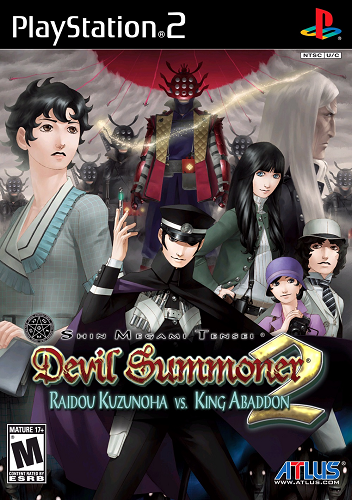
Raidou 2 Background
Summer 2012 was a transitory time for me. I spent that summer living with my dad, only to move out the following fall season. Things didn’t work out. Part of the reason was that I loathed the area. Total wasteland of infrastructure once built for swathes of people seemingly spirited away before I had arrived. Metropolitan decay in America has become increasingly prominent in the face of corporate monopoly and digital distractions, so this is an experience many of my readers should connect with.
The family and I visited our local indoor mall, which spiritually had battle scars. The floors and walls had scuff marks, every other shop was shuttered up, and nary another soul wandered its halls. Still, the lights were on, and somebody had to be home.
We had no particular objective in mind; just killing time. Walking past an EB Games, my dad remarked to me, “aren’t you gonna check out the game store?” He was aware I liked video games. He dabbled in them himself when I was a kid, thought it was almost exclusively the Donkey Kong Country games for whatever reason.
My dad hates video games. Both of my parents do. They found them viscerally obnoxious, wastes of time, and my dad especially lamented their role in “turning me into a nerd.” He wasn’t super aggressive about it, but he’d said enough to make his conviction obvious. This is the same dad who didn’t want me to have an Easy Bake Oven for Christmas because it would “turn me gay.” I just wanted to eat cupcakes, dad. I wasn’t going to fuck them. Easy Bake probably didn’t provide donut trays.
I really wasn’t playing video games that much during this time of my life. Listening to new music albums was my big thing, with the occasional reading of what we once called “books.” In hindsight, I was just bored. I had nowhere near enough money to purchase any consoles past the PS2 generation, and it had probably been a while since something in that generation’s vast library really hit the spot.
I told my dad, “nah, I’m not really into video games anymore.” Legitimately, can’t recall another time when his face beamed at me in such exuberance. “Wow, I never thought I’d hear the day!” Then I said or thought something like, “well, I’ll check it out for the hell of it.”
There was a rack in the center of the store, likely for relatively recent titles. One immediately got my attention: Shin Megami Tensei: Devil Summoner 2 – Raidou Kuzunoha vs. King Abaddon. My first non-Persona Megami Tensei (SMT) game was Digital Devil Saga 2, purely because I likewise chanced upon it browsing a mall we held my then-birthday celebration at. I knew that, other than the modern Persona games, SMT titles were quite rare. I’d heard they were high-quality games, but even if they didn’t strike my fancy, I could probably flip them for a profit.
That line of logic was enough for me the first time, and it was enough for me now. I scooped up Raidou 2 and went to the counter, which was manned by two guys around my age. One of them remarked on how he was considering getting the game himself, and all three of us soon discussed our joint interest in the franchise stemming from enjoying Persona 3 and 4. The convo didn’t go on for that long, and if it weren’t for my perpetual difficulty in starting friendships, maybe I could’ve had something to make my time living with my dad suck less.
But who needs friends when you got gaaaaames!? Of course I was going to at least try Raidou 2. I got home and did just that. But something magical happened after I played it: I kept playing it. Then I played it again. And played it some more. I played it so much that the unthinkable happened: I finished it.
The curse was broken. It’s no exaggeration to say that Raidou 2 rekindled my interest in video games. It wasn’t some “come to Jesus” moment—because that would be blasphemous for a Megami Tensei game. Raidou 2 was simply really good, and more importantly, really interesting. That magic formula of a good feedback loop, narrative hook, and compelling ideas was the spice whose absence had jaded me.
I hadn’t “grown out of” video games—I just needed something to be more intellectually stimulating. I was past the age where my focus was easily bartered with. The Megami Tensei franchise was at its creative epoch during the PlayStation 2 generation, and its undeniable sense of impeccable style, daring themes, and engaging, tense combat pierced my cynical veil. To put it another way, Persona 3 and its sequel were not serendipitous successes. Those titles were among a larger wave; one of the best runs of an RPG franchise in all of gaming history.
Immediately upon finishing Raidou 2 a month later, I sought out its prequel and Shin Megami Tensei: Nocturne. The latter was another astonishing success, but that’s a story for another day. Persona 3 became an all-time favorite for me practically an hour after starting it, but this whole saga was what ultimately turned me into a Megami Tensei superfan. Whenever I find myself tired of video games these days, I remind myself of this exact incident. The next surprise is always out there; you just have to look for it.
The first Raidou game is without question the weakest of Megami Tensei‘s PS2 run. I have my preferences regarding the rest, but Raidou 1 is the only title I would describe as anything less than excellent. It’s not without its good ideas, but most were salvaged in its sequel.
Its story wasn’t, which is the main reason to still play Raidou 1, but Raidou 2 scarcely even mentions it. Character development from the first game is virtually retconned so as to be repeated in Raidou 2. It seems even Atlus had little expectation of Raidou 2‘s audience having played its prequel. That worked out perfectly for me, but I can imagine the original’s cult following feeling a little burned by the cast-wide amnesia.
In my review, I’ll be covering some of the mechanical distinctions (i.e. improvements) of Raidou 1 and Raidou 2 whenever relevant. The greater relevance is in question, however, as Raidou Remastered: The Mystery of the Soulless Army released June 19, 2025.
For once, the “remaster” label actually underplays the game’s alterations. Remastered is practically a full-on remake, most pointedly in how it discards the original combat system in favor of Raidou 2‘s. I suspect this doesn’t bring the two games to parity, as Raidou 2 has a much greater scope than the first game. The two-and-a-half years between the games is evident by the ambitions of Raidou 2, which is a much bigger, longer, and overall more-involved experience.
Review
From what I understand, the Devil Summoner games have been going on long before the Raidou Kuzunoha games. It was still an SMT spin-off series, but had different characters, themes, settings, and totally different gameplay. The Raidou games are action RPGs (and perhaps the only action RPGs in the franchise?) where you play as the detective of the same name. Raidou Kuzunoha is actually an honorary title given to detectives that past the trials needed in order to become a detective dealing in paranormal/spiritual/demon cases, etc.
Despite Raidou not being the main character’s real name (you choose that), it’s what everyone refers to him as, with the exception of Gotou, a black cat that’s a previous detected reincarnated that acts as Raidou’s assistant. Raidou works under Detective Narumi from the Narumi Detective Agency. Though Narumi has no special powers of his own, he is very competent in his job and sort of acts as the manager to Raidou, who does most of the fieldwork when there’s danger involved. The Narumi Detective Agency is also at the beck and call of the Yata-Garasu, a mysterious mostly hidden organization that oversees Japan along with other places around the world to protect mankind from demons and keep order in the world.
In this game, an unknown woman shows up at the detective agency and asks the crew to locate a man. Raidou soon finds this man is connected to strange phenomenon happening around the capital of Japan. Many people have been experiencing a complete and utter loss of good fortune, with almost impossibly bad things happening to them constantly, even resulting in the death of some people.
Though at first brushed off as a coincidence, Raidou finds that the cause of this is actually a special insect known as a Luck Locust that the man he’s after employs on the general populace to steal their luck for reasons unknown. Because normal people have no spiritual awareness, it’s up to Raidou to find the source of the Luck Locusts and stop them.
There’s much more to the plot than that, but I’d hate to give away any twists. Also joining him is the intrepid female reporter Kichou “Tae” Asakura, who can’t resist the opportunity for an interesting scoop despite the danger, and Geirin Kuzunoha XVII and his female apprentice, Nagi. Geirin Kuzunoha was the name of one of the four great Kuzunoha summoners, and the elder and experienced XVII also inherited his title much like Raidou.
I will say that while the story of Raidou 2 started out as just a tad dull, I was soon roped in by it and found myself playing for several hours a day. I enjoyed it a lot, was generally surprised by many of the twists, and loved the dialogue and charismatic cast of characters. Also added to the game that wasn’t in the first was an alignment system.
Similar to other SMT games, certain dialogue prompts will push you towards either the Law, Chaos, or Neutral alignments. One positive thing I can say about Raidou 2‘s alignment system is that it is one of the most morally ambiguous I have seen in an SMT game (and on that note, any game) and there’s a pretty even argument for any of the “sides” represented in the game.
Unfortunately, this concept is not fully utilized, as your alignment only affects the ending slightly (a few lines of dialogue, completely inessential) and changes a few bosses in the final dungeon, only one of which is story-related. Your choices do matter in that sense, but they don’t matter much, which is fairly disappointing. I think that if it had to be that way, that they should have scrapped the alignment system, kept the morally ambiguous plot themes (leaving the player to just have their own opinion), and just have combined them into one ending that explores and touches upon all angles (after YouTubing the endings, this is totally possible with just a little tweaking).
This would have gave the game a stronger narrative, but as it is it doesn’t really suffer much at all, even if the ending of the game is a little underwhelming no matter which alignment you choose. I think I ended up falling under the Law alignment, which is odd because I thought my views of the story fit Chaos more. So that’s something to consider, if the alignment point distribution for the dialogue prompts was done well. Still though, hardly a big issue.
As Raidou, you’re a detective so you have to do a bit of investigating. To advance the plot, at certain points you will have to explore the many towns and other areas in the game and talk to the right NPCs and use the right demon field skills to progress.
IMPROVEMENT #1: In the original Raidou, you could encounter monsters anywhere in the game, including the towns. This was a gigantic annoyance as the whole point of the investigations is that you don’t know exactly where to go at first. This made exploring and running around talking to people a huge pain the ass because you would encounter (usually pathetically weak) monsters constantly who would interrupt your search and often your train of thought as well. Complete pests and a waste of time considering monsters in towns don’t get stronger over the course of the game and you will often revisit the same towns to talk to certain NPCs.
As I was saying before, each demon has a certain field skill. Something they can either use while exploring towns or talking to NPCs. For example, one demon has a skill that allows them to read the minds of certain NPCs. This is sometimes needed to get necessary information out of NPCs that are hiding it from you, and sometimes it can just be used to read other information that you don’t need but can still be funny or interesting, like any RPG NPC.
There’s other skills that are used specifically to extort information from NPCs, and some that are used for exploration. One skill that can be used to freeze water so you can walk across it, for example. There’s also optional skills that can just allow you certain bonuses. Some can reveal hidden items on the screen, tell you what monsters are in the area, how many items there are in the total area you haven’t gotten, lower/raise the encounter rate, and so on.
These are pretty helpful, and I like them. I do not like the idea of these skills being mandatory. It’s pointless. You have plenty of room for demons in your party, so you’ll often just have to keep around dumpy demons that are useless in battle but you need their skill just in case it’s randomly called upon for deep in a dungeon or some other place in the game. If you are missing that skill, that means you have to call the fucking way back to the Gouma-Den and fuse a new demon or buy an old one from your compendium. Because there’s a compendium, it means that the moment you first get a demon, every area that you need to reach using that skill is open.
You have nothing more to “prove.” You’ve done what is really necessary to progress, and having to make sure you have a demon in your party with the skill at all times is cumbersome and pointless from a gameplay perspective. This could have been substituted with obtaining a key item that allows you to access new areas, or allow you to somehow use the skills without having the demon in your party, or have a demon that helps Raidou but is not a part of his party use the skill when called on (for instance, a demon joins you after a certain quest that allows you to travel on water on the world map, even though that demon doesn’t fight with you). Or just remove exploration skills altogether.
I understand what they’re trying to do, showing how Devil Summoners use demons to help them with detective work, but there’s better ways to portray that than this feature that will end up annoying any player at least a few times through the course of the game. You can also send your demons out on solo investigations. Rarely will you use this, but the demon separates from Raidou for a while and you can use them to get to certain areas Raidou can’t access by himself.
IMPROVEMENT #2: While alone, the demon no longer has to fight battles like in the first Raidou. This is mostly due to there being no more battles in the towns. This also means you don’t get to control the demons in battle, ever, which was kind of cool, but it’s worth less frustration and faster investigation progression.
Every once in a while you have to explore a dungeon. Some of these dungeons are unique areas, and some are located in the dark world. Each town has a dark world that is a mirror of the real world, only with demons inhabiting it. While in any of these dungeons, you can encounter other demons. You can fight them, or negotiate with them. With the right dialogue choices, items given, and luck, the demon will join your team if you have an open summoning tube and are at the demon’s level or higher.
You can get more tubes by increasing your Loyalty, a separate bar that fills up after battle along with the experience points bar. As it is filled, Raidou gains more total Loyalty Points and as he passes certain marks, his summoner rank increases which allows him to hold more summoning tubes along with certain other bonuses here and there. Each demon has a cap on their loyalty bar, forcing you to use a variety of new demons so your rank keeps rising. When a demon’s loyalty bar is capped, this means nothing except for the fact that it will always agree to be fused when you choose it (some demons refuse to be fused unless their loyalty is maxed out).
In battle, you summon up to two demons to your side that are controlled by a decent AI to fight enemy demons. You can command them to use skills manually if you want, or you can set them to attack with only that skill. This is kind of annoying, because demons never use skills unless you command them to. There is no general AI pattern you can choose to make demons use both a mix of physical attacks and skills.
You play as Raidou, who fights with a sword. He’s able to perform a dodge roll to evade enemies, or hold down a button to block attacks. You can also use your gun, which while weak, has unlimited ammunition and can sometimes stun enemies while shooting. Pressing triangle unleashes your special attack. There are 3 special attacks, and which one you use depends on the type of sword you have equipped. One special attack is faster but weaker, one is slower but stronger, basic stuff.
You can also hold down R3 to bring all demons on the field to your side. Continuing to hold it down makes them vanish and they are invulnerable to enemy attacks, though they cannot move while invulnerable. If Raidou’s HP is reduced to 0, the game is over regardless of whether your other demons are alive or not. You can switch out demons and summon more from your tubes at any time during battle, except for certain status effects preventing you from doing so.
IMPROVEMENT #3: Two demons in battle instead of just one like in the first Raidou. This makes battles seem like they have a lot more going on, and gives the player more involvement when controlling his demons now that he has another one to take care of.
IMPROVEMENT #4: The addition of a dodge roll. This makes battles go faster as it is quicker than simply running. This not only gives Raidou more defensive maneuvers and gives the player more control of him, but also just makes the game more fun to play.
IMPROVEMENT #5: Unlimited ammunition. The gun is not useful enough to justify having to micromanage ammunition like in the first game (especially how many different types of ammunition there were). It has a decent enough purpose, isn’t strong enough to make the sword irrelevant, and it just works as it should with no bother to the player in or outside of battle.
IMPROVEMENT #6: Special attacks. Just another thing that gives the player more to do in battles and makes fighting more involved and fun. In the first game, the lack of things Raidou could do made him seem too helpless without his demons. In Raidou 2, he actually comes across as a competent and strong fighter rather than just someone who gets demons to do everything for him.
IMPROVEMENT #7: Being able to call demons to your side. You cannot control demons, yet they are absolutely essential for you to put up a good offense in battle. It’s not your fault if the demons are stupid and walk right into an enemy’s super-attack and get killed, and you would normally suffer big time if you were caught without demons (and you obviously don’t want to waste costly revival items or other healing items).
Demons called to Raidou’s side are invisible and invincible for the time, but this is balanced out by the fact that all enemies will target Raidou, so it is completely up to the player’s skill in dodging to keep him safe, so the ability to hide your demons doesn’t make the game easier, it just makes it more fair. Also adding the time you’ll most use this ability is when a boss uses one of their super attacks that cover the whole screen that your demons don’t know how to dodge. With Raidou, you can, and then once the attack is over you can let go of the button and let your demons come back.
IMPROVEMENT (?) #8: The negotiation system. In the first game you had to capture demons in tubes. Done by hitting their weakness and pressing a certain button while near them in battle. They got easier to catch with lower HP, much like Pokémon. You had to mash the X button to capture them. This was annoying and kind of pointless, but I’m not sure if the negotiation system is particularly better. The first system wasn’t really bad at all, but I guess I’m going to say the negotiation system is an improvement just because there’s no stupid button mashing involved.
Also new to the game is the MAG bar. A green bar at the top of the battle screen that works as a sort of MP bar. When demons use skills, they consume various amounts of MAG. MAG is gained by defeating enemies (slowly) or by hitting their weakness (fast). If you hit an enemy’s elemental or physical weakness, they sometimes get stunned. They cannot move for a while and when Raidou hits them in this state he gains a ton of MAG. This continues the SMT tradition of hitting enemy weaknesses, “playing smart” so to speak, being a big part of winning battles.
After the stun ends, the enemy has a brief grace period where they can’t be stunned again for a few seconds, so stunning your enemies isn’t too overpowered. Defeating enemies is the only other way to gain MAG, so in boss battles where you would normally run out of MAG before finishing if they didn’t have a weakness, there are several “breaks” during the boss battle where once you eliminate enough of their HP, the battle will pause, the boss will say something to Raidou, and you’ll gain a good amount of MAG each time these happen. On another note, it’s cool to have the boss interact with you during the course of the fight and it pulls the player more into the battle. Even for enemies that don’t speak, these breaks still happen and you just get the MAG.
But there are some issues that come with the balance of Raidou 2‘s battle system. Like most SMTs, Raidou 2 at its core tries to be a bit challenging. It’s clear from the competent enemy AI and the fact that they can hit you for a decent amount of damage, making dodging very important, at the least. But generally Raidou 2 ends up on the easier side once you get used to the quirks of the battle system. You gain far too much MAG from hitting weaknesses, making it unlikely you’ll ever run out and can just spam powerful skills and healing skills without really worrying about running out.
There’s also the fact that there are certain types of spells in this game that hit multiple times. For example, a certain fire spell shoots three fireballs. Though individually weaker than single target spells, because of the damage multiplier on weaknesses, these actually end up being extremely powerful if the shots connect. These skills are easy to come by and are better than anything “stronger” than them if used this way. Enemies are never difficult targets to hit you don’t need to worry about the multiple shots missing.
As long as you have your enemy’s weakness to get MAG from and a multi-target spell, the battle is as good as over. Without these, the enemies are fairly challenging, but you shouldn’t have to cripple yourself to get a good challenge, especially considering how hitting your enemy’s weakness is an integral part of the game. You can’t help it if hitting a weakness benefits you more than it should. Hitting weaknesses is supposed to make battles easier for you, just not this easy. The MAG gained from hitting weaknesses should be lowered by a good bit, and the MAG gained from killing enemies raised by a small amount.
Other than all this, you can obtain and use items in battle like normal, and your demons can level up and learn new skills with each level. When Raidou levels up you can increase any of his stats you want by one point, something I always like in SMT games. They give you a lot of control over your party, and you feel satisfied when you see the choices you made in making your team and raising Raidou pay off and when you battles. That’s not necessarily because you just had a strong party member who has good level ups, it’s because you made the right choices yourself.
IMPROVEMENT #9: The MAG system. In the first game, hitting weaknesses just made demons easier to capture in tubes. Though it did also deal more damage. MP was too difficult to gain back in the first Raidou, and this system still limits the amount of skills you can use so can’t abuse them. It ends up being unbalanced because of how much MAG you gain from hitting weaknesses, but that’s not a problem with the idea of the MAG bar itself.
IMPROVEMENT #10: The battle screen is WAY FUCKING BIGGER than the tiny box you had to fight in in the first game that fit in the entire screen. Holy shit. This means more can happen on the screen at once and makes fighting more exciting and… more fun!
IMPROVEMENT #11: I forgot to mention this earlier, but sometimes in dungeons in the first game you were impeded by spiritual walls (they had a name but I’m not looking it up) that you entered battle with. Each one had a specific hidden weakness that you had to hit with one of your demon’s elemental attacks. It was not only a huge pain in the ass to use every elemental skill until one worked, but it also added another layer to the cumbersome need of having every single skill in the game on you at all time to fully explore dungeons.
If you didn’t have the right elemental skill, you either had to capture one in the dungeon that did or go all the fucking way back to the Gouma-Den to get an old demon that did. This terrible idea is gone in Raidou 2, replaced now with walls that only Raidou’s demons can go through. Any demon can do this so this isn’t really a problem.
Every once in a while, a message will flash on the screen saying Raidou felt a strong presence. When this happens, your next battle, NO MATTER WHAT YOU DO, will be with a Fiend. Fiends in the SMT series are extremely high-ranking demons that are very powerful and usually optional bosses. When you run into one in Raidou 2, you can either fight it (and probably get yourself killed), or negotiate with it.
I don’t think the Fiends ever ask for anything you don’t have on you, but their demands are outrageous, often asking for a ton of MAG, the life of one of your demons, or an extremely rare item. Any player is going to get fed up with one of these demands and try and fight one of the Fiends, and they’ll likely be frustrated as they will probably be killed and have to reload from a previous save point (escape is not possible after a Fiend battle starts).
Because there is no way to avoid a Fiend battle other than giving them really valuable shit, they are basically a game mechanic only added to make the game harder and annoy the player. The Fiend battles themselves are really fun because of how challenging they are, and I’ve managed to win a few even when drastically weaker than the Fiend by dodging well, but they’re still extremely time consuming because of their high amounts of HP. Even if you defeat a Fiend, it comes back and can bother you again at random later in the dungeon. As you go through the game, later dungeons have different Fiends that are stronger than the previous ones, so you can really be too safe.
Oddly enough, the last dungeon’s unique Fiend is actually the easiest one. In the final dungeon, there’s a point where you must fight all the fiends in a row with the exception of the final one, so you do have to fight them all eventually. There’s one Fiend in particular that is probably the most difficult enemy in the game, because during the fight it can create up to two copies of themselves that are just as strong as the original and have the same amount of HP. All three must be killed to win. This fight drove me fucking nuts.
Outside of battles, there’s a very wide variety of sidequests you can go go on that actually give you pretty good rewards, so they are worth your trouble. Some rewards are needed to beat the game, but you’d never know this without looking those ones up, so that kind of sucks.
Otherwise, they just look like normal sidequests. You can buy items at the only store in the game and in the same building go down to the Gouma-Den, where Victor (a hilarious mad scientist based off Dr. Frankenstein who is probably the greatest assistant in any SMT game) can fuse demons for you to create new ones, and fuse demons to your sword to make them stronger.
IMPROVEMENT #12: When fusing demons in the first game, the skills you got were also random, but they could not be changed by simply exiting out of the fusion menu and trying again. I’m not sure what determined what skills your demon inherited in the first game, whether it was the order of the fused demons’ skills or something else, but it was very annoying and the player could end up with demons with crappy skillsets through no fault of their own.
IMPROVEMENT #13: I think you were able to fuse demons to your weapon in the first game, but here there is a greater amount of weapons you can fuse and a greater amount of special effects your weapons can gain from weapon fusion.
That about summarizes in way more detail than I thought I would have to go into all the changes and improvements from Raidou to Raidou 2 and gives a general overview of the game. Though it is fairly different than a standard SMT, being an action RPG and more light-hearted than most of the series, Raidou 2 still has a captivating and intelligent storyline, and plenty of dark themes that won’t let down usual fans of the series.
For many reasons I outlined in the improvement sections above, I was genuinely impressed for the most part by all the really intelligent gameplay design in Raidou 2. I say give this one a try, but you’re not missing much by skipping the first game.
The first game barely even had any exposition, you never really see Raidou meet Narumi for the first time or anything interesting like that, and the plot of the second game can be fully appreciated on its own. It almost gives one the impression they were trying to reboot the whole thing, though there are some references to the first game’s plot in sidequests. I really enjoyed the hell out of Raidou 2, and will probably replay it in the future to complete all of the sidequests and such.
Leave a Reply