








My Background
When I originally wrote some of these thoughts, it was after I had just finished Super Robot Wars: Original Generations (SRW: OGs) for the first time, which would have been shortly after the release of the first complete English fan translation patch. If I recall, I had no audience for the piece, and it was sealed away in the Barks vault until I launched my site (i.e. saved as a .txt file). It was never meant to be seen, and only served as personal catharsis. But content is content, right?
In August and September of 2025, I replayed Original Generations, mostly motivated by 100%ing the game after I had accidentally deleted my original (yet completed) save file. I thought I would just skip all the cutscenes and blast through the game as I had done with my countless replays of Original Generation 2 on GBA. And yet, once I gave the story even an inkling of my attention, I was hooked all over again. It’s just too damn fun, and it had felt like too damn long.
This was a gradual process. While replaying OG1, I would skip certain cutscenes when the RPG feedback loop became too strong. When the time came to play OG2, I resounded to read the thing in whole. Certain opinions of mine were reignited by this revisit, and it made me consider returning to the subject at hand. Likewise, I felt the itch to do a full analysis of Original Generations. Considering how much of an impact OG2 had on me personally, that project feels inevitable. Granted, it will be a monumental undertaking, because I have a lot to say about the OG games—and that’s coming from me.
At some point, this article will be consolidated into a larger review of OGs. Until that time comes, I thought I would revise it with some more refined musings. Essentially, it’s a notepad for things I want to say about the translation patch. Normally, it would join my hundreds of drafted articles, but since it’s already been semi-published, and because I’m hurting for new content, I’d like to make any revisions immediately public. It’s something for people to chew on while waiting for my larger works. I hope you enjoy!
Waiting for Super Robot Godot
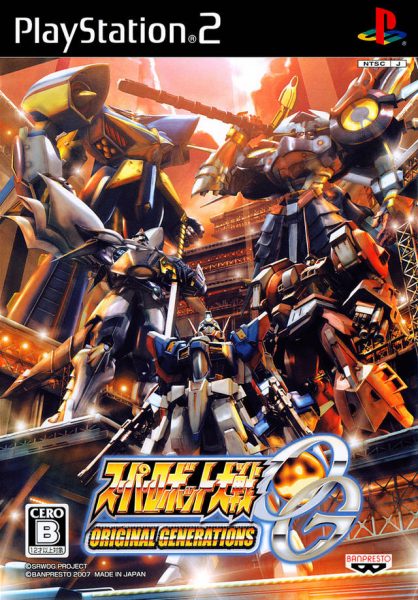
Some of y’all just don’t get it. You won’t get it. For those of us who played and loved the GBA Original Generation games upon their release in the west, the subsequent years carried nothing but despair. These two titles released rather late into the GBA’s life, particularly for English territories. OG2 dropped November 21, 2006, which was over a year out from the Japanese release. PAL regions had it even worse, only getting the game at an astonishingly late date of May 1, 2007. Just a month out from that on June 27, Japan would receive a combined, enhanced, and expanded PlayStation 2 remake of both games: Super Robot Wars: Original Generations.
Remakes are commonplace now, especially as the definition has blurred with that of “remasters,” but the circumstances surrounding OGs were downright anomalous. Not only were we receiving a remake of niche games, but one from the same video game generation as its successor platform, and rarely was such a dramatic leap in hardware ever observed. These games that had debuted on a system just barely able to handle high-end Super Nintendo titles were now going to be rendered on what was not too long ago considered cutting-edge hardware. This kind of thing just didn’t happen. It’s the kind of stupid, selfish concept you see kids post about wanting on forums. It didn’t make sense, it was too good to be true, and yet there it was in spite of it all.
And what an absolute curse it was.
With OG2 still fresh in our minds, western fans were left scraping gaming news sources on the daily hoping for the announcement of an English localization. Forums weren’t dedicated to discussion of the actual game so much as they were places for desperate, digital orphans to beg for scraps. “Will Original Generations come to the Americas, sir? I am rather hungry…” Well, it was probably more like, “is this gunna come to englsh?” I’m assuming they were American, due to their poor literacy. Regardless, it was a waste of time. Nobody fucking knew. Threads like that were, and still are, stupid. No one could do anything other than speculate and share what they found on Google.
The optimism and pessimism surrounding a potential OGs release fluctuated more than hit rates against Shadow Mirror units in OG2. Which is to say, a lot. For every person mentioning that because the GBA versions were localized, OGs was likely too, there was at least one more to point out the GBA games’ abysmal sales in the west. There are reasons for those sales—some of which could be mitigated with the next attempt—but for corporations, numbers are what matter. Safe, consistent results are what matter. Why that ideology led to the GBA games being localized to begin with is anyone’s guess. Maybe some rogue hero snuck into the backrooms at Atlus and pulled a bunch of levers to make it happen.
I propose the “will they/won’t they” was less of an expression of curiosity than it was some kind of euphemism. I think deep down, on some level, nearly all of us knew it was a longshot. Localizing Original Generations simply did not make sense from any business perspective. A broad demographic already failed to catch on once, and the very thought they would spend even more resources localizing a bigger game was laughable. And if a localization was ever in the cards, why wouldn’t they have skipped over localizing the GBA games? Original Generations was close enough to their release dates that it’s inconceivable Atlus wouldn’t have had knowledge of its production. They likely chose the GBA games specifically to cut costs and reduce financial risks. As much as I hate to say it, there is no doubt in my mind that an OGs localization would have been a net loss for Atlus. They were right not to do it. Always were.
I always heard rumors about Sony having some policy where games with a Japanese voice track were required to have an English dub when localized, but I have no idea if this was ever true. It would be a very stupid policy, but that makes it more likely to me, if anything. To this day, some attribute OGs staying in Japan to this arcane rule. Personally? I don’t. Not anymore. I think even if Atlus or whichever publisher could have released OGs with no voice acting, they still wouldn’t have done it. There were no costs one could cut that wouldn’t have made OGs a net loss. I truly, fully believe that it was a doomed project given the context of its time.
And like what happens to begging orphans, eventually they stop showing up, and the begging stops with them. Who can say why.
For whatever future the Original Generation games had, it was probably now a given that the west would have no part in it. Mind you, the west did receive Super Robot Taisen OG Saga: Endless Frontier, likely because it was a different genre of game, but that flopped as well and we never got its sequel. Awesome! I never even considered Endless Frontier to be a victory. The Elemental Lord subseries of Super Robot Wars featured only original characters and was receiving games on the DS and PSP, but we got a mediocre turn-based action RPG instead. We could’ve squeezed just one more failure out and had it be a “real” SRW game. The guy at Atlus pulled the wrong fucking lever.
Well, so it was. Super Robot Wars fans were hardly unfamiliar with Japanese exclusivity, so many returned to form. Thanks to emulators and console mods, Original Generations received a strong following among the international fans for its high level of quality. For people such as myself, too embittered to play the game with the knowledge of what might have been, it remained an enigma. Maybe some day, some group would release a fan translation. People did one for Super Robot Wars: Alpha Gaiden… just barely, but still. Super Robot Wars J was an impressive undertaking too, even if it wasn’t to the scale of a PS2 game. It wasn’t impossible. It was at least more possible than getting an official English release ever was—not that that’s saying much. But, come on. A modern, console SRW translated into English? Who the hell would put the time into—
The English Patch Background
Oh. I guess someone did it.
If you weren’t a part of the SRW community at the time, you have no idea how big of a deal this was. People had been edging since 2007, and on December 23, 2020, Christmas would come early. Sorry for the choice of metaphor, but the exuberance must be stressed. Super Robot Wars translation project releases have long coincided with the December holiday season. I’m not sure where it started, but to this day, the fans always collectively cross their fingers when Christmas rolls around. And yeesh, what a gift for that year. Even yours truly dropped everything to start what should’ve began 13 years earlier.
The patch in question is credited to Kingcom. Without doing much further research, I assume they’re a ragtag group of fan translators, and these are apparently the same angels responsible for translating SRW J, SRW W, and even the GBA entry of the Oriental Blue series. The SRW community clearly owes much for them. So much so that I personally forgive them for having the project for J marked as “99% complete” for what felt like 6 years. I don’t have much to say about the group, but I have played every one of their projects, and they’re all of more than acceptable quality.
Grammatical Errors
I don’t enjoy scrutinizing grammar; part of that is because I know I make many of the same mistakes, and it feels hypocritical. Regardless, I appreciate it when people correct my errors, so perhaps someone will value this section. The Kingcom patch has a lot of incorrect grammar. A lot. When I say these errors are high in volume, I do not mean they are severe. The vast majority of Kingcom’s script is perfectly legible, and I suspect most players won’t detect anything is even amiss. I don’t like that barometer, however. English literacy rates and writing ability are on a major downtrend in certain territories where English is the common language (America). I don’t want to encourage the acceptance of poor grammar simply because people have had their standards eroded by decades of coordinated anti-intellectual propaganda targeting reading and writing education.
Also, if you are one of the people who can recognize these mistakes, works containing them can become a nightmare to navigate. Even if one can sus out the intention of the text based on context, the nagging thought that incorrect syntax might have changed a sentence’s meaning can make the simple act of reading stressful. You ever stare at a math equation you’re asked to solve, and your brain feels like it’s turning into a brick as you desperately try to focus and parse what the symbols mean and how they interact? It’s like that for English nerds, except we can rarely get catharsis by solving the problem—the text is already written. Enough of that, though.
My biggest issue with the Kingcom patch is its abundance of comma splices. Essentially, a comma splice refers to when a comma is used to separate what ought to be separate sentences. For example, “I piloted a Gespenst today, piloting is really difficult.” The use of a comma in this sentence is incorrect, as both clauses (the text on each side of the comma) are independent. In this example, you have two complete sentences, so they should be separated using a period, semicolon, or coordinating conjunction. So, spotting comma splices is often as simple as asking yourself if your clauses could work as their own sentences. There are certain stylistic reasons a writer may intentionally opt to use comma splices, such as to convey a strict sense of pacing, but that doesn’t apply to the majority of Kingcom’s usage.
I believe comma splices are often an intuitive mistake inferred from how people typically speak in conversation. In English classes, commas are often first taught as a means of transcribing “pauses” in one’s speech. This is an oversimplification, but it’s good conceptual grounding for novice English speakers. An unfortunate side effect of this explanation is that some writers assume commas should be used when it’s expected that the “speaker” would take a shorter pause between independent clauses. In other words, there’s a misconception that periods are for long pauses while commas are for short pauses. This can overlap with the rhythm of how people speak, but in written communication, the rules are different. If a character is meant to be depicted as speaking urgently, it is still preferable to let the dialogue’s context speak for itself rather than lean on comma splices. Even engaging in this would require perfect consistency in the script, so that it can always be trusted a comma splice is communicating the same thing. In the Kingcom patch, comma splices exist in dozens of different contexts, which makes me unable to consider them as anything other than errors. This results in a bulk of text unintentionally laden with anxiety coding. It’s exhausting to parse, as the lack of periods don’t allow statements to “breathe.” Literally, it’s breathless pacing.
Kingcom, if you are reading this, I would happily help you revise your script for an updated patch. I don’t know if your group has any interest in returning to OGs, but I’m willing to proofread and fix any grammatical errors—free of charge. It would be an honor to contribute something of value to the SRW OG universe. I won’t touch any of your cornball jokes.
Repetitive Phrasing
Something that really gets my goat as a writer, and more importantly, a reader, is repetitive phrasing and vocabulary. This is exactly what it sounds like; you use identical wording to describe something, despite a litany of adequate substitutions, often in a short textual proximity. This is one of the most common ways dialogue can feel stilted, as it gives the impression that your cast is robotic and of the same hivemind. It’s unnatural, and it exposes the quirks and biases of the author, therefore weakening immersion by eroding the psychic wall between the writing and its creator(s). Realistically, every character is a unique individual who ought to have their own instincts when it comes to preferred phrases and words, and the text should not reflect the fact that it’s actually coming from a singular voice. Beyond that, human brains have evolved to pick up on patterns. They both commit and notice repetition easily, and the latter distracts readers and, again, takes them out of the story’s fictional environment.
Making these mistakes is something common to writers of any skill level; what matters is that you catch them. For high-profile works, this is usually passed to an editor (among other duties). For small-scale projects, such as this translation (and this article), the writer often has to catch these errors when proofreading. That might sound like it’s just as good, given many writers’ predilection for reading, but any writer is naturally less cognizant of their own mistakes. If they weren’t, those mistakes likely wouldn’t exist to begin with. In other words, we can have blinders on, and that’s part of why a separate editor can be so helpful.
I believe an editor with more time to dedicate towards being attentive could have contributed greatly to making the Kingcom translation more natural to parse. To wit, here are some repetitious phrases and words I saw the text continuously falling back on:
- Honcho: Or “head honcho.” This is one of the most puzzling words in the patch’s vocabulary. It shows up constantly in lieu of synonyms that are more common in English vernacular; boss, chief, leader, etc. In America at least, calling a superior you have no rapport with “honcho” would likely be considered disrespectful. Its uncommon usage would potentially have the effect of “othering” the superior, which is a negative reaction. In a neutral context, it’s not what I would call a professional address. I would expect someone being called “honcho” to be done tongue-in-cheek, similar to calling someone “bossman.” Both of these can be acceptable in an established casual environment, but the necessity of that requirement demonstrates it not carrying the same connotation as something like “boss,” which works in any environment.
In scenes where Excellen is using the word “honcho,” I can buy it. She’s a carefree, jocular character, and her dialogue constantly reflects that. She’s even shown to be lax about standards of decorum. But when the entire cast is using the word “honcho,” I can’t help but suspect that this word was translated literally and not adapted for an English cultural context. Are we to assume every time the word “honcho” is used, that it’s a relaxed, unserious situation? Certainly not, so it ought to be preserved for those instances. That’s one of the benefits of the English language; its vast array of synonyms with connotations more appropriate for specific contexts. To forgo it is to forgo English itself, and it contributes to a script feeling foreign in nature despite it literally being in English. If “honcho” in the original script is used in the same default manner “boss” would be for English-speakers, then it should be changed to reflect that.
And frankly, it’s just a weird word to frequently use. No one in America defaults to calling a leader “honcho,” but that certainly isn’t the case in this patch. Hell, it’s a syllable longer than “boss,” so people are even less likely to use it instinctually. Moving on… - Got it in one: Used to respond to someone’s correct assumption about a situation, casually framed as if it were a guessing game. It’s used accurately in the Kingcom patch, but its prevalence is enough to give the impression everyone worries they’re secretly on the set of a game show. Replace a few of these with something like “nailed it,” or “right on the money.” These are common English expressions with the exact same meaning and level of formality.
- Monolithic entity: Used when referring to an organization or some other group of people who aren’t aligned on certain interests. In English, this is a rather formal way of expressing this behavior and something you would sooner expect in academia. There are contexts in OGs where I think its use is believable, such as when Brian Midcrid and Nibhal are speaking. Similar to other list entries here, however, its common usage leads to it being the default phrase for this concept, which reads as awkward and forced. This isn’t an idiom or anything, being just two descriptors, but that means there’s countless substitutions. “Unified group,” for instance. It goes on. The point is to just have variety that feels natural.
Something I will give this patch major props for is not including the translated phrase, “even if you say that.” Holy shit, do I loathe that one. I’m not saying that Kingcom did as poorly as possible with this (or any other) element. I just think a little cleanup could have made the script flow much better.
Lamia’s Speech Quirk
Early on in OG2, quasi-android Lamia damages her linguistic processor. This results in her dialogue frequently not coming out as intended. With her role as a soldier naturally demanding decorum, this is routinely played for comedy. There’s a juxtaposition between Lamia’s typically formal, straightforward dialogue and her abrupt dips into improper syntax. This is intended to activate the audience’s laughter protocol.
This impediment has been portrayed differently across languages, including both existing English translations of OG2. I’ve tried to find out exactly what the original context for this speech impediment was but, of course, I keep finding different explanations. I’ve heard some people claim that in the Japanese script, Lamia’s speech problems occur when she tries to use honorifics, thus resulting in a social faux pas where one speaks with undue casualness. TV Tropes, on the other hand, says that it emerges when Lamia uses a word written with the same kanji as her intended word, causing her to say the incorrect word instead.
Without knowing what’s true, I can’t properly critique how each English translation handled this. Are people online talking about Lamia from Super Robot Wars A, Original Generation 2 GBA, or Original Generations? Does it matter? Are they repeating what they’ve heard, or have they actually read the Japanese script? I’m hesitant to trust anyone. Some sources are written in such broken English themselves that I can’t corroborate them in good faith.
It’s a pain in the ass. Feel free to correct me if I’m mistaken on anything, or if you know what the deal with Lamia’s Japanese speech impediment is (and please establish your sources and/or credibility).
If I’m understanding everything correctly, the closest English equivalent to the kanji dilemma would be homonyms; words that sound the same but have different meanings. That doesn’t work for this joke, however. If you’re speaking, as the characters in the game are in-universe, there is no perceivable way to mix up words like “two” and “too” in a sentence. They sound the same, so an audience will just assume the correct one based on context. When speaking, it’s essentially impossible to mix words up in this way. Theoretically, a translator could hope that an English audience wouldn’t realize this text-based joke was at odds with a scene’s context, but I would assume most people aren’t that inattentive.
Another option is to just excise the gag entirely. It’s not like it’s important to the storyline, and even with regards to Lamia’s characterization and development, it’s inconsequential when compared to her main motivations and struggles. However, multiple scenes have characters commenting on her speech impediment at length. To remove this gag would require a knock-on effect of script changes. While preserving this joke isn’t strictly necessary, by the same token it isn’t due that much extra attention from the localizers. So, what’s to be done?
In the original OG2 English translation done by Atlus for the GBA version, Lamia’s impediment was communicated with a stutter. It worked well enough. Most of the humor was originally derived from the awkwardness of the situation and Lamia not being able to control her speech, and that’s still present. It has its issues that I’ll get to, but it was a fine solution that kept most scenes intact.
The Kingcom translation opts for something more involved. Lamia now creates fake compound words in sentences that once contained honorifics. Synonyms like “contemplate” and “consider” might become “contemsider.” Lamia notices she misspoke, characters notice she’s making words up, hilarity ensues. This seems to be closer to the original Japanese context. Because English doesn’t have ways to phonetically confuse words in speech, they portray the mix-up by having Lamia combine two similar words. It’s not a perfect replacement, as this changes the punchline to be Lamia’s funny-sounding words rather than an entire sentence’s meaning being changed. Still, it’s a fine solution to a potentially unsolvable problem.
In both English scripts, the altered context occasionally results in scenes that don’t make any sense. When Lamia first speaks with Vindel after her speech has malfunctioned, Vindel becomes offended that Lamia is speaking to him in such a disrespectful way. The implication seems to be that Vindel thinks he’s being mocked. Unless Vindel is insecure about his own non-existent stuttering problem, this reaction doesn’t square with Atlus’s localization. In the Kingcom translation, it’s… a little better, I suppose? I could see Lamia’s compound words as seeming like mocking “baby talk,” like when someone speaks in a blubbering tone and affixes Ws to the start of each word. I still think someone would respond with utter confusion and think the other person was embarrassing themselves rather than get angry at perceived mockery, but Vindel does take himself very seriously. It’s strange to me that he wouldn’t immediately assume something was wrong with Lamia, rather than assuming she’s speaking this way intentionally.
Speaking of, the scene continues with Axel explaining Lamia’s condition to Vindel. He then instructs Lamia to “speak normally,” and she proceeds to converse with Vindel devoid of any speaking errors. What the hell happened there? Isn’t the whole point of Lamia’s condition that she can’t speak normally? If she can simply choose to, where is the conflict? From what I can recall, the Kingcom patch never explains this incongruity.
The inconsistencies continue with Scenario 33. Lamia speaks extensively in the map’s opening cutscene, and she does so without a single error. Again, it gives the impression that she has control over something otherwise depicted as being spontaneous. At first blush, this might seem like the writers’ decision to not remove emotional weight from an important scene. If that is the case, it’s simply too much to ask that the audience not realize Lamia’s spoken so long without any issues. It’s such a common occurrence in the script that it immediately stands out when absent. Going back to what I mentioned earlier, some people have told me Lamia only messes up speaking in specific sentences. What’s the trigger supposed to be here, and why was it completely absent from 30 or so lines straight? The Kingcom patch yet again doesn’t acknowledge this in any way. It’s frustrating.
Naming Conventions
Nothing inspires as much… passionate debate as the subject of names in translations. It stands to reason, given that their use is ubiquitous. People are made very aware of a translator’s intent here, whereas its often imperceptible with standard English words. Even a fan’s choice to use one name over another becomes a statement in and of itself. People’s natural insistence on official material, or “canon,” incenses discussions further, as there is often the insistence that this element of a translation is capable of having an “objectively” correct choice.
I’m out of my wheelhouse with a lot of this, and I’m personally not interested in the granular details. I do have thoughts about a few of Kingcom’s decisions, mind.
(Everything Past Here Is the Original, Unedited Article)
I want to just say, for whatever misgivings I might have, I’m extremely grateful for this patch. This likely might have never been done, and it’s something I’ve been waiting on for around 15 years. Original Generation 2 is one of my favorite games of all time, and having the opportunity to experience its remake in a much more complete capacity is a treasure. Thank you to everyone responsible for this patch for what was no doubt a time-consuming effort. I would be happy to play any SRW with this quality of translation/localization.
That said, upon completing the game, I had misgivings that made the experience bittersweet.
Just to mention it somewhere, the patch does have its fair share of typos. They’re not frequent enough to be obtrusive, nor do I expect it to be free of them, but they do exist. For the volume of text in question, this patch can be said to be remarkably well-edited. I can’t recall an instance where a typo or formatting error caused me to not be able to interpret what might’ve been the correct sentence, so that all worked out.
I should also give a nod to the name changes. Ultimately, these are frustrating at most, and not something that would ever ruin a patch. I generally prefer consistency to perfect accuracy and would’ve liked to see more adherence to the original Atlus translation’s names. It’s bothersome within the community to have to juggle multiple names around in your head for dozens of things. Sometimes the Atlus name was so close to the translation on display here that I wish they had just kept it for simplicity’s sake.
At other times, the Atlus name was so obviously wrong despite being close that I can empathize with the decision of the translators. See “Ring Mao” becoming “Ling Mao” in this patch, when her last name makes it obvious she’s Chinese. That’s something I can adjust to and maybe would have been in favor of myself. Again, it’s not a big deal at the end of the day. You get used to it.
The only one that particularly bothers me is Aschenretter, as that’s unambiguously not the mech’s name. The insistence on this name between this patch and the patch for A Portable makes it feel like the translator is trying to force their fanfiction on others. Like, they thought of a naming convention that would’ve been really great had the original writers come up with it that they can’t stop themselves from trying to retcon the name in patches. But… it’s just not the name, and a misrepresentation of the artists’ work.
Moving on, the dialect. A lot of people are driven up the wall by more liberal localization choices. I’m not. Technically speaking, the OGverse is meant to take place in a setting with advanced technology but culture similar to modern day (hence the contrivance of the three meteors). My gut tells me that the dialect of Original Generations, were it released today, would have changes to connect it to contemporary informal English. One could argue that the game wasn’t released today, however, and that the translated script should’ve matched the culture around the game at the time.
I could see the argument for either, so Tenzan having updated gamer lingo or characters saying “welp” doesn’t bother me. That is technically how they’d be likely to speak in present day, which the OGverse is modelled after. There are a few cases where I wonder if the original line even was a reference to something (“ghost in the shell”), but those are few and far between. I wouldn’t be a fan of those decisions, but whatever.
My main issue lies with the general script, namely for Original Generation 2. I know the Atlus script like the back of my hand, so if you want to insist I’m biased, I guess you could. But I genuinely believe the original translation was far more direct, punchier, and dramatic in several key areas. So many lines I thought were once iconic are reworded in subtle ways that I felt reduced gravitas for no benefit. There’s many cases where the official translation and the fan translation are close enough to the same meaning, but the official translation words things more succinctly and/or powerfully.
Certain lines in the fan translation feel “overly” accurate in the sense they’re overwrought in English and lose a natural urgency or sense of realism. That’s what made this playthrough so bittersweet. It was a parade of seeing lines I thought were iconic, or powerful, or even beautiful replaced with readings that were mundane by comparison. I was left feeling like one of my favorite video game stories ever was reduced to something so much more typical. In the future, I might do a direct line-by-line comparison to provide pertinent examples, but for now I can personally guarantee that I’m remembering most of these changes correctly. I know that original script extremely well.
Leave a Reply