








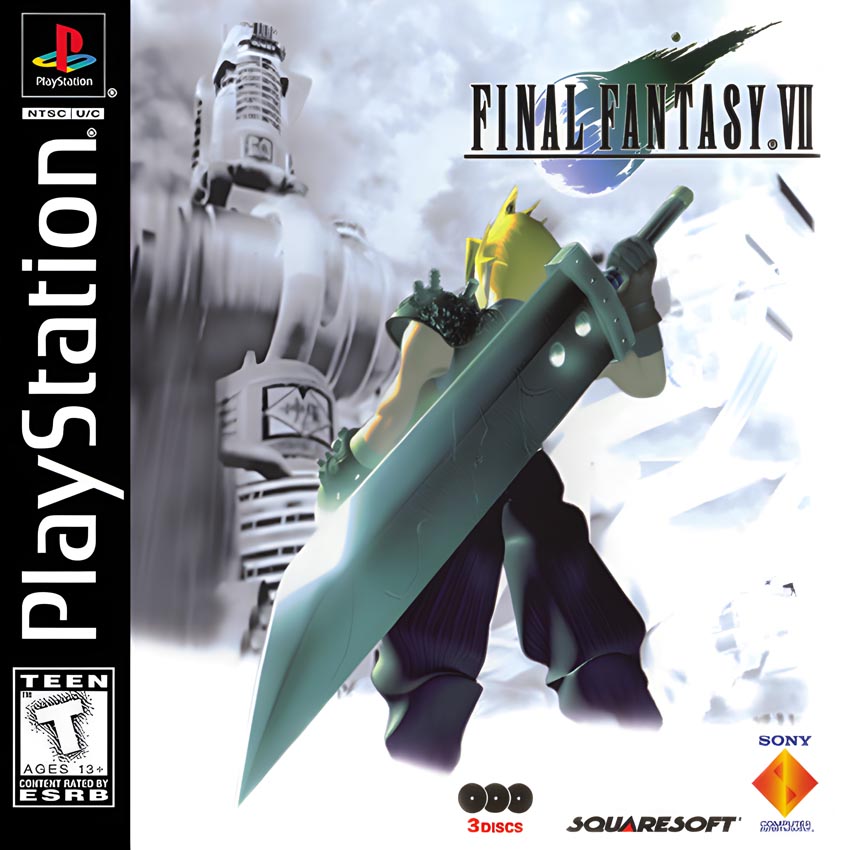
NAME(S): Final Fantasy VII / ファイナルファンタジーVII / Fainaru Fantajī Sebun
PLATFORM(S): PlayStation
DEVELOPER(S): Square
PUBLISHER(S): Square (Japan) / Sony Computer Entertainment (Worldwide)
GENRE(S): Role-Playing Game (RPG)
RELEASED: January 31, 1997 (Japan) / September 7, 1997 (North America) / November 17, 1997 (PAL)
Back in my earlier internet days (the 2000s), Final Fantasy VII (FF7) hype was still gigantic. The powerful initial impression over the ground it broke in gaming had not yet waned or been weakened by its sequels. Years out, the hype persisted as if it were just released. When flash animation was still a thing, Final Fantasy was one of the most popular parodies, and you can bet VII was usually the game of choice.
I didn’t own a PlayStation (PSX) growing up, and I didn’t get a PlayStation 2 until many years later. Eventually, I was walking through my local supermarket—which never sold PSX games—and for some reason, they carried a single copy of Final Fantasy VII. The Greatest Hits version, sure, but still sealed. I practically shit myself. $7 for one of the most acclaimed games ever made, brand new.
I don’t even remember when that was. Point is, I found FF7 easy to get into. Yet, it became one of those games I wouldn’t finish for a long time. In fact, it was the last of the PSX trilogy I had to beat. Unsurprisingly, it’s my least favorite, but I still loved it. It’s one of the few FFs that I would still recommend to anyone. Time for the rundown.
Final Fantasy VII still has some of the best story concepts and themes in a JRPG. Though on its surface, your main mission is to stop the obviously evil Shinra Corporation and Sephiroth from destroying the planet (for different reasons). However, there’s an even greater, far more relevant struggle in FF7. That is, the consistent conflict between spirituality and modernization, and the former’s sacrifice for the latter. It’s a potent issue for any contemporary culture, but even more so coming from Japan, which had a much more gradual shift from spiritual and moral traditions to joining the logical, political race of economic expansion for greater quality of life and profits.
Writer Kazushige Nojima was inspired by his mother’s death, and imagined the Lifestream to comfort himself with the idea that death doesn’t mean someone is gone forever. Naturally, this is a particularly “Japanese” concept, because it’s descended from Taoist philosophy. I don’t feel the desire right now to justify my interpretation of FF7’s themes with examples from throughout the game. It’s a valuable story that examines a fictional society that parallels our own regardless of the many fantastical things in it.
Though Final Fantasy VII‘s narrative—or Nojima—favors the spiritual side in this battle for obvious reasons, the conflict peaks with the escalation of both forces. Sephiroth is a product of science going too far in its manipulation of life, yet his ultimate plan to assimilate everything into the Lifestream is equally as undesirable.
What I like most about FF7 is that even though these themes are apparent, they aren’t battered over your head like an environmentalist’s sermon. It’s all centered around the main goal of stopping Sephiroth, which is interpersonally justified. He’s a murderer, seeks to kill more, and has negatively impacted countless lives in the game’s world. Character motivations are easy to understand, and the thematic conflict provides a fantastic framework for the plot to breathe. It can be appreciated on its own terms based on the player’s interpretation.
With all that said, the script of Final Fantasy VII has some serious issues. The translation is a common point of criticism, and yeah, it’s pretty fucking bad. For the first several hours, it’s tolerable. There are typos galore, but character personalities persist, and the plot isn’t hard to follow. After reaching the Temple of the Ancients, I feel the translation just falls the fuck apart.
I like FF7’s story, and I was paying attention to it. But once the vague metaphysical shit came in, something was lost in translation. For example, there’s a lot of ambiguous dialogue in the Temple of the Ancients that seems meant to be a little confusing and mysterious even in the original Japanese script. However, in translating that, the scant information that you were supposed to pull out from the ambiguity is obfuscated even further. What remains in the English script is a broken, untrustworthy mess.
After this point, there’d be conversations where characters came to conclusions without me understanding their reasoning. Though my initial guesses at the gist of what was going on usually turned out to be correct, the lack of confidence I had in doing this became frustrating. That added mental work took me out of the story and really hindered my enjoyment of it.
Translation aside, Final Fantasy VII also gets some props for balancing party member relevance—at least compared to other games in the franchise. FF9 detractors like to pretend this isn’t a major problem with pretty much all of the games: certain characters are given meager justification to be in your party and barely impact the plot when compared to the central two or three characters.
Party member favor is still uneven in Final Fantasy VII, but the entire cast are given highlights throughout most of the game. On the other hand, Red XIII is mostly ignored after Cosmo Canyon, Yuffie gets her own big sidequest, which is great, but does nothing in the main story, and Vincent is… yeah. Compare this to a character like Cid, who isn’t present for much of the main storyline, but the parts where he matters are sizable and spread evenly from the moment he joins. This includes getting your first boat, finishing his personal mission, and having him temporarily become the party’s leader.
Most of it works well and subverts what I think is normally a disservice in any RPG storyline, which is when only your immediate party members have dialogue in cutscenes. Ideally, dialogue would be evenly split between all party members, because they’re all supposedly present. But since most players stick to a consistent party, only those three out of the nine party members with will receive characterization to become attached to them during the game.
Yuffie and Vincent’s neglect could be justified by them being optional party members—but it shouldn’t, because there’s no good reason for them to be optional in the first place. Party members, especially ones that aren’t even overpowered, have too major of a gameplay role to not be treated as such in the narrative.
I was also surprised at how downright funny the game was. FF7’s reputation of being dark and brooding couldn’t be much further off. The “now” cool, aloof, borderline-silent protagonist Cloud was originally a crossdressing, panty-stealing, mild-mannered, friendly guy. He’s easily pushed around by Aeris, and when the suggestion that there’s a traitor in their group comes up, he’s the first and only one to claim that they “trust everybody.” Though he has problems working with Avalanche during the story’s beginning, he’s changed by the deaths of his comrades just three or so hours in.
I might go as far as to say the game’s bizarre sense of humor complements its sleazy world and modern societies, and is the best, most consistently enjoyable part of the writing. It helps that any butchering by the translation just makes it funnier. Though the plot and characters have their rough spots, there are comparatively few segments of the game without laughs. The segments that don’t have them are clearly deliberate, appropriate areas with emotionally-heavy developments.
Seeing sequels like Advent Children and playing spinoffs like Dirge of Cerberus makes me wonder if anyone on their writing teams actually played the original fucking game. FF7’s legacy is nothing like how it actually is, and considering its popularity, that’s kind of mindboggling. Maybe everyone played it as a kid, never returned to it, and only retained the material that was most shocking to them during that stage of their life.
The Materia system is my outright favorite Final Fantasy battle system, and that’s for a variety of reasons. For starters, it’s the only one I think actually encouraged using it the way it was intended. One can’t as easily ignore large swaths of it like previous games’ job system, and there’s no ways to circumvent certain parts elements like with FF8’s Junction system. It rewards planning, which alone is enough to make it better than most of the franchise. Though there are overpowered Materia combinations, pulling these off either takes a ton of grinding if you’re anywhere before the endgame, or they require an understanding of the battle system’s intentional creative expression.
All colors of Materia are relevant in an optimal setup (well, summon Materia is somewhat lacking), and their variety of attributes, scarcity, and even negative effects on your stats (a balancing element I love that should’ve been even stronger), makes you constantly consider how you’re going to balance your party.
There’s never enough optimal Materia to go around, so almost no specific Materia goes without use in a single playthrough. It’s a wonderful battle system. It even understands the fun of constantly learning new abilities, and it has a collector angle where you’ll want to grab enough Materia for your entire party just for the sake of it.
In a future game, I would have liked to see them go even further with linked combinations. It would be cool to be able to line up vertical links between weapon and armor, putting more pressure on deciding between Materia and equipment stats. The Materia system has more potential than what was realized, as is the case with most FF games, because one of the franchise’s standards is constantly changing its mechanics, for better and worse.
I love Limit Breaks just as much. The fact that you can only use them once and preserving them means you either have to draw out battles by not using your normal attack, or by spending your limited MP keeps them balanced. You’re discouraged from saving them for specific enemies or bosses without no cost to inconvenience. In FF8, you have easy control over your Limit Breaks which unsurprisingly made them ridiculously broken. In FF9, you had almost no control over when your Trance activated, which made them ridiculously useless.
FF7’s Limit Breaks strike the perfect balance, and I especially like how a few of them have utility effects rather than just dealing straight damage. I would’ve liked more Limits like that. I also think the player should be able to access all of their Limit Breaks when they choose to use one, rather than being limited to their selected Level. I feel like it wouldn’t be game-breaking and would open up more strategies. On the other hand, it might ensure you always have a Limit Break relevant to any situation you’re able to use one in. That could remove the decision-making aspect of whether or not to keep your Limit Break in reserve.
Nobuo Uematsu is a consistently high-quality composer, and like all of his works, FF7 contains some of my favorite tracks of the franchise. I don’t like the overall sound of the OST, though. It really shows its age, and can often sound even more synthetic than his SNES works. At times, the “bleating” sound of the keyboards works well, such as in modern environments like Midgar, or the eerie and atmospheric Ancient Ruins. Other times, it has an unsubtle, abrasive tone. “One-Winged Angel” deserves all the hype it gets. “Let the Battles Begin!,” is one of the franchise’s strongest random battle themes. “Cosmo Canyon” rules—you know all of the good ones.
FF7 shows its age even more in its graphics. Though revolutionary when they came out (for a reminder, the first Suikoden came out before FF7), to the point they immediately raised the standards for believable worlds and storytelling in gaming, the visuals have bigger problems than their resolution. The blocky overworld models aren’t just bad—they’re bloody awful.
Why does Cloud have straw-thin arms yet gigantic hands? Even with what limited technology they had, they could have added another “block” in the middle there. The eye and mouth textures are downright disturbing. Playing this game on an emulator gave me nightmares. They lack the realism of the prerendered backgrounds, and further contrast poorly with bright, flat, inappropriate colors. These “LEGO” models are certainly cute in their own way and help the game’s humor stick the landing, but they have the opposite effect during serious plot moments. Unlike some older FFs (or at least their later ports), there are no highly-detailed portraits to complement the simplistic field models.
My actual biggest complaint about FF7 goes beyond that, though: a lot of the locations are just boring to look at and explore. Many of them lack some sort of distinctive flavor or element. A few settings are unforgettable, like Midgar and the Golden Saucer. Many more have a solid presence, like Costa del Sol and Junon’s upper level. Other towns like Kalm, Nibelheim, and Junon’s entrance level look generic and too contemporary; as if you could find lifeless places just like them all over the crappy American Midwest. I play RPGs to go to a different world.
The quaintness of some of FF7’s towns do serve as a thematic reminder of how many Midgar resources is draining from the rest of the world, but there’s a way to demonstrate “quaint” without it being dull. Case in point being just about any town in FF9, which generally have the same level of technology as the most ordinary locations in FF7. Even Dali has a windmill serving as a landmark, and the iconic, artfully-framed shot of the airship at the town’s rear—and Dali is like, three “screens” big.
I wish FF7 had some more sidequests built around the standard gameplay. Minigames are potentially fine, but they should all contribute to helping you in battle somehow. There’s only three optional superbosses, and if I’m counting right, two short bonus dungeons. Almost none of the extra content expands on the world to the extent that FF8’s did. A more limited scope and budget for their first 3D entry, perhaps.
I want to be finished with writing this, so I can go play an actual game. While FF7’s sometimes aimless translation and occasionally unexciting setting design made my eyelids heavy, its relatively great battle system, surprisingly ambitious story themes, and eclectic tone and sense of humor turned out to be enough to cement it as one of my favorites. It’s stood the test of time very well—but for almost none of the reasons some fans and Square Enix themselves think. And thank God for that. Take your literally one-winged Gothic vampire Sephiroth and shove it. Well, he wasn’t that amazing of a villain to begin with, anyway.
Leave a Reply