








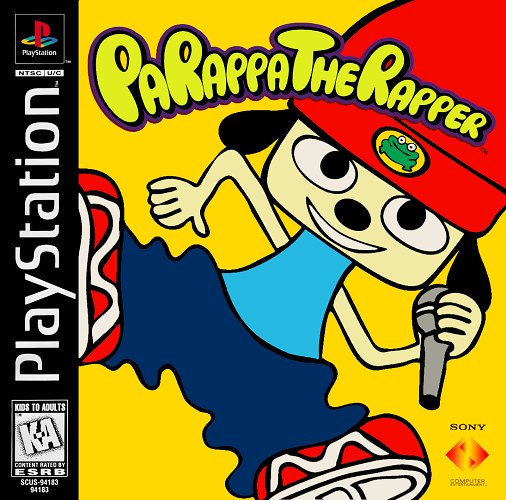
I didn’t own a PlayStation growing up, so the only time I ever got to play one was when I went over to a friend’s or my cousin’s. My cousin had a PlayStation, and I used to love playing the Crash Bandicoot games. One time I went over and asked to play this game, seeing the disc laying around. My cousin said I could and popped it in for me, and I’d never seen anything like it before. I was completely mesmerized.
I’d try and ask for PaRappa every time I went over to her house from when on, but eventually her brothers took the game back and I never got to play it again until years later. On a side note, I remember my cousin once told me that Chop Chop Master Onion was the “bad guy” because he was on the CD because “the bad guy is always on the CD.” Ha.
PaRappa the Rapper is a music rhythm game developed by NanaOn-Sha for the PlayStation in 1996 and was released one year later in the US. NanaOn-Sha to this day has made very few games, many never coming to the US. Fortunately PaRappa did, and the game sold moderately well and proved that music video games could have an audience outside of Japan. In a way, PaRappa changed the face of gaming. Maybe only slightly, but it’s something to think about.
In PaRappa the Rapper, you play as a rapping anthropomorphic dog named PaRappa. He has a crush on his friend Sunny (a literal flower person) and desperately wants to earn her affection. Throughout the course of the game he is rivaled by Joe Chin, a overly-confident and better-looking dog than PaRappa, who competes for her attention.
PaRappa is presented with a bunch of various scenarios where he needs to complete some sort of task, such as learning karate to be “tough,” or earning his driver’s license, all with the end goal of getting Sunny to like him. The story is told through animated cutscenes featuring characters illustrated by the prolific artist, Rodney Greenblat.
The game has a ton of style both due to the colorful cast of cartoon characters but also due to the flat graphics, where every character looks and moves as if they were made of paper, even though they’re in a 3D world. The game has a great sense of humor and the voice-acting is excellently done. They also coined PaRappa’s memorable catch phrase, “I Gotta Believe!,” which no one who has played this game will forget any time soon.
The gameplay is typical for a rhythm game. Each stage consists of a different “teacher” that speaks a line of rap that PaRappa must then follow by hitting the right commands on the screen. There is a line across the top of the screen that has a different button pictured at different places (any button from the 4 shapes to the L1/R1 buttons).
When PaRappa’s turn comes, his head will move from left to right across the line, and as it passes each symbol the player must press the corresponding button. If they did a line correctly, nothing happens. If they did a line wrong, then they get a warning. Failing the line again will cause their rank during the stage to lower from “Good” to “Bad” to “Awful.” Likewise, doing the line right twice in a row will cause the rank to go back up.
To pass the stage, the player must finish with at least a Good rating. If the player fails a line twice with an Awful rank, they will fail the stage automatically. Across the command line, there are also a few stars dotted. If the player guesses the correct command when passing over the star, they can potentially increase their rank up to “Cool,” where the teacher will leave and the player will have to play without the command prompt. This is known as freestyle rapping and gets you a very high score, though it is pretty difficult and its unlikely the player will figure it out without a lot of practice.
Of course, a music game would be nothing without the music. The lyrics of PaRappa the Rapper are all very silly with many memorable lines, and the music is simple but is never without a catchy beat. All great rhythm games should be addicting to play, and with both the catchy music and fun gameplay, PaRappa succeeds. I should also note that many of the songs in the game sample parts of real songs, which is pretty cool. My favorite stage in the game is the third stage, the flea market with the hippie frog.
The game is not without its flaws, though. It takes a good amount of failing on the first stage before you properly understand the timing of the game and are able to get it right. I often found that I would have to press the button a little before PaRappa’s face crossed the icon, which was very confusing. Unlike most rhythm games where following the button prompt is a good way to go, I would actually advise the player follow their natural sense of rhythm first and use the prompts as a guide second.
This sounds vague at first, but once you get it down you’ll notice what I mean. Try timing your button presses only to your memory of the beat first and then use the placement of the button icons to give you better timing, never go off them alone because that doesn’t seem to work. Even with that in mind, I found PaRappa’s hit detection to be often odd. There were times when I’d complete a line and the game would say I did it wrong and I would have no fucking idea how I screwed it up. People say it’s just a thing with older rhythm games, but I’m not sure if that’s true.
Another complaint I have is that you can’t see the command prompts ahead of time. You have to wait for one line to finish before the next pops up, so it is difficult to time when your turn starts and you may miss a prompt. On the upside, it’s sort of a good thing the game can trip you up at times, because repeating the stage trying to beat it adds more length to the game.
Oh yes, the game is that short. Painfully short. Six stages long, with each stage being short to begin with. I beat the whole game in one sitting and never looked back. You can compete for high scores, but freestyling is a bitch to figure out and having to deal with the game’s almost seemingly-random hit detection at times can get frustrating.
Once you beat PaRappa, it’s pretty much done and you might replay it a few years later or something. If you beat every stage with a “Cool” ranking then you unlock a bonus “stage” called KT & The Sunny Funny Band, which is actually just a really stupid video of Sunny and KT dancing on a platform in some club. It’s one of the worst rewards for hard work I’ve ever seen in a game. There’s also a stage select mode where you can pick out and play whatever stage you want, which is nice. Oddly enough, there is no music player mode. Duh…
PaRappa the Rapper is the strictest definition of “short and sweet.” The game can be beaten in an hour but it’s still one of the most originally stylistic games ever made. Nowadays rhythm games in the US are pretty common, but back a game like PaRappa the Rapper was completely original and mind-blowing. In a way, it still is. A game like Rock Band or Guitar Hero definitely can’t match the quirky charm of PaRappa the Rapper, and for that reason I would recommend PaRappa the Rapper to anyone who likes music games.
“I gotta believe!”
Leave a Reply