








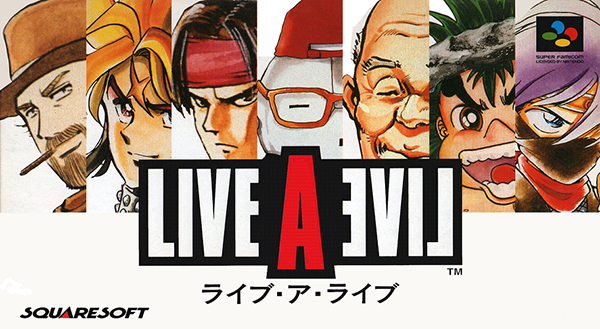
I’m going to start with my conclusion and say that Live-A-Live is my favorite SNES RPG—just ahead of EarthBound. Like that game, my reasons are primarily because of the many ways the game is still very unique today and there’s never been anything really comparable to it. Live-A-Live is a SquareSoft game that was only released in Japan, but thanks to the fan translation group Aeon Genesis, a patch has been made to put the game in complete English. In fact, this patch actually improves the game by changing the text font style based on what character’s story you are playing!
Upon starting Live-A-Live, you are immediately shown a story select screen. There are a total of eight stories. Seven are selectable at the beginning, and there is a hidden chapter that is unlocked after the others are beaten, and then a final chapter after that one that ties all of the stories together. Each story has a different cast of characters, music, slightly different gameplay, and a different story and setting.
Each story takes place in a different part of the world and in a different time era. For example, one is a wild west story while another is a sci-fi adventure story. In order to possibly entice any new people to try out this excellent game, I’m going to go through each story as they are labeled in the game and explain how they are unique from the others. Whenever you access the story select screen, a random story is highlighted, further making the point that there is no “correct” story or main character, and all of them are equal, so the order doesn’t necessarily matter. I’ll be listing the chapters in the order I remember playing them in.
MECHA: Set in a near future version of Tokyo, you play as a hot-headed boy named Akira who has psychic powers. He can read the minds of other people, and so can you by pressing the Y button while next to someone in the field. An evil gang known as the Crusaders has been kidnapping people around the town for reasons unknown. Akira is attacked by them several times while walking around and they are the main antagonists. Sometimes assisting Akira is his friend, the cool-headed biker Matsu, who is an expert fighter and general hero everyone in the town admires and Akira looks up to. Later, Akira gains a new party member in the form of a robot named Taro.
There is also a supporting cast of NPCs, such as the other kids at the orphanage where Akira lives, and the oddball mechanical scientist, Toei. Battles in this story are unique because while most of your enemies are machines, they are controlled by one Crusader enemy on the screen. If the Crusader is defeated before all the robots, then the robots will all be automatically destroyed and the battle won.
But if you fight the robots first, you can obtain items from them after battle that can be used to power up Taro, or can be taken to Toei who can transform them into different items. With all of this in mind, Akira has to explore the town and stop the Crusaders from carrying out their plans, and he may have to enlist the help of an underground giant robot that can only be controlled by a powerful psychic. This story is the most like a traditional RPG when it comes to gameplay, and as such I recommend it to any new player to start with because it is great for learning how to play the game.
WESTERN: You play as Sundown, a sharpshooting outlaw whose mysterious character and design is heavily inspired by Clint Eastwood’s character Blondie in the Fistful of Dollars movie trilogy. Sundown is constantly chased by a bounty hunter known as Mad Dog. When the two come across a town that is being exploited by bandits, the two decide to put aside their differences and come up with a plan to capture the bandits.
There are only three fights in this story. Your main objective is to assign the villagers to set up traps throughout the town for when the bandits come. The better choices you make based on what you know about the villagers, the easier the boss battle will be when the bandits arrive. If you set up no traps, the boss battle will be the bandit leader and a ton of his grunts that completely cover the screen and make winning impossible.
By setting up the right traps, you can lower the amount of grunts you have to fight. This is an extremely short chapter, which is disappointing because the dialogue of this chapter captures the unique western setting perfectly and you’ll definitely wish you could have seen more of it. Short and sweet, but it could have and should have been more. Hardly any sort of blight on the game though, as this chapter is still a good experience.
SCI-FI: This is an adventure/mystery of sorts. There is one fight in the whole chapter, and that is the final boss. There is an optional minigame in the form of an arcade machine where you can fight ten battles in a row and win a power-up item if you complete it. A young boy named Kato is a crew member of the futuristic spaceship, the Cogito Ergosum. He creates a helping spherical robot that he ironically names Cube.
You play as Cube and will have to explore the ship, interacting with the crew members and observing their relationships as well as exploring the spaceship to advance the story. Strange things start to happen aboard the spaceship as several important systems malfunction and put the crew in danger. I don’t want to spoil any of the great twists this story has, but there are many references to other famous sci-fi works, including 2001: A Space Odyssey that I really enjoyed.
In the end, it comes up to Cube to save the crew of the spaceship. I recommend saving often, because there are ways to die in this story by doing the wrong things in the environment (such as choosing to open the air lock, you get sucked out into space and are destroyed). This is one of my favorite chapters in the game, and the mystery of the story will keep the player entertained despite the lack of fighting.
KUNG-FU: You take the role of the master of the Xin Shan Quan style of kung-fu. The master is growing old, and realizes he needs to choose an apprentice to pass on his art. He meets three youths while out on the town and offers to train all of them. The player then has to fight battles and do other obstacles to raise the stats of the pupils.
I’ll say now though that only one of the pupils will fight the final boss (the one you train the most), so I advise just training one pupil you like the most and ignoring the others. When a rival dojo attacks because of the master insulting their brutish behavior, the master and his pupils must rise up and stop them for good. This is a solid chapter, and the only thing I would really change about it is making the training part of the story longer to give the story more impact.
NINJA: In feudal Japan, a ninja assassin (you) is called on to rescue a politically influential prisoner being held by a man known as Ode Iou who is throwing Japan into chaos. You must infiltrate Iou’s castle by yourself and use stealth to rescue the prisoner and assassinate Iou. At your disposal is the ability to use a grappling hook to walk across high areas and a special cloak that can turn you invisible (though you can’t move in this state).
Because you are by yourself and have a limited amount of equipment, you are encouraged to avoid enemies as they generally overpower you. You can choose to fight if you want, but you must pick your battles carefully as all your items and equipment must be acquired on-site. This adds a really cool survival mechanic to this chapter that makes it one of my favorites. The castle is very large and there are many secret events and items you can uncover that aren’t even necessary to reach the end (there’s even a totally optional party member!).
If you try really hard, it is possible to beat this chapter without a single kill. Or if you want, you can just kill everyone. Either way, the game keeps count of your kills and will tell you at the end of the chapter (it does not impact the ending, but a low amount of kills gets you a very strong sword, if I recall.)
WRESTLER: In the present day you play as a professional fighter who joins a world martial arts tournament held at several locations throughout the world. This chapter is all fighting. There is an opponent select screen and music both akin to Street Fighter, and when you lose there is a countdown to retry the battle like in other fighting games, which is really cool.
Each fight is you 1v1 against a boss character. The gimmick of this chapter is that if a boss uses a particular move of theirs on you, you can learn the move yourself and use it. I recommend learning all the moves, but it can sometimes be a huge pain in the ass if the enemy never decides to use it and just wails on you instead.
After defeating all of the opponents, there is a title match you have to win to clear the chapter. There is no exploration at all in this chapter and you cannot access the menu. I find this chapter to be the worst out of them all. It is not that the chapter is bad, it is just very short and has the least amount to offer compared to the others.
PREHISTORIC: You play as a caveman boy known as Pogo. When a tribe of cavemen prepare to sacrifice a beautiful girl named Bel to a large dinosaur they revere as a God, the young girl escapes and hides in the cave of a rival tribe where Pogo discovers her and attempts to keep her hidden from the pursuing tribe with the help of his gorilla friend, Gori.
Several times throughout the story Pogo is taunted and Bel kidnapped by a warrior of the enemy tribe known as Zaki. This is a very silly and humorous chapter, if it’s not obvious enough already. There is no dialogue in this chapter because the cavemen cannot speak. They communicate through gestures and occasional thought bubbles that show pictures. You must use these clues to solve problems and progress in the game.
Otherwise, this much like a traditional RPG. There’s a small world map to explore with many fights, which is good. You can also use items won from battles and found in the world and combine them with the help of another caveman into new items. This was a pretty good chapter, but I also found it the most frustrating because there were many parts where I got stuck and had no idea what to do.
MEDIEVAL: You play as a knight named Oersted who is a beloved hero of the people and must rescue your fiancee, the beautiful princess Alicia from the clutches of the Demon King. He is joined by his best friend, the wizard Straybow, and two heroes who fought the Demon King in the past, the priest, Uranus, and the knight, Hash.
This is obviously the most like a traditional RPG in setting (though I don’t think there are shops) and I found it a drag at first to play because I felt it took away the unique settings of the other chapters that made them so interesting and fresh to play compared to other SNES RPGs. By the end though, I had changed my mind due to the excellent storyline and I now consider this one of the best chapters. This chapter is only available after clearing the other chapters and serves as a prelude to the final chapter.
FINAL CHAPTER: This explains how all the chapters actually tie together. I won’t say anything more, because revealing any more of the premise spoils the chapter. But beat this final chapter and you beat the game.
There are a few other running gags in the chapters. There’s always a character named Watanabe who has horrible luck and is treated badly by the other characters, and his dad always dies sometime during the course of the story or is already dead (this is never really plot relevant and just a joke, so I don’t consider it a spoiler).
The game also has a fantastic sense of Earthbound-esque humor. That’s not to say the plots can’t be taken seriously. In fact, some (most, even) of them have the darkest twists I’ve ever seen in a JRPG. I was very impressed by how entertained and engrossed I was by each chapter’s story, considering how short they were.
When you get into a battle, the gameplay is a small mix between a turn-based RPG and a strategy RPG. Strategy in the sense that when a character’s turn arrives (based on their agility stat) you can move them around the battlefield like a grid. Each character and enemy is sized differently, and a character cannot move into a space they cannot fit. Each character has their own unique set of attacks that have different effects and range and target different squares of the battlefield depending on where the character is positioned.
There are a variety of status effects as usual, and there are even moves that can change the battlefield grid. For example, if a character uses a lava attack or something of the sort, the spaces affected by that attack can turn to lava and hurt the characters that walk on them for a few turns. The same goes for poison attacks, except then you are inflicted with the ailment.
There are status effects that decrease enemy level and increase player level when they work, and they are by far the cheapest moves and completely break the game. I’m not sure how much the moves increase/decrease the levels, but it must be a lot because it’s enough to make a character completely helpless and you deal a ton of damage. Needless to say, the same goes for the enemy, but they can use this moves far less often than you can.
You can also use a “Pass” option in battle which skips your turn and makes another party member’s turn come faster. I don’t like this option, as it is too easily abusable and the player will opt to simply spamming their best character’s strongest attack repeatedly while ignoring the others. You can also access a menu in most chapters where you can use items, equip items, and so on.
Overall, I liked the battle system. Each character having unique skills forced you to think and use what you had at your disposal and form the best strategy you possibly could with limited, but diverse, options. Moving around the battlefield was also really cool and added more to the strategy of the game, as once you learned what squares your enemy’s attacks targeted, you have to pay attention and keep your characters out of those squares and move them around constantly.
Live-A-Live‘s battle system is both very original and effective, which is a rare thing to see in JRPGs from any era. The most annoying thing I have to say about the battle system is that like a lot of older JRPGs, it is very slow-paced, which is a pain.
The graphics are colorful and the sprites well-detailed, and the attention paid to shading and such depending on the era of the chapter and general tone of the story is very impressive. The soundtrack was composed by Yoko Shimomura, an experienced musician who has several other great game soundtracks under her belt.
Live-A-Live‘s is no exception and has an amazing soundtrack full of moving songs that are only made more impressive by the fact that Shimomura had to explore several different styles of music to convey the time period the chapters were set in. The amount of work she put into the soundtrack must have been staggering, but her work paid off as the music of Live-A-Live is consistently excellent, and as much as I hate to say it, there is no other word that can describe the boss battle theme other than “epic.”
There are constant twists and turns in Live-A-Live, and the strength of its narrative and presentation make it a more enthralling game than just about any JRPG I’ve played before or after its time. Live-A-Live is not only within my top JRPGs, but it is one of my favorite games ever made and remains one of the most original.
Leave a Reply