





Mega Man is a contender for my favorite game franchise. I can’t think of another series that has put out so many games with such consistent quality. Most of the time I rag on a series for not changing up the formula very often, but in the Mega Man series this is more often a strength. How can you get tired of traversing a bunch of different obstacles and puzzles, collecting upgrades, and mashing buttons to blow shit up? I don’t think you can.
Honestly, Mega Man isn’t really a series in need of much improvement. Expansion, sure, but the core concept and game engine is very smooth and addicting. Before I begin going through the Mega Man X games I’ve played, I just want to say that people should expect these to be shorter write-ups than most, because there’s just not a lot of differences to comment on between the games. I’ll go over the core gameplay of the series in this write-up and re-direct all the others to that.
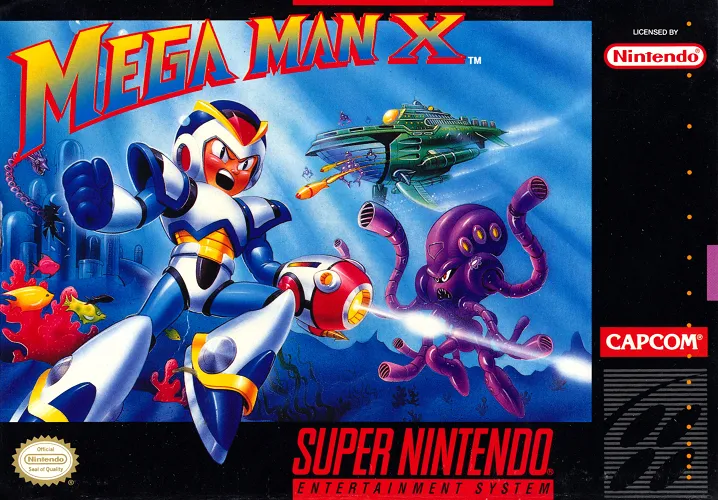
Capcom is a company that never messes with a good thing, for better and worse. The NES Mega Man games gained popularity, and Capcom didn’t want to take any risks at all with updating the series for the SNES. Even though the series had lost a lot of steam by the 6th and final game for the NES and the SNES had already been released, it took a while for Capcom to realize Mega Man needed a facelift. Capcom released Mega Man X, the first in a spin-off series of Mega Man games that offered higher-paced, more intense action that seemed like a natural progression for the franchise.
Thankfully, at this point in time Capcom did not can the original Mega Man series and also eventually brought it to newer consoles, allowing more than one Mega Man series to be updated simultaneously. Sadly, this really doesn’t happen anymore, with Capcom focusing on one Mega Man spin-off at a time and only releasing updates to the other series once in a blue moon.
But I digress. I think I prefer the X series to the original. It’s a close call, but I see no reason not to like the X games more. The faster action is invigorating and you have more control over your character, making player skill all the more necessary to dodge the attacks of the much more difficult enemies and the gameplay feels more rewarding as a result when you finally win. The music is more uptempo to fit the speed of the game, and the addition of upgrades and power-ups add just a slight amount of replayability and exploration that the Mega Man franchise can always benefit from. =
There is one aspect I think the original series has over X, and I think that it has more interesting stage design, with more gimmicks and puzzles that make you play differently than normal rather than X’s obstacles which basically just test your dashing and wall-jumping skills. The original series had pace-changing gimmicks like the reverse-gravity stage and littler things like having to hop from bubble to bubble while floating up through Bubble Man’s and Tengu Man’s stages. They weren’t revolutionary, but they made the stages a bit more memorable.
The center of Mega Man X is identical to the original series. You play as a new, tougher model of X in a dystopian future and have to destroy Mavericks, which are Reploids (normal robots) gone bad. The stage select is still there, and each of the eight stages has a Maverick boss at the end that you must destroy, upon which you will gain one of their attack powers. On defeating them all, you fight Sigma, who is the main antagonist, or “Dr. Wily” so to speak, of the X series.
In each of the stages there are many different power-ups hidden that vary based on the game. Mainstays include Heart Tanks, which increase your maximum life bar, sub-tanks, which can restore your special weapon energy or life, and my personal favorite, the various pieces of armor upgrade for X that change his appearance in addition to granting him very useful abilities.
When you finish collecting all the armor, Mega Man looks completely different and really cool, and I never get tired of that. Most Heart Tanks etc. are hidden out of sight and require you to go through tough obstacles or find hidden passageways to retrieve them. On top of all of this, there is a super secret power-up you can get at the end of the game that lets X use the Hadoken from the Street Fighter series. It can only be used on the ground, but anything hit by it will instantly die—including bosses!
The music for the X series is well-known for being aggressive and catchy. The music from the first game is definitely the favorite of the series. While I of course think it is excellent, I find myself listening to music from X4-6 the most. Sorry, guys! But it’s still great and as I said before, matches the fast-paced action perfectly.
Other series innovations include the introduction of an opening stage, a short stage that preludes the standard stage select screen and sets up the game. There’s no power-ups in these stages and you usually can’t revisit an opening stage, but they do a great job of hyping the game and getting you right into the action, because most opening stages put you right in the middle of a conflict that’s already going on. It’s a subtle addition and may in retrospect seem to just be inferior to the real stages , but the immediate tensity of the stages makes them very effective in getting you ready for the rest of the game, and are easy enough for any player to complete and still feel excited about.
The plot of the X series is also much more involved than the classic series, and while it’s definitely not Shakespeare (I have never seen a Capcom game with a good storyline, I think) they do a good job of setting up a narrative, and the characters don’t blather on enough to make the plot detrimental and distracting from the action. X and his even more talented (as far as the plot is concerned) superior Maverick Hunter, Zero, are token level-headed tough guys, and you can’t help but like them and feel the same way playing as them. I don’t think that would be the case without at least a little bit of that narrative.
The biggest addition to the gameplay is the dash function, which replaces the slide function from the original series and is a total game-changer. In the first game, you need the boots armor upgrade to use the dash, which is a stupid idea as it is integral to dodging and fighting bosses among other things, but in the other games its handed to you from the start. Pressing the dash button does just that. Mega Man does a short, fast dash to the left or right, and this plays the largest part in the thumb-wearing action of the X series. X and Zero will use the dash constantly to avoid attacks, surprise enemies, do longer jumps, all sorts of shit. It’s a very understated mechanic of the X series and this one “little” mechanic really is what makes the series so great.
X and Zero also cling and hang off walls when pressed against them, and if the jump button is pressed, they can jump off the wall. If you press dash as soon as you jump, you can jump even further, and even climb up walls or clear large gaps. If you have a quick reaction time, this can save you from pitfalls and is integral to fighting bosses and dodging their attacks. This is another aspect of why the X series is so satisfying to play, wall-jumping and the dash mechanic are both used constantly in the X series and really reward you for quick reflexes and keep you on edge, always looking for a way to dodge and counter-attack and constantly doing so.
I think that about covers the X series in a nutshell. The first X game contains a great set of stages and is very consistent, albeit very short like all Mega Man games. There are a few Mavericks that are associated with certain elements, and if you defeat them before going to another Maverick’s stage, then the stage might physically change and become easier. For example, if you defeat Chill Penguin before going to Flame Mammoth’s stage, then the lava in his stage will be frozen over, giving you an easier time in the stage. This is an interesting little feature that doesn’t really add much to the game or change much, especially considering the fact that only a handful of stages are affected by it, but it’s kind of cool and was never used in another Mega Man X game (for little consequence).
Many fans of the original series complained that the X series was too difficult and not meant for casual players. While the X series is generally undeniably more challenging than the original, I do not think the difficulty is insurmountable for the majority of players, when considering that the players the X series appeals to are action game fans. If you have trouble, I suggest using a guide to go through the stages and pick up all the power-ups beforehand to give yourself an advantage. Also, you should never, ever stop dashing because X is capable of changing directions when dashing. This means when you are going through a stage constantly dashing and run into a surprise enemy or obstacle, you can change direction and quickly fall back and take care of whatever was ahead of you.
This is in addition to the common sense of using your dash to normally dodge attacks and quickly get to walls when in Maverick fights to dodge attacks and jump across most of the screen. It’s also a common oversight of new Mega Man players to overlook the charged buster blast. It might look that in the same amount of time it takes to charge and aim your blast that regular shots will do as much, if not more, damage than the charge, but when you take into account that you are able to hold a charge shot, you can focus on dodging while still being able to regularly deal good damage on the rare occasion you get a perfectly safe opening.
If you use the normal buster you will either have to play too offensively and recklessly to deal the same amount of damage, or the battle will drag on too long and the hits on you will inevitably pile up and kill you. With these tips and the use of sub-tanks, no one should have too much trouble with the game, at least until the final boss fights against Sigma, who is admittedly a very challenging boss in all of the games.
Capcom eventually remade Mega Man X for the PSP and retitled it Mega Man Maverick Hunter X, which is closer to the original Japanese series name. This version contained more plot cutscenes (with surprisingly decent voice acting but who cares about the storyline that much?), updated graphics, and remixed music. While this is a good port that does an honest job at trying to update the game and remains very fun to play in addition to making it a respectable introduction to the series for younger players, I prefer the original game still because I feel that it is less superfluous.
Among new difficulty modes and the ability to rewatch the new, sparse anime cutscenes, there is also a bonus mode available where you can play as the early recurring protagonist, Vile (the purple Boba Fett knockoff). I like this idea a lot, because Vile is a well-designed character in appearance should have been used more in the series instead of being all but forgotten later on. I can’t comment on Vile’s playing style because I haven’t tried it out, but he has his own set of sub-weapons to X at the very least. Though I think I would have preferred being able to play as Zero. I mean he is in the game, it only makes sense you should be able to use him instead of just watching him outshine X in the storyline. Anyway, Vile mode surely adds more replay value to the game that it so desperately needs.
The first X game is still probably the most popular of the series. While I do think it is one of the many peaks in the series due to its great consistency, it is not my most favorite X game (we’ll get to that). I do think it is the second-best X game on the SNES, and is just a step or two below X2 which adds just a few more flourishes to the winning game design, and a good bit above X3.
There are a good number of people who think only the SNES X games are worth playing, and even some who think X is the only good game in the series (both statements are ridiculous, but the latter is just absurd). Throughout the series, the X games would continue to evolve slightly, sometimes for better, and sometimes for worse. I’ll be outlining those changes in my upcoming write-ups and will do my best to explain why I think they benefited the series or hindered them in addition to general opinion on the games.
From a Grouvee comment I made on someone’s status:
It’s always cool to see people playing these games for the first time in the modern year. Your frustrations are definitely understandable. I circumvented this by playing the games when I was younger and still happy to use a guide, but I recognize the fundamental issue.
X1 is infamous in this regard because of Chill Penguin. Not only is he typically recommended to fight first because he’s relatively easy, but his stage also has the Dash Boots. There’s never any reason to not go for him first, unless you’re specifically challenging yourself. The fact the dash isn’t a basic mechanic also throws into question the whole game’s design, which is to what extent obstacles and enemies are meant to be experienced with such a major mobility upgrade.
On the other hand, the sheer simplicity of them not being necessary does give X1 a sort of parkour flow to it when you’re used to it. Since things have to be made to be completable without the dash, when you do have it and are used to using it, you can skillfully leave stages in the dust. That can be pretty fun.
All the same, I think it’s broadly a top tier platformer for the time. The responsive physics alone are enough, and it’s great the game is willing to ask a lot from them. It shows a surprising amount of confidence from the developers, but it’s not unearned. The game feels very intuitive. I do think they could’ve allowed for infinite continues from checkpoints, but we know how older games are.
As you said, it certainly helps the stages are just short in general. And I want to give them some props for the hidden collectibles making traversing through stages again potentially more rewarding than being a mere punishment. Ditto for hopping around trying to find a first boss to defeat. I think if they had more permanent fixtures to differentiate repeat attempts like split paths it could have gone a long way to cutting down on tedium. Granted, that’s a lot more development time, so no shade there.
Anyway, a lot of people prefer X2. Like a lot of sequels, it often does feel like they hit their stride. I flip back and forth on my preference all the time. The only thing I’m kind of settled on now is I think X1 has the superior soundtrack.
Curious to see how you react to the rest! Especially as they become increasingly divisive. I have an old review of X2 on my site if you’re ever curious, but given that it’s nearly 10 years old, my opinions are liable to have changed.
Leave a Reply