








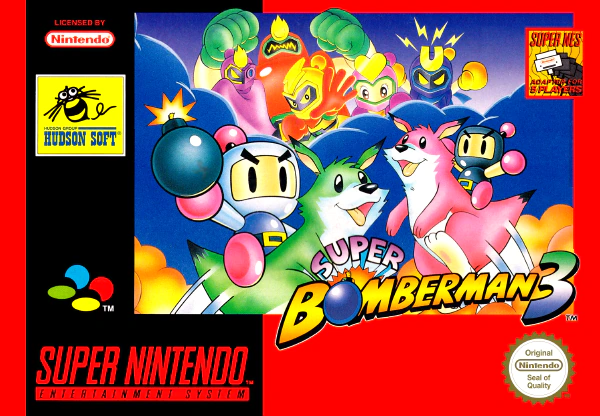
I recently played through Super Bomberman 3 (SB3) with a friend, the first time for both of us. This was through using Game Share with the Nintendo Switch 2 version of the Super Bomberman Collection. It’s part of a larger project to play through the entire collection. We beat Super Bomberman (SB), but I have too many things to say about it to make a timely, exhaustive review, and Super Bomberman 2 had to be skipped over due to its lack of a co-op campaign.
Mistakes were made. Super Bomberman 3 kind of sucks, in my opinion. It may even be the worst Bomberman game I’ve yet played. I don’t doubt there’s some worse, esoteric title somewhere, but this earns the dishonor among more notable entries.
While writing this mini-review (and ensuring it stays “mini”), I had to fight the urge to dip into an indirect review of Super Bomberman, because it stands as a contrary example to everything I find dissatisfying about Super Bomberman 3.
Forming an immediately negative first impression is SB3‘s visual style, which completes the transition from Super Bomberman‘s rendered graphics, to Super Bomberman 2‘s hybrid of renders and traditional sprites, to an entirely sprite-based style. I’m not sure what prompted this change, but I do think SB3 failed to justify it. On the other hand, the greatest failings of its new art direction aren’t because of its style.
In immediate, practical terms, the on-screen action of Super Bomberman 3 scans much less clearly to the eye than in Super Bomberman. Stages and worlds have an awful habit of using limited color palettes, which can make it difficult to discern what’s going on, especially when it comes to peripheral vision. The first stage of SB3 is styled after a river, and the blue water tiles can passively blend in with the stage’s soft blocks, which are green bushes (or trees?). This compounds with bomb sprites, which are shaded a light black that crosses over into a bluish-grey.
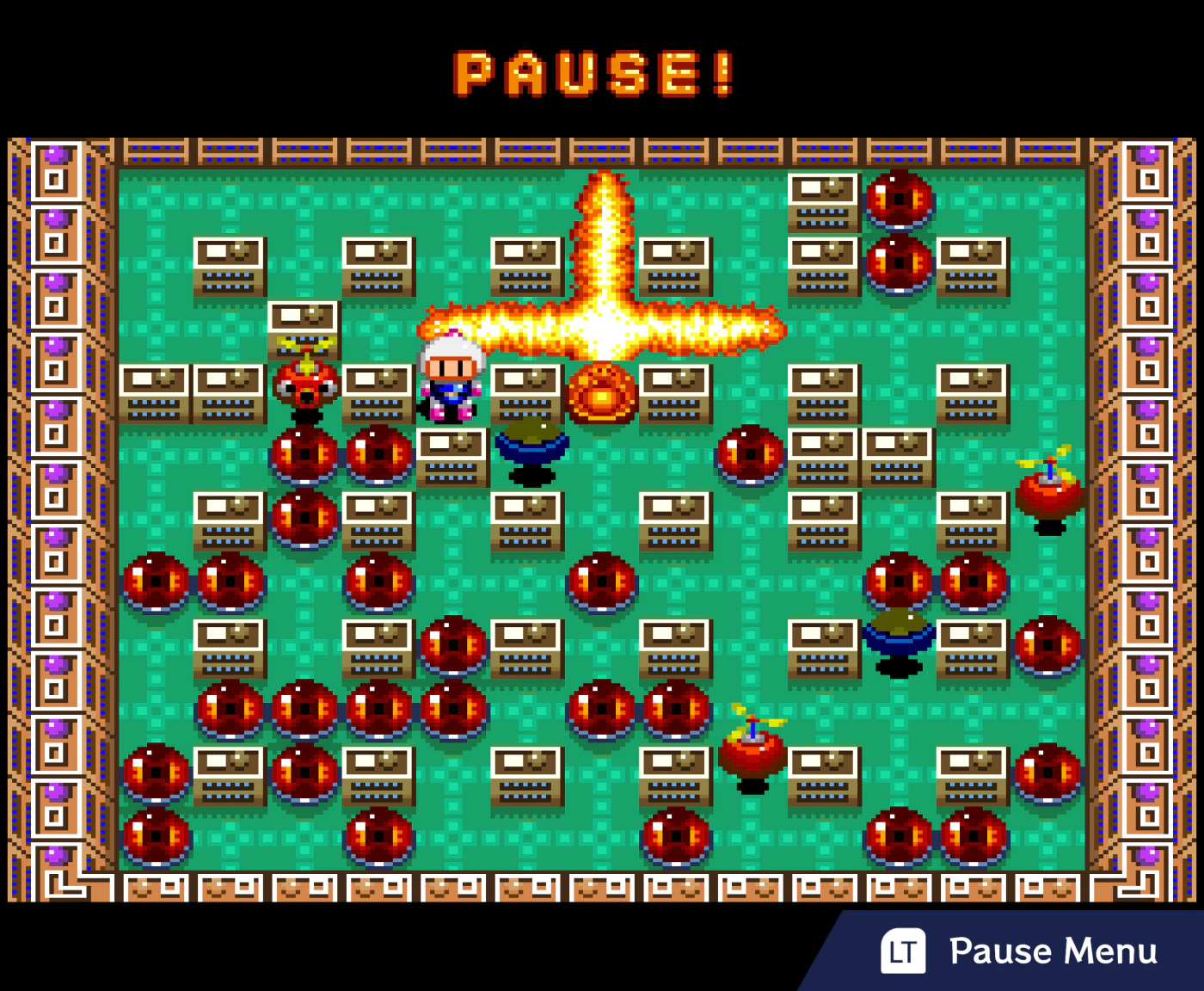
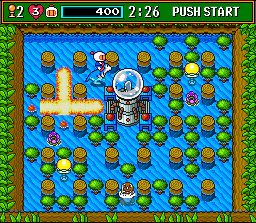
While some might not find this to be as disorienting as I did, I think it’s still difficult to argue that Super Bomberman‘s approach is holistically better. Using its first stage, the relationship between all objects on screen is instantly recognizable. The green floor tiles have no overlap with other visual information. Soft blocks are red while hard blocks are grey. Not only that, but soft blocks are spherical while hard blocks are square. Not only that, but soft blocks have a looping animation of light glaring across their surface, hinting at their less permanent nature compared to hard blocks and highlighting them as objects to be cleared. Because of this animation, there’s also no conflict with the red-colored enemies. While not all soft blocks in Super Bomberman are animated, the majority of them are, giving me reason to think visual clarity was a consideration when designing the game’s stages.
To speak more abstractly now, I think Super Bomberman 3 is somewhat ugly by comparison. Super Bomberman oozes with a unique character and style that stands alone even when compared to games utilizing similar graphical techniques. Donkey Kong Country has fur textures on its renders, for instance, and more naturalistic shading. In Super Bomberman, lighting appears to come from a fixed position and is generally reflecting off of smooth surfaces, giving the game’s objects a plasticine, toy-esque appearance that complements the condensed, diorama-style levels. That playfulness is expanded upon by a level of abstraction visible in its strange enemy designs and difficult-to-place locales.
Super Bomberman 3 features much more traditional biomes and enemies, and while consistency is often a thing to be valued, in this case it helps cement the overall blandness of SB3‘s art direction. I feel like these sprites with their low level of detail and basic theming could have originated from any number of 16-bit games. It doesn’t inspire my imagination or pique curiosity about the game’s broader context.
As the game goes on, the designers become more ambitious with stage hazards. This isn’t necessarily a bad thing, but the increased challenge becomes more frustrating than fun because of how they’re implemented. One of the final stage hazards has two hard blocks, which are actually antennae, occasionally have electricity pass between them. This electric shock hurts you, but the graphic for it is so thin that it’s often made practically invisible by the game’s chaotic action. Making matters worse is how the towers themselves predominately share a grey color palette with the rest of the area, so neither me nor my friend realized at first that they were unique from other indestructible environments.
SB3 can be a very frustrating game. At times, it appears there’s no logic to where enemies can spawn or how they can behave when a level is started. If a player is unlucky, multiple enemies can immediately hound their spawn position and box them in. After not observing a problem to this extent with other Bomberman games, I can only assume it’s standard to not allow a stage’s randomization to place enemies to close to the player(s), and they might have AI set to not pursue them until a certain number of frames have passed. If that’s the case, SB3 shows why it’s necessary.
And the only reason this handicap is as notable as it is is because Super Bomberman 3‘s enemies gain increasingly obnoxious gimmicks. They’ll split apart, jump over blocks and bombs, take multiple hits, shoot projectiles, and spawn new blocks—sometimes a combination of these things. While I appreciate the creativity and level of challenge, having so many variables in how enemies can interact with a stage increases the likelihood that they coalesce into game states that feel arbitrarily difficult simply due to “bad RNG.”
These situations can feel unreasonable to have to account for. Imagine already having to watch your spacing to avoid contact damage or death by your own bombs, only for an enemy to split into four more enemies while another shoots a projectile at you from behind, but moving left or right will cause you to collide with an enemy that’s just jumped over a wall. It’s an absolute mess.
Super Bomberman 3 introduces a new level structure that’s theoretically interesting. Worlds are comprised of stages with each stage completion functioning as a checkpoint, but a level of endurance is still required as stages begin to have multiple screens. It essentially adds another layer to standard Bomberman progression; worlds and sub-worlds, if you will, with a stage’s multiple sections functioning as a set of levels much in the same way worlds worked in prior games. In those, if you died before clearing a world, you might have to replay half or all of the world’s levels. SB3 works similarly if you fail on any of a stage’s screens; it’s back to the beginning of the stage.
I have no real opinion on whether this system is an improvement or not. If it’s ever an annoyance, it’s because of how punishing later stages can be, but that’s related to the larger issue of oppressive level and enemy design. What I do directly disapprove of, though, is how stages are cleared. Rather than destroying all enemies, players need to seek out and destroy special towers that unlock a screen’s exit. I don’t really see the point of this. Making a path to the towers usually entails destroying most or all enemies regardless.
Near the end of the game, my friend and I took advantage of this to avoid freeing enemies that spawned in closed-off areas so as to not risk losing lives in our current stage gauntlet. That may seem like it’s adding a level of strategy, and to an extent it is, but it’s strategy that encourages disengaging with certain elements of the game, and it’s again heavily dependent on getting good RNG with spawns. It results in feeling like more of an exploit than anything else. Just require players to destroy all enemies. That worked perfectly fine. This innovation is a lateral move at best.
Super Bomberman 3 adds Louie, a green kangaroo thing that’s been Bomberman‘s on-and-off lover for decades. I have nothing against the Louie mechanic. It seems blatantly inspired by Super Mario World‘s Yoshi, as it’s almost one-to-one on features. Riding Louie allows a player to take an extra hit (though, no opportunity to recapture that Louie), and bestows an ability while ridden that corresponds to that Louie’s color.
What I find frustrating is that there’s, again, no visual context for what a Louie does. I know one of their colors can punch bombs, but I never remember which. Instead of just a palette swap, it might’ve been nice to depict that Louie as wearing boxing gloves or something. It’d only take up a few pixels of the existing sprite, wouldn’t it? Finding out what Louie does in context is also unintuitive, if not a safety hazard. Super Mario World basically only uses two buttons the entire game, so it’s inevitable that every player will discover any interaction that a Yoshi color changes. SB3 sometimes requires you to press a button that normally has no function, and/or to do so in a dangerous place. You sure the Y button punches bombs? If you’re wrong, you may just kiss your ass goodbye when it explodes.
As said, I ain’t got nothin’ against Louie on a fundamental level. I don’t think his existence necessarily makes the game better, but he certainly doesn’t make it worse. He’s just a more vibrant contextualization of existing Bomberman powerups. He’s also more rare than those, so the excitement of getting what’s essentially a Heart powerup plus something else at once is well-deserved. Louie may be dopamine-spiked version of previous Bomberman gameplay, but there’s inherently nothing wrong with appealing to our baser, childlike instincts. If it feels better to get a Louie than to pick up a powerup, isn’t that enough justification for its inclusion?
Alas, life with Louie is still not an easy one. When we reached the final world, my friend started to abuse the Collection‘s rewind feature to get through the game. It was solely his idea, which morally exonerates me. But I’d be lying if I said I took offense to it. By that point SB3 stopped being a fun game, and at times, even felt downright unfair. We never discovered if the final boss was a checkpoint, but seeing how hard he was, I don’t think facing him without powerups would be preferable to starting the entire stage gauntlet over again. Just the idea of either makes me shudder.
I haven’t commented on any bosses yet, but I don’t think there’s much to say. Bomberman bosses have pretty much always felt perfunctory, and SB3 is more of the same. If they’re any worse than usual, I think that’s mainly down to my previous complaints of difficult-to-see projectiles and stage clutter. The final boss is the only one to reach egregious levels of difficulty, with stage-covering attacks and extremely small windows of vulnerability. At least the second part of the fight was a pretty cool setup.
Super Bomberman 3 feels like a cheap game—both literally and figuratively. I’ve mentioned design I perceive as unfair and alluded to poor production values, but I still need to expound on the latter. The game just feels worse to play than its predecessors. It’s not an online input lag thing, because we tried the previous games during the same play session. Super Bomberman feels more intuitive with which frames it allows you to make a directional input, and SB3 comes across as sluggish in comparison.
But god damn it all, it even sounds bad. The music on both a compositional and stylistic level is such a major downgrade from Super Bomberman, and it’s made extremely obvious by the frequent reuse of its melodies.
I’ll let this aural assassination speak for itself:
Who brought out the Fisher-Price keyboard? Why has all acoustic space vanished? Why is the driving melody so buried in the mix? Every instrument sounds so much more synthetic too. Listen to that ass-tuba.
How did Super Bomberman 3 happen? Why did Super Bomberman 3 happen?
While we were playing, I remarked that SB3‘s production values felt on par with a Satellaview game, the Super Nintendo’s Japanese-exclusive broadband internet service and storefront. Later, I looked up if SB3 was indeed on Satellaview. Yep, I’m a genius with an IQ of 6000. Super Bomberman 3 is a Satellaview game.
…Kind of? Not the IQ thing; it’s just hard to find any information on SB3‘s relationship with the Satellaview (probably because no one cares). Some sources include SB3 in their list of games offered by the service while others don’t. Despite that, there doesn’t seem to be any real dispute over whether SB3 was on Satellaview. I think some sources are just less comprehensive.
What I really wanted to know is if SB3 was made for the Satellaview, and I didn’t see any mention of that. In my mind, that could explain a lot regarding its production values. It might have been graphically and aurally downgraded to be a smaller file size for digital transfer. But all of this is thrown out the window because of two things: one, the previous two Bomberman games were also on Satellaview in some capacity, and secondly, Super Bomberman 3 has the largest file size of the three by a wide margin. It’s nearly double that of SB2.
…So, I guess Super Bomberman 3 is just lame. Goodnight, everybody!
All right, this autopsy isn’t over yet. If you were wondering if Super Bomberman 3 saw a switch in developers, congratulations—you’re correct! But probably not in the way you expected. As it turns out, developer Produce! (The 7th Saga, Brain Lord) created the first two games while Hudson Soft handled publishing, which you might not expect given Bomberman is one of Hudson’s flagship creations. But it’s true. I suppose Produce! deserve high marks for beating Hudson at their own game, at least for the time. That distinction may be responsible for why they were hired to develop four total Bomberman games for 16-bit hardware.
Hudson Soft took the reins for Super Bomberman 3 and seemingly didn’t have the same beneficial creative instincts that Produce! had when creating Super Bomberman and Super Bomberman 2. It’s a simple-enough narrative only made dubious by being an outlier example of an outsourced developer surpassing the original creators. Of course, this is just my paradigm. Some people may claim Super Bomberman 3 to be the best entry thus far, though I suspect I’ll never see eye-to-eye with them.
Topping off SB3‘s mildly weird release context is the fact its only English release was within PAL territories, and it would end up being the final 16-bit Super Bomberman game to leave Japan, period. I don’t know why Europe got a time extension with Bomberman, but that’s not the weirdest part: the European release was published by Sony. Super Bomberman 3 came out in 1995, which was just after Nintendo began licensing their games for the Philips CD-i and therefore should be after the start of their bad blood with Sony. Don’t ask me how that all shakes out. I just don’t have the time right now, man.
There’s a surprising number of Bomberman games that came to the United Kingdom despite never reaching America, though I actually think that’s easier to form an hypothesis on. Hudson Soft had a close relationship with several Japanese computers during the early ’80s—it’s where they started as a developer and first debuted Bomberman (long before its more popular NES port). Many of those PC brands found success in European markets, which wasn’t the case for the United States. Maybe Hudson Soft perceived the Bomberman name to have more awareness in Europe due to their longer history, thus making a European release of SB3 less of a financial risk. Or perhaps Hudson Soft had more favorable distribution channels in the UK resulting from their PC-focused days, making production costs more tenable relative to SB3‘s expected sales returns. I don’t know the specifics, but I’m satisfied with this general theory.
Do I recommend playing Super Bomberman 3? No. If you’re thinking of playing it, just play Super Bomberman instead. If you want a change of scenery, play Super Bomberman with your monitor turned upside-down. It’d probably still be a better experience.
Leave a Reply