








NAME(S): Yu-Gi-Oh! Early Days Collection / 遊☆戯☆王 アーリーデイズコレクション / Yū Gi Ō Ārī Deizu Korekushon
PLATFORM(S): Nintendo Switch / PC
DEVELOPER(S): Digital Eclipse
PUBLISHER(S): Konami
GENRE(S): Card Game / Turn-Based Strategy / Board Game / RPG
RELEASED: February 27, 2025 (Worldwide)
Background
My Personal History
At long last, the past is finally here! It’s been just over a year since the Yu-Gi-Oh! Early Days Collection (EDC) was announced in February 2024, and I’d been anxiously awaiting its release. Yu-Gi-Oh! (YGO) was a big part of my childhood, and the video games were my formative experience with the property. Sure, I had some physical cards. But in my elementary school district, things progressed in the same manner as the Pokémon Trading Card Game: no one knew how to actually play it, but we knew full well how to brag about our fancy holofoil cards.
The first game I played was Dark Duel Stories, which fortunately knew about as little as I did when it came to playing the real-life card game. It wasn’t until Eternal Duelist Soul that I was dragged kicking and screaming into following the actual rules. That indoctrination has lasted to this day, where I continue to follow the card game across its many video game incarnations. I personally can’t financially justify the switch to the physical format, but I digress.
This is all to say that these games are near and dear to my Duelist heart, and I suspect they are for many of you as well. I have met many people who have had a brief fling with YGO. They often express fond memories of video games from our shared generation, like The Eternal Duelist Soul, but for one reason or another they did not follow the franchise’s evolution. I can guess as to why. YGO’s multimedia presence is pretty heavily child-coded, and Americans in the early 2000s could get brutally, socially ostracized for associating with any properties deemed to be too “childish.” Some people, such as myself, would keep their interest on the downlow as cultural interests changed, but others would quit cold turkey.
I’d like to believe things are at least bit different now. Once you’re out of school, selecting your social groups is almost entirely within your control—especially with the increasing usage of the internet. It’s harder to be shunned for your interests when you can pre-select the groups you interact with partially or entirely because of those interests. The advent of the Yu-Gi-Oh! Early Days Collection is liable to tantalize with those old memories, this time in reach when you’re the one in most control of your free time.
Of course, this doesn’t speak for everyone that might be interested in the EDC. Some of you might be entirely new to the franchise, spurred to intrigue just from a new anthology of retro games. Others might be familiar with YGO, but not with this early era or its associated video games. I intend to craft this review for all audiences, so each one can make an informed decision about whether the EDC is a justifiable purchase for them.
The Devs Behind the Duels
While published Konami, the owners of the Yu-Gi-Oh! property, this anthology was developed by Digital Eclipse. If you don’t know that name, Digital Eclipse is a company that has been porting and emulating games since the company’s inception in the early 90s. In those days, you would most often see their logo upon booting up one of their countless collections of Midway and Atari games—many of which released on the same platforms as these Yu-Gi-Oh! titles.
In the 2010s, Digital Eclipse would partner with Capcom and SNK to deliver packages like the first volume of the Mega Man Legacy Collection and the SNK 40th Anniversary Collection, among many others. More recently, Digital Eclipse is developing original titles alongside their standard compilation releases, such as 2024’s Mighty Morphin Power Rangers: Rita’s Rewind. You ever wonder who was responsible for 2022’s weird Garbage Pail Kids retro throwback game, Garbage Pail Kids: Mad Mike and the Quest for Stale Gum? Yeah, Digital Eclipse shares the blame with Retrotainment Games and Topps.
Digital Eclipse are nothing if not experienced with projects just like the Early Days Collection, which suggests good things. However, they aren’t without their missteps. While the aforementioned first volume of the Mega Man Legacy Collection generally received positive feedback from critics and fans, more scrupulous players noted suboptimal emulation that resulted in considerable input lag. Input lag has also been observed in some of their fighting game collections, and there are other various criticisms throughout their back catalogue.
Fortunately, Digital Eclipse’s most recent compilations have seen some of the company’s highest praise yet, so it seems they’re improving their craft. Personally speaking, I have not noticed any emulation issues while playing the Early Days Collection. There are things to criticize, but the technical elements are rarely among them.
I should mention that I often ascribe blame to Konami throughout this article, but I don’t actually know which entity is behind every single decision. The involvement of a producer in the direct development of a video game varies greatly, but it’s common for them to shoulder responsibility due to having the most power in a production. Producers usually contribute the money and means to disseminate a product, so contention from the developer is sometimes an extreme risk. Producers are often perceived as having the “final say” on any decision, so the buck stops with them. If any of my assumptions regarding this relationship or anyone’s involvement is incorrect or misdirected in any fashion, I apologize and welcome correction(s). I mean no ill intent or unfairness, and I can only write to the most of my knowledge.
On that note: it’s time to d-d-d-d-d-d-d-do a really in-depth review of this collection.
NOTE: I plan to review each individual game in the Early Days Collection as I complete them. When a review is published, I will edit this page to link to it! Stay tuned!
The Whole Package
Included Games
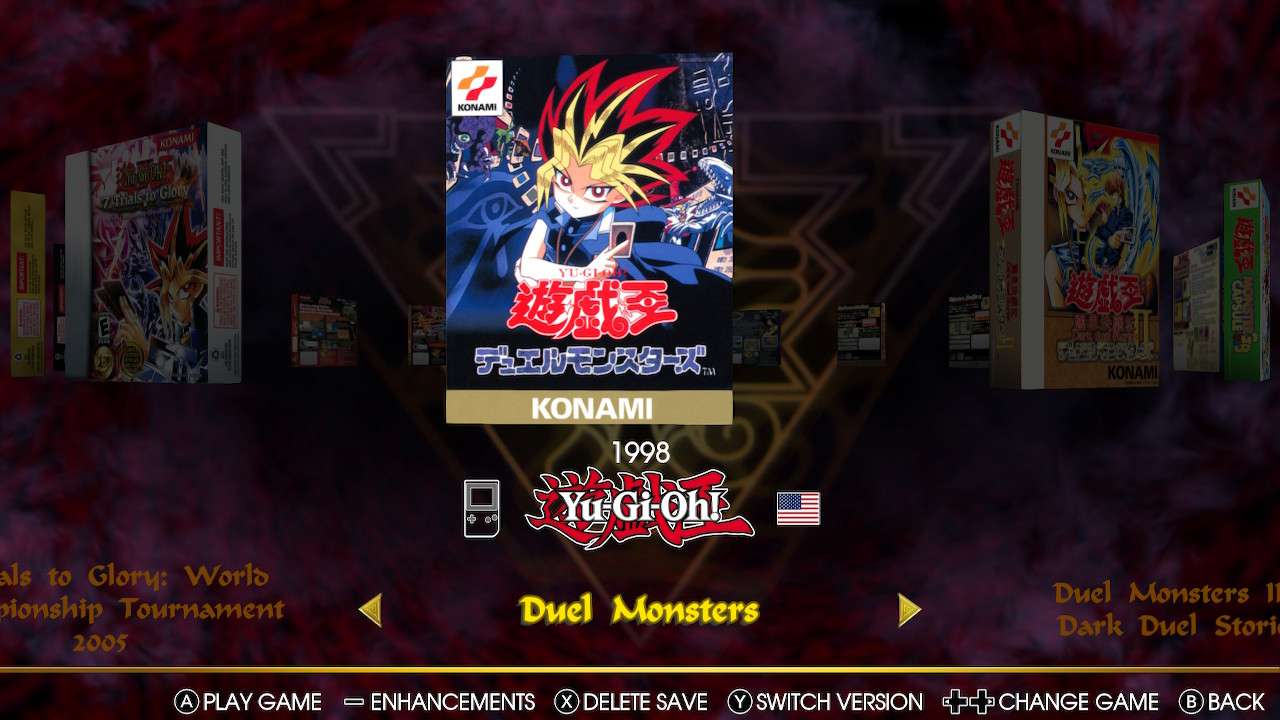
Please permit me as I lift Wikipedia’s list (not as if doing so violates anything):
- Yu-Gi-Oh! Duel Monsters (GB, 1998)
- Yu-Gi-Oh! Duel Monsters II: Dark Duel Stories (GBC, 1999)
- Yu-Gi-Oh! Monster Capsule (GBC, 2000)
- Yu-Gi-Oh! Dark Duel Stories (GBC, 2000)
- Yu-Gi-Oh! Duel Monsters 4: Battle of Great Duelists (GBC, 2000)
- Yu-Gi-Oh! Dungeon Dice Monsters (GBA, 2001)
- Yu-Gi-Oh! The Eternal Duelist Soul (GBA, 2001)
- Yu-Gi-Oh! Duel Monsters 6: Expert 2 (GBA, 2001)
- Yu-Gi-Oh! The Sacred Cards (GBA, 2002)
- Yu-Gi-Oh! Reshef of Destruction (GBA, 2003)
- Yu-Gi-Oh! Worldwide Edition: Stairway to the Destined Duel (GBA, 2003)
- Yu-Gi-Oh! World Championship Tournament 2004 (GBA, 2004)
- Yu-Gi-Oh! Destiny Board Traveler (GBA, 2004)
- Yu-Gi-Oh! 7 Trials to Glory: World Championship Tournament 2005 (GBA, 2004)
That’s a total of 14 games. If you want to think like a marketing agent, it’s technically 16 due to there being three versions of Duel Monsters 4. But those versions have even less differences between them than your average Pokémon game, so I personally wouldn’t count them. The collection is priced at about $50, which gives each game a value of roughly $3.60. Nice! There’s more nuance than that when it comes to a collection’s value of course, and I’ll get to that. This is just a ballpark estimation.
Physical Edition Promo Card
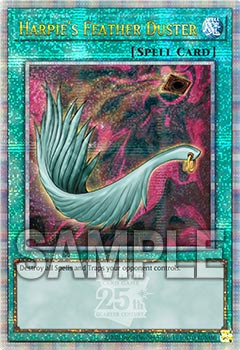
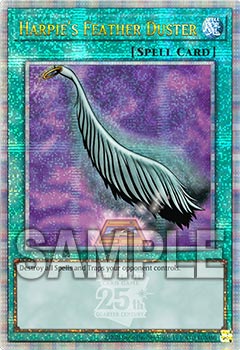
If you’d like to purchase the game physically, the Early Days Collection continues the legacy of incentivizing would-be buyers with a pack-in promotional card. For western buyers, this time it’s Harpie’s Feather Duster (HFD). It’s a card with a legacy every bit as classic as the games contained within the collection. For those somehow unfamiliar, it’s a no-strings-attached Spell card that destroys all of your opponent’s Spells and Traps on the field. It’s an incredibly strong card that has only recently been unbanned from the real card game. Japanese players, however, can expect either Perfectly Ultimate Great Moth or Seiyaryu. These cards are not nearly as useful as HFD, but they can still make for neat collector’s items.
As someone who predominately plays control-based decks, HFD is the bane of my existence, so I can vouch for its value. All the same, this iconic card has seen plenty of reprints. Those just wanting an HFD can buy one separately for as low as one or two dollars. If you care about rarity, it’s a bit more complicated. The EDC HFD is a Quarter Century Secret Rare, which is a new foil aesthetic for HFD. In addition, you have a chance of pulling one of two artwork variants, with the alternate being an even rarer reprinting. It seems the EDC promo is going for around half the price of the game itself, but I’ll try and update this claim as prices stabilize.
Now for some bad news: it seems that the promo cards are printed in a questionable quality. I have seen several accounts from people saying their card is defaced or has some kind of error. One EU Reddit user shared a picture of two promo cards that have ink smears on their packaging, as well as scuff marks on the back of each card. Depending on the severity of the damage, these can render a card unplayable in officially sanctioned events. As an anti-cheating measure, official rules state that cards can’t be “marked.” While the damages I’m describing weren’t done nefariously, they still have to be included due to the potential of people disguising their intentional marks as normal card wear-and-tear.
“It seems that the promo cards are printed in a questionable quality.”
Another Reddit user stated that they bought the game in Germany expecting a German print of the card, but it was in English. The comments in threads like these reveal additional concerning anecdotes. I won’t go into every one of them, but suffice it to say there’s reason to be wary when buying these promo cards. If you still want them, I would advise being comfortable with the possibility that you might not be able to play your promo card in official games.
Collection Features
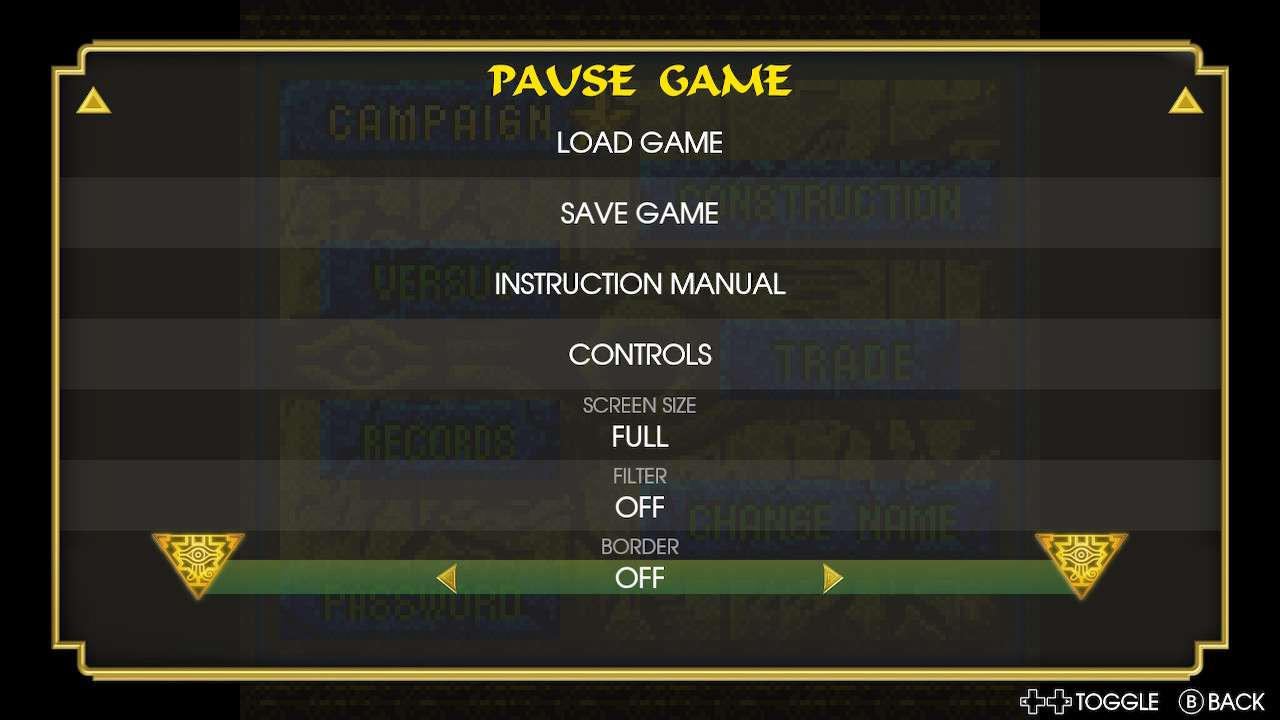
And now for a list of my own design, which details bonus features of the collection itself:
- Japan-exclusive titles are in English (and other languages) for the first time, with the exception of Yu-Gi-Oh! Duel Monsters 6 Expert 2, which is mostly identical to Yu-Gi-Oh! Worldwide Edition: Stairway to the Destined Duel (also on the collection). I’ll talk more on this later.
- Instruction manuals and original box art are viewable through the in-game menu. Manuals for Japan-exclusive titles are fully translated into the language of the regional variant you’re playing. No new box art was created, so the boxes of formerly region-locked titles can only be viewed through the Japanese version’s manual.
- Ability to toggle between each game’s different regional versions and languages. The versions appear to be separate ROMs, meaning they each have their own save file, save state, and option configuration.
- The first two Duel Monsters games and Monster Capsule include both their Game Boy and Game Boy Color variants. Only the Color variants were translated, but I assume no one minds not being able to play the English translations in monochrome.
- General cheat code toggles for each game to unlock all cards, remove deck capacity, have unlimited in-game money, disable the forbidden and limited lists, and so on.
- Online play (currently only for Duel Monsters 4).
- Save states (limited to one slot). As with standard emulators, the save state is distinct from your save file, but once loaded it will overwrite your save file at the next automatic or manual save. Be careful!
- Fully customizable control schemes for each game.
- In-game rewind feature that saves up to one minute of playtime.
- Fast-forward feature for battle animations in the first four Duel Monsters games, and only those games. More on this later.
- Game-dependent border artwork during gameplay which can be toggled on or off.
- Screen size options for “original”, “full” (touches screen borders while retaining proper aspect ratio), and “stretched” (distorts screen to fill entire screen size).
- Optional filters to simulate CRT TVs, monitors, and LCD screens.
- Optional color palettes for the three games that were playable on the original Game Boy. These simulate the displays of the Game Boy, Game Boy Pocket, and Game Boy Light (the Game Boy Light is a Japan-exclusive Game Boy model that has a built-in backlight.)
- Credits for the Early Days Collection viewable at any time, as well as the game’s license agreements. Hey, I never said every detail was going to be exciting.
Games Delivered “As-Is”
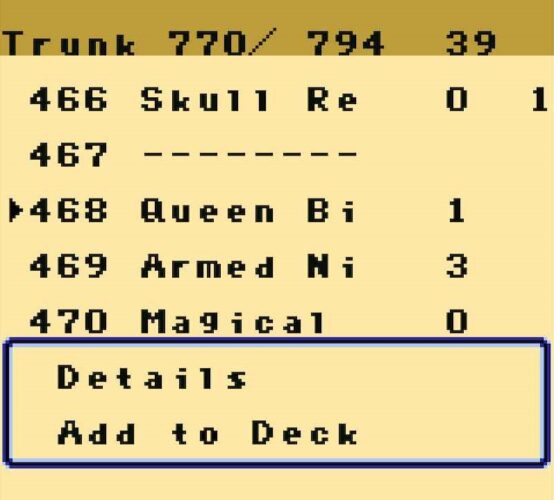
From what I’ve seen, all of these games are presented in their original formats, for better and worse. I haven’t noticed any glitches being fixed, typos or syntax errors being corrected, or censorship being undone. This extends to the manuals too. Reprinted manuals containing false info, such as the manual for Destiny Board Traveler, are unaltered.
Even when presented with the most obvious opportunities to fix mistakes, things remain unchanged. For example, the original English release of Dark Duel Stories wrote Magical Labyrinth’s effect as “structure of maze on field revealed,” which is complete nonsense. There are no game mechanics that this could even remotely be referring to. Its actual effect powers up the card Labyrinth Wall by one stage. The literal translation of the Japanese text is very direct with this relationship, so I have no clue how the original localization got the line that they did.
I even asked my friend Ryan, who is fluent in Japanese, if there was any conceivable way the translators could have interpreted the original Japanese text the way that they did. In this own words: “not a clue, man.” The new translations, such as that of the game’s sequel Duel Monsters 4, ought to have corrected this. I mean, what are the odds of different localizers making the same highly idiosyncratic misinterpretation?
100%. The crazy fools did it again. Naturally, I don’t actually buy that. Instead, I think it’s strong evidence that the original English script, where applicable, was copied and pasted for the “new” translations. This is, sincerely, corner-cutting laziness. Translators were already hired to work on the Early Days Collection because they had to translate the unique text from the Japanese-exclusive games. What most likely happened is that someone higher up on this project did not want to pay a pittance more to their workers to translate even a handful of more text. That expense is instead paid by the customer in the form of a lower quality product. This collection was in development for over a year. Where did that effort go? They’re charging $50 for it. Where did that confidence come from?
The oddities don’t stop there. While I stand by my assumption that much of the text was reused, there is a circumstance where the developers are compelled to make a minor alteration: erratas. The team may not fix inscrutable card text, but they’ll be damned if they’ll let you play Frog the Jam. Unless it’s in Dark Duel Stories, because editing the text already in that game would be additional labor. Do you see the pattern of behavior yet?
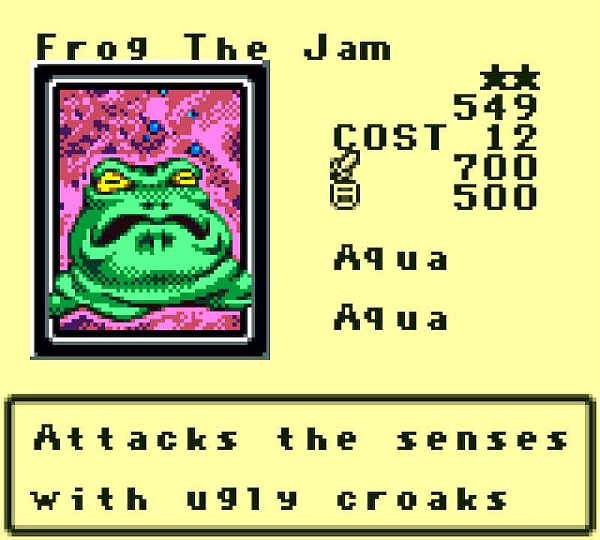
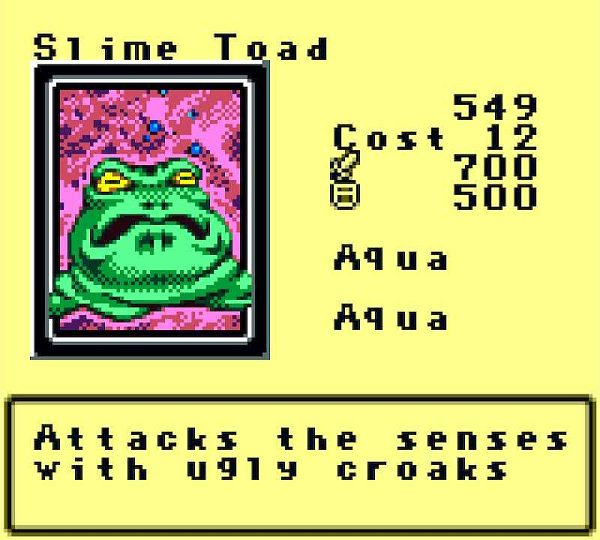
At least you can use Frog the Jam as a barometer to tell you whether or not you’re playing a new translation. Anyway, make what you will of all this information. I will share more of my opinions on these approaches later on in this review.
What to Expect
The “Duel Monsters” Series
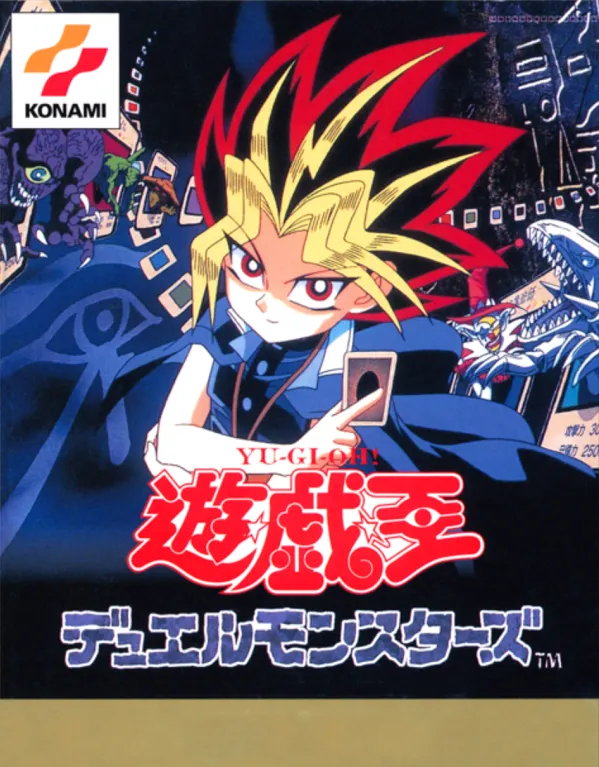
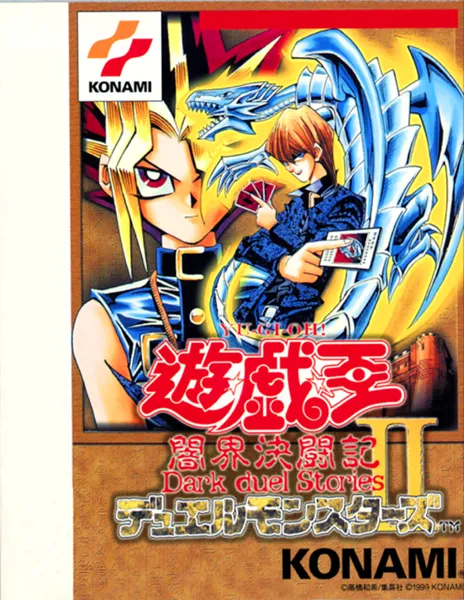
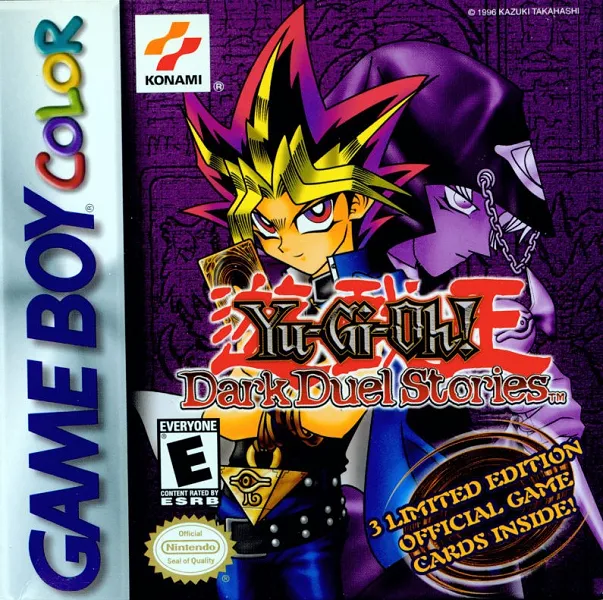
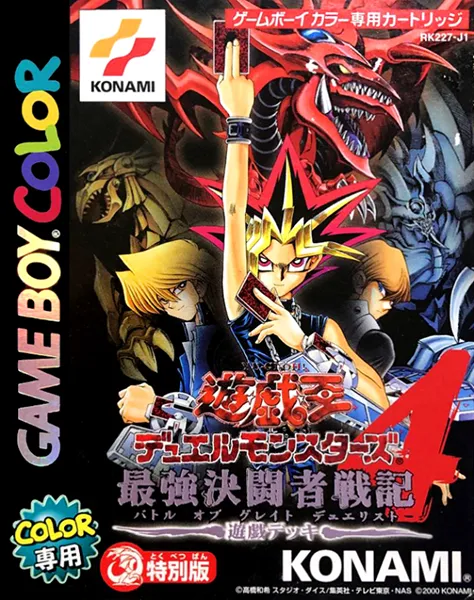
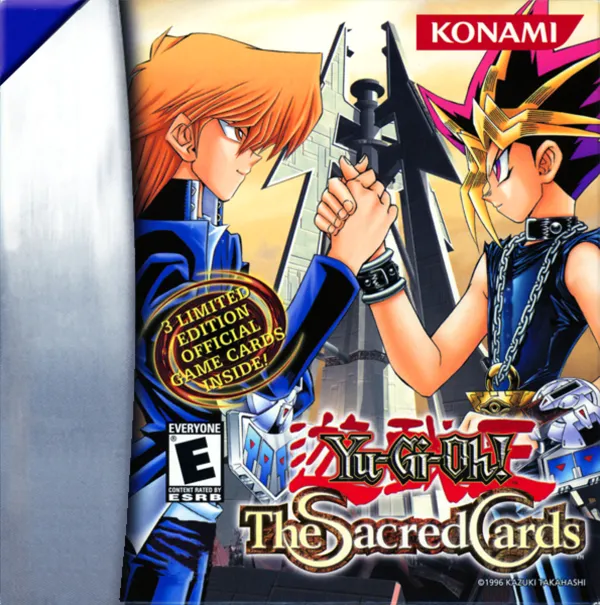
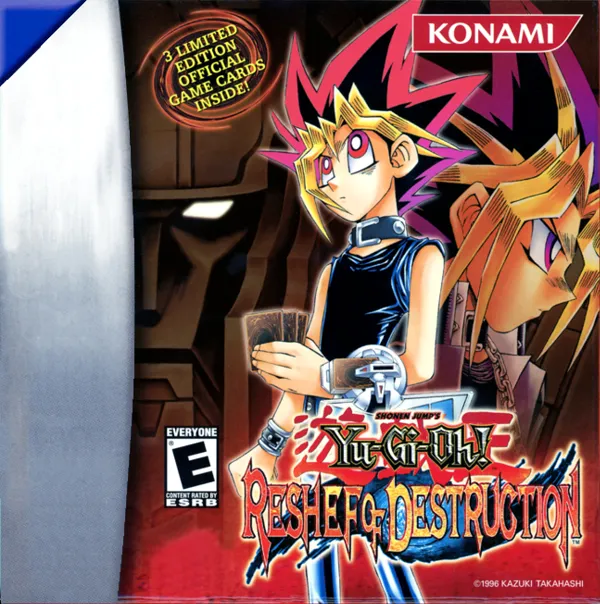
I am talking about these games: (click to expand)
- Yu-Gi-Oh! Duel Monsters (GB, 1998)
- Yu-Gi-Oh! Duel Monsters II: Dark Duel Stories (GBC, 1999)
- Yu-Gi-Oh! Dark Duel Stories (GBC, 2000)
- Yu-Gi-Oh! Duel Monsters 4: Battle of Great Duelists (GBC, 2000)
- Yu-Gi-Oh! The Sacred Cards (GBA, 2002)
- Yu-Gi-Oh! Reshef of Destruction (GBA, 2003)
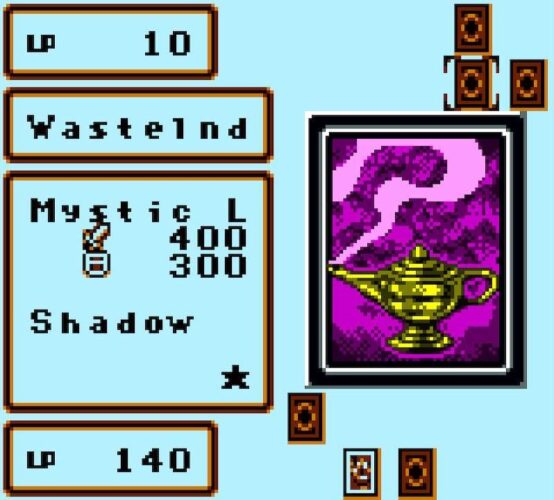
These are the weird ones. Before the Yu-Gi-Oh! card game came to exist in its current form with associated rules and regulations, we had video games attempting to capitalize on the “fictional” card game. If anyone’s unaware, creator Kazuki Takahashi envisioned Yu-Gi-Oh! as a story where the protagonist would compete in a variety of games, typically changing each week—hence the franchise’s translated title, King of Games. In Yami Yugi’s first showdown with Seto Kaiba, the two played a then-unfamiliar game: Duel Monsters. Japanese fans wrote in asking for more Duel Monsters, they were given more Duel Monsters, they continued to ask for more, and the rest is history.
In the time it took for the real card game to manifest, these video games were manga fans’ opportunity to play Duel Monsters for themselves. As such, they attempt to replicate the loosely-defined rules contained within the manga. Takahashi was possibly not considering Duel Monsters existing as a proper competitive game, and may have originally designed the simple game flow around showing off his remarkably ghoulish monster designs. Everything else might have served as a conduit, with effects from Spells and Traps existing to add some extra narrative tension and visual variety.
To put it another way, Takahashi might have been winging it, and the Duel Monsters (DM) games seemed to follow suit. This is evident within the games themselves, as there are frequent rule adjustments and altered cards between entries. I won’t go over every difference between games, but I’ll cover the broad strokes.
The first four Duel Monsters games are entirely menu-based, and progression is simple. You’re given a predetermined starting deck and are tasked with defeating all selectable opponents five times each. When this is done, a new set of opponents appears with more powerful cards. You repeat this process until you simply run out of new opponents to face. Of course, you can also play until you complete your card collection. Each duel you win rewards you with one random card, and opponents can have card “drops” specific to them. Which opponents drop which cards is never told to you, which can make hunting certain cards daunting and time-consuming. Even if you use guides to eliminate this guessing game, you’re still at the mercy of the RNG. It can take you upwards of a hundred duels against one opponent to get a single copy of the card you want. This is just for completionists, mind. Also, the EDC allows you to use cheat codes and expedite this process.
The Duel Monsters games are the Yu-Gi-Oh! card game at its most simplistic. While more cards and effects are added to each game, thereby increasing complexity, this series in particular is mostly a numbers game. You want your Monsters to have a higher attack number than your opponent’s attack or defense number so that you can empty their field and attack their Life Points (LP) directly. Reducing the other player’s LP to 0 wins you the duel. If you’ve played Forbidden Memories for the PlayStation, you will be very familiar with many of these mechanics.
The first Duel Monsters game may be the simplest card game you will ever play. It’s practically Candy Land levels of determinism; duels are often decided before they even start. Can your average Monster beat the strongest Monster in the opponent’s deck? If so, you’re probably fine. If not, you better pray they don’t draw it. You know the traditional card game, War? It’s like that. In this first installment, Monster Effects and Traps don’t even exist! For what few Spells there are, they are hard to come by. Decks can only be 40 cards, but there is no limit on the number of copies you can have of any card. If you want to grind for a million hours (or cheat) so you can use 40 Blue-Eyes White Dragons, more power to you. Oh, and you’d actually want to do this: tribute summons aren’t a thing. This is playground Yu-Gi-Oh! taken to its illogical conclusion.
As the Duel Monsters series progresses, each game attempts to add a little more depth and balance to the game. Though Monster Effects, Spells, and Traps do provide a bit of variety and decision-making to games, they are often low-impact. The ones worth using typically bottom out at removing one Monster per card Effect, allowing you some breathing room if you haven’t drawn the Monsters you need. Effects that power up your Monsters, such as Equip Spells and Field Spells, can also be very useful when a new opponent is using a higher caliber of Monsters than your own. Traps can be nice, but you’ll be hard-pressed to find useful ones that don’t simply destroy an attacking Monster. High-impact Spells and Traps, like the iconic Raigeki (which destroys all of your opponent’s Monsters), are generally prohibited by rarity or deck capacity.
Deck capacity is another (infamous) mechanic associated with the DM games. In games past DM1, every card has a numeric cost ranging from 0 to 255. The general idea is that more powerful cards have higher costs. The total cost of the cards in your deck cannot exceed your maximum deck capacity, and your capacity increases over time through dueling. This was seemingly implemented after DM1 in order to prevent players from raising their deck’s power too quickly, thereby giving the sequels more longevity. This is paired with a similar mechanic, your “duelist level,” which also rises as you win duels. If you don’t meet the required level for a card, it doesn’t matter how much deck capacity you have: you cannot use that card.
These mechanics introduce a somewhat notorious “grinding” element to these games, and it’s particularly controversial with its strictest incarnation in Reshef of Destruction. You will often be excited to receive a useful card, only to find out you can’t play it. Sometimes you’ll need to duel hundreds of times—long past the point of completing the campaigns—due to truly absurd costs.
A few of these costs and level requirements need to be seen to be believed. I went through the entirety of DM2’s campaign and post-game without ever being able to use a single Equip Spell. Even if I met the level requirement, Equip Spells wouldn’t be worth their whopping 150 cost. With how cost is calculated, this hypothetically would be equal to the cost of adding a Monster with 15,000 Attack to your deck. I’m not kidding. The cost evaluation of many cards is downright incomprehensible. Jirai Gumo, who has no drawback in these games, can cost a meager 23 points while some trash card like a Ritual Spell has the maximum cost. The thought processes involved are a constant mystery.
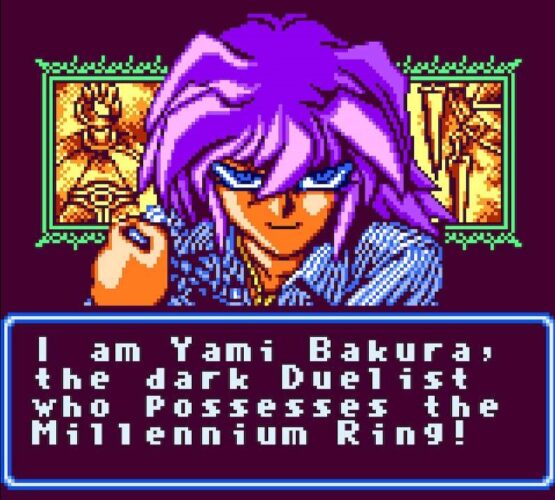
There are two other shared mechanics of the DM games I think are worth mentioning, and they have to do with Monsters. One of them is that the DM series eventually introduced Monster Attributes. These are different from Monster Types, which exist from the start and are used to determine compatibility between Monsters and card effects, such as stat-boosting Spells. Attributes determine a Monster’s strength and weakness relative to other Attributes, and this manifests in two circular charts.
Most of the time, battling Monsters will have a neutral Attribute relationship. Those battles are conducted as normal, with victory going to the Monster with the higher stat. However, if a Monster is disadvantageous against an opposing Monster’s Attribute, the disadvantaged Monster is instantly defeated regardless of any stat difference. Not only that, but a Monster with an Attribute advantage won’t even receive Battle Damage when destroying a Monster with higher stats.
It’s important to keep Attribute relationships in mind, otherwise you risk your strongest Monsters being steamrolled by something as weak as a Kuriboh. For the most part, this just adds an element of unpredictability to the game rather than increasing the skill level. That might sound detrimental, but I think it at least provides Duels with a sense of “narrative” tension where things can go suddenly in or out of your favor. In DM1, duels were decided before they even began. It’s not a great mechanic, but it’s something. It’s fortunate that the EDC allows you to pull up manuals mid-game and reference the Attribute relationship charts, as some are quite unintuitive. Light loses to Shadow. That’s unusual, isn’t it? Oh, but Light beats Fiend. Okay, that makes sense. But what the hell is “Dreams,” and what is it weak to? Oh, Dreams loses to Fiend, which beats Shadow. Sure, man. Whatever.
Lastly, Fusions can be done between Monsters by placing one Monster card on top of another. If the two Monsters are incompatible, then the Monster that was first selected “replaces” the other one, which is now gone for the Duel. If the two are compatible, then they create a pre-determined Fusion Monster. These are stronger Monsters that can quickly give you a major stat advantage in Duels. The “problem” is that working Fusion combinations aren’t saved anywhere. You have to look them up or experiment and memorize them. You don’t necessarily need Fusions, but they can save you a lot of grinding for more powerful cards by allowing you to meet the stat thresholds of stronger opponents.
Duel Monsters 4 is worth mentioning for its wacky gimmick of having three versions. Interestingly, you actually “play” as the version’s titular character. This doesn’t amount to much, as it pretty much only displays the character’s name instead of your own when it’s your turn, but I’m sure some kids wept tears of joy at being able to roleplay as Kaiba. Less fun is the way they justified this gimmick: each game can only use a fixed, partial selection of the card pool. It doesn’t matter what you do in-game—your character is never using certain cards. I learned this the hard way when I had Heavy Storm drop early on, only to find out that Joey’s version couldn’t use it for some arbitrary reason. If you receive an unusable card, you effectively did not get a reward. That means the grind got even worse. The collection’s cheat function allows you to disable the version-based card restriction, and I would not blame you for using it.

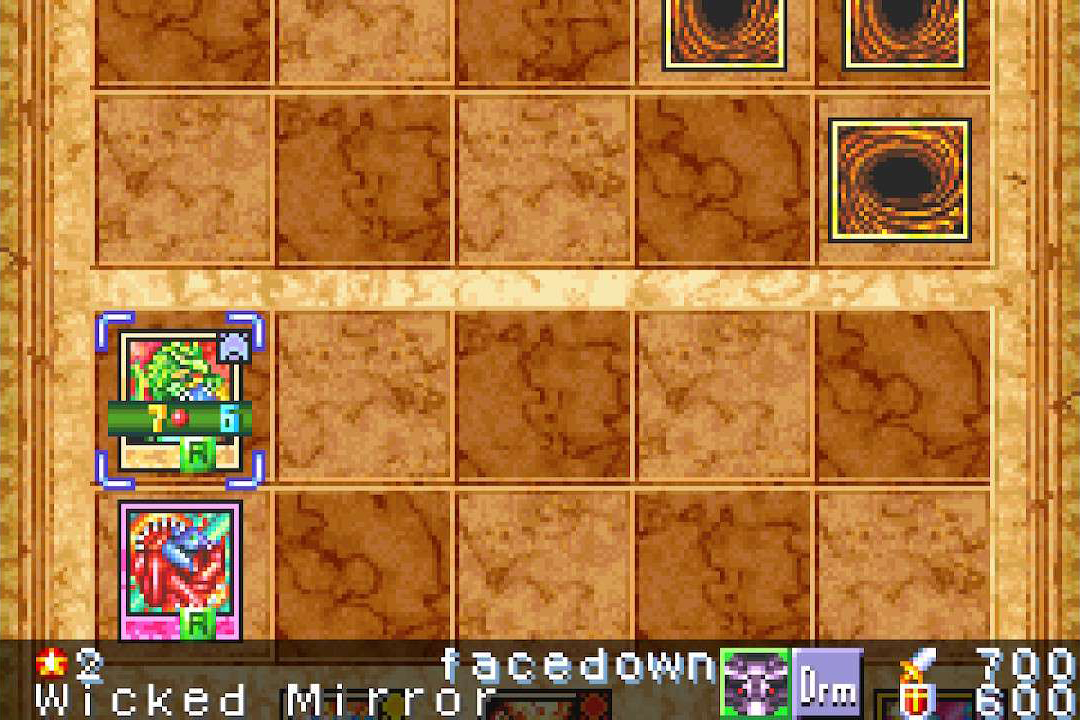
The Sacred Cards and Reshef of Destruction continue with these fundamental mechanics, but progression changes to a top-down RPG structure. You can walk around in environments, talk to NPCs, and challenge some of them to Duels. That might sound nice, but it’s just as simple as the Duels themselves. There is never anything to interact with within the static, flat environments, so this style of gameplay just adds playtime that’s spent running around looking for Duels. At the very least, the more involved storyline might please fans of the source material or children (ideally both). Except for Reshef of Destruction, which was made ludicrously grindy as a response to people criticizing its predecessor’s low difficulty. It can take literal hours in that game just to get a goddamn Shapesnatch.
So, yeah. That’s the Duel Monsters games in a nutshell. They’re very basic, but there is some appeal to the blunt simplicity of them. Progression is less of an abstract concept based on deck building principles, being more linear with regards to replacing Monsters with low numbers with Monsters with higher numbers. It’s a very literal kind of growth that replicates basic RPGs. It was fun to see your character level up in Dragon Quest back in 1986, and it’s still fun to see the numbers go up within your deck. Only a select few people will understand the catharsis of attacking with an Effect-less Jirai Gumo, but those that do shall be rewarded. Sort of. At least until it’s immediately destroyed by a Scorching Scrunklo because it was Fire Attribute.
You can use the EDC’s cheat options to circumvent things like deck capacity or available cards, but I would actually recommend against doing that. The entire appeal of these games, in my opinion, is the gradual growth of your deck’s “stats.” If you eliminate that so you’re only left with the card game itself, there just isn’t enough strategy to keep anyone but the most easily entertained players coming back. Especially when titles that offer richer gameplay are in this very collection.
The “Simulators”
I am talking about these games: (click to expand)
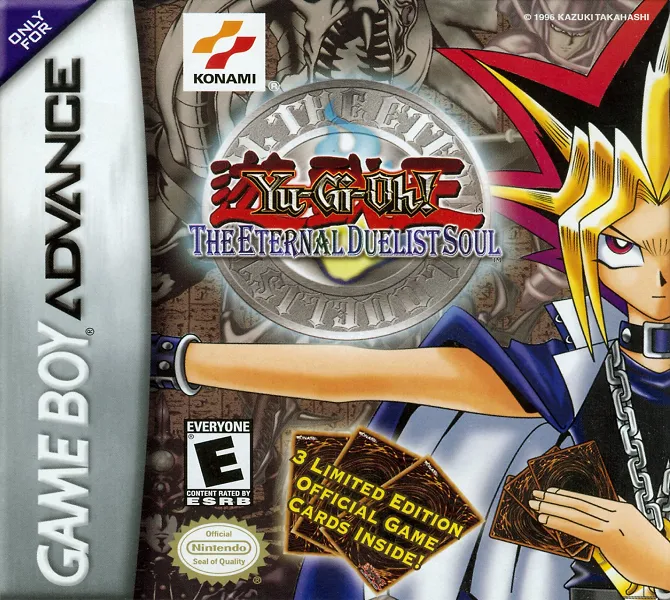
- Yu-Gi-Oh! The Eternal Duelist Soul (GBA, 2001)
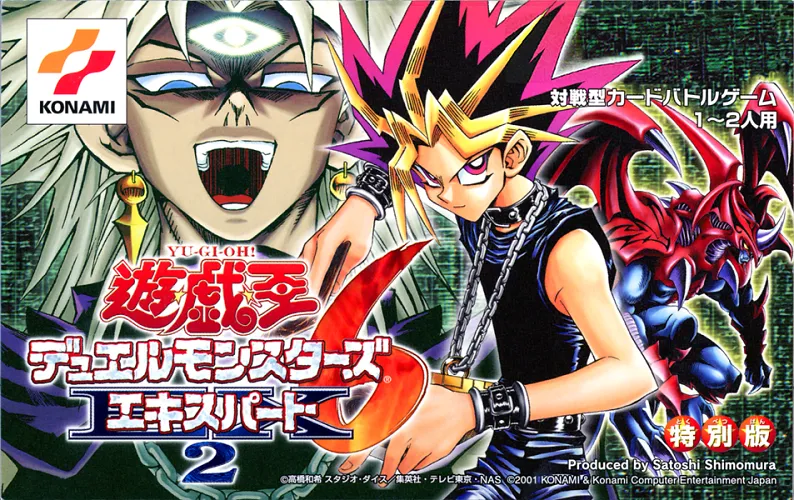
- Yu-Gi-Oh! Duel Monsters 6: Expert 2 (GBA, 2001)
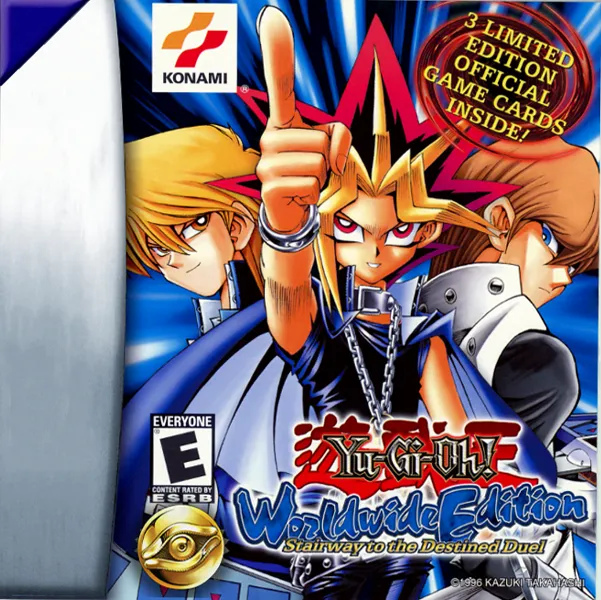
- Yu-Gi-Oh! Worldwide Edition: Stairway to the Destined Duel (GBA, 2003)
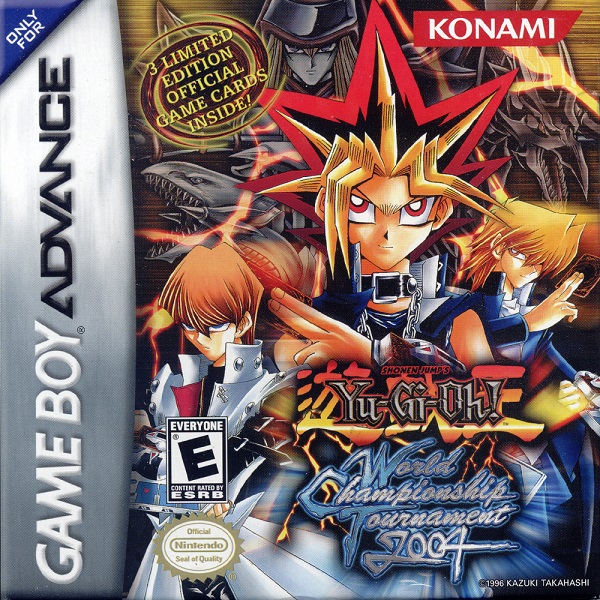
- Yu-Gi-Oh! World Championship Tournament 2004 (GBA, 2004)
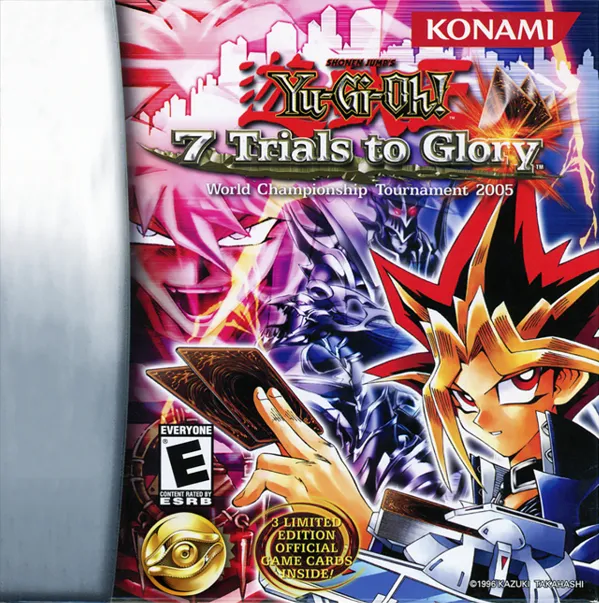
- Yu-Gi-Oh! 7 Trials to Glory: World Championship Tournament 2005 (GBA, 2004)
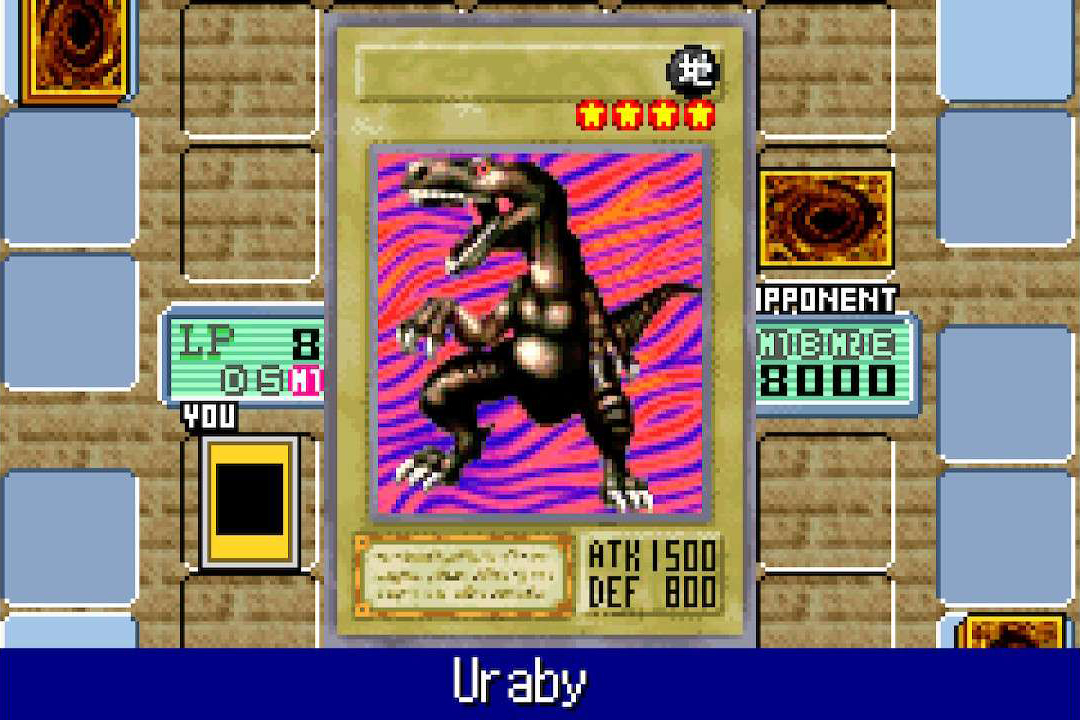
These are the meat and potatoes of Yu-Gi-Oh!: video game adaptations that attempt to simulate the real-life card game. They were a great way to play the game without having to spend a fortune to keep up with physical set releases. One of the detriments of playing YGO in this way was that the format was static: you would never receive new cards. The only way to remedy that was to buy the next YGO game, and you had to hope Konami released it in a timely fashion and on a platform you owned. You’d also prefer that it wouldn’t suck.
Now, things are different. What was once a flaw is now a benefit, in a sense. “Legacy” formats have become increasingly popular in the last few years. The YGO fanbase will sometimes create custom formats that replicate real formats from the past. This is typically done because people find the “meta” of that format to be interesting. That meta might be perceived to be more skill-intensive, unique or iconic in some way, or the top decks of the time could be fan favorites—if not a combination of these things (and more). You may have heard of the Edison format, which is based on the 2010 Shonen Jump Championships held in Edison, New Jersey. Many consider Edison to be the most balanced format in the game’s history, and the engaging games it has produced contribute to its strong following.
“Goat” format is another common legacy format, and it’s based on the April 2005 TCG banlist. It gets its name primarily from the card Scapegoat, which is a centralizing staple card in the format. It doubles as a tongue-in-cheek usage of the acronym GOAT, for “Greatest of All Time.” While Goat format isn’t as revered for its skill level as Edison is, it remains popular due to being placed just before the Cyber Revolution set. Said set would introduce many format-defining cards such as Cyber Dragon, and it’s here where some fans consider the game to have fundamentally changed form into something faster-paced, more aggressive, and more focused on the game’s “special summoning” mechanic. To put it another way, Goat format has the largest card pool while still being considered “classic” Yu-Gi-Oh!.
While Edison is not represented in any games in the EDC, Goat is fairly close to the format of Yu-Gi-Oh! 7 Trials to Glory: World Championship Tournament 2005. Unfortunately, it remains unclear if that title will ever receive online functionality. If you’re getting the EDC near launch, be sure you’re comfortable with the possibility that you’ll only be playing it for the single player content. Konami is no stranger to abandoning games after sales fail to meet expectations, as purchasers of Yu-Gi-Oh! RUSH DUEL: Dawn of the Battle Royale!! learned the hard way (myself included).
“If you’re getting the EDC near launch, be sure you’re comfortable with the possibility that you’ll only be playing it for the single player content.”
If you’ve never played the Yu-Gi-Oh! card game before and want me to sell you on it, I’ll do my best to describe the general appeal. For this beginning era in particular, much of the enchantment comes from Takahashi and the other unnamed artists’ excellent monster designs. The card game is both loved and hated for the potential to make explosive plays through high-impact card combinations while knowing you’re always one bad draw away from having the same done to you. There is no “mana” system in Yu-Gi-Oh!, with the only restrictions coming from the card text itself as well as your single “normal summon” per turn.
Because of this, skill mainly comes in the form of card management (or “card economy”) and not overextending your plays. Do you go for a blowout with your powerful cards, hoping to finish off your opponent before they draw their own, or do you hold them as a contingency? Can you successfully bluff the opponent with your hidden (“set”) cards? Can you predict what your opponent has or might draw into based on the cards you’ve seen up to that point?
It’s a lot of “knowledge checks,” as the community often calls it. But I do think some people use that term too derisively. Nearly every game that involves probability is a knowledge check. There’s ultimately a mathematically “correct” decision to make at every juncture if you’re good enough at card counting and know the likelihood of standard deck compositions. Until we start getting Yu-Gi-Oh! cards that demand you fight the other person in an MMA-style cage match, that’s about the extent of how skill can manifest in a card game. You can introduce more variables to cloud a player’s intuition as they’re considering probabilities, but it’s ultimately the same skills and processes.
That all said, just ask yourself this: do you generally like trading card games? If the answer is yes, you will probably enjoy the gameplay of this collection well enough. It really is pretty simple—in more ways than one. Most of the simulator games take their structural cues from the Duel Monsters series: beat a set of opponents X number of times, unlock more opponents and do the same, etc. Worldwide Edition recontextualizes the menu navigation as something exploration-based, while World Championship Tournament 2005 is a top-down RPG similar to The Sacred Cards and Reshef of Destruction.
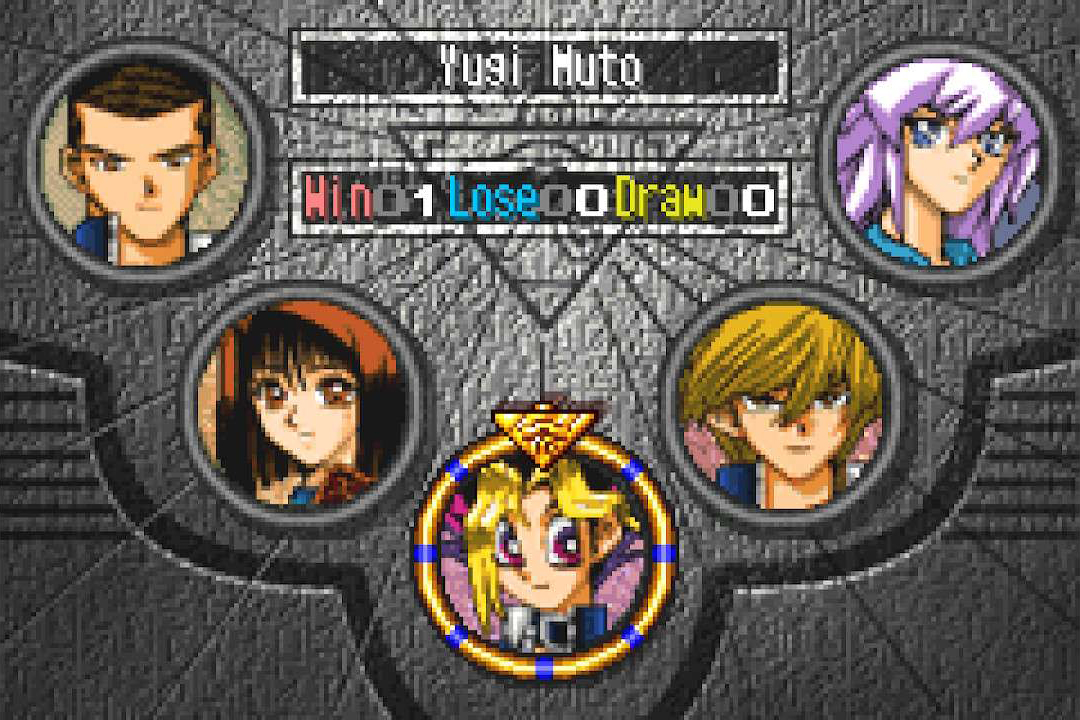
So, what’s the deal with these games? You may be asking yourself why you wouldn’t just jump to the latest one in order to use the most cards. That’s a perfectly reasonable priority, but there are other reasons to play older games. I mean, if there weren’t, what’s stopping you from playing Master Duel right now for “free?” The main reason is what I mentioned earlier, which is that each entry has a different metagame. Depending on what’s banned or not, or what has or hasn’t been powercrept, the cards you can expect to see in each game vary.
As you gain experience playing YGO, you may begin to appreciate the subtleties of this and enjoy using cards you can’t get away with playing elsewhere; either because they’ve been banned, or they’ve been too surpassed by more powerful cards. For instance, if you wanted to try playing an Exodia deck for a change of pace, you might be best off doing so in The Eternal Duelist Soul, as it’s the earliest game using the traditional rules. By sticking to TEDS, you can avoid some cards released later on that make playing Exodia more difficult, and thus potentially less enjoyable.
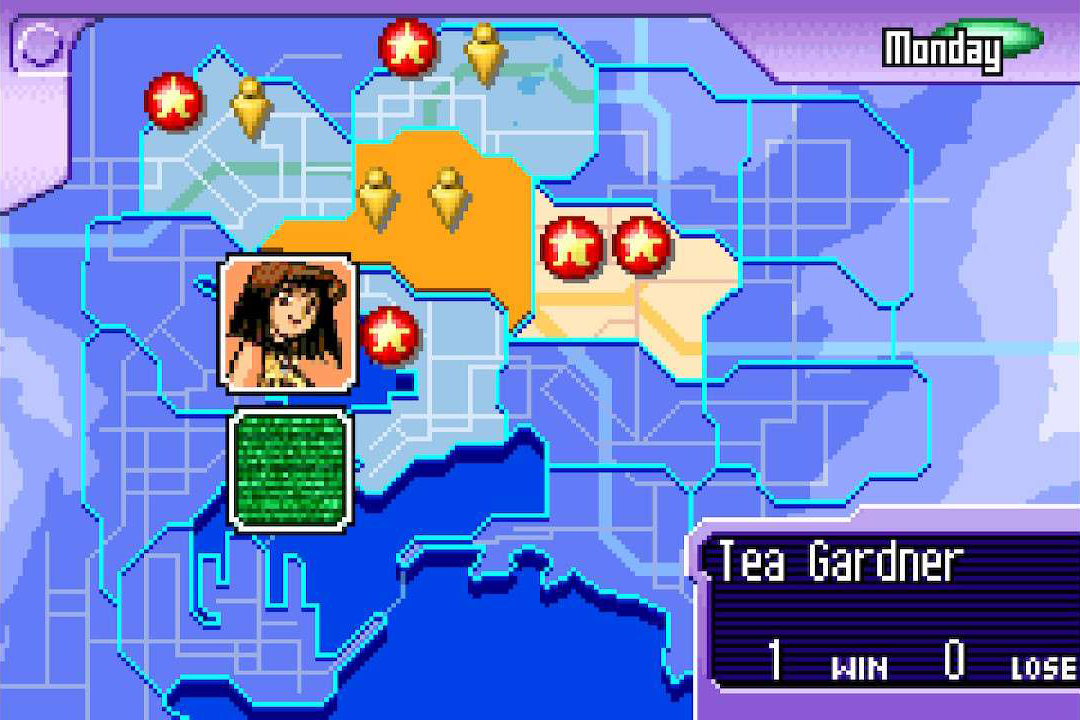
Another reason is that these simulators are of surprisingly unequal quality and style. You might expect each game to only increase in quality by iterating on the previous games’ systems and presentation, but it’s not that simple. Worldwide Edition might have more cards than The Eternal Duelist Soul, but it also has a more convoluted way of dueling: you have to move your cursor across map nodes and find opponents at random. Some players may appreciate being able to immerse themselves in the anime and manga’s “Battle City” arc, but others might find this process annoying or obstructive compared to the simple menu navigation of previous games.
The game’s successor World Championship Tournament 2004 uses a similar menu system to TEDS, but the pacing of animations in duels is inexplicably slower and sluggish, the AI’s decks are laughably incompetent, and unlocking new opponents is a guessing game. That title is a contender for the worst game on this collection despite being nowhere near the earliest just due to its abysmal feedback.
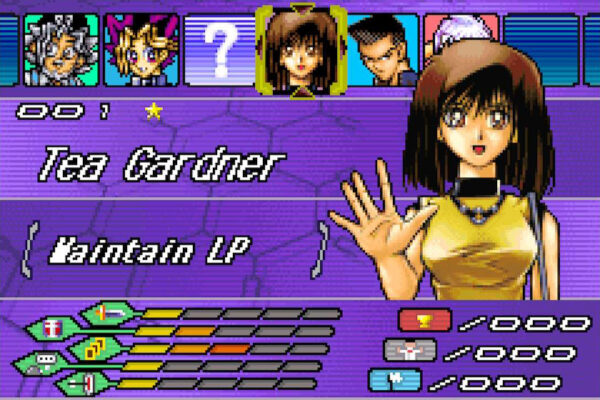
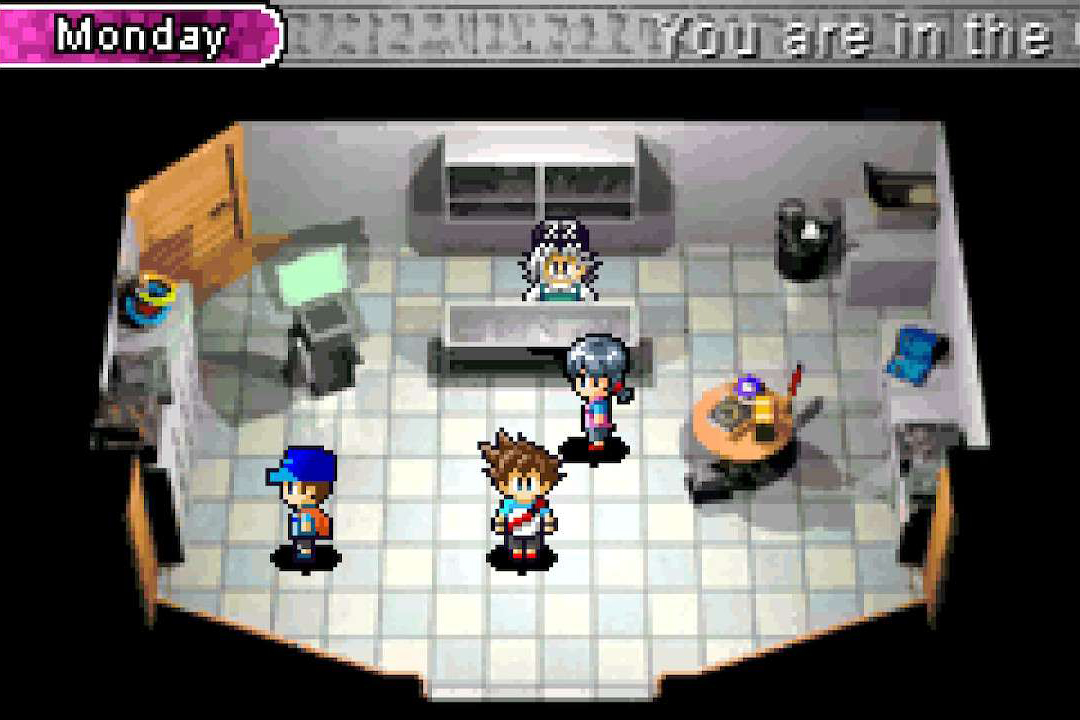
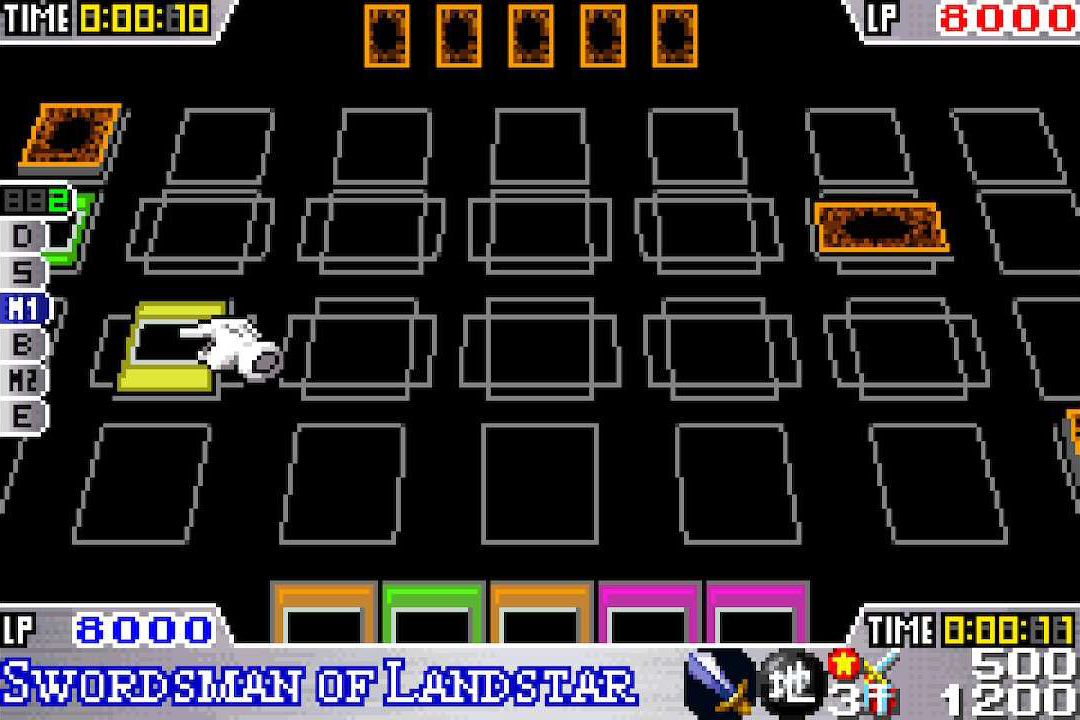
2004‘s gaffes are made up for somewhat by World Championship Tournament 2005, which is undeniably the most ambitious game in this anthology. It features a story campaign complete with an overhead RPG-esque open world, new challenge modes that encourage you to use a wider variety of cards, and a revised wireframe dueling interface that, frankly, does look a little rad. If you just want to dive into the most “complete” video game experience here, WCT 2005 is absolutely that.
As an aside, Yu-Gi-Oh! Duel Monsters 6: Expert 2 is the only game in this collection to remain exclusively in Japanese. Konami’s official page for the Early Days Collection claims the game can be experienced in English by playing Worldwide Edition, but that’s sort of a lie. I’ll explain why later on.
The Spin-Offs
I am talking about these games:
- Yu-Gi-Oh! Monster Capsule (GBC, 2000)
- Yu-Gi-Oh! Dungeon Dice Monsters (GBA, 2001)
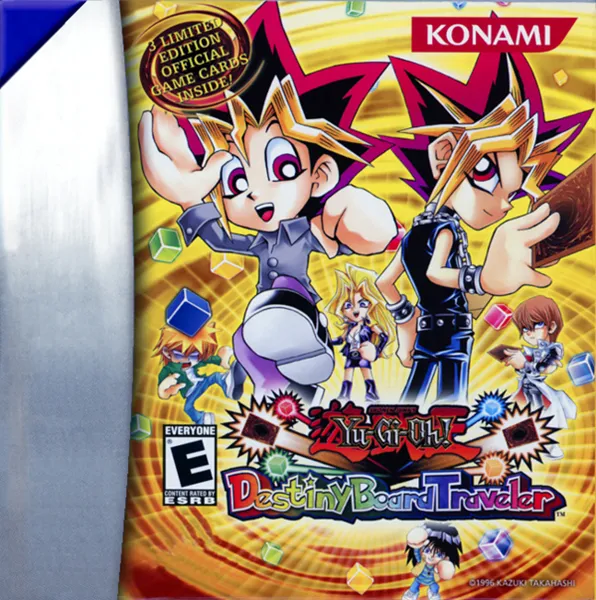
- Yu-Gi-Oh! Destiny Board Traveler (GBA, 2004)
These are the really weird ones. I’ll be honest: I have little experience with these games. I tried them for a bit, but it’s obvious that learning each of these games will be ordeals unto themselves. I absolutely will play these more in-depth and cover them in the future, but for now, please settle with these summaries.
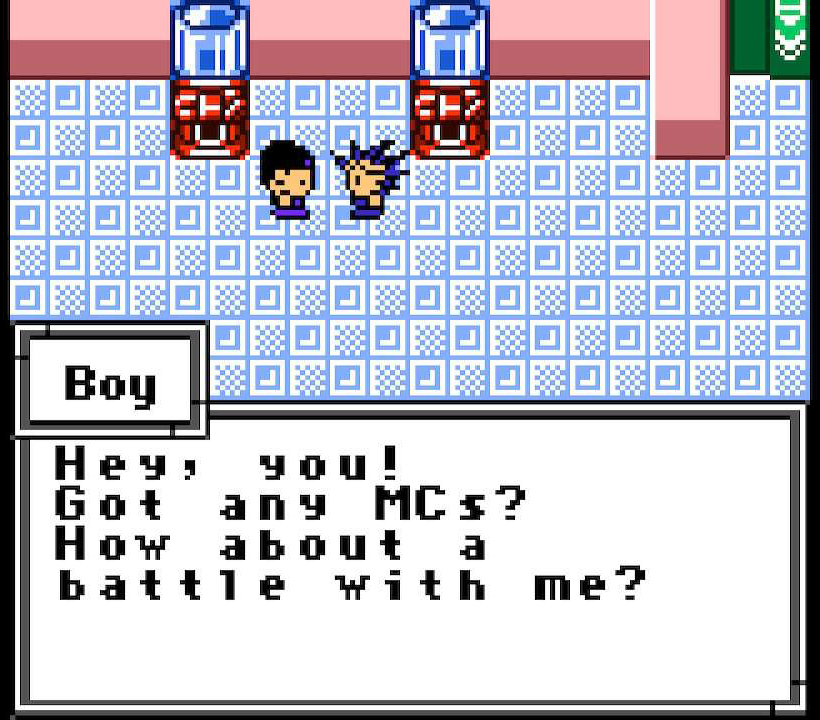
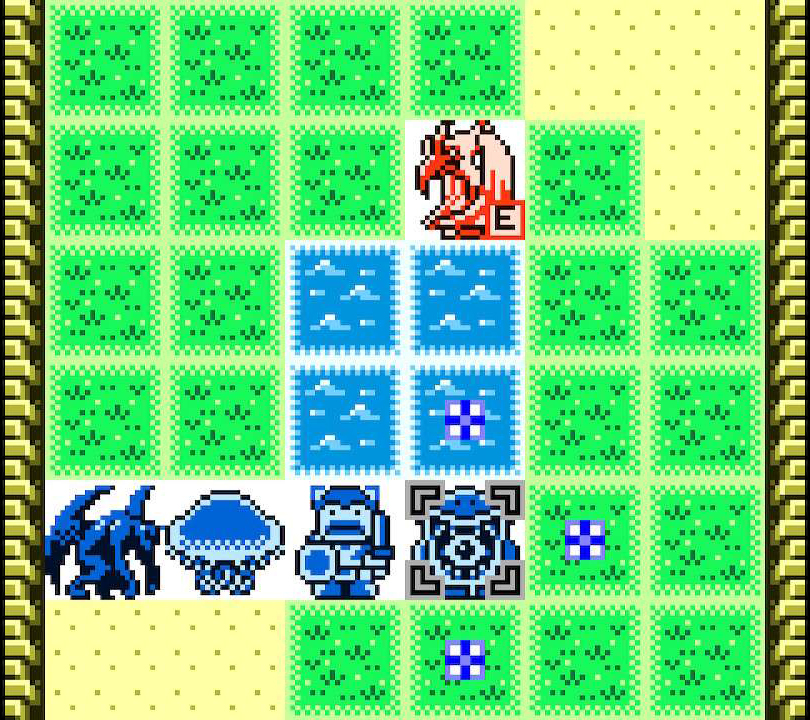
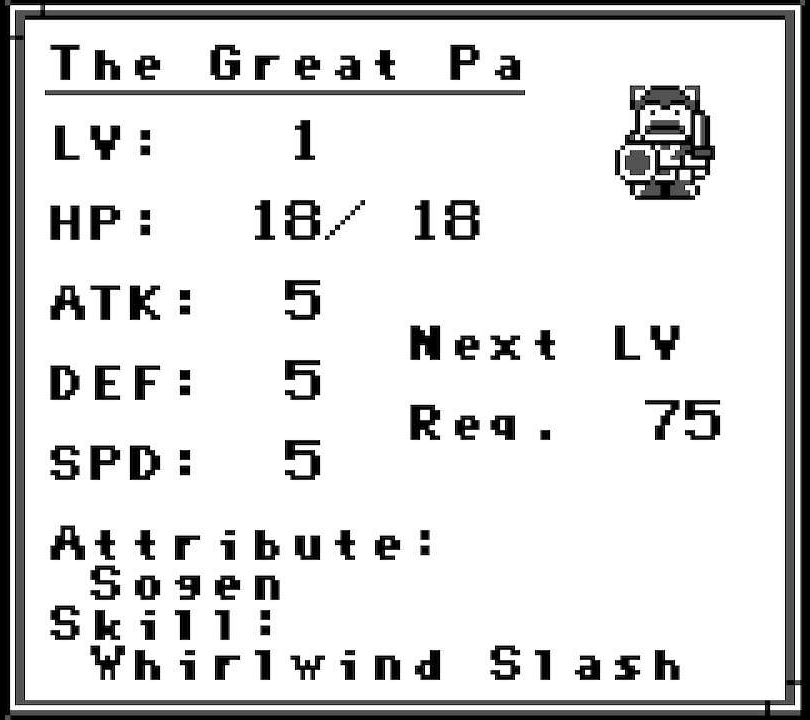
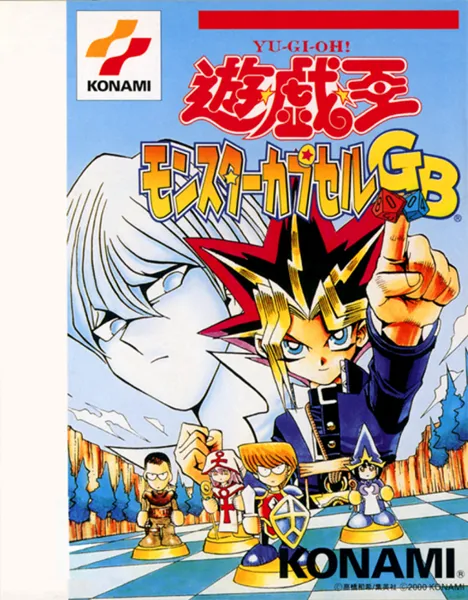
Yu-Gi-Oh! Monster Capsule is the only spin-off in the EDC to have not been released in English territories. Thankfully, it’s now in English. Konami has done a bang-up job localizing the game, and it feels like it could’ve been an unreleased localized ROM from the early 2000s. Fans of the English anime dub will be happy to see everything rendered in the ways they’re most familiar with. This Game Boy Color title is a sequel to the first Yu-Gi-Oh! video game ever produced, Yu-Gi-Oh! Monster Capsule: Breed and Battle, which was on the PlayStation and is not included in this collection.
Monster Capsule sits firmly in the turn-based strategy genre. There’s an in-game “gacha” machine that randomly gives you Monster Capsules in exchange for currency. You use these Monsters to battle those of your opponent’s, where you can place up to five of your choice onto the 6×6 battlefield grid. Each Monster has its own attacks with their own area of effect. Some might be in a straight line from the Monster, while others can be complex patterns. Board spaces have terrain types attached to them, and compatible Monsters can receive an attack and accuracy boost while on those spaces. You and your opponent take turns moving one Monster per turn and attacking until the opposing force is wiped out. Your goal is to defeat every AI opponent and save the day. Hooray.
It seems neat enough, and I imagine testing out new Monsters will be fun. I can’t say much about the gameplay depth at this point. The game is based on yet another non-Duel Monsters game that was played in the Yu-Gi-Oh! manga. Anime watchers might also remember a capsule-centric game being played throughout a filler arc. There’s also a PlayStation 2 game, Capsule Monster Coliseum. None of these have anything to do with each other, and they each use different rules. Don’t ask me why.
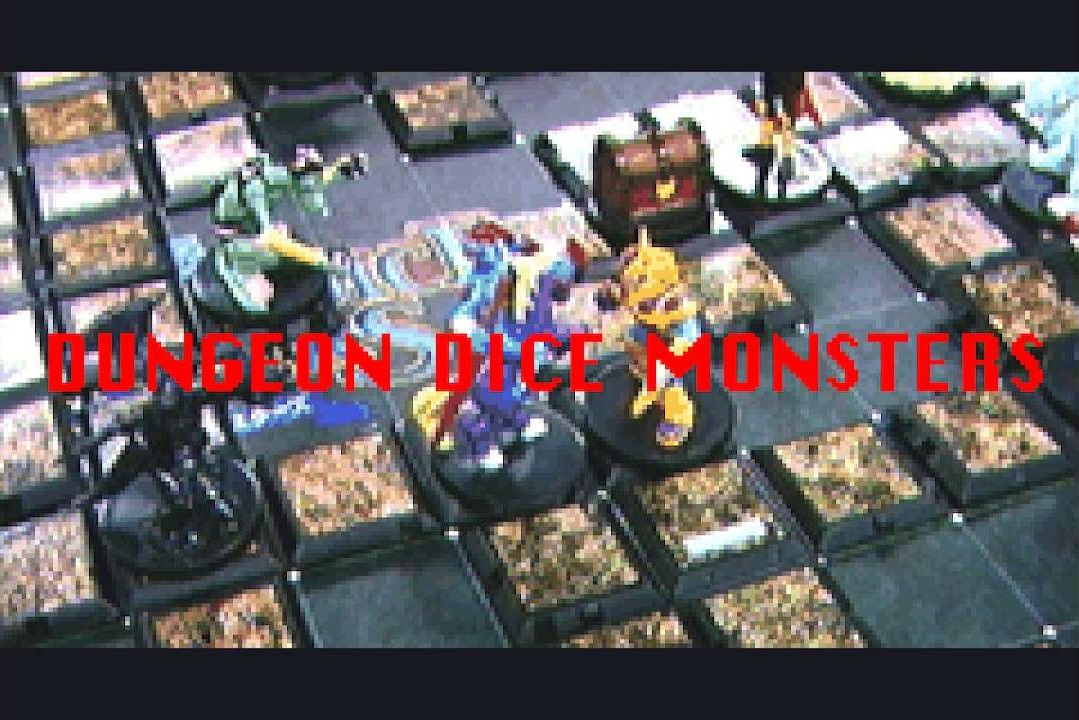
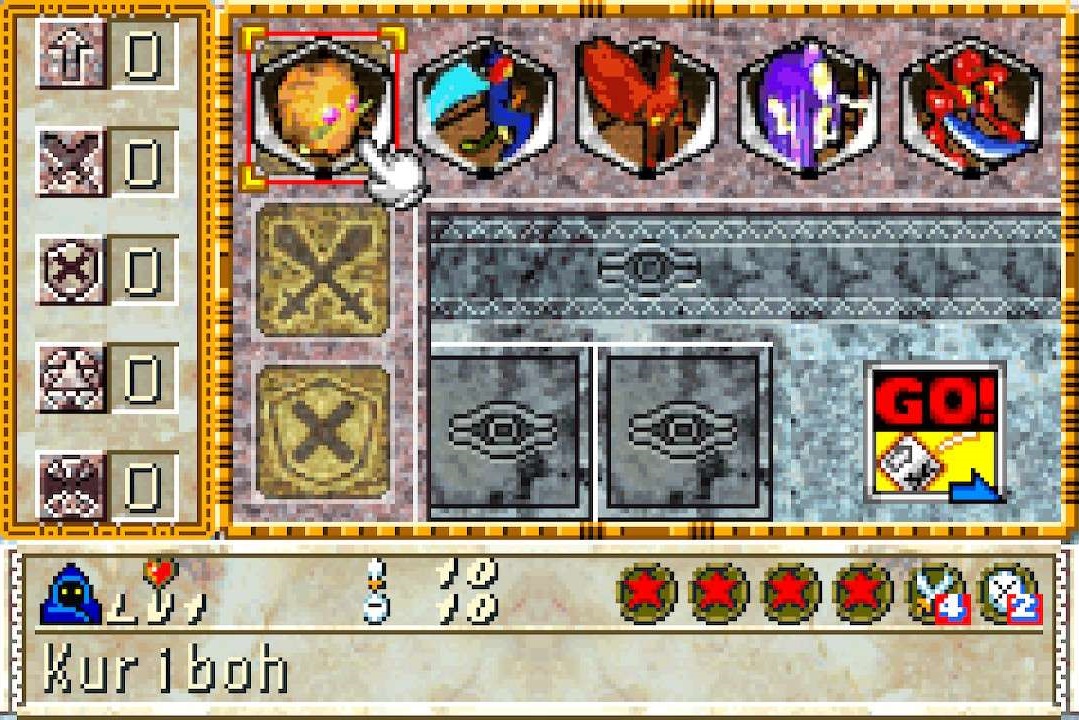
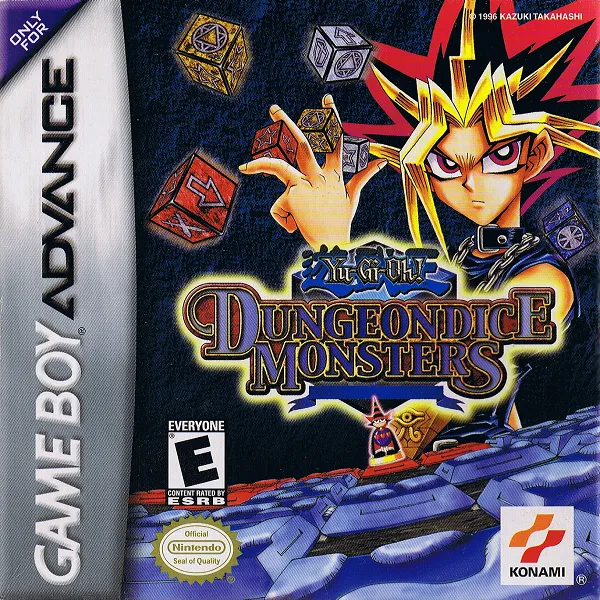
This oddity would repeat itself with Dungeon Dice Monsters, a game based on and yet different from the real-life Dungeon Dice Monsters board game that commercially bombed. There are no tutorials for this game, and I find myself floundering when trying to experiment by myself. Thankfully, we have the original manual available in the EDC. I will familiarize myself with it when I play this game proper. I know it has its fans.
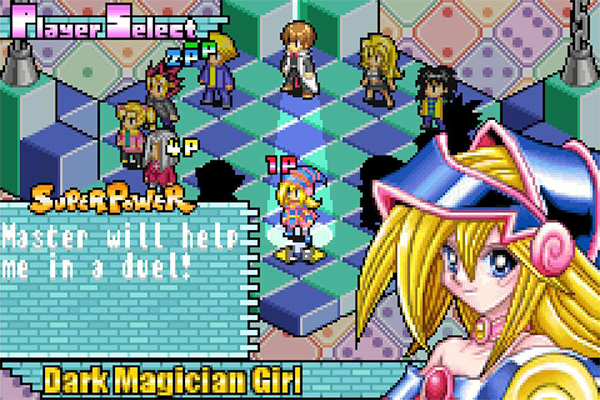
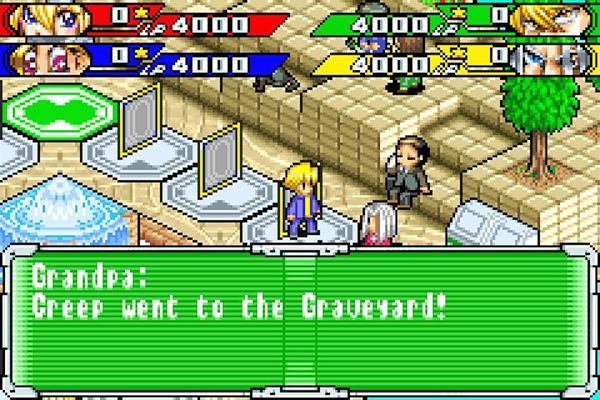
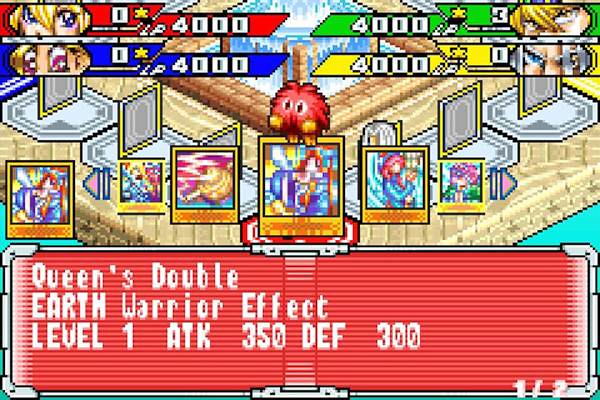
The most controversial of any game on this collection is undoubtedly Yu-Gi-Oh! Destiny Board Traveler. It bears the dishonor of being the lowest-rated YGO game on Metacritic. Cool!
Well, those are just critics. Let’s hear what the common folk have to say. Let’s hear what the GAMERS—
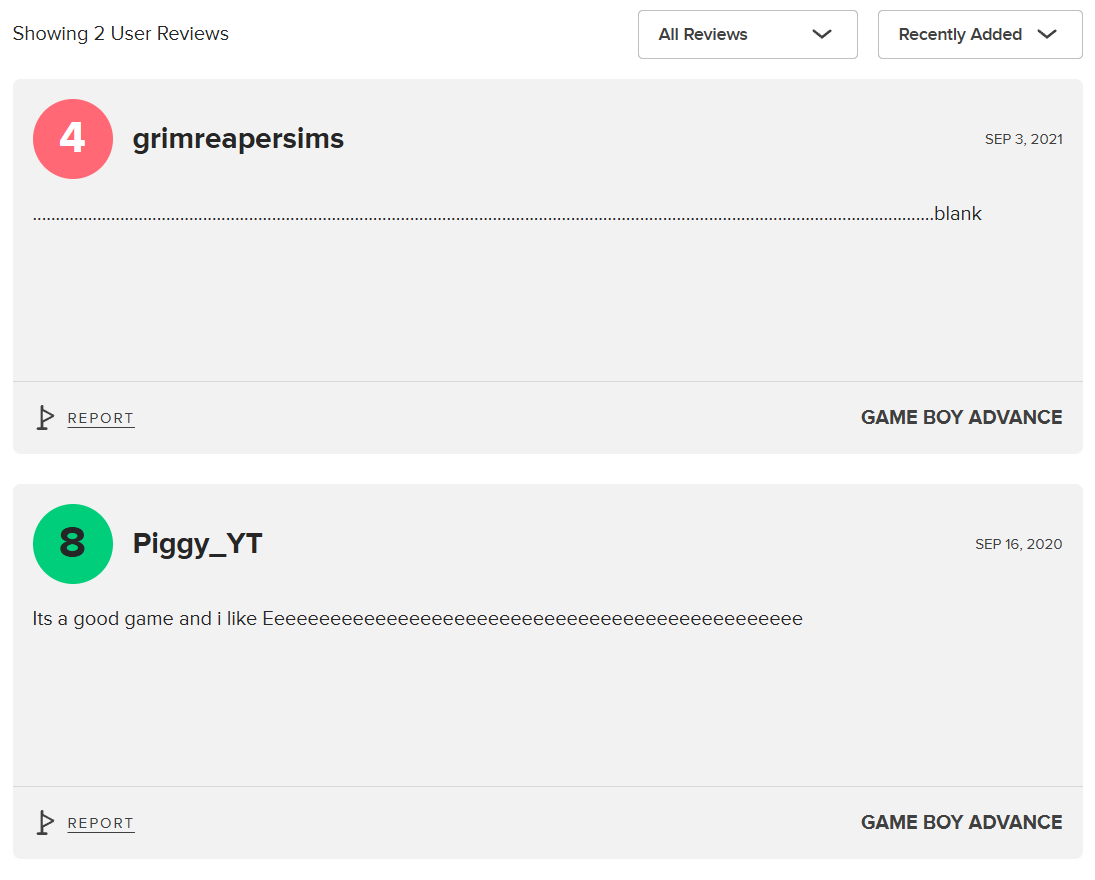
Never mind.
Destiny Board Traveler is a more traditional-styled board game. You select one of many characters from the original anime and manga series and travel around a board with three opponents in search of destiny. I think you’re competing for territory by attempting to claim board spaces.
Yeah, I don’t really know. Sorry. The game is kind of an enigma. Hardly anyone played it, and that number didn’t exactly go up in the face of terrible review scores. It’s commonly criticized for luck-centric gameplay and unclear rules. YouTuber Pikasprey Yellow reviewed the game in 2019, and I would recommend it. Through trial-and-error, Pikasprey learns the rules of the game and even begins to have some measure of fun with the title. One of the most noteworthy things he mentioned was that the instruction manual is outright wrong with some of its descriptions. He showed the manual claimed that you could move your character if you rolled a blank side of the dice when it actually ends your turn. I checked the manual in the Early Days Collection, and this misinformation is still present. A bit embarrassing.
Anyway, I do like the game’s bright colors, and the number of playable characters is pretty cool. You can even play as Dark Magician Girl! So I think it’s a 10/10 game.
Where to Start
If you’re completely flying blind, I would recommend starting with World Championship 2005 for the reasons stated earlier. It has the most involved gameplay and features of any available game, and as such it’s the game most likely to retain someone’s attention. If you would like a simpler entry point as you learn the game, I would recommend Eternal Duelist Soul. It’s very straightforward and allows you to focus on learning the card game and interface. Just know that you can speed up duels by holding L and R during the rock paper scissors game that decides who gets the first turn, then letting go of L and R after the duel starts.
For the spin-offs, engage with them at your leisure. But be aware that they have their own gameplay and rules that may require you to read the manual before getting into the game. Don’t expect them to be pick-up-and-play titles until you’re willing to spend time doing this. It’s a bit of a chore, but it’s better than trial-and-erroring your way through the games and dealing with all the accompanying frustration.
As for the non-simulator Duel Monsters games… play them when you’re looking for wry amusement, I guess. Doesn’t matter which one, really.
An Ode to Darman and Bownly
Click to read more
I am incredibly grateful to the fan translation communities within the gaming sphere. Time and time again, they have brought me remarkable video games I would have never otherwise experienced, both satisfying my curiosity and simple desire for more quality entertainment. With that in mind, I’d like to dedicate something to two contributors who just so happened to get kind of a raw deal.
The first is Darman, who released an English translation of the first Duel Monsters game in 2021 and lived to regret it. I confess that I never played his translation, but I had always intended to do so eventually. In fact, I never would have guessed that it was released in 2021. I can remember the announcement so clearly, and I was excited to see interest in translating these “lost” Yu-Gi-Oh! games. It’s sort of a goal of mine to complete every YGO game eventually, so that’s pretty important. Thank you for your work, Darman. I know I at least played your translation of Fire Emblem: New Mystery of the Emblem – Heroes of Light and Shadow, and I loved it.
At the very least, Darman’s translation had a few years where it was players’ only option. That can’t be said for romhacking.net user Bownly, who created a fan translation patch for Monster Capsule that was released in November 2023. This was just three months before the Early Days Collection was announced. It’s unfortunate timing, and I think their work deserves having a longer legacy than it did. So here’s to you and the rest of the fan translation community for being more eager to bring us these games in English than Konami themselves. Interestingly, both translators opted to localize the scripts in the style of the 4Kids English dub. Konami did the same for the EDC, so it could be intriguing to compare the choices made between translators sharing the same goal.
Overall Value
What Is Above and Beyond
New Instruction Manuals
Expand
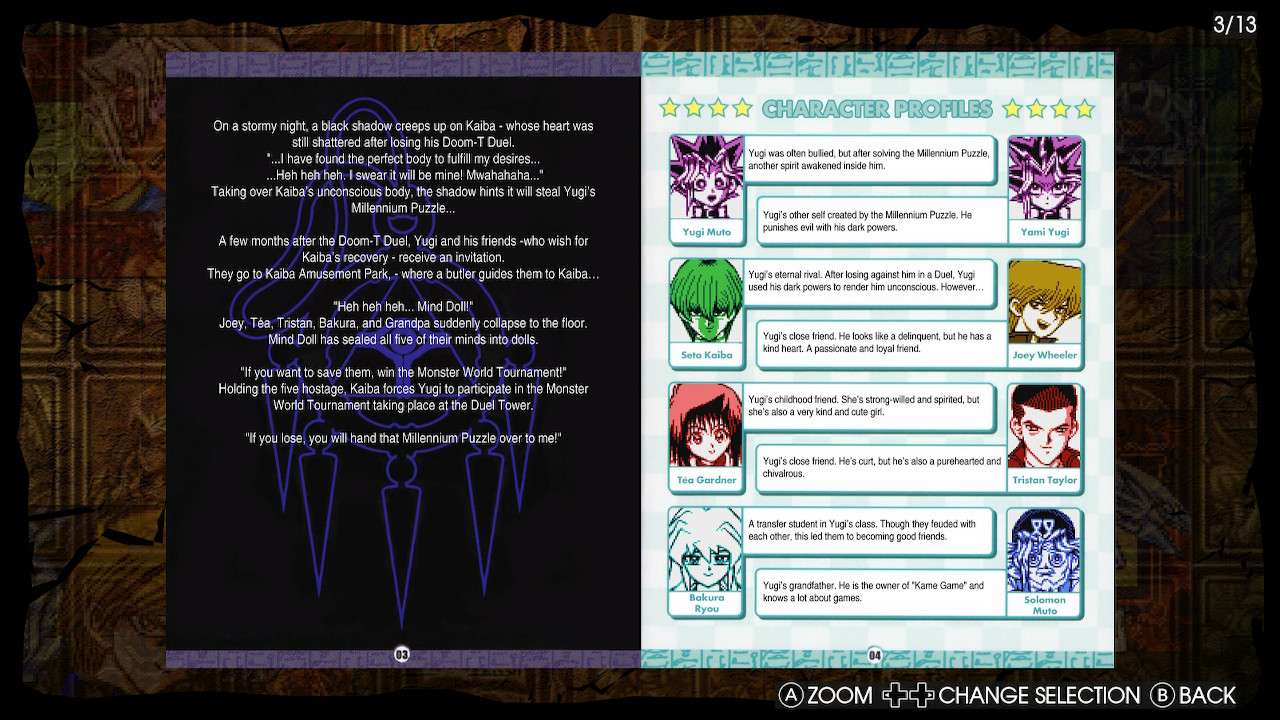
Without a doubt, the most impressive aspect of the Early Days Collection is the included instruction manuals. It’s already appreciated whenever a compilation deigns to scan and preserve the original manuals, but to translate ones not already in English, and to do so at such a professional level? Top class.
To contrast with this, one need only look at 2022’s Neo Geo Pocket Color Selection Vol. 2. This release included two games that were never localized. Not only did SNK neglect to translate them, but the English manuals were heavily truncated, being about 3-4 pages each. To make matters worse, those two games were the most esoteric of the entire group: they needed manuals to make sense. It spit in the face of western audiences who purchased the collection and lowered its already questionable value when compared to the preceding volume.
But here? No such worries. It’s even more amusing in hindsight, because Konami totally could have gotten away with not translating the manuals. The Duel Monsters games are very easy to understand just by experimenting, and Monster Capsule has help text that explains how the game plays. People probably would have shrugged off the manuals’ absence, but they were included anyway, and the whole package is better off for it.
New Translations
Expand
By the same coin, the developers deserve some acknowledgment for translating the games themselves. Unlike the manuals, I think not doing this would have been unforgivable neglect, but that same NGPC collection showed us that nothing was stopping them from releasing the games in only their original language. It’s a practice that should be obligatory, but it’s technically not. So, hats off. Maybe half of a hat.
Original Box Scans
Expand
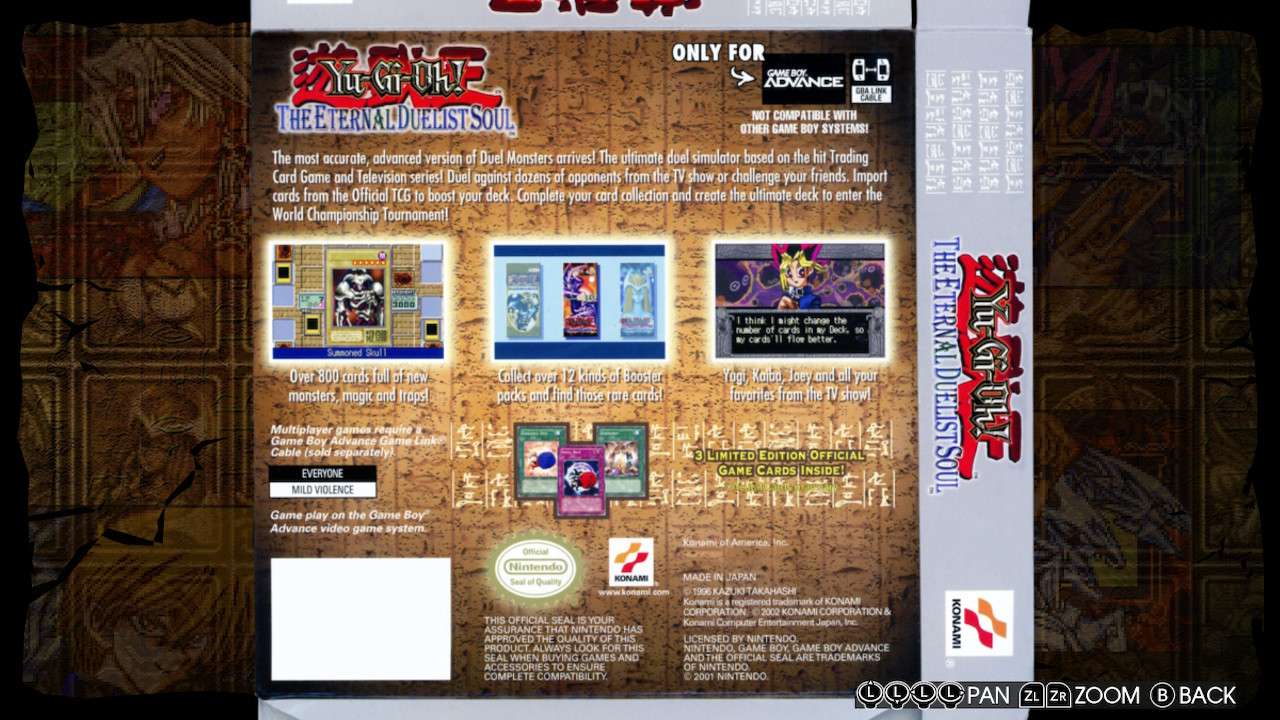
While being able to view the old game boxes is nothing earth-shattering, it’s still a valiant preservation effort. It actually was relevant to the construction of this article. I normally use LaunchBox as my source for high quality box scans, but the Yu-Gi-Oh! games are so niche that they rarely had decent images, and Google Image Search didn’t turn out much better. It then dawned on me that I could simply use the EDC’s scans of the original boxes.
Easier said than done. For starters, boxes are viewed amongst the instruction manual images and only appear for variants of the game that originally had a box for that region. What this means is that Konami and Digital Eclipse didn’t make an original, hypothetical English box for originally Japan-exclusive games such as Duel Monsters. To be able to view these boxes, one must swap the game’s regional version to Japan on the main menu, open the in-game instruction manual, and navigate to the last couple of pages.
As with all gallery images, you can use the typical basic maneuvering options: panning, zooming in, and zooming out. I zoomed in as much as I could without clipping the cover art, panned to the left so that the game UI wasn’t covering the box, and snapped a screenshot. Then I transferred these images to my computer, cropped the stuff beyond the borders of the cover art, and resized the final image to a standard resolution for my site. …Only to then realize that the Switch outputs screenshots at a maximum of 720p—a highly compressed 720p. This defeated the entire purpose of doing this to obtain higher quality images. I ended up asking a friend who owned the Steam version to repeat the screenshot process on their end and send me those screenshots for cropping and resizing. They helped out, but declined to be credited. I salute thee.
Now that I’m an expert, I judge these box scans to be… pretty decent. I can’t help but wonder where Konami and/or Digital Eclipse sourced them from, because it appears like they had to make some compromises. Understandable, considering the age of many of these games. Most developers from these eras didn’t even retain their games’ source code. You think they’re gonna conserve packaging? Not likely, in my opinion. So, did the staff pay top dollar for independently sold near-mint condition copies? Weird to think about, but it’s entirely possible some guy on eBay had their preserved copy of Duel Monsters II purchased by a Konami representative after their listing had been up for like, 10 years.
I use Duel Monsters II as an example because it’s the most obviously compromised box scan I noticed in this collection. You can see for yourself how the right border of the box is cut off. It’s a weird problem. We can see that they had the entire box to scan, so what happened? I can only conclude that they weren’t paying attention and either folded the box wrong or didn’t center it on their scanner. That’s pretty lame. In other cases, the scans appear complete but aren’t angled at a true 90 degrees. That’s pretty much irrelevant for someone just wanting to look at the images and is only an obstacle to someone like me trying to use the scans as an image source. Some of the post-processing (or lack thereof) appears off as well, with Destiny Board Traveler looking oddly washed out.
All in all though, the scans are a good improvement over what we had access to before. I find it a little annoying they erased the system logos from the covers. Did they really not have permission to use those trademarks despite being allowed to commercially emulate the systems themselves? I could potentially overlay a transparent logo onto the box scans in an attempt to reconstruct the actual box appearance, but my Photoshop skills are a little rusty, and this project is taking enough time as it is. I understand that most people will be completely satisfied by these galleries, which is great.
What Could Have Been Done Better
Game Selection
Expand
This is an obvious one. No matter how big a collection is, unless it’s comprehensive, some people are going to be disappointed in certain exclusions. I was never under the impression we were going to get every YGO game. When the EDC was first announced, I saw some people predicting the inclusion of Duelists of the Roses and Forbidden Memories, and I sometimes told them I thought they were a bit of a pipe dream.
The reason isn’t that complicated. These are games that have to be ported via emulation, which requires highly specific coding tailored to the hardware it’s on to ensure accuracy. When considering the EDC is a multiplatform release, this exponentially increases the workload. From my understanding, the Game Boy systems are relatively easy to emulate due to their simplicity, but a disc-based system that renders graphics in real-time requires many more “gears” be tuned to the perfect rhythm.
So, think about this collection from an economic perspective. If you get Game Boy emulation working, you enable several YGO titles to be ported at once. That’s not only efficient—it allows you to market the collection based on the raw number of games included. When choosing what games to include, developers have a massive bias to select systems that are relatively easy to emulate, and which can share a lot of the same programming efforts. The YGO franchise has both of these due to most of its video games having been released on the Game Boy line of handhelds.
The PlayStation is close to the opposite end of the spectrum. For working with more complex hardware, they are paid off with what, two games? For the original PlayStation, at least. And one of them is yet another game and manual to translate into English. The PS2 would provide three games, but one of them is from the GX era, which this collection seemed to make a point of ignoring. The decision to emulate just one more system, let alone two, increases development costs and—having never tried a collection like this before—their confidence is limited with regards to how much the game’s sales will offset those costs.
Don’t misunderstand me: I am not saying anyone is wrong for being disappointed that some games weren’t included. I would have been over the moon to have seen the PlayStation 1 and 2 games. But there is a line where pragmatic decisions have to be made at where to cut the collection off relative to its cost and expected revenue. I’m not even necessarily defending Konami. It’s just that without a clearer picture of the cost analysis involved with the EDC, it’s difficult to credibly accuse Konami of being “cheap,” or whichever insult. In my opinion, people should have expected the PlayStation games to not be in this collection from the start using only the logic I’ve just detailed.
Now for the fun part: what I consider to be a very legitimate reason to criticize the game selection. And it’s very simple: they seemingly learned their way around the GBA hardware, so why the hell are any GBA games absent?
I called this very early on, but yet again, it’s something I wish I wasn’t right about. I predicted that nothing featuring GX era branding would be included in the collection just because all of the marketing leading up to the game’s release focused solely on characters from the first anime and manga storyline. I hate to be this cynical, but I genuinely believe there is no reason Duel Academy and World Championship Tournament 2006 were not included other than the fact it wouldn’t have fit the collection’s branding.
And honestly? Fuck off. That’s a shitty reason. I mean, what’s the alternative explanation? That the only GBA games they couldn’t get working in time were coincidentally the ones featuring GX icons? Their porting priorities should have been decided early on in development, and for that to be true, it would mean they chose to get games like Destiny Board Traveler and Dungeon Dice Monsters working before far more popular, more representative games in the franchise.
Yeah, no chance. They did it on purpose. Not because it was too hard or time-consuming, as they already had GBA emulation working and would have determined their development schedule early on, but because the differing branding gave them a convenient excuse to withhold titles for a possible future collection. I.E., Konami can always respond with “we feel those titles did not represent the era of Yu-Gi-Oh! we wanted to cover,” and them being related to GX technically justifies that decision. And if the first collection bombs and that follow-up is never made? Well, what do they care that it had two less games? It’s not like their inclusion would’ve been enough to completely reverse that.
Maybe it’s no skin off Konami’s back, but it certainly chafes me. I consider World Championship Tournament 2006 to be the best Yu-Gi-Oh! video game ever made, and I think it by its lonesome is more value than everything on this collection put together. I’m not even kidding. Not to mention, the card game was just starting to get more interesting around that time. Archetypes were becoming an increasing focus, and the playstyle of some of them, such as Dark World, added needed variety and a higher skill ceiling. Online compatibility for WC 2006 on its own would make it much easier to recommend this anthology. It’s such a shame.
Polish
Expand
The early Yu-Gi-Oh! games had quite a few bugs, especially when they began to simulate the real card game. It’s understandable, given the complexity of all the rules and effects involved. But Konami doesn’t have the justifiable excuse of overlooking these anymore. We’ve known exactly what the bugs are for years now, often what causes them in the programming, and all of this is documented across the internet. It takes very little work to find any of these “bug reports,” and once they’re known, it’s also trivial to fix most of them. Yet, from what I can tell, none have been resolved in the EDC.
Similarly, the abundance of typos and grammatical errors not only remains but gets worse. While mostly fine, the formerly Japanese-exclusive games’ new English scripts have their fair share of text blunders. It’s not constant enough to be too annoying in my opinion, and the meaning of each sentence is generally unchanged. All the same, it’s an unprofessional level of quality for a company of Konami’s standing. I guess one could argue that these mistakes make the localizations feel more “genuine” to the time period…
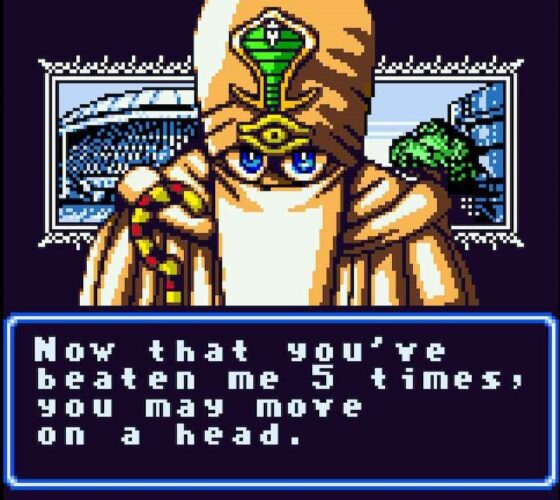
Lastly, I’d like to talk about the EDC itself: the menus are just kind of lame. They come across as cheap and hastily thrown together. Sound effects when navigating are barely audible, and the in-game overlay menus are entirely text. No icons or flavor whatsoever. It’s not a huge deal, because you’ll be spending most of your time in the games themselves, but come on. We deserve better.
Incomplete Games
Expand
I wasn’t certain where I should put these details, but there are some issues that came with porting a few of these games without changes. So far, this mostly appears to affect Duel Monsters 1. First off, there are a few cards in the game that can normally only be obtained via entering a password. Those familiar with the 2002 McDonald’s promotion will recognize many of these cards! Anyway, the passwords are meant to be the names or nicknames of people involved in the game’s creation.
The new English version of this game does not allow inputting Japanese text, so the passwords were Romanized. This created a new problem where players at launch had no idea how to input some of the passwords. The troublesome ones included a blank space, which there is no way to input. After a few days, people discovered that by entering the password in full, selecting “back,” and pressing B that they were able to delete a character and allow the passwords to be read. It’s ridiculously esoteric, and it’s not hard to imagine a world where this makeshift solution wasn’t discovered for months, if not years.
Also unplayable are several cards that were only handed out at the Yu-Gi-Oh! Duel Monsters National Tournament held in Japan. Participants who ranked high enough would receive physical prize cards, as well as their digital counterparts in Duel Monsters. If you’ve seen images of Black Luster Soldier, Fiend’s Mirror, Super War-Lion, and Zera the Mant printed as Normal Monster cards, this event is why.
Now, the EDC did kind of introduce a workaround. Remember the cheat feature? Yeah. You can just turn that sucker on and immediately obtain all cards—and only all cards. If you want to get 100% in Duel Monsters, you are straight up required to cheat. I think that sucks. I was actually enjoying grinding and gradually improving my deck via lucky card drops even after beating the game, and learning this took all the wind out of my sails. If you’re a completionist like me and don’t like using cheats, there’s no great way to reconcile this. You could max out on copies of all other cards, but Duel Monsters allows you to run up to 40 of any card, so you would have to get 40 of each card. And some of those cards only drop once every 100 duels against specific opponents.
I wanted to grind this through while watching TV and such whenever I felt like it, but now it’s no longer fun to do legitimately. I either have to get 40 of every card, which takes an eternity and a half, or just bite the bullet and use the cheat to obtain everything. Most people will not care at all about this, and that’s their prerogative. The real issue is that it’s a problem that did not need to exist. It would have been trivial to add these unobtainable cards to the random drop pool, but no one cared to bother. Just like how no one cared to test if some passwords could even be entered. Does that not imply a lack of effort to you? I feel like it does. We all deserve more than the bare minimum for $50.
The second thing I want to bring up is a bit of a different beast and concerns Yu-Gi-Oh! Duel Monsters 6: Expert 2 (DM6), the only game in the collection to remain exclusively in Japanese. Konami assures English audiences that this game is playable via Yu-Gi-Oh! Worldwide Edition: Stairway to the Destined Duel (WE). This is a bit of a fib. Maybe more than a bit. These are not the same exact game. It’s obvious when you think about it: why would Expert 2 be the only regional version of a game to receive its own spot on the game selection menu? Why would it not be listed as the Japanese version of Worldwide Edition, similar to all other games with optional regional variants and accessed in the same way?
Because it’s not the same game. They know it’s not the same game. They have to know, because Worldwide Edition was rereleased in Japan as Yu-Gi-Oh! Duel Monsters International: Worldwide Edition and is also in this collection. As is par for the course when it comes to Yu-Gi-Oh!, Japan is getting something English audiences don’t. Not because they can’t give it to us, but because we don’t matter enough for them to bother.
So what are we missing? The Cutting Room Floor goes over the differences in full, and it’s a well-organized read. The most notable difference is that WE has 29 less cards than DM6. Six of these are unplayable “trophy” cards, so those are no big deal. As for the rest, I have no idea why these cards were chosen or why they weren’t included to begin with.
While most of these cards aren’t a part of the meta, many are nonetheless fun to use and provide variety. Some examples are Swift Gaia the Fierce Knight, Ancient Lamp, and Magic Drain. The most significant exclusion is Scapegoat, a meta-defining staple. So careless were some of these removals that they even affected AI deck strategies and caused glitches. I don’t know what to say. It just feels as if the developers sabotaged their own game on a lark.
Due to disinterest in translating DM6, English audiences are given a game that’s inferior in some significant ways. It’s very lame that DM6 wasn’t translated like every other game here. It should have been relatively easy to do, as much of the code used to facilitate English text in WE could likely have been repurposed for DM6. For $50, you don’t even get the full set of games in English. Konami just did not care.
There are other incongruities between some English games and their Japanese counterparts, but fortunately most of them are negligible. For whatever reason, many visual effects and animations in the first few GBA games were removed from the English versions. Naturally, the EDC doesn’t restore them. Supposedly, when Toon World is played in the Japanese version of The Eternal Duelist Soul, the music changes to a unique theme. I can’t find an upload of it for the life of me. It’s not always a bad trade, however. In many cases, the English versions had their UIs improved along with other polishings. Again, I would direct those curious to browse The Cutting Room Floor. To my knowledge, the only other genuine content loss is the removal of the D-Tactics mode from TEDS. This mode was similar to the “Duel Puzzle” modes seen in future YGO games. It would have been a great thing to restore and advertise the collection with, considering TEDS is one of the most popular games in it, but alas: the profit margin.
Game Speed
Expand
Above all else, we finally get to what I think is the biggest mistake in the Early Days Collection: no universal speedup options. I mentioned earlier that the only games to receive a speed boost were the first four Duel Monsters games, but I didn’t talk about the incredibly weird way it’s implemented. Standard practice for speeding up emulated games is to increase the framerate either by processing more frames a second or intermittently skipping frames. The EDC does not do this. It appears me that the developers created new code. Let me explain.
The way the feature works is by holding down the A button (or whatever your configuration is) during battling animations. To eliminate all ambiguity, I’m talking about when the screen changes from the battlefield to show the two battling monsters side-by-side. If the A button is held during this, the animation appears to play at twice the speed.
There’s three reasons I think this is a change to game code instead of an emulator function:
- The audio doesn’t play at a higher speed. If the emulator was speeding the game up, it wouldn’t be able to pick and choose which elements were being sped up without desyncing the audio and visuals. A common way emulators avoid distorted, sped-up audio is by muting
- You can only speed up during battle animations. An emulator isn’t going to inherently “know” the difference in context between a battle screen and other parts of the game. You could program an emulator to recognize that, but I suspect it would be far easier to modify the games themselves. When a battle scene concludes, the remaining Monsters hold still while the LP counter ticks down (if at all). The number of frames until the screen changes is probably a set value. If that’s the case, I don’t think it would be difficult to program a function where that value is replaced by a faster value while the A button is being held. If that value isn’t referenced by other code, then it shouldn’t affect anything else in the game.
- The feature is only shared between games made on the same engine. This would make reusing the code easy for those games, but would probably require different code for the GBA games.
While I didn’t test every game, I did test the original US version of Dark Duel Stories. It appears holding A does nothing to speed up the game there. The obvious thing to wonder here is why speed up was implemented in this arcane fashion when doing it through the emulator would have been easier and applicable to all games. I refuse to believe it’s a matter of processing power. Unless their emulator is the most unoptimized GBA emulator ever made, even the Switch should be able play Game Boy games at dozens of times the original speed.
I wracked my brain trying to come up with a reason, and I regret to inform that the only one I thought of might also be the dumbest possible justification. I think someone connected to the project thought that the jittery, messy visuals and audio that comes from sped-up emulation looked “unprofessional” and said to avoid implementing speed-up measures unless it was done internally. I know it sounds insane that a developer would forgo a beneficial feature and risk their game’s reception based on image, but I just cannot think of any other explanation. If that was what happened or anywhere close to it, then I’m glad to see that choice has backfired: Wikipedia’s article intro states that the game has seen mixed reviews partially due to “slow gameplay.”
If you had asked me at the game’s announcement whether I thought game speed would be untouched, I would have unequivocally said “no chance.” Egg on my face, I suppose.
This sucks. This really sucks. I don’t think I have to explain wanting to be able to make duels faster, but I will anyway. The primary gameplay is the decision-making in the card game, and speeding up animations and transitions decreases the time spent idling between those decisions. Faster animations means more of your time spent playing the game is actually spent, well, playing it. Some people are fine with sacrificing some of that for visual flair, and there’s nothing wrong with that. By the same coin, I don’t see why we can’t at least be given a choice to make the games faster.
The lack of this feature is especially bad for World Championship Tournament 2004 and Reshef of Destruction. The former has agonizingly slow phase transitions for no reason despite using the same dueling interface as previous, faster installments. The latter similarly uses the same interface as Sacred Cards, but some absolute psychopath on the development team decided to add an effect where a cursor scans across the entire dueling field every single time a card is played. I can’t overstate just how stupid and pointless of an effect it is. Whoever is responsible for it should be fired for betraying the best interests of the company. Not even kidding. Anyway, a turbo feature would have greatly mitigated these terrible design elements. There are no good excuses for it being absent after over a year of development time and a $50 price tag. Absolutely none.
Cheats
Expand
I think cheats can be a great quality-of-life addition to game compilations, but this is about as basic of an implementation one could possibly do. Remember: fans created ten times the amount of cheat codes within the first few days of these games being released. And yet, we can only get about three or four per game and they almost all do the same things, effectively being “beat the game” switches. Some cheats give you a modicum of control over the level of power they provide, but let’s be real here. Having 1 of every card over having 3 of every card is already enough to demolish any of these games’ campaigns. Yu-Gi-Oh! specifically doesn’t let you use more than 1 of the most powerful cards in your deck. Finding 40 usable cards out of the card pool in each game is just not a meaningful restriction.
The cheats are a phaser gun with two settings: “kill” and “kill harder.” There’s no gradient for people who want to speed up the grind without removing game progression entirely. You can’t choose to give yourself specific cards. You can’t choose to increase your deck capacity by only a little bit. It’s all or nothing. You can’t even have two save files where you have one cheated file to mess around with and one legitimate file. Every game here natively only has one save slot, and while emulation could have provided hundreds more, they just didn’t bother.
Of course, there’s other ways cheats can be useful. They can increase your movement speed, or increase text scrolling speed, or sometimes disable animations. None of these are present, either. Again, I want it to be made abundantly clear that everything I’ve described is trivial to add. Hobbyist coders have done all of it in their spare time for free across decades, and this multi-billion dollar company couldn’t accomplish it in over a year? And they’re asking $50 for their work? No, they chose not to do it because it was cheaper and easier. That took priority over the game’s quality.
Online Play
Expand
Well, there’s no way to sugarcoat it: only having one game playable online at launch sucks. Having that one game be Duel Monsters 4 sucks even harder. I think people would be far more interested in playing the actual card game than the Duel Monsters variant, which will probably be a solved and stale format in a week. At the time of writing this, we also have received no communication with regards to when more online compatibility will be added or which games will receive it.
As Konami has stated that not all games will receive online functionality, which games should we even hope for? Do we really need every card game format playable online? Wouldn’t it make more sense to have a variety of play experiences by having online for the spin-offs? The fact we have to consider choosing is really lame, because there’s genuine arguments for both sides.
If you ask my cynical ass, I expect they didn’t want to commit resources before knowing if the EDC would sell well. Developing online gaming netcode takes time and money, and if a company doesn’t see returns on that investment it can be considered wasted effort. Of course, delivering a quality product should never be considered a “wasted effort,” but the economy doesn’t necessarily incentivize quality so much as it incentivizes keeping cost-to-profit ratio as uneven as possible. It’s not enough to turn a profit; the profit must be as large as theoretically possible.
So, Konami allowed themselves an avenue where they could cut and run. They made it so they could advertise the EDC as having online support and technically be telling the truth. But how many people would buy the EDC only to play Duel Monsters 4 online—a game unfamiliar to English audiences? Genuinely, I think the number of those people might be within the single digits. Rather, Konami is hoping you either don’t do research before buying the EDC, or you have blind faith the games you’re hoping for will eventually receive online support. Konami likely did some kind of analysis and/or speculation and determined that the number of purchases and revenue they might lose by launching with lackluster online would probably not eclipse the potential cost of developing said online features.
If the collection sells poorly, they can just abandon future support and save themselves the cost of doing so. Because they technically “promised” at least one more game would receive online support, they could even potentially repurpose some of DM4’s netcode for DM3, shove DM3 online, and vanish into the dreamscape of their next scheme. Hell, it wouldn’t be the first time. Yu-Gi-Oh! RUSH DUEL: Dawn of the Battle Royale!! released for the Switch in 2021, and dataminers found partially complete English translations for a major DLC update. After the game had disappointing sales in the west (likely due in part to Konami’s own lack of marketing), the DLC was never released.
Point being: they don’t care about you. They don’t even want your money: they want everyone’s money. This will be preaching to the choir to some of you (good work), but it will hopefully be a reality check to others. There’s a tendency to respond flippantly to this kind of rhetoric with, “a company being greedy? What a surprise!” But it’s important to remember that it’s not about making enough money to keep your company afloat and pay staff. It could be about that, but that style of generating revenue doesn’t meet shareholder obligations for infinite, perpetual growth. It doesn’t have to be this way. A market can exist where a party creates something they think is actually worth the cost without being in an inherently antagonistic relationship with their customers and even their own staff. Don’t respond to this rhetoric as if it’s some inevitable outcome. It’s not. A small amount of people allow it to be this way for their exclusive benefit. Now, if you’ll excuse me, we can move on to:
The Cost
Expand
$50 for a collection of Game Boy games with next to no additional work being done is a lot to ask for. It’s the same price Nintendo asks for a yearly subscription to their Nintendo Switch Online + Expansion Pack deal. Think about this for a moment: you need to at least subscribe for NS Online to even play this game online (if you’re on Switch). For an upgraded cost, you get access to some of the best games ever made and more.
As much as I like the games in this collection, I do not think any of them meet that “best ever” qualifier. To be fair, the NSO subscription is just a subscription—you don’t own the games like you would with the EDC. On the other hand, you can cut the NSO fees even further with a family plan. There’s not a perfect comparison between the two when it comes to establishing the EDC’s value, but it’s food for thought. I’m not even shilling for NSO here: I think most of its features should be free, I think the updates it receives are pathetically slow and sometimes of questionable quality, and I think it’s also overpriced in many aspects.
But like, come on. I’ll call a spade a spade. The EDC’s $50 price is kind of nonsense. Honestly, I’m shocked it took an entire year from announcement for this collection to even come out. What were they doing that entire time? I do not believe a company with the resources and experience that Konami has should need that much time to properly emulate Game Boy games and translate a few of them and their manuals. It’s not a trivial amount of work. But a year? For a company that has a market cap of $16.49 billion? They couldn’t spare the money to hire enough people to have a collection of Game Boy games be fully featured even with an entire year?
Yeah, I don’t think so. Again, the interest of keeping costs low usurped their obligation to push out a higher quality product. To give a counter-example showing how it doesn’t have to be this way, look no further than one of Konami’s longtime rivals, Capcom. While they have certainly earned their own share of criticism, Capcom significantly outperformed the EDC with their release of the Mega Man Battle Network Legacy Collection. The difference in effort is pretty staggering. Games have had their code adjusted to fix certain bugs and other problems. The interface has a copious amount of flair and even voice acting. Every game is fully online compatible, despite the action gameplay necessarily requiring relatively high-quality netcode. It’s $60, sure, but it’s in exchange for the games and all of those features.
I can’t tell you if the Early Days Collection is worth your $50. You know the value of your money more than I do. The most I can do is give you an idea of what you can expect so that you can make an informed purchase. Speaking personally, I don’t regret buying the game, but I did expect more than what I got. I can’t overstate how simply having fast-forward across all titles would have greatly rose my evaluation of this product. The thought that I could have a much better playing experience with emulators created nearly as long ago as these games looms over me. Sure, they don’t necessarily have online—but neither does this. If you read my intro, you can probably agree that I am the target audience for the Early Days Collection. Yet, even I have reservations about recommending the game at its $50 price point. Naturally, anyone curious can wait for a sale or more online compatibility, but only time will tell how those affect this collection’s estimated worth.
The Future
In a sense, Master Duel has normalized routine updates for a Yu-Gi-Oh! video game, though I understand the difference of obligation for a live service game. I’d like to believe that the Early Days Collection could receive patches that fix at least some of the issues I brought up. A fast-forward option for all games would, I expect, be trivial to implement. They practically advertised the game as having such, so I think they owe us that much for their dishonesty (intended or not).
There’s also the potential for DLC. I don’t think it’s very likely, but it would be one way to force players to cover the costs of figuring out PlayStation emulation, or a smaller scale way to nickel and dime us for the missing GBA games rather than producing an entirely new collection. Depending on how it’s done and priced, I could be in favor of DLC.
Solemn Judgment
A fun collection that rarely rises above the bare minimum, which often gets in the way of feeling said fun. If you have to ask yourself if The Early Days Collection is for you, then it probably isn’t. Nevertheless, I do appreciate Konami acknowledging the fascinating video game history of Yu-Gi-Oh!, and I genuinely hope to see more of that in the future. I would be more enthused with the company enshrining the most unique Yu-Gi-Oh! experiences rather than adaptations of the existing card game. Bring back the weird spinoffs like The Duelists of the Roses and The Falsebound Kingdom. Hell, make a Yu-Gi-Oh! Dynasty Warriors game, already. And don’t you dare leave Red-Eyes Black Dragon out of the roster.
Leave a Reply