







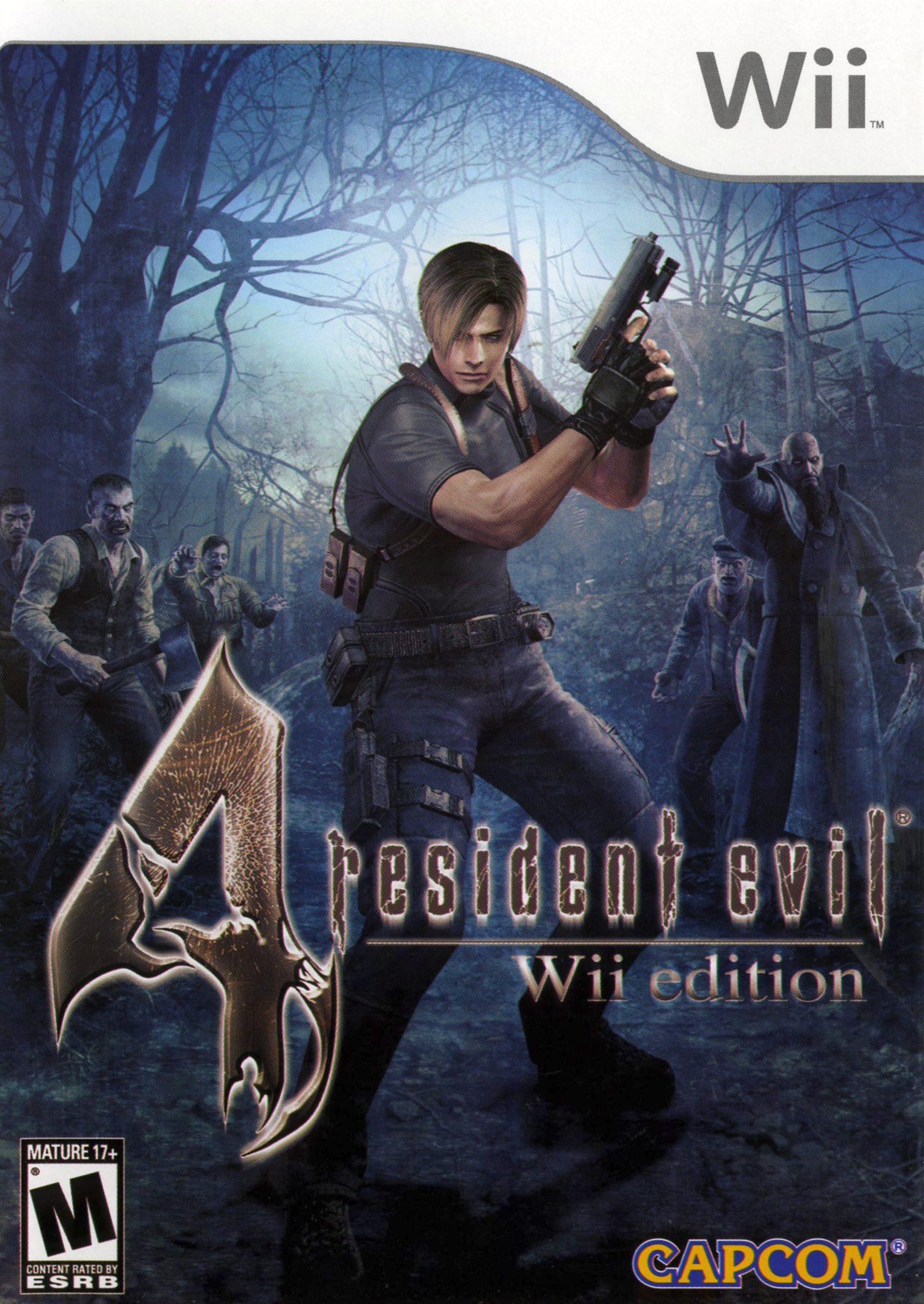
NAME(S): Resident Evil 4 / RE4
PLATFORM(S): Wii
DEVELOPER(S): Capcom
PUBLISHER(S): Capcom
GENRE(S): Third-Person Shooter / Adventure / Survival Horror
RELEASED: January 11, 2005 (North America) / January 27, 2005 (Japan) / March 18, 2005 (PAL)
This one was long overdue, obviously. When Resident Evil 4 (RE4) came out it was unavoidable, but I did my best to because A. I was still a coward who avoided anything horror-themed as much as I avoided sleeping with the lights off, and B. It doesn’t have cute anime art, which is something I’m still struggling with.
It’s pretty unfortunate that the best-designed game I’ve played on the Wii so far isn’t an actual Wii game. With emulation, I could’ve played the original GameCube (GCN) version regardless, but it’s better to have one great game than a bunch of decent ones. Anyway, when I got over being a coward, it became impossible to find the GCN version, and I wasn’t going to play the watered-down PlayStation 2 port I saw in every single GameStop. I also couldn’t have my own debit card back then, so I rarely ordered things online.
But that’s all in the past now. I got a Wii, was looking up games, saw Resident Evil 4 got a port and was like “hey” and here I am. I wish I could’ve been there when this game came out and cinematic action adventure games were still rare pleasures, but I didn’t need to be to see how this is leaps and bounds better than a bunch of the triple A garbage that copied it, and it should be a primer in how to involve a player in a fixed narrative but naturally it was only an influence on a superficial level.
Developers that look at a game, say “let’s put this and that and this and that in” and put no thought towards the chemistry and how it worked as a package because haphazardly focusing on individual parts leads to an unbalanced game where these parts have to shove other parts out of the way which ends up weakening the whole experience.
Resident Evil 4‘s own granddaddy, if it has one, is the original Metal Gear Solid which popularized inserting the player’s actions into the narrative as much as it could, and by creating a game full of unique set pieces and locales created a sense of true involvement in events by creating an in-universe logical progression of gameplay that doesn’t sacrifice player agency. It was a notable step forward for making bigger games than ever before that could fit any fun mechanics we had before, no matter how complex or simple.
Unfortunately, it was the story, primarily the uncontrollable movie-like cutscenes everyone stuck to, rather than Metal Gear Solid‘s subtleties of game design that aided that same storytelling. This lead to a rise of games that made it their mission to only tell the player that they were important, rather than making them feel like they were important.
Resident Evil 4 is an extremely narrative focused game, and yet it is not at all plot focused. This is opposed to Metal Gear Solid which was definitely both due to the aforementioned uncontrollable cutscenes. Resident Evil 4 has an extremely basic plot without many details towards any of the individual elements that are used to create reasons for the game world existing and the player’s motivation to explore it, yet the player is guided to feel specific emotions at almost every given segment through the game’s non-stop rollercoaster of action set pieces.
I kept playing the game only to be continuously amazed at how almost every single room in the game was turned into unique terrain your enemy took advantage of that you had to find a way around, unique spins on the usual gameplay such as having to snipe enemies away from a distant Ashley or having to shoot enemies from the back of a moving truck, or unique super-scripted QTE events such as needing to dodge a sudden rolling boulder or grab onto a bridge as it suddenly snaps and falls. It’s easy for me to compare Resident Evil 4‘s stage structure to Metal Gear Solid 3‘s (MGS3), yet the framework of Resident Evil 4‘s “stages” or rooms is much smaller and more focused, full of many different ways to reach a solution that all feel valid.
MGS3, as much as I greatly like the game, put a few obvious solutions in your face but there were always plenty of equally obvious approaches that felt extremely cheap to do yet are much faster and even encouraged due to the game’s cliffhanger plot dangling in front of you like a carrot on a stick. You could say making an exciting game comes down to how good you are at contrivances, and Shinji Mikami goes all out in this regard.
Resident Evil 4‘s style is something like that of John Carpenter’s. It’s a mix of horror and action tropes while excelling at both as much as the “genuine” article, and also like John Carpenter is able to reap the benefit of focusing on one of these things without sacrificing the other when it’s in a different context. Though RE4 invites you many times to laugh at the absurdity of your own “terrifying” enemies, it’s also full of genuinely unsettling imagery aided by its fantastic graphical detail that looks very similar to Silent Hill 3‘s, and its sense of atmosphere never comes out of focus due to self-parody thanks to a commitment to frequent eerie silence and a stalker-like ambient score that effectively provokes the player in the presence of possible danger.
I don’t have a whole lot of experience with shooters so it’s much easier for me to comment on the actual level design, but mechanically I found Resident Evil 4 to be pretty satisfactory. Shooting is quick and easy to do, weapon variety and upgrading is almost always more fun than none at all, and despite the game’s fairly easy difficulty the reward of seeing your enemy’s head splatter or blowing a group of enemies to pieces with a grenade rewards skillful playing in a way that isn’t demanded by necessity. Mitigating easy difficulty with good mechanical feedback is a perfectly acceptable way to design game as not everything needs to be some arbitrary level of challenge, but this mitigation still benefits some games more than others. In RE4’s case, issues arise from the easy difficulty for a couple of reasons.
One of those is the atmosphere. Being alone should be inherently uncomfortable, but if you never find yourself wanting help, after a while it becomes less and less uncomfortable as your confidence increases by how easy enemies are to deal with. RE4 puts such a great visual and sonic effort into maintaining its atmosphere, and the level design is full of surprises particularly with the beginning of the game encouraging stealth somewhat, and it’s unfortunate that this quality is gradually shifted away from to splatter more enemies as I don’t think it’s an equal conversion.
The other major reason is that it undermines the second phase of navigating RE4’s level design. Since the game is composed almost entirely of original set-pieces with their own gimmicks and terrain, you could say the general progression of the game is: enter new room > analyze territory while avoiding the enemy > use the territory against the enemy to clear the room and turn the advantage around.
This flow is always satisfying because the final victory seems a reward towards the player’s cleverness, but the significance of the player’s skill here and thus their feeling of accomplishment is partly undone by how little the game punishes the player ignoring the terrain or making a mistake in judging it (as healing items are extremely common). This means the player can choose to not fully engage with the level design if they can’t be bothered. It also means that the advantage gained from sussing the terrain out isn’t that big of a deal when it comes to defeating the enemy because they’re almost never threatening when handled in a traditional way, usually taking your time being more than enough.
Despite the glaring issue of the low difficulty making it sometimes feel as if I’m playing to see how the action can get mixed up rather than the action inherently being perfectly satisfying, RE4 more than makes up for it with its addicting dynamic stage structure and how fun it is to simply kill enemies on their own in a variety of ways.
This focus on action over ineffective B-movie horror and simple approaches to combat make RE4 the first Resident Evil game I’ve really enjoyed, and one of the most ambitious games I’ve played in recent memory. It’s sad to realize that this is because RE4 is an old game and thus a thing of the past, where profit through immediate stimulation wasn’t the be all end all of a game experience and many talented studios full of talented people were still pouring their complete heart into making memorable experiences comprised of hard work, and an extreme attention of detail to their predecessors that carried over in their attention to their own game design. When Resident Evil 4 came out, we were in an ideal era where almost no game seemed too big or too small due to its technology, and even a giant game like RE4 wasn’t breaking at the seams.
Leave a Reply