








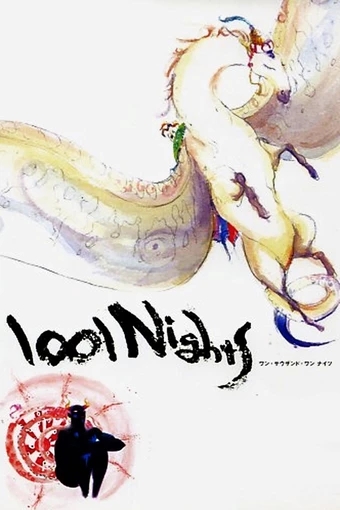
I’m not sure why 1001 Nights is considered anime, because as far as I can see it was made almost entirely outside of Japan. But it looks thoroughly familiar to many who’ve immersed themselves in Japanese culture due to featuring the artwork of Yoshitaka Amano, frequent concept artist for the Final Fantasy series, among others.
While I’ve always thought Amano was an immensely skilled and distinctive artist, I’ve been at odds with his work in the past when I’ve felt it didn’t have much chemistry with the end product. He’s typically involved at the pre-production stage, which means his intent can be warped by the end. Seeing 1001 Nights present his style in a format finally free from all pretensions was a treat, and I’ve never respected him more than after seeing this.
This is a thoroughly surreal 22-minute animated short film whose only context is depicting a state of dreaming. That’s perhaps the only world perfectly suitable for the fantastical lens Amano paints his worlds with, making them look familiar to our own but presented in an unfamiliar, illogical fashion. To be able to see his style animated is a significant selling point for this movie, and the exotic, shifting inversions of colors and rippling, refracting transitions flow with a lack of restraint that reflects his ethereal character designs.
David Newman’s expressionist orchestral score is reminiscent of something you’d hear during a Shakespearean play performance, which feels appropriate when combined with imagery of deities and devils interfering in the thoughts of man. The images move with such a turbulent pace that I didn’t have time to link together a coherent message or story, if there even is one. However, a consistent pattern of images implying desire, temptation, and envy give the impression of a thematic narrative, rather than what would otherwise only be an animated gallery of Amano’s artwork. I found 1001 Nights a relaxing watch, and for that reason, I think I’ll return to it in the future.
Leave a Reply