








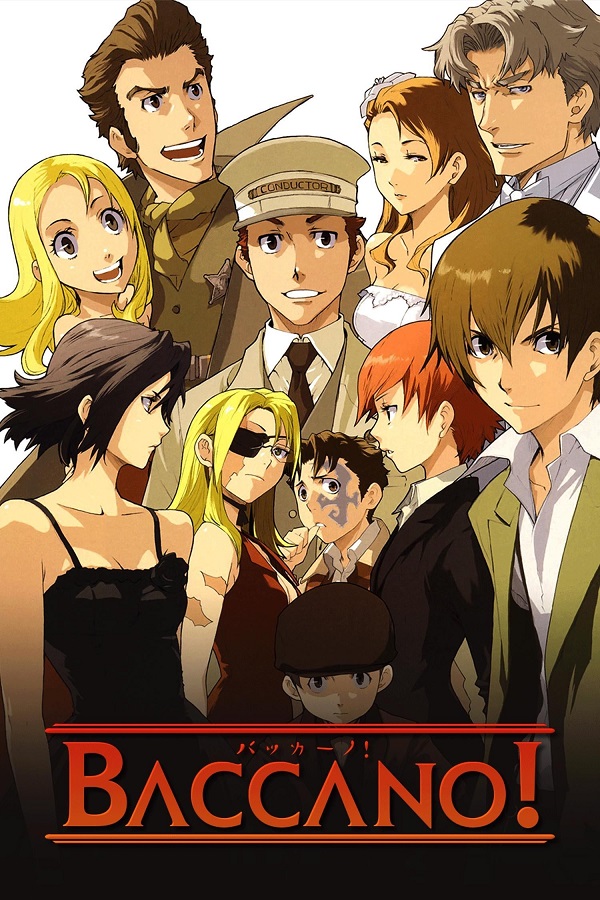
Name(s): Baccano! / バッカーノ!
Baccano! Review
I’ve been having this one recommended to me for years. Baccano! is a widely-popular series that I just never got around (we all have those, and always will). I probably put it off because most people who recommended it to me were never able to explain what it was about. It’s hard to decide whether you’re in the mood for something when you don’t even know what it is.
I eventually came across a description that made it sound right up my alley, so I finally took that plunge. If you ask me, a description is actually pretty easy. An immortality elixir has been discovered, and the secrecy and demand surrounding it sets into motion a series of hijinks that impact a cast of characters (mostly mobsters) in the 1930s.
To begin with, Baccano! has received a lot of comparisons to the films of Quentin Tarantino for several (superficial reasons). This had made it convenient to recommend for fans of the famous director, and it’s convenient for my review because I am a fan of Tarantino and have a direct frame of reference for how off-base and exaggerated the comparisons are. And why one’s one of the most acclaimed working directors and why the other is a series only known to members of a niche interest.
Baccano! has been noted for being anachronistic like many Tarantino movies, yet they have vastly different approaches. Tarantino uses anachronism to cross reference pop culture and inject modern social commentary and perspective into old clichés.
One such example is Inglourious Basterds, a World War II era movie that fictionalizes America’s involvement, notable for the common opinion that America’s intervention in the war wasn’t as severe as it should’ve been. Tarantino humorously mocks the patriotic nationalism surrounding the story of America’s involvement by including a team of wild super soldiers that retroactively enact violent justice on the Nazis.
It’s a form of historic revisionism, wish fulfillment that allows Americans a more satisfying revenge against one of the most despised groups in human history. All of this angle is confirmed by the movie’s central plot element and rebellious coup de grace being that of a war propaganda film made for the Nazis.
In Django Unchained, Samuel L. Jackson plays a wiseass slave who’s often humorously cynical of much of his life being in the hands of white men. Again, the injection of this more modern attitude into the classic slave story into a tale not just about gaining freedom, but about getting revenge against now increasingly archaic ideas of race superiority that have, in more modern times, been faced by much of black culture with increasing confidence and indignation.
Similar to the revenge against the Nazis, this modern language and perspective over written history makes for a satisfying indulgence for many modern progressives, given the story more relevant weight and all of the action more punch. Beyond that, this anachronistic direction complete with newer dialect, the regrets of the past, and direction that visually winks at the audience and throws in retrospective pop hits from around the ages made Tarantino a director that has continuously excited an audience that’s formed much of the 21st century.
Baccano!, on the other hand, makes no statements with its anachronisms. That’s because it has no general ideology with its approach. Tarantino’s anachronism forms an identity because those elements are consistently used through the course of the entire movie and used in conjunction with the rest of its themes. Baccano! doesn’t form a theme or a message because its construction changes constantly. The majority of the series attempts to play its setting legitimately, and yet at random instances will upend it with a nonsense portrayal of its setting.
The anachronisms are spread thinly enough that when they invade it’s extremely jarring. At other times they’re small or big enough to remove the legitimacy of its setting. To put it another way, Baccano! fails both as a period piece and trying a unique take on one. To begin with, the prohibition era America setting is used to almost no unique effect. The political elements of the time, both governmental and underground, regarding the ban on alcohol are essentially not used. A speakeasy is mentioned once or twice, only notably as one gang’s is said to have been shot up by another, causing bad blood.
The fact that it was a speakeasy turns out to be irrelevant because the business of the speakeasy or how it’s possibly interrupted is never talked about. All of Baccano!’s plot could’ve taken place in the modern era without having to change anything other than the aesthetic. Competing gangs exist to the modern day, and their grudges and alliances between each other aren’t beholden to anything having to do with prohibition.
Someone would make the point that this doesn’t matter, and that a strong aesthetic is worth pursuing alone as simple framework for the story. I completely agree, but this falls apart as well because Baccano!’s tone is so inconsistent. At times the cast will speak with a dialect appropriate for the time and proper accents, and at other times certain characters will lack accents entirely or put on a very artificial one (Todd Haberkorn).
This show has often been praised for dialogue, and while most of it is totally fine, I wasn’t expecting a series praised for this element to frequently dip into outright bad dialogue. I wish I took some more notes, but I can think of a few examples.
One is during the Advenna Avis, a boat sailing during 1711. Many of the passengers are in a room together at night lit in candlelight. The atmosphere is heavy because one of the passengers is currently absent and planning to summon the devil using alchemy. Naturally, many are apprehensive. Still, only a few lines of dialogue are shared between a small number of people in the corner of the room so the atmosphere isn’t too thick or oppressive.
Then, a completely random character jumps up from the center of the room and shouts “Smile! Smile, everyone!” like a little girl character in a shonen anime. Not only is a complete overreaction to the heaviness of the room’s atmosphere, but the childish phrasing is laughable and only magnified by the older setting. A much more believable way of handling this would’ve been to have one of the men, many of whom could be burly since they’re sailors, and have them offer to pass around a drink to lighten the mood. Instead of something to that effect, we get someone who sounds mentally handicapped.
Another example is when a room of gangsters is shot up. Only one is still alive, and he’s limping to the phone. In one of my biggest writing annoyances, even though the man’s completely on his own in the room he feels the need to talk to himself and say “I have… to reach the phone… to tell my boss… what happened…” This man, who should be in shock or conserving energy, feels the need to tell the audience that the reason he’s walking towards the phone while in danger is so that he can use the phone. You should be able to tell all of this by common sense and just watching, but Baccano! will lay on everything thick when it can.
Lastly, my favorite example that I can remember, is when a character condescends to another by saying “you can think of me as the walking air.” The other character responds with “if you’re the air, then why don’t you quit talking!?” It’s brilliant stuff.
Two characters in particular have no business being in this environment at all, and sadly they’re the most featured ones. The Bonny and Clyde duo of Isaac and Miria will appear every episode to destroy the sense of an engrossing period piece that could have any hope of taking you back to its time. These two comic relief characters possess a completely unrealistic idiocy that could’ve been fine in a story that particularly aimed for humor, but as a minor element they only conflict with the more focused thriller/drama writing style of the show.
Isaac and Miria are like a virus, injecting themselves into a scene that’s trying to sell serious character drama and then doing their repetitive shtick of misunderstanding a situation, responding with a variety of non-sequiturs, and then having Miria play the role of an airhead blonde who repeats everything Isaac says in an ear-piercingly high pitch.
Further intervening with the aesthetic, the two morons often carry out their crimes while wearing things such as native American headdresses and samurai armor. This comes across as irritatingly stupid in a world where most characters are normal human beings (albeit in exaggerated stereotypes), and in a non-comedy series you’re left thinking how these characters even manage to breathe. Not to mention they clash both visually and in dialogue with the rest of the setting’s attempts at accuracy.
They are some of the worst characters I’ve seen in any anime; the type that cheapens the attempts of everyone and everything else in the show. They’re “random humor” characters which is known for being a bottom barrel style of humor for how difficult it is to properly pull off, and their application here highlights why that’s the case. It’s easy enough to understand their role in the plot as a force of chaos that inadvertently set many events into motion, but it should be obvious that that’s entirely possible without writing them as a pair of contrived, impossible nitwits.
The series has also been compared to Tarantino for its excessive, nihilistic violence. This shouldn’t be much of a sell on its own. Horror movie gorefests are typically recommended for their impressive makeup and other special effects, and the creative ways with which they frame and portray kills.
There’s an artistry to portraying even something as primal as violence and blood. Unless you’re insane, blood alone isn’t enough to get you excited. You know blood becomes more significant based on how its shed. You might have your favorite action movies based around how well it handles the physical action and if draws more of a response out of you if you can feel the characters’ pain and fear.
Someone can’t just throw blood and guts on the screen and be said to have done it well, but that’s exactly what Baccano! tries to get away with doing. It’s rare to find a Tarantino movie without violent, psychopathic characters in it and Baccano! has plenty of its own.
The difference between them comes in how they make these characters and their actions interesting and memorable. In a Tarantino movie, one scene has a psychopath having tied up an innocent man to a chair. Tension mounts as the killer mocks the victim by playing pop music and dancing while threatening to hurt him but holding off of doing so.
What could be tonally inconsistent instead is allowed to be both blackly comic and disturbing, due to the proper attention given to both the strong presence of the killer and the victim. The victim’s fear is as emphasized as the killer’s childish glee, so although you can laugh at the killer’s eccentric mannerisms you also begin to feel unnerved as you continue to identify with the terrified face of the sniveling victim.
That empathy begins to make you feel like you could be in that chair, in that deadly spot, which lends weight to the killer’s following actions. Where he could’ve just then blown the victim’s head off, he instead cuts off his ear and continues to mock him by talking into the detached ear and laughing. We grow increasingly uncomfortable upon realizing the victim is going to actually be tortured, and yet we still have attempts to disarm our view of the situation with an unexpected joke.
This is a practically ideal set up for ultraviolence in every way. The pain delivered becomes something significant that can be felt by the viewer in some way, and it’s carried out in a creative method that will make that pain resonate in the mind beyond the point where it’s delivered.
Baccano! on the other hand has its violence peak when a character simply repeatedly beats the face of a complete nobody into a pulp. Not only is this boring to watch because it’s a series of ordinary straights and hooks and thus ordinary violence we’re accustomed to, but the pain feels insignificant to us because the victim is. If the victim is a nobody, then he’s essentially an object. A sandbag that happens to bleed. And nobody thinks about a busted sandbag after it’s thrown away, especially when the sandbag is broken for the only reason it’s meant for. A sandbag is hit, it breaks eventually, and then there’s nothing else to it, nor these characters and their actions. Baccano!’s violence is not only surprisingly spread thin over the 13 episodes, it’s boring to watch and be involved in. It’s just blood.
The narrative style is worth talking about, as Baccano! tells its story in a non-linear fashion. The episodes jump through multiple time periods. This style amounts to nothing more than a gimmick. It’s also a very poorly-advised one, as the light novels Baccano! is adapted from tells its story in a linear manner. This means that the pacing at which information is given in the series changes completely for no reason and thwarts what the original story was meant to make the audience feel at specific times.
One possible benefit to this style could be that the show could quickly transition between different time periods to drive home the themes of cause and effect, how seemingly minor incidents lead to major ones at different points or encounters had more meaning behind them than it seems at the moment.
However, the transitions between time periods in Baccano! are lazily considered and typically don’t complement each other in any way, a scene usually lacking direct relation to the one proceeding it and information about scenes being unclear and distant from when they happen. This jumbled chronology is also a poor format given Baccano!’s style of writing.
It is essentially a thriller, a genre that aims to subvert the expectations of the audience and surprise them. Baccano! becomes a series that reveals all of its greatest punches and their outcomes before they happen, removing anticipation and shock from a series that so obviously wants nothing more than to shock. This narrative style obfuscates a simple cause and effect story with easy to understand characters with brief backgrounds to imply a complexity that just isn’t there by using confusing narration.
It’s a shallow intent, and what is at its heart a simple story that should succeed based on the guided impact of base appeals at emotion like most dedicated action/thriller works ends up weakening itself by posturing as a complex drama with ambiguity. Everything actually falls into place by the end, but you get an assumptive picture of the puzzle before it’s complete, and the significance of each piece isn’t known until you’ve already used it.
In one scene, a character remarks that he’s worried about using his real name in an earlier conversation. Why this matters is only found out episodes later, so in the moment this becomes a completely pointless scene that tells us nothing. We’re not even sure if there’s an actual question or mystery to be posed by not knowing why he’s panicking, and at this point it’s far easier to incorrectly infer that the kid was just a moron who spoke his real name in a dangerous situation for no reason. This pointlessly sours the perception of the scene.
Other than the countless moments like these, the plot constantly loses momentum by switching time periods whenever a situation is escalating. It feels like the show never actually delivers on its thrills through this constant blue-balling of the audience. Building tension is one thing, but pacing is another. Baccano! constantly feels like it’s trading builds for builds, and in this way nothing feels like a payoff even when it hits.
Baccano!’s production values are also lacking. It’s a completely average early-2000s series, which means it was made when digital production was really starting to catch on. The cheaper cost of digital is used to full advantage here, all to the series’ visual detriment. The whole thing lacks character in its art style, with the cast and backgrounds looking like many digital shows that came out at the time and still do today.
The shading is particularly terrible, and if you have a distaste for poorly done digitally drawn shows you’ve probably noticed what I mean. Shading is emphasized by drawing dark grey geometric shapes over characters and objects that look like someone used a shape-drawing tool in Microsoft Paint so it doesn’t look like light is actually bending around anything.
Because of this method of shading that doesn’t gradually change the light on an object like how things look in reality, every color in the show is a flat, consistently solid color other than the parts with gray shading. So this looks like someone used the color fill tool in Microsoft Paint. The production team had a difficult time keeping the character designs consistent, and from scene to scene the quality and style of the faces can vary incredibly which is sloppy and jarring.
The backgrounds are done in the same way they’ve been done for over a decade now. They’re all blanketed with a blur effect because using focus in visual direction is too much work, and as a result these 3D render-looking fuzzy backgrounds clash with the stark simplicity of the things in the foreground that are actually animated.
As for the animation quality, it’s not particularly bad but not at any commendable level either. Frames noticeably skip at complete random, and it’s obvious the team tries to avoid movement as much as possible. When a character is talking, usually only their mouth moves and nothing else in the room moves in response to what they say. It’s that kind of corner-cutting you’ve seen before that makes the same story feel duller than it has to.
The music is all right. That’s really the highest praise I can give it. The best thing is that this part actually suits the aesthetic. The soundtrack is full of jazz that isn’t too far outside of its era to be unbelievable, and it’s at least the dominant genre of its setting.
Other than that, the compositions themselves are very forgettable. It becomes an appropriate but typical anime soundtrack. Baccano!’s opening has been particularly praised, and to give credit where credit is due, it is a good one. Namely with how the scenes cleverly transition from character to character, and the name cards are a genuinely useful way to help the viewer keep track of who’s who in the large cast.
I’m less enthusiastic about the song, which begins as some bustling mischievous jazz but then suddenly transitions around the midway point into sounding like the theme song to a late ’60s American sitcom. The ending theme is baffling, a dully dramatic and slow female-sung ballad that doesn’t complement even the most serious moments of the series with next to no animation or dynamic art direction.
I don’t hate Baccano!. In fact, I almost don’t even dislike it. I just felt next to nothing while watching it, and I’m amazed to say that about such a popular series. There’ve been several things I don’t feel as strongly about as most people do (as well as the inverse), but for the most part I can see the qualities of those things even if I think others exaggerated them.
When it comes to Baccano!, I’m nothing short of puzzled by how much it’s caught on. I can’t really imagine what drew so many people to the series other than the most superficial elements. The Tarantino comparisons, even though anyone who’s seen Tarantino should realize the difference in execution and quality. The American-set period piece, even though it’s anachronistic and doesn’t completely tap into the appeal and aesthetic of the era.
The violence, even though it’s very unimaginatively carried out and lacking impact. The immortality story, even though very few characters have their motivations impacted by the fact that they are now immortal which takes that hypothetical drama out of the equation, and the fact that a what-if immortality story is undermined when everyone in your show has superhuman strength regardless.
A thriller that doesn’t thrill because its format disrupts all set up. An ensemble cast where many of the characters in the opening do almost nothing and have no complex characterization to make the plot worth watching for the sake of itself.
Baccano! is the kind of series I would normally recommend to no one because I don’t think it does anything very well, but for whatever reason, its popularity has persisted in spite of that.
Leave a Reply